
SLIDE 1
Minnesota State Capitol Preservation
Presentation from the Preservation Subcommittee - Overview
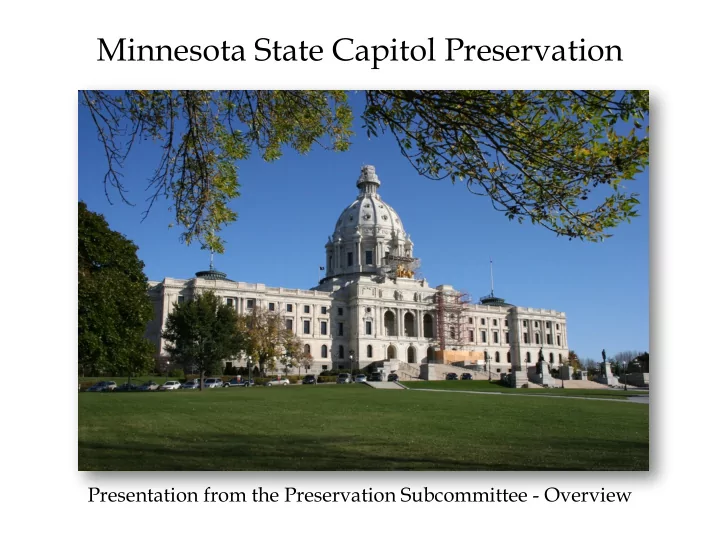
Minnesota State Capitol Preservation Presentation from the - - PowerPoint PPT Presentation
Minnesota State Capitol Preservation Presentation from the Preservation Subcommittee - Overview Basement Basement Ground Floor Ground Floor First Floor First Floor Second Floor Second Floor Second Floor Mezzanine Third Floor Third Floor
Presentation from the Preservation Subcommittee - Overview
Basement
Basement
Ground Floor
Ground Floor
First Floor
First Floor
Second Floor
Second Floor
Second Floor Mezzanine
Third Floor
Third Floor
Third Floor Mezzanine
Fourth Floor
Overview of Appropriations and Benchmarking
Year Amount Purpose 1985 $1,790,000 General Renovation $ 250,000 Clean, tuck-pointing. (Exterior) $ 582,000 Dome and Lantern. (Exterior) 1987 $1,500,000 Exterior (rehab. Phase III-MD). (Exterior) $4,800,000 Senate Chamber 1988 $ 350,000 Space planning $ 220,000 Dome (Exterior) 1989 $3,000,000 Senate remodel-north corridor; HR 107 & 112 $ 575,000
$2,200,000 House Chamber
Year Amount Purpose
1990 $ 300,000 Remodel in east wing (Per House & Senate) 1992 $1,645,000 Fire mgmt system; investigation and testing of roof and Quadriga 1994 $ 400,000 Campus security lighting. $5,000,000 Roofs (Exterior), Quadriga restoration $ 65,000 Exterior maintenance manual 1995 $1,715,000 Renovation/Predesign 1996 $7,400,000 NE & NW Terraces ($4.8), lantern ($1.4), cafeteria ($1.2), structural stabilization. (Exterior & Bsmt.) $1,500,000 Elevators' equipment. (Admin) 1997 $1,035,000 Add to Café in Subd. 4 of '96, and Subd. 2 of '94. 1998 $6,600,000 Structural stabilization. (Exterior & Bsmt.) SE & SW Terraces $1,500,000 Accessibility (doors & hardware). (Admin) 1999 $ 520,000 Security upgrades. (Admin)
Year Amount Purpose 2000 $1,000,000 Remodel in east wing. (Per House & Senate) $ 300,000 Predesign 2002 $ 54,000 Paint & Plaster: G-2 $ 646,000 General fund for restoration of painting and plaster
2005 $ 1,170,000 Paint & Plaster: third floor $ 1,200,000 Schematic: entire Capitol Bldg. 2006 $ 2,400,000 Repair & Restoration Capitol Building Dome ($1.4) Continued design for Capitol Building Interior ($1.0) 2007 $ 250,000 To the LCC for planning process related to Capitol Building and Complex 2008 $13,400,000 Renovation of State Capitol Building, including but not limited to stabilization of plaza and the building's exterior envelope, replacement of air handling units at risk of failure, and projects to improve interior emergency lighting, dome lighting and catwalks
2010 $ 1,250,000 Security upgrades campus-wide, including State Capitol Building 2011 $ 550,000 Capitol Preservation Commission $ 4,000,000 Asset Preservation for Capitol Building TOTAL 1985-2011 $69,167,000
Recent Asset Preservation Appropriations Amount
Dome (Outer and Middle)
Internal
Exterior
Facility Condition Assessment
Minnesota State Capitol - Asset Preservation
+
cool air warm, humid air
Minnesota State Capitol - Asset Preservation
+
Minnesota State Capitol - Asset Preservation
+
Minnesota State Capitol - Asset Preservation
+
– Finial Repair & Re-guilding Construction – Replace 12 Large Drum Windows Design
– Comprehensive Exterior Stone Assessment Investigation – Main Roof Replacement Investigation/Design – West Plaza and Stair Repair Design
– Replace Hot Water Heating System Construction – Storm Sewer/Sanitary Sewer Separation Design/Construction – Senate Media HVAC Upgrade B29 & B32 Construction
Minnesota State Capitol - Asset Preservation
+
Minnesota State Capitol - Asset Preservation
+
Minnesota State Capitol - Asset Preservation
+
Minnesota State Capitol - Asset Preservation
+
– Stone Repairs Construction – Moisture Monitoring Equipment Construction – Replace 12 Large Drum Windows Construction
– East and North Stair and Plaza Investigation – West Plaza and Stair Repair Construction – Main Roof Replacement Construction – Stone Repairs requiring immediate attention Design/Construction
Benchmarking Benchmarking is a process that uses information from other State Capitols, comparing their scope and costs, allows for identification of what the restoration might cost prior to defining the full scope of the restoration project. Cost Benchmarking – What did they spend?
Preservation Work Scope Benchmarking - What did they buy regarding?
– Architectural Integrity – Building Function – Life Safety
Built in 1903 Restoration 2007-2011 = $162m Escalated to 2015 = $205m Adjusted Scope (2015) = $187m Renovated SF = More than 300,000 sf Cost/SF = $624/sf
Additional Program: Underground 550-car parking garage was added at approximately $14,850,000 in 2007 escalated to 2015 = $17,360,000 Architectural Integrity: Efficient use of existing and new spaces and appropriate care of irreplaceable historic materials. Building Function: Maximization of existing spaces by converting underutilized areas, such as the basement, into usable spaces. Improvement of the building’s function through the use of new building systems and computer technology. Life Safety: Grade-level skylights provide natural lighting to ground-floor corridors and adjacent office spaces.
Built in 1878 Restoration 1989-1992 = $ 58m
Escalated to 2015 = $94m Adjusted Scope (none) Renovated SF = 225,000 Cost /SF = $416 sf Additional Program: None Identified Architectural Integrity: Storage cabinets had been constructed in hallways, and half floors were built between the original floors and their 22 ft. ceilings. Cubbyholes were placed in every nook and cranny of the building. The Michigan Capitol was successfully restored to its true and intended beauty. Building Function: A redesign of heating, cooling, plumbing, electricity, telephones, audio and video, voting systems, computers, etc. – that were not anticipated in the original design. Life Safety: Skylights, decorative roof fixtures and glass ceiling panels that were previously removed for safety reasons were replaced and brought up to code.
Built in 1861 Restoration 1989-1996 = $121m Escalated to 2015 = $184m Adjusted Scope (2015) = undefined Renovated SF = 273,000 sf (multiple buildings) Cost/SF = $674/sf
Additional Program: Creation of a television studio to produce educational programs and to broadcast legislative Sessions. Additional public and educational facilities, including the Ohio Statehouse Museum Education Center. Architectural Integrity: The re-opening of numerous skylights and windows allows natural light once again to flood the building. Building Function: Each legislator’s desk offers a laptop computer connection that allows the legislator the opportunity to call up bills electronically via the
electronic voting system. Life Safety: Deficiencies included lack of a sprinkler system, unclear emergency exit paths, antiquated electrical, heating, and cooling systems, asbestos requiring abatement, leaky roofs, and lack of a security system.
Built in 1885 Restoration 1990-1994 = $200m Escalated to 2015 = $318m Adjusted Scope (2015) = $223m Renovated SF = $360,000 Cost/SF = $620
Additional Program: The Capitol Extension, an underground building designed to provide the Capitol with additional space without sacrificing its historical integrity. This project involved digging a 65-foot-deep site out of solid rock and provided the Capitol with approximately 667,000 additional gross square feet. At a cost of $75,000,000 or adjusted at $95,000,000 Architectural Integrity: Repairs were made to the metal dome and roof, granite, mortar and architectural detailing. The entire exterior of the building was restored and stabilized. Function: Entirely new plumbing, electrical and communication systems also were installed Life Safety: Installation of new infrastructure, including fire protection systems, water- conserving irrigation, and handicap-accessible walkways.
Built in 1916 Restoration 2008 = $210m Escalated to 2015 = $265m Adjusted Scope (2015) = $152 M Renovated SF = 310,000 Cost/SF = $492
Additional Program: Base Isolated the capitol at a cost of $70,000,000. Added a 330 car garage at $15,000,000 and re landscaped the entire 44 acres at $6,000,000. Total additional scope of $91 million adjusted to $113 million. Architectural Integrity: Restored the historic desire for terra cotta on the exterior of the
fixtures and made new light fixtures as replicas of what was originally there. Function: Provide new committee rooms which the capitol did not have, functionally reorganized the house and the senate space for greater government efficiency and
storage. Life Safety: Complete Seismic upgrade, full fire protection with a smoke evacuation systems, sprinklers and alarm system. Provided over 350 security camera along with centaury stations on the perimeter. Landscaping and terrace was hardened to protect against attack
Built in 1785 Restoration 2004-2007 = $83m Escalated to 2015 = $105m Adjusted Scope (2015) = $98 m Renovated SF = 89,978(Reno) 27,120(New) Cost/SF = $736
Additional Program: Construction of a 27,000 sf. extension for a visitor's center underground on the South side of the Capitol. Architectural Integrity: Restoration of architectural and historic features, such as original decorative painting. Renovating and replacing the exterior surfaces Building Function: Replacement of mechanical, plumbing, storm water systems, heating, air conditioning, and electrical distribution. Preventing water and moisture penetration into the building Life Safety: Fire protection, communications, security
Built in 1917 Renovated in 2001 = $145m Escalated to 2015 = $203m Adjusted Scope (2015) = undefined Renovated SF = 240,000 Cost/SF = $848 Additional Program: The Capitol basement floor was lowered two feet to provide additional usable office space. Architectural Integrity: Remodeling projects of the 1960s and 70s had introduced features out of character with the architecture of the Capitol, such as drop ceilings, movable partitions and fluorescent light fixtures, and many
public spaces to their original appearance Function: Integrating modern technology into the original architecture. Electrical, mechanical (such as plumbing and heating) and communications systems. Life Safety: Asbestos was removed, and air conditioning was added.
Built in 1905 Estimated in 2007 = $267m Estimated to 2015 = $337m Adjusted Scope (2015) = $198m Renovated SF = 379,000 Cost/SF = $523
2015 = $139,000,000
painting and historic spaces.
being more efficient. Mechanical, electrical and plumbing replaced with new systems
systems, emergency exit requirements.
State Capitol Renovated Square Footage Escalated to 2015 Adjusted Program Adjusted $/SF Kansas Capitol 300,000 SF $205 million $187 million $624/SF Michigan Capitol 225,000 SF $94 million $94million $416/SF Ohio Capitol 273,000 SF $184million $184million $674/SF Texas Capitol 360,000 SF $318 million $223million $620/SF Utah Capitol 310,000 SF $265 million $152million $492/SF Virginia Capitol 117,000 SF $105 million $98 million $736/SF Wisconsin Capitol 240,000 SF $203 million $203 million $848/SF AVERAGE 260,725 SF $196million $163million $600/SF Minnesota Capitol* 387,000 SF $337million $198million $523/SF
* This is a benchmark only and is not intended to be a cost estimate for the renovation. Cost estimate will be completed as part of the pre-design and project definition phase.
Process Recommendations for Going Forward