California State Capitol Annex Demystification of the Restoration - - PowerPoint PPT Presentation

california state capitol annex
SMART_READER_LITE
LIVE PREVIEW

California State Capitol Annex Demystification of the Restoration - - PowerPoint PPT Presentation

California State Capitol Annex Demystification of the Restoration Process | July 10, 2017 01 Meet Our Presenters Capitol Projects 2000 2004 Utah House and Senate Extension 2000 2010 Utah Capitol Restoration and Base


slide-1
SLIDE 1

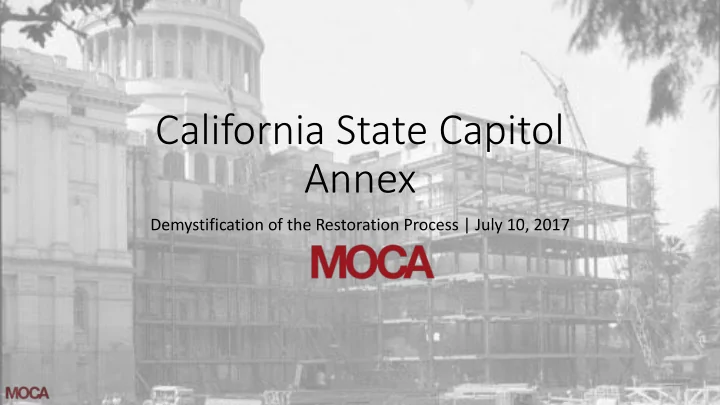
California State Capitol Annex

Demystification of the Restoration Process | July 10, 2017
slide-2
SLIDE 2

Meet Our Presenters

David Hart

Executive Vice President

Joe Stahlmann

Project Manager

Capitol Projects

  • 2000 – 2004 Utah House and Senate Extension
  • 2000 – 2010 Utah Capitol Restoration and Base

Isolation

  • 2011 – 2017 Minnesota State Capitol

Restoration

  • 2014 – 2016 Minnesota New Legislative Office

Building

  • 2015 – 2019– Wyoming State Capitol and

Herschler Office Building Remodel

01

slide-3
SLIDE 3

Characteristics of Capitol Project

1.Ownership is largely elected and changes every 4 to 6 years 2.Political by Design – Varying degrees of trust between Legislative, Executive and Judiciary 3.Many Stakeholders, Voices and people who believe they are capable of making the right decision 4.Lack a Constituency for the Capitol or Complex – No one speaks for the Capitol 5.Restoration is expensive due to the grandeur of the building and schedules 6.Government never takes a break – Legislature meets annually – Work must adjust to Legislature 7.Programing and Planning is not the typical process that proceeds the design process, it is resolved later 8.Imposition of Modern Concerns – Technology, Security, Life Safety, Committee Rooms…… 9.Tourist destinations even during construction 10.Swing Space during construction poses challenges in logistics, communications, work flow 11.Confusion about how to get started There is a positive way forward – These projects are able to be done and done well!

Capitols and Capitol Project

03

slide-4
SLIDE 4

Typical Steps in the Design Process

  • 1. Owner identifies an internal need for a facility
  • 2. Budget is developed quickly with many assumptions – political pressure drives the budget
  • 3. Schedule is assumed based on past projects of similar size
  • 4. Seek funding for design and construction services
  • 5. Hire a design firm to do programing, planning, studies
  • 6. Stakeholder are talked to, designs are completed
  • 7. Owner retains Contractor/CMr or other to construct
  • 8. Owner retains PM to basically manage the relationship between the architect and the contractor

Outcomes:

  • 1. Capitols are not like other projects – Large, Complex, Politically Messy, - Challenges Occur immediately
  • 2. Changes, schedule impacts, delays can all occur with change
  • 3. Tensions increase between the Legislative and Executive Branch's of Government and Finger Pointing occurs
  • 4. News coverage is not positive, Anxiety levels increase.

Common Capitol Pit Falls

04

slide-5
SLIDE 5

Change the Process:

1.Identify a need 2.Seek council from an Owner Representative who has done Capitols or Legislative projects successfully 3.Create a Governance Committee, Board, Commission that has broad authority to act 4.Listen to Leadership, Executive Branch – Governor, Legislature Branch – Assembly/House and Senate 5.Understand and identify the expectations and guiding principles from Leadership – project to follow 6.Clearly Define the project, quality, quantity, scope and schedule – Comprehensive Master Plan 7.Align the type of Procurement Method with the guiding principles and project definition 8.Work with Leadership to determine feasibility and funding 9.Retain the right professionals (Architects, Engineers, Builders….) for the project

  • 10. Allow the Professionals to do what they do best, while the Owner Representative work with Leadership

We call this Early Project Definition and Alignment (EPD&A)

Recommended Capitol Process

05

slide-6
SLIDE 6

Project Definition and Alignment -

06

slide-7
SLIDE 7
  • Procurement – Project delivery methods
  • Project establishment and organization framework and structure
  • Budget management
  • Schedule management
  • Design management
  • Security
  • Seismic consideration – Structural information
  • Overall Owner Involvement
  • Management Planning – Outline development of overall process

Outline for Today’s Discussion

Recommended Process (Demystification)

07

slide-8
SLIDE 8

City Planning EPA Agency Chamber of Commerce Department Streets & Highways Beautification Commission Unions OSHA Fire Marshall Public Works Street and Highways ADA EPA Historical Preservation

Sub-sub Manufacturer Supplier Manufacturer Manufacturer Supplier Sub-sub Manufacturer Manufacturer Supplier Manufacturer Sub-sub Sub-sub Manufacturer Manufacturer Manufacturer Sub-sub Manufacturer Manufacturer Manufacturer Manufacturer Supplier Manufacturer Manufacturer Supplier Sub-sub Manufacturer Supplier Sub-sub Supplier Sub-sub Sub-sub Sub-sub Manufacturer Manufacturer Manufacturer Manufacturer Supplier Manufacturer Sub-sub Supplier Sub-sub Manufacturer Sub-sub Manufacturer Manufacturer Manufacturer Supplier Manufacturer Manufacturer Sub-sub Supplier Sub-sub Manufacturer Sub-sub Sub-sub Manufacturer Manufacturer Manufacturer Manufacturer Supplier Manufacturer Supplier Manufacturer Manufacturer Supplier Sub-sub Supplier Sub-sub Manufacturer Manufacturer Supplier Manufacturer Manufacturer Manufacturer Manufacturer Sub-sub Manufacturer Supplier Supplier Manufacturer Sub-sub Sub-sub Manufacturer Manufacturer Manufacturer Supplier Manufacturer Manufacturer Manufacturer Supplier Manufacturer Sub-sub Supplier Manufacturer Manufacturer Manufacturer Manufacturer Supplier Sub-sub Supplier Manufacturer Sub-sub Manufacturer Manufacturer Sub-sub Manufacturer Supplier Manufacturer Manufacturer Manufacturer Sub-sub Supplier Manufacturer Sub-sub Supplier Supplier Manufacturer Supplier Manufacturer Sub-sub Supplier Supplier Sub-sub Sub-sub Supplier Sub-sub Supplier Supplier Supplier Supplier Supplier Supplier Supplier Supplier Supplier Supplier Sub-sub Manufacturer Manufacturer Sub-sub Sub-sub Sub-sub Manufacturer Manufacturer Manufacturer Supplier Manufacturer Supplier Sub-sub Manufacturer Sub-sub Manufacturer Manufacturer Manufacturer Supplier Manufacturer Manufacturer Supplier Sub-sub Sub-sub Sub-sub Manufacturer Manufacturer Supplier Manufacturer Supplier Manufacturer Manufacturer Manufacturer Sub-sub Supplier Manufacturer Manufacturer Sub-sub Supplier Sub-sub Supplier Supplier Toilet compartments & accessories Compressors and fan units Concrete reinforcement Architectural woodwork Rough framing Metal fabrications Signage Vacuum systems Building specilaties Hauling Roof and site drainage Grading & excavation Metal fabrications Lockers Moisture protection Striping Stucco Wall coverings Concrete supply Doors and frames Hardware RO water Counter tops Food service Glass & glazing Fencing Security systems Soil treatment Structural steel Cleaning Carpeting Ductwork Flooring Landscaping and planting Mechanical Insulation Sealants & caulking Skylights Window wall Block and brick Firestopping Control wiring Flagpoles Network wiring Metal wall & roofing panels Pools and fountains Millwork Site sprinklers Termite control Window coverings Building insulation Elevators Tile Roof hatches Plumbing Mold control Overhead doors Demolition Concrete formwork Flashing & sheet metal Windows, glass & glazing Telecommunicati
  • ns consultant
Audio Visual consultant Mechanical EngineerElectrical engineer Testing and Inspection Life Safety consultant Civil engineer Graphics and signage consultant Design architect Network cabling consultant Code consultant System Quality Control Schedule Control Construction Agent Users Users Users Users Users Users Users Users Acoustical consultant Sanitary engineer Food service consultant Security consultant Users Users Users Users Users Users Users Users Users Users Users Users Users Users Users Users Users Users Users Users Users Users Users Users Administrators Users Users Users Users Users Users Users Users Contracting Cost Control Structural engineer Architect of record Acoustical Consultant Hardware consultant Lighting consultant Contruction Erosion control Ornamental Iron Paving Roofing Acoustical ceilings Casework Drywall Electrical Fire protection Painting Clearing & stripping General Contractor

INNOVATIONS IN PROCESS MANAGEMENT

Media

The Truth Behind Project Procurement

  • Conflict
  • Unknown results
  • Change orders
  • Arguments, hurt

feelings and litigation

  • Missed schedule

commitments

  • $$$$$$ Cost over-runs

08

slide-9
SLIDE 9

Understanding Design-Bid-Build

Contractor’s incentive is to maximize job profits through ambiguities, errors and changes

Client GC GC A/ A/E U S B S Con Constr truction tion PD PD

$

Des Design La Late e news on cost

Ta Takes too long No No Collaboration

Procureme ment st

strate tegy is prima

mary skill required for selection

OR OR

09

slide-10
SLIDE 10

Truth of Design-Bid-Build Organization

Innovations in Process Management

Pr Project

Bu Budget

Con Constr truction tion

PD PD $

Des Design

Pe Period of Reliance on Estimates

Pa Painful corrections Fir First h t hard c cos

  • st kn

t known wn = Q = Quality lity L Los

  • st a

t at C t Cor

  • rrection

tion

10

slide-11
SLIDE 11

Design/Build

Contractor’s incentive is to maximize job profits through Management of Design and quality incentive shared savings

Client

GC GC A/ A/E U S B S $ Des Design

Sh Shorter time period

Lim Limit ited c collab llaboratio ion b between O Owner an and A/ A/E

Pr Procurement of sub-co contractor is typica cally on hard-bi bid d or ne negotiations ns $

Ea Early discussion on cost De Design b builder b budget a and q quality c control

Con Constr truction tion

Impr Improved ed collabo boration

OR OR PD PD

11

slide-12
SLIDE 12

Design/Build

Period of Reliance on Estimates

GM GMP Pr Project Buy-Ou Out

Pr Project

Bu Budget

Con Constr truction tion

$

Des Design =B =Budget a t and Q Quality lity C Cor

  • rrection

tion Con Contr tractor

  • r M

Managed Bu Budget Ow Owner r Approved Budget

PD PD

12

slide-13
SLIDE 13

Client

GC GC A/ A/E U S B S Con Constr truction tion Qu Qualit lity, Bu Budget & & Sche hedul dule Des Design

Contin inuous Monit itorin ing of Cost and Schedule le

Ma Manage e Sched edule e from Day y One =Excellent Collaboration

CM/GC is selected at the beginning of the project Provide flexibility on hiring of Sub contractors Incentive Shared Savings Procurement of Sub contractor is is Fle lexib ible le and managed as a team to deliv liver best valu lue

Soft Relationship to Sub-contactor

INNOVATIONS IN PROCESS MANAGEMENT

Construction Management at Risk

Primary role is Manage Budget and Schedule

OR OR $ PD PD

13

slide-14
SLIDE 14

Project

Budget

Constructio ion A/E Desig ign

Period of reliance on estimates Ongoing correction to ma maintain Quality Project Buy out Period

PD PD

GMP

INNOVATIONS IN PROCESS MANAGEMENT

Construction Management at Risk

Pr Project

$ Qualit lity, Budget & Schedule le Management

14

slide-15
SLIDE 15

Project establishment and organization framework and structure

INNOVATIONS IN PROCESS MANAGEMENT

How the project is set up is the single most important aspect of the project The Project Delivery Method should be selected based upon:

  • Guiding Principles which will govern the project
  • Owner Expectation around quality, cost and budget
  • Hierarchy of priorities that the owner care the most about – Project Definition

This information is then built into a “Procurement Matrix” which will help identify the delivery method and contract provisions.

15

slide-16
SLIDE 16

INNOVATIONS IN PROCESS MANAGEMENT

A Delivery Strategy that

Best Fits

the Project

INNOVATIONS IN PROCESS MANAGEMENT

Project establishment and organization framework and structure

Selecting a delivery method is as critical as selecting the:

  • Owner Representative
  • Architect
  • Contract

This process must be driven by the:

  • Governing Principles
  • Hierarchy of priorities
  • Owner Expectation on

Quality, Cost and Schedule.

Where do you Start?

16

slide-17
SLIDE 17
  • Well defined projects cost 17% less than the average
  • Poorly defined projects cost 20% more

Edward Merrill Independent Project Analysis Corp., Reston, VA Average

20%

Good Poor

17% 37%

INNOVATIONS IN PROCESS MANAGEMENT

Project establishment and organization framework and structure

17

slide-18
SLIDE 18

The cost of a change in a project increases by a factor of about 10 each time the project changes its state. Without out developing the principles by which the project is governed and the hierarchy of expectations the project is subject to political outside pressures that can and will increase costs and lengthen schedules.

Written requirements Design drawings Construction drawings Occupancy Construction

INNOVATIONS IN PROCESS MANAGEMENT INNOVATIONS IN PROCESS MANAGEMENT

Project establishment and organization framework and structure

18

slide-19
SLIDE 19

Project establishment and organization framework and structure

INNOVATIONS IN PROCESS MANAGEMENT

Understanding the Professions Roles on a Project

OWNERS REPRSENTATIVES

  • Assist the owner in establishing expectations and setting the and hierarchy of owner

priorities.

  • Oversee and participate in decision making with users, builders and designers.
  • Coordinates with Leadership to maintain consistent communications

ARCHITECTS

  • Manage other design professionals and consultants.
  • Responsibility for the design process.

CONSTRUCTION MANAGERS

  • Integrate and manage subcontractors.
  • Responsible for the construction process.

19

slide-20
SLIDE 20

Owner’s Interest

SITE DEV. SKIN ROOFING CORE PLAN FINISHES MILLWORK MECHANICAL ELECTRICAL PLUMBING STRUCTURAL CIVIL

INNOVATIONS IN PROCESS MANAGEMENT INNOVATIONS IN PROCESS MANAGEMENT INNOVATIONS IN PROCESS MANAGEMENT

Project establishment and organization framework and structure

Sharing the Vision

20

slide-21
SLIDE 21

INNOVATIONS IN PROCESS MANAGEMENT

SITE DEV. SKIN ROOFING CORE PLAN FINISHES MILLWORK MECHANICAL ELECTRICAL PLUMBING STRUCTURAL CIVIL

Architect’s Interest Owner’s Interest INNOVATIONS IN PROCESS MANAGEMENT INNOVATIONS IN PROCESS MANAGEMENT INNOVATIONS IN PROCESS MANAGEMENT

Project establishment and organization framework and structure

Sharing the Vision

21

slide-22
SLIDE 22

INNOVATIONS IN PROCESS MANAGEMENT

SITE DEV. SKIN ROOFING CORE PLAN FINISHES MILLWORK MECHANICAL ELECTRICAL PLUMBING STRUCTURAL CIVIL

Contractor’s Interest

By aligning early the

  • wners:
  • Governing

principles,

  • Expectations
  • Hierarchy

The project avoids a blurred vision and delivers the quality on time and budget.

Sharing the Vision

Architect’s Interest Owner’s Interest INNOVATIONS IN PROCESS MANAGEMENT INNOVATIONS IN PROCESS MANAGEMENT INNOVATIONS IN PROCESS MANAGEMENT

Project establishment and organization framework and structure

22

slide-23
SLIDE 23

COLLABORATION

The traditional approach

Selecting the Right Team

Project establishment and organization framework and structure

Selecting the whole team at once can lead to some members of the team being weaker that what would be desired.

23

slide-24
SLIDE 24

COLLABORATION

INNOVATIONS IN PROCESS MANAGEMENT

a paradigm shift a traditional approach

Selecting the Right Team

INNOVATIONS IN PROCESS MANAGEMENT INNOVATIONS IN PROCESS MANAGEMENT INNOVATIONS IN PROCESS MANAGEMENT INNOVATIONS IN PROCESS MANAGEMENT

Project establishment and organization framework and structure

24

slide-25
SLIDE 25

Project establishment and organization framework and structure

Design Management

25

slide-26
SLIDE 26

Design Scoping Workshops

  • Bring all brain power to the workshop
  • Utilizing the Governing Principles,

expectations and hierarchy of priorities

  • Create a collaborative environment
  • Develop trusting project relationships

Summary Sessions

  • Resolve cost and schedule impacts
  • Everyone has an assignment for the next

workshop

Project establishment and organization framework and structure

Design Management

26

slide-27
SLIDE 27 CSI Number Section Orignal MOCA Estimate MOCA EstimateCombined J.E. Dunn and MOCA 11/02/2012 Cost Model 11/12/2012 J.E. Dunn Workshop # 2 Difference 11/12 vs Workshop # 2 Workshop # 3Difference Workshop # 2 vs Workshop # 3 Workshop # 4 Difference Workshop # 3 vs Workshop # 4 Workshop # 5Difference Workshop # 4 vs Workshop # 5 Workshop # 6Difference Workshop # 5 vs Workshop # 6 Workshop # 7Difference Workshop # 6 vs Workshop # 7 Workshop # 8 Difference Workshop # 7 vs Workshop # 8 Workshop # 9 Difference Workshop # 1 General Requirements/General Conditions 10,312,179.00 $ 10,312,179.00 $ 8,872,000.00 $ 8,872,000 8,872,000 8,872,000 8,872,000 8,971,262 99,262 8,971,262 8,971,262 8,971,262 8,971,262 8,971,262 2 Existing Conditions 5,750,000.00 $ 5,750,000.00 $ 5,491,250.00 $ 4,338,803 4,338,803 5,397,142 1,058,339 4,964,384 (432,758) 5,082,939 118,555 5,175,403 92,464 5,215,704 40,301 5,780,503 564,799 5,780,503 5,780,503 2A Hazaradous Materials Abatement 5,750,000.00 $ 5,750,000.00 $ 5,491,250.00 $ 1,150,000 1,150,000 1,150,000 1,150,000 1,161,615 11,615 1,161,615 1,161,615 1,161,615 1,161,615 1,161,615 3 Concrete 7,475,000.00 $ 7,475,000.00 $ 7,138,625.00 $ 5,000,000 5,000,000 5,000,000 5,000,000 5,050,500 50,500 4,848,480 (202,020) 4,848,480 3,186,711 (1,661,769) 3,132,052 (54,659) 2,930,032 (202,02 4 Masonry 17,556,791.00 $
  • $
  • $
750,000 750,000 750,000 750,000 757,576 7,576 757,576 757,576 757,576 757,576 757,576 5 Metals
  • $
  • $
  • $
2,949,262 2,949,262 3,234,922 285,660 3,218,892 (16,030) 3,134,096 (84,796) 3,583,435 449,339 3,512,502 (70,933) 3,929,961 417,459 4,126,378 196,417 4,126,378 6 Wood, Plastics and Composites
  • $
  • $
  • $
1,794,613 1,794,613 1,705,966 (88,647) 1,691,228 (14,738) 1,698,703 7,475 1,698,703 1,580,599 (118,104) 1,580,599 1,580,599 2,848,741 1,268,142 7 Thermal and Moisture 6,025,540.00 $ 6,025,540.00 $ 5,754,390.70 $ 6,104,390 6,104,390 7,889,326 1,784,936 6,207,250 (1,682,076) 6,667,671 460,421 6,667,671 6,667,671 6,667,671 6,667,671 6,667,671 8 Openings 3,573,600.00 $ 36,700.00 $ 70,508.80 $ 3,441,954 3,441,954 3,420,932 (21,022) 2,945,293 (475,639) 3,515,025 569,732 3,515,025 3,515,025 3,515,025 3,515,025 3,515,025 9 Finishes 31,375,536.00 $ 31,375,536.00 $ 30,057,763.49 $ 11,891,504 9,334,367 10,162,263 827,896 9,243,346 (918,917) 9,362,442 119,096 9,362,442 9,523,513 161,071 10,140,114 616,601 10,223,232 83,118 10,333,294 110,062 10 Specialties
  • $
  • $
  • $
650,000 1,118,935 1,103,440 (15,495) 1,109,599 6,159 1,129,737 20,138 1,129,737 1,016,328 (113,409) 1,016,328 1,017,354 1,026 1,267,613 250,259 11 Equipment
  • $
  • $
  • $
28,835 11,725 11,726 1 11,726 (11,726) 303,030 303,030 12 Furnishings
  • $
  • $
  • $
209,831 209,831 219,327 9,496 (219,327) 201,823 201,823 13 Special Construction
  • $
  • $
  • $
14 Conveying Equipment 1,775,600.00 $ 1,775,600.00 $ 1,701,024.80 $ 3,000,000 3,000,000 3,000,000 3,000,000 1,939,392 (1,060,608) 1,939,392 2,094,443 155,051 2,094,443 2,094,443 2,094,443 21 Fire Suppression 1,795,017.00 $ 1,795,017.00 $ 1,719,626.29 $ 2,020,113 2,020,113 1,836,459 (183,654) 2,074,949 238,490 1,877,835 (197,114) 1,877,835 1,877,835 1,877,835 1,877,835 1,877,835 22 Plumbing 2,841,558.00 $ 2,841,558.00 $ 2,722,212.56 $ 2,816,503 2,816,503 2,739,764 (76,739) 2,686,153 (53,611) 2,645,970 (40,183) 2,645,970 2,645,970 2,645,970 2,645,970 2,645,970 23 HVAC 32,707,722.00 $ 32,707,722.00 $ 31,333,997.68 $ 34,270,334 34,270,334 35,248,157 977,823 34,996,240 (251,917) 35,332,055 335,815 35,332,055 35,332,055 35,332,055 35,332,055 35,332,055 25 Integrated Automation
  • $
  • $
  • $
26 Electrical 17,791,272.00 $ 17,791,272.00 $ 17,044,038.58 $ 14,682,515 14,985,226 16,300,267 1,315,041 15,741,642 (558,625) 15,918,892 177,250 15,918,892 15,918,892 15,918,892 15,918,892 15,918,892 26A Historic Lighting 7,854,242 8,618,059 8,680,923 62,864 8,118,939 (561,984) 8,212,049 93,110 8,212,049 8,212,049 7,743,212 (468,837) 7,743,212 6,717,632 (1,025,5 27 Communications
  • $
  • $
  • $
150,000 150,000 150,000 150,000 150,000 150,000 150,000 150,000 150,000 150,000 28 Electrical Safety and Security
  • $
  • $
  • $
31 Earthwork 234,600.00 $ 234,600.00 $ 224,746.80 $ 225,000 225,000 225,000 225,000 227,273 2,273 227,273 227,273 227,273 (227,273) 32 Exterior Improvements
  • $
  • $
  • $
1,169,163 1,169,163 1,041,943 (127,22 33 Utilities
  • $
  • $
  • $
150,000 150,000 150,000 150,000 151,515 1,515 151,515 151,515 151,515 151,515 151,515 SUBTOTAL 112,349,899 111,311,115 117,247,614 5,936,499 112,306,641 (4,940,973) 112,986,547 679,906 113,326,330 339,783 113,380,307 53,977 112,848,560 (531,747) 114,016,352 1,167,792 114,794,848 778,496 Insurance and Bond Cost
  • $
  • $
2,703,669.00 $ 2,831,217 2,805,040 2,954,640 149,600 3,369,199 414,559 3,546,535 177,336 3,557,372 10,837 3,559,085 1,713 3,542,208 (16,877) 3,634,093 91,885 3,665,578 31,485 Contractors Fee 4,511,578.00 $ 4,511,578.00 $ 2,116,800.00 $ 1,958,079 1,939,975 2,043,438 103,464 1,966,489 (76,949) 1,981,062 14,573 2,071,430 90,368 2,072,428 998 2,062,600 (9,828) 2,081,640 19,040 2,099,675 18,035 State Satisfaction Fee Match NIC NIC NIC NIC NIC NIC NIC NIC NIC Escalation to May 2013 @ 1.01 % incl incl incl incl incl incl incl incl incl incl incl Contingency (5,382,302.00) $ 6,050,000.00 $ 5,856,960 5,802,806 6,112,285 309,478 5,882,116 (230,168) 5,925,707 43,591 5,947,757 22,049 5,950,591 2,834 5,922,668 (27,923) 5,986,604 63,936 6,028,005 41,401 Total 149,475,993.00 $ 123,000,000.00 $ 128,491,903.69 $ 122,996,155 121,858,936 128,357,977 6,499,041 123,524,446 (4,833,531) 124,439,852 915,406 124,902,889 463,037 124,962,411 59,522 124,376,036 (586,375) 125,718,689 1,342,653 126,588,106 869,417 Variance To Budget (3,845) (1,141,064) 5,357,977 5,357,977 524,446 524,446 209,852 209,852 672,889 672,889 732,411 732,411 146,036 146,036 1,488,689 1,488,689 287,606 287,606 BUDGET w / ESCALATION 123,000,000 124,230,000 124,230,000 124,230,000 124,230,000 Add Millwork 1,300,000 339,783 53,977 112,848,560Add Wayfinding 1,167,792 250,000 778,496 463,037 59,522 124,376,036 Add Wd Blinds 1,342,653 200,000 869,417 Add Technology 300,000 Subtotal 2,050,000 Escal @ 1.01% 20,500 2,070,500 REV BUDGET = 126,300,500

Project establishment and organization framework and structure

Budget Management

Consistency in review the numbers and understanding the constrains and trade offs. The project organizational structure (workshops) must allow for continuous live budget evolution and management

27

slide-28
SLIDE 28

Project establishment and organization framework and structure

Schedule Management

Must start with where you want to go. Need to develop the overall project schedule – best guess. Schedule management is then all about managing tasks.

  • Schematic Design - 30,000 foot view
  • 100 to 200 tasks
  • Design Development – 10,000 foot view
  • 1000 to 5000 tasks
  • 50% Construction Documents – 2,000 foot view
  • 10,000 to 20,000 tasks
  • 100% Construction Documents – Focused view
  • 25,000 to 50,000 tasks.

28

slide-29
SLIDE 29

Project establishment and organization framework and structure

Security

29

slide-30
SLIDE 30

Seismic design has a huge impact on the:

  • Cost
  • Schedule
  • Architecture design and expression

Seismic building safety is typically the reason for many renovation and seismic upgrades to government building. The goals and objectives for the project along with the seismic design (life safety to immediate re-occupancy) must be decided before the design team is engaged. This should be considered as on of the governing principles and should be clearly defined as to what the owners expectations are.

Project establishment and organization framework and structure

Seismic Consideration

30

slide-31
SLIDE 31

Project establishment and organization framework and structure

Overall Owner Involvement Creating a process to move forward

Capitols & Capitol Annex have complex and varying

  • wnership roles, However there are some

fundamental that are required

  • Owners have to be involved early in setting the

governing principles, hierarchy, and expectations

  • Owners must be the constituency and champions

for the project.

  • Authority to take actions that are going to be

questioned in pubic

  • Ability to continue despite electoral changes
  • Other elected officials outside of the designated
  • wner must allow the owner to make the

decisions

31

slide-32
SLIDE 32

Project establishment and organization framework and structure

Overall Owner Involvement Creating a process to move forward

The typical owner structure is:

  • Board
  • Commission
  • Leadership group

Composition is typically made up of the State Leadership or if there is a separate governance body for the facility that can be empowered to act as the

  • wner.

They should be empowered to:

  • Develop the comprehensive master plan
  • Commitment funding
  • Make financial decision associated with construction

32

slide-33
SLIDE 33

Executive Branch Legislative Branch Judicial Branch Capitol Leadership/Ownership Commission or Committee Department of Administration Project Management Owner Representative Design and Construction Team Contractor Architect Government by design is adversarial pitting Executive against legislative with checks and balances. To bridge this gap – Owner Representatives work in a variety

  • f ways with the Capitol

Leaders/Owners and the Executive Branch Administrative Services

Project establishment and organization framework and structure

Overall Owner Involvement and Working Relationships - Trust

33

slide-34
SLIDE 34

Project establishment and organization framework and structure

Management Planning – Outline of Overall Process

  • 1. Establish the Governing Body
  • 2. Select the Owner Representative
  • 3. Clearly Define, principles, expectations, hierarchy
  • 4. Select the team Members
  • 5. Develop the Design Scoping workshops

California Capitol Annex Project

34

slide-35
SLIDE 35

Case Study 1 Utah State Capitol

  • Senate and House Buildings
  • Capitol Renovation
slide-36
SLIDE 36

Project Definition Master Document

INNOVATIONS IN PROCESS MANAGEMENT INNOVATIONS IN PROCESS MANAGEMENT

Utah State Capitol

Procurement - Project Definition Comprehensive Plan

40

slide-37
SLIDE 37

INNOVATIONS IN PROCESS MANAGEMENT INNOVATIONS IN PROCESS MANAGEMENT

Utah State Capitol

Procurement - Design Guidelines

39

slide-38
SLIDE 38

Funding Process Organization Schedule of Procurement Overall Project Schedule

INNOVATIONS IN PROCESS MANAGEMENT INNOVATIONS IN PROCESS MANAGEMENT

Utah State Capitol

Comprehensive Master Plan Funding, Schedule and Alignment of Process

41

slide-39
SLIDE 39

INNOVATIONS IN PROCESS MANAGEMENT INNOVATIONS IN PROCESS MANAGEMENT

Construction Management at Risk

Capitol Design Scoping Workshops

51

slide-40
SLIDE 40

17 workshops brought together all interested parties: Owners, Users, Sub-contractors, Manufacturers, Officials, Professionals etc. INNOVATIONS IN PROCESS MANAGEMENT INNOVATIONS IN PROCESS MANAGEMENT INNOVATIONS IN PROCESS MANAGEMENT

Construction Management at Risk

Capitol Design Scoping workshops

52

slide-41
SLIDE 41

INNOVATIONS IN PROCESS MANAGEMENT INNOVATIONS IN PROCESS MANAGEMENT INNOVATIONS IN PROCESS MANAGEMENT

Construction Management at Risk

Capitol Design Scoping Workshops

53

slide-42
SLIDE 42

INNOVATIONS IN PROCESS MANAGEMENT Utah State Capitol

Results

  • 1. Senate and House Building – 3 Months ahead of Schedule - $1,000,000 saved and use to complete fountain
  • 2. Capitol - Grand opening on Statehood day, completion 1 Month ahead of schedule - $3.5 Million below

budget

  • 3. Parking Structures – completed on time and with in budget.

57

slide-43
SLIDE 43

INNOVATIONS IN PROCESS MANAGEMENT Utah State Capitol

Management Planning – Outline of the Overall Process

  • 1. Establish the Organization and Ownership structure – Capitol Preservation Board Statute
  • 2. Develop an Overall Comprehensive Master Plan including:
  • 1. Quality Expectation of the Owner – Guiding Principles for the entire project
  • 2. Design Guidelines and Imperative
  • 1. Extension Building (Senate and House Building) – With Bridging Documents
  • 2. Capitol Base Isolation and Restoration
  • 3. Security
  • 4. Signage
  • 5. Furniture
  • 3. Preliminary Architectural Program and Space Ownership diagrams
  • 4. Budget expectations
  • 1. Comprehensive budget development for entire project.
  • 5. Schedule expectations
  • 1. Overall comprehensive Schedule of all work, moves, furniture acquisition and move in.
  • 2. Design Management Planning – Design Scoping Workshops schedule and process
  • 6. Delivery Strategy based upon the Procurement Matrix for each selection
  • 7. Design/Build with Bridging Documents for New Structures & CM@Risk for Historic Structures.
  • 1. Team development strategy (who is selected first, second …)
  • 3. Design Scoping Workshops and Colocation of Design Team and Contractor on site for Management

58

slide-44
SLIDE 44

Case Study 2 Idaho State Capitol

  • Capitol Renovation
  • Underground Wings
slide-45
SLIDE 45

INNOVATIONS IN PROCESS MANAGEMENT INNOVATIONS IN PROCESS MANAGEMENT

Idaho State Capitol

Procurement - Project Definition Comprehensive Plan

Department of Public Works lead the overall team Owner Representative collaborated together to develop the comprehensive plan and Project Definition & Bridging Documents Design/Build Team developed the expansion shell. Architects implemented the project definition. Collaboration occurred in workshops and through the architectural process.

67

slide-46
SLIDE 46

INNOVATIONS IN PROCESS MANAGEMENT INNOVATIONS IN PROCESS MANAGEMENT

Idaho State Capitol

Procurement - Project Definition Comprehensive Plan – Design Guidelines and Imperatives to shape desired outcome

68

slide-47
SLIDE 47

INNOVATIONS IN PROCESS MANAGEMENT INNOVATIONS IN PROCESS MANAGEMENT

Idaho State Capitol

Procurement - Project Definition Comprehensive Plan - Programing

70

slide-48
SLIDE 48

INNOVATIONS IN PROCESS MANAGEMENT INNOVATIONS IN PROCESS MANAGEMENT

Idaho State Capitol

Procurement - Project Definition Comprehensive Plan - Programing

71

slide-49
SLIDE 49

INNOVATIONS IN PROCESS MANAGEMENT INNOVATIONS IN PROCESS MANAGEMENT

Idaho State Capitol

Procurement - Project Definition Comprehensive Plan

Options for Expansion

  • 1. Below Grade Wing Expansion
  • 2. Two Story Deep solution
  • 3. One Story Deep solution
  • 4. South Garden Level Expansion

All options were evaluated on:

  • 1. Consistency with the Principles
  • 2. Constructability
  • 3. Cost
  • 4. Schedule impact

Solution:

  • One Level below grade expansion

72

slide-50
SLIDE 50

INNOVATIONS IN PROCESS MANAGEMENT INNOVATIONS IN PROCESS MANAGEMENT

Idaho State Capitol

Security

Idaho State Police Provide Security for the Capitol Private Unarmed Security provide 24 hour 7 day a week support – they notify a officer for law enforcement Idaho State Police Provide Security for the Governor Executive Protection is co-located with the Governor

73

slide-51
SLIDE 51

INNOVATIONS IN PROCESS MANAGEMENT INNOVATIONS IN PROCESS MANAGEMENT

Idaho State Capitol

Security – Operation Center

There are 10 public entrances. All entrances are monitored from security operation center by camera Security is located within the Capitol There is not security in the Rotunda, however office is very close to Rotunda Two security officers in the SOC at all times. Dispatching to calls within the Capitol Monitoring camera’s within surrounding State buildings Monitoring camera’s within the Capitol campus: Monitoring all campus panic alarms Responsible for campus lockdown Answer all security related phone calls

74

slide-52
SLIDE 52

INNOVATIONS IN PROCESS MANAGEMENT INNOVATIONS IN PROCESS MANAGEMENT

Idaho State Capitol

Security Policies

Evacuation Plan There is an evacuation plan for every office that covers evacuation procedures for employees. Major events Protests have to be requested and authorized via permit. If a major event is requested, there are usually 2 to 3 security guards present. Threat Levels: Currently there is not a threat level program in place

75

slide-53
SLIDE 53

INNOVATIONS IN PROCESS MANAGEMENT Idaho State Capitol

Results

  • 1. Project was completed on Budget and on Schedule

76

slide-54
SLIDE 54

INNOVATIONS IN PROCESS MANAGEMENT Idaho State Capitol

Management Planning – Outline of the Overall Process

  • 1. Establish the Organization and Ownership structure – Department of Public Works
  • 2. Develop an Overall Comprehensive Master Plan including:
  • 1. Quality Expectation of the Owner – Guiding Principles for the entire project
  • 2. Design Guidelines and Imperative
  • 3. Programing and Space Planning working with Leadership
  • 3. Two Delivery Methods
  • 1. Design Build for Extensions
  • 2. CM@ Risk for Capitol and interior of Extensions
  • 4. Budget expectations
  • 5. Comprehensive budget development for entire project.
  • 6. Team collaboration with Design Builder and CM@Risk
  • 7. Security Operations and Management very involved.

77

slide-55
SLIDE 55

Case Study 3 Minnesota State Capitol

  • Capitol Renovation
  • Senate Office Buildings
slide-56
SLIDE 56

56 Executive Branch Legislative Branch Judicial Branch Capitol Preservation Commission In Statute Department of Administration Project Management Owner Program Manager Owner Representative Architect Capitol Design Builder Senate Office Building CMr Capitol Architect (National) Architect

Minnesota State Capitol

Organization and Structure of the Ownership

  • The OPM (MOCA) was work

directly with the Legislature and occupants and to be the fact of the project

  • The OR (CMPI) was to handle

the in-house accounting and management

79

slide-57
SLIDE 57

1984 1988 2001 2007 2008 2011 2012 – 2017

Requested study of public spaces in Capitol – no funding Comprehensive plan and implementation proposed – no funding Interior restoration pre-design studies – project stopped

Pre-design update and conceptual design completed – no money appropriated for project Dome exterior preservation work – piece meal funding Exterior deterioration preservation - piece meal funding Capitol Restoration Commission MOCA Early Project Definition & Alignment - $309M

INNOVATIONS IN PROCESS MANAGEMENT Minnesota State Capitol

History of the Minnesota State Capitol Restoration

80

slide-58
SLIDE 58

1. Architectural Integrity

  • It is critical to preserve the integrity of the building and its great

architecture.

  • Consideration should be given to original 1905 plan.
  • The building must work for the next 100 years.

2. Building Function

  • The building must work to support the function of Government.
  • Functional relationships should be improved both within and

between the different branches of government.

3. Life Safety and Security

  • Capitol must be safe from security threats, fire and deterioration of

systems.

  • It must provide for accessibility of all Minnesotans.
  • The building needs to be current on life safety codes.

Minnesota State Capitol

Organization and Structure of the Ownership Guiding Principles developed by Capitol Preservation Commission

82

slide-59
SLIDE 59

A 20 year plan that covers:

  • Comprehensive Planning
  • Restoration 2012 – 2017
  • Maintenance & Stewardship

2017 - 2032

Minnesota State Capitol

Organization and Structure of the Ownership Comprehensive Master Plan

83

slide-60
SLIDE 60

Minnesota State Capitol

Organization and Structure of the Ownership Comprehensive Master Plan – Understanding the Building Structure & Function

86

slide-61
SLIDE 61

Minnesota State Capitol

Organization and Structure of the Ownership Comprehensive Master Plan – Keeping the Building open & Swing space

88

slide-62
SLIDE 62

Minnesota State Capitol

Organization and Structure of the Ownership Comprehensive Master Plan – Phasing of the Project

89

slide-63
SLIDE 63

Minnesota State Capitol

Organization and Structure of the Ownership Comprehensive Master Plan – Procurement – Goals and Objectives

90

slide-64
SLIDE 64

Minnesota State Capitol

Organization and Structure of the Ownership Comprehensive Master Plan - Stewardship

91

slide-65
SLIDE 65

Minnesota State Capitol

Organization and Structure of the Ownership Comprehensive Master Plan – Budget Projection and Budget Management

92

slide-66
SLIDE 66

Minnesota State Capitol

Organization and Structure of the Ownership Comprehensive Master Plan – Schedule and resequencing the work

93

slide-67
SLIDE 67

Minnesota State Capitol

Organization and Structure of the Ownership Design Guidelines

94

slide-68
SLIDE 68

Minnesota’s workshops were held in the Capitol. Discussion and Activities included: Design and Design Discussion Cost impact discussion and resolutions Schedule impacts and resolutions

Minnesota State Capitol

Organization and Structure of the Ownership Design Guidelines

97

slide-69
SLIDE 69

Annua Annual Repo port

Budget

  • Detailed Budget Included

Out of Scope

  • Water Infiltration Settlement
  • Lot N and Lot O Modifications
  • Aurora Avenue Modifications
  • Ground Floor – North Hall Decorative

Paint

  • Fine Art Conservation (Attached)
  • Additional Decorative Paint
  • Reopening South Loggia

Minnesota State Capitol

Organization and Structure of the Ownership Communication

103

slide-70
SLIDE 70

Project establishment and organization framework and structure

Security

  • 1. Established a “Large” Security Committee that met monthly – Lead by the Highway Patrol who provided

security for the capitol campus.

  • 2. Non-public meetings
  • 3. Utilized both cameras and card readers
  • 4. Ballistic glazing was a huge issue, How much and where to locate it.
  • 1. Initially it was going to be located at all lower level windows – Budget Problems
  • 2. Final decision was to limit its use to location that were of critical importance our housed critically

important people.

  • 5. No written plan (created problems for the design team and took a long time for the committee to come to

resolution since they had to revisit items each time.)

104

slide-71
SLIDE 71
  • Continuing to utilize the guidelines
  • Realizing the vision
  • Seeing collaboration through
  • Benefiting from trusting project relationships
  • Shared understanding of schedule impacts
  • Providing temporary accommodations
  • Assistance and guidance in phasing
  • Providing necessary information and materials
  • Continued communication and collaboration on

schedule

Minnesota State Capitol

Organization and Structure of the Ownership Keeping the Building Open

105

slide-72
SLIDE 72

INNOVATIONS IN PROCESS MANAGEMENT Minnesota State Capitol

Results

  • 1. Capitol was the home of the House during renovation – Chamber was successfully used for all sessions.
  • 2. Workshop process resulted in a clear understanding the need for a new Legislative Office Building
  • 3. Project was completed on Budget – separate budgets for Interior, Exterior, Roof, Window and Landscaping.
  • 4. Capitol - Grand opening on scheduled for August of 2017

106

slide-73
SLIDE 73

LEGISLATIVE OFFICE BUILDING Vision Workshop 8/21/2013

Minnesota State Capitol

Organization and Structure of the Ownership | New Legislative Office Building

Result of the Capitol Restoration

  • 1. Everyone realized that there was not enough physical space

in the Capitol during the workshops.

  • 2. Senate Offices were spread throughout the Capitol no ability

for collaboration or impromptu meeting of senators.

  • 3. No real Senate facilities. Everything in the Capitol is shared

while the House has separate Hearing rooms

  • 4. Senate Staff was likewise spread throughout the Capitol no

real head or leadership location

  • 5. Senate Needed a location for the 2 session they were going

to be out of the Capitol.

The Capitol is not the Office Building the Senate wanted it to be. Solution = Build a New Legislative Office Building

107

slide-74
SLIDE 74

Minnesota State Capitol

Organization and Structure of the Ownership | New Legislative Office Building

108

slide-75
SLIDE 75

Results

Minnesota State Capitol

  • 1. 5 design workshops and summary

documents

  • 2. Strict Design Build process
  • 3. Completed 1 month ahead of schedule –

Critical in order to hold the scheduled legislative session.

  • 4. Completed for Less than the budget
  • 5. Opened up the Capitol and Provide

additional public space within the Capitol:

  • 1. Lounge
  • 2. Two reading rooms/Small Conf. Rm.
  • 3. Library
  • 4. Art Gallery
  • 5. Large Conference Room

111

slide-76
SLIDE 76

INNOVATIONS IN PROCESS MANAGEMENT Minnesota State Capitol

Management Planning – Outline of the Overall Process

1. Establish the Organization and Ownership structure – Capitol Preservation Commission 2. Great working relationship with the Department of Administration 3. Owner Program Manager (MOCA) was retained to bridge the Trust Gap between Executive and Legislative 4. Develop an Overall Comprehensive Master Plan including:

  • Quality Expectation of the Owner – Guiding Principles for the entire project
  • Design Guidelines and Imperative

§ Capitol Restoration § New Legislative Office Building (Senate Building) – QBS selection used Guidelines

  • Preliminary Architectural Program

§ Space Ownership diagrams for the Capitol § Space Ownership and functional programing and planning for the NLOB

  • Budget expectations

§ 4 different budget, Interior renovation, Stone renovation, Site Restoration and NLOB all managed independently

  • Schedule expectations – based upon keeping the House Chamber operational for each session
  • Delivery Strategy

§ Capitol was delivered as CM@Risk § New Legislative Office Building was delivered as D/B Qualification (QBS)

  • Team development collocated off site by about 2 miles from site

112

slide-77
SLIDE 77

Case Study 4 Wyoming State Capitol

  • Capitol Renovation
  • Herschler Office Buildings
slide-78
SLIDE 78

Executive Branch Legislative Branch Capitol Task Force No Authority or Responsibility Department of Administration Construction Management Architect Capitol CMr Capitol

Wyoming State Capitol

Organization and Structure of the Ownership Up to 2015

State Attorney General In 2015 the Capitol and Herschler project was $45 Million over budget.

114

slide-79
SLIDE 79

Executive Branch Legislative Branch Capitol Oversight Group Full Responsibility Department of Administration Construction Management Owner Representative Replaced AICM as Leader Architect Capitol CMr Capitol

Wyoming State Capitol

Organization and Structure of the Ownership Up to 2015 to Present

State Attorney General In 2015 the Capitol Oversight Group took control of the project. MOCA was retained as Owner Representative by the Oversight Group. MOCA was to lead the State through the process, reduce cost and schedule.

116

slide-80
SLIDE 80

Wyoming State Capitol

Stop! – Introduce Early Project Definition and Alignment – Restart!

117

slide-81
SLIDE 81
  • Public Access
  • Public Meeting Rooms
  • 4 Committee Rooms in Capitol
  • 6 Committee Rooms in Extension,
  • Auditorium and conference center in Herschler
  • Restored Public Corridors in Capitol and Extension
  • New Public Restrooms in Capitol and Extension
  • Function
  • New MEP Systems
  • Efficient office utilization 83%
  • Preservation and Restoration
  • Water Management – Stone Repair and Entablature
  • Fire and Smoke Protection
  • Windows

Wyoming State Capitol

Capitol Oversight Group – Guiding Principles

118

slide-82
SLIDE 82

Alig lignment – Quality Expectations, Scope with Cost and Schedule Colla llaborativ ive Workshops – Following the Vision sessions with the Oversight group the team them embarked on a number of Design Scoping Workshops to realign the project and cut $50M GM GMP – The Cost for which the CM will agree to construct the project, based upon completed design documents and sub bids. Dynamic ic Cost Modelin ling – Collaborative process of aligning the

  • wner expectations for quality and budget with the design.

Capitol Building

Wyoming State Capitol

Organization and Structure of the Ownership Up to 2015 to Present Re-Alignment Process for the Capitol

119

slide-83
SLIDE 83

Alig lignment of Owner Qualit lity Expectatio ions - The Guidelines and Imperatives have provided guidance to the Architect regarding the priority of project elements. Alig lignment of Scope or Functio ional l Program – Functional program (Space Plan 8A) identifies the project space needs to comply to use. Created more Space in the Garden Level. Alig lignment of Schedule le – reconcile the schedule to the scope and expectations, CM has indicated that he thinks that we have picked up 4 to 6 months based upon windows, MEP, Roof Alig lignment of Cost wit ith the Constructio ion Cost Lim imit itatio ion by Ow Owner – Design to Budget $110,300,000.

Capitol Building

Wyoming State Capitol

Organization and Structure of the Ownership up to 2015 to Present Re-Alignment Process for the Herschler

127

slide-84
SLIDE 84

Original Design (North Building) = 53,550 NSF New South Extension to Herschler = 52,985 NSF

  • Net Difference
  • 556 NSF

Original Conference Center (6 Exec.) = 12,220 NSF New Conference Center (4 E. 2 L.) = 13,697 NSF

  • Conference Center=

9,039 NSF

  • Committee Rooms =

4,658 NSF

  • Net Difference

1,477 NSF

Wyoming State Capitol

Herschler Redesign Workshop – Reduce cost maintain functional square footage

132

slide-85
SLIDE 85
  • Classical Orders
  • Athenian Story
  • Entablature
  • Composite/Corinthian
  • rder
  • Column
  • Pedestal

Wyoming State Capitol

Herschler Redesign Workshop – Sympathetic Exterior to the Capitol

133

slide-86
SLIDE 86

GMP Summary Budget Proposed GMP budget Difference Construction Cost Limitation 219,382,000.00 $ 219,382,000.00 $ Proposed GMP 219,359,697.00 $ Variance 22,303.00 $ Capitol Cost 110,215,226.00 $ 116,045,398.00 $ (5,830,172.00) $ Herschler Cost 100,770,919.00 $ 95,107,399.00 $ 5,663,520.00 $ Site Cost 8,395,855.00 $ 8,206,900.00 $ 188,955.00 $ 219,382,000.00 $ 219,359,697.00 $ 22,303.00 $

In July 2015 the project was approximately $45,000,000 over the approved construction cost limitation. Alignment was the only way to recover the project

Wyoming State Capitol

Cost Analysis

137

slide-87
SLIDE 87
  • Completion of Herschler
  • Impacts
  • Sequence of relocation of employees in East and West wings
  • Original November 2018
  • End of first quarter of 2019
  • Completion of Capitol
  • Impacts:
  • Additional underpinning & entablature
  • Original November 2018
  • Early second quarter of 2019
  • Completion of the Site and Landscape
  • Impacts
  • Winter of 2018/2019
  • Spring of 2019
  • Grand Opening July 10, 2019 – Statehood Day

Wyoming State Capitol

Schedule – Re-sequencing of both design deliverables and construction

140

slide-88
SLIDE 88

Wyoming State Capitol

Reporting - Monthly

Monthly Report - Overview Monthly Report – Contingency Monthly Report – PCI Report

141

slide-89
SLIDE 89

INNOVATIONS IN PROCESS MANAGEMENT Wyoming State Capitol

Results – To Date (presently under construction)

  • 1. Project Definition was completed within 3 months – Provided clear direction to A/E and CM.
  • 2. Herschler has been redesigned to provide more square footage at a higher efficiency ratio and lower cost.
  • 3. Signed a GMP for $219 M in July of 2016, one year after being $45,000,000 over the budget.
  • 4. Due to early expenditures on Swing Space and other items Owner Contingency was reduced by 50%.
  • 5. Capitol - Grand opening on scheduled for July 2019 (only 3 months beyond the original date of April 2019).

144

slide-90
SLIDE 90

INNOVATIONS IN PROCESS MANAGEMENT Wyoming State Capitol

Management Planning – Outline of the Overall Process

  • 1. Project was initially over budget by $45,000,000
  • 2. Delivery Strategy – In place = CM@risk
  • 3. Establish the Organization and Ownership structure – Capitol Oversight Group With Authority
  • 4. Stopped the Project. Initiated a complete restart quickly. (No Masterplan)
  • 1. Quality Expectation of the Owner – Guiding Principles for the entire project
  • 2. Design Guidelines and Imperative (developed in 3 months)
  • 1. Capitol – retained the space planning
  • 2. Herschler building – Redesigned completely the project to save cost
  • 3. Site – Reverted to historic design
  • 3. Budget expectations
  • 1. Budget was re-crafted to get back to construction cost limitation (12 month recovery period)
  • 2. Design Management Planning – Design Scoping Workshops schedule and process
  • 3. Scope was scientifically modified to reduce cost and align with the expectations of the Owner
  • 4. Signed GMP July 2016 at the construction cost limitation $219M.
  • 4. Schedule expectations
  • 1. Original delivery date was November 2018 – New Dates summer of 2019 (7 month adjustment)
  • 5. Team Development partially collocated on site in construction trailers (office distance – Problem)

145

slide-91
SLIDE 91

Summary

slide-92
SLIDE 92

Idaho DPW Decision Shell of Wings Capitol/Int. Wings OR Before A/E Yes Yes By PM By PM By PM Master Plan Limited Commission Limited Integrated w/DPW Minnesota Matrix New Senate Capitol OR Before A/E Yes Yes EPD&A EPD&A EPD&A Committee No Commission Limited Integrated w/DA Wyoming CMD Decision None All Re-established No Late PD&A PD&A PD&A PD&A Committee Limited Group Yes - Complete Over CMD Utah Matrix House/Senate Capitol OR Before A/E Yes Yes EPD&A EPD&A EPD&A Master Plan Yes Preservation Board Yes- Complete Integrated w/CPB

Summary

Procurement – Project Delivery Design/Build - Bridging CM at Risk (CMR) Project Establishment & Organization Comprehensive Master Plan EPD&A Budget Management Schedule Management Design Management Security Seismic Considerations Overall Ownership Involvement Authority OR Relationship with State

147

slide-93
SLIDE 93

93

Final Thoughts California Capitol Annex

slide-94
SLIDE 94
  • Clearly identify the Ownerships rolls:
  • What authority Rules Committee will have and expectations
  • What roll will the Governor and Lt. Governor have and expectations
  • What authority DGS will have and how will they collaborate
  • Retain a knowledgeable Owner Representative
  • Who knows Capitol and Capitol Buildings
  • Will Lead the Owners group through the right process
  • Project Definition and Alignment Process
  • A clearly defined project with a comprehensive plan will cost less and be completed earlier.
  • Include a well defined swing space plan that is acceptable to the Leadership
  • Provide a comprehensive budget
  • Schedule out the entire project
  • Communicate upward to both political parties – always!
  • Political change can impact the project – it is important to always communicate with both

parties – the project should be not be one parties or the others.

Final Thoughts

California Capitol Annex Recommendations

149

slide-95
SLIDE 95
  • Avoid the urge to do what you have always done.
  • Capitol are unique politically complex building and require a different process
  • Create contractual clauses that promote Collaboration & Trust
  • Through the use of the procurement matrix identify those qualities you want in to come out in

the project and write them in to the contract.

  • Retain the right professionals at the right time not before!
  • Design & construction professionals are critical to a team, however you must know what

expertise and collaborative skills you are looking for in order for them to be successful

  • Give the professional the luxury to do what they are best at
  • Hold to the plan – or be prepared to manage unintended consequences
  • Complex project can be solved by stick with the comprehensive plan, changes and deviations

result in consequences that will require management.

  • Recognize the Human Element
  • Feeling are reciprocal – issues and problems will occur they always do – be prepared to work

through the problem not assign blame.

Final Thoughts

California Capitol Annex Recommendations

150

slide-96
SLIDE 96

Item 1: What is the most important thing to the Owner?

Define what the owner really cares the most about

Item 4: Idea Documentation & Hierarchy Item 10: Communication, Collaboration, Communication

Final Thoughts – Lessons Learned

10 Keys to Creating A Clear Project Definition

151

slide-97
SLIDE 97

Item 7: Encourage a Satisfaction Fee – eliminate a shared

savings clause

Item 8: Flexibility to allow for a multitude of a variety of

subcontractor relationships – this engenders an atmosphere where the subcontractor can provide intellectual capital to the project 10 Keys to Contractual Modifications

Final Thoughts – Lessons Learned

152

slide-98
SLIDE 98

Item 2: The design of the selection process is as important

as the design of the project

Item 3: Shape agreements that avoid adversarial relationships Item 4: Create an environment that fosters collaboration and

trust 10 Keys to Facilitating Collaboration

Final Thoughts – Lessons Learned

153

slide-99
SLIDE 99

Item 3: A Happy Owner – personal credibility increased with

the successful delivery of the buildings

Item 10: Credibility of the Process – as a direct result of the

  • verwhelming success of the East and West Buildings and

plaza, the Legislature was willing to fund the $212 million renovation and seismic upgrade of the State Capitol. 10 Benefits that have resulted from this process

Final Thoughts – Lessons Learned

154

slide-100
SLIDE 100

Salt Lake City, Utah 84111 (801) 557.3542 dhh@mocasystems.com

David Hart – dhh@mocasystems.com Paul Brown – pdb@mocasystems.com Paul Ernst – pje@mocasystems.com Joe Stahlmann – jts@mocasystems.com

Questions