Minimum spanning tree Minimum spanning tree Given. Undirected graph - - PowerPoint PPT Presentation

minimum spanning tree minimum spanning tree
SMART_READER_LITE
LIVE PREVIEW

Minimum spanning tree Minimum spanning tree Given. Undirected graph - - PowerPoint PPT Presentation

BBM 202 - ALGORITHMS T ODAY Minimum Spanning Trees Greedy algorithm D EPT . OF C OMPUTER E NGINEERING Edge-weighted graph API Kruskal's algorithm Prim's algorithm Context M INIMUM S PANNING T REES Apr. 5, 2016


slide-1
SLIDE 1
  • Apr. 5, 2016

BBM 202 - ALGORITHMS

MINIMUM SPANNING TREES

  • DEPT. OF COMPUTER ENGINEERING

Acknowledgement: The course slides are adapted from the slides prepared by R. Sedgewick 
 and K. Wayne of Princeton University.

TODAY


  • Minimum Spanning Trees
  • Greedy algorithm
  • Edge-weighted graph API
  • Kruskal's algorithm
  • Prim's algorithm
  • Context

3

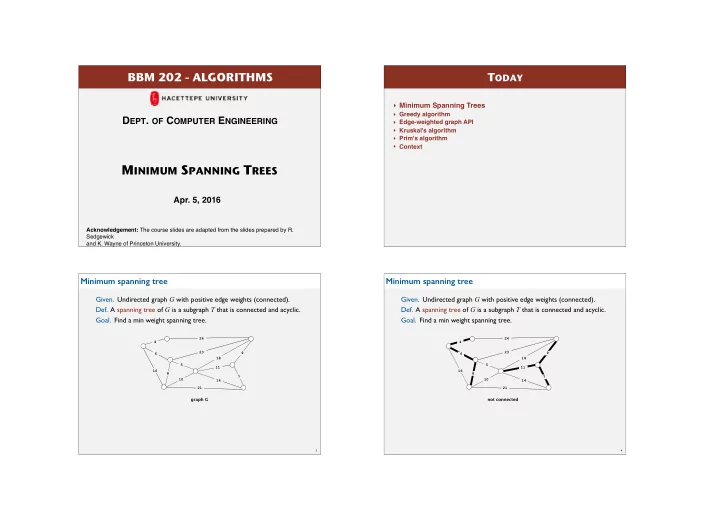
  • Given. Undirected graph G with positive edge weights (connected).
  • Def. A spanning tree of G is a subgraph T that is connected and acyclic.
  • Goal. Find a min weight spanning tree.

Minimum spanning tree

graph G

23 10 21 14 24 16 4 18 9 7 11 8 5 6

4

  • Given. Undirected graph G with positive edge weights (connected).
  • Def. A spanning tree of G is a subgraph T that is connected and acyclic.
  • Goal. Find a min weight spanning tree.

Minimum spanning tree

not connected

23 10 21 14 24 16 4 18 9 7 11 8 5 6

slide-2
SLIDE 2

5

  • Given. Undirected graph G with positive edge weights (connected).
  • Def. A spanning tree of G is a subgraph T that is connected and acyclic.
  • Goal. Find a min weight spanning tree.

Minimum spanning tree

23 10 21 14 24 16 4 18 9 7 11 8 5 6

not acyclic

6

  • Given. Undirected graph G with positive edge weights (connected).
  • Def. A spanning tree of G is a subgraph T that is connected and acyclic.
  • Goal. Find a min weight spanning tree.

Brute force. Try all spanning trees?

Minimum spanning tree

spanning tree T: cost = 50 = 4 + 6 + 8 + 5 + 11 + 9 + 7

23 10 21 14 24 16 4 18 9 7 11 8 5 6

7

MST of bicycle routes in North Seattle

http://www.flickr.com/photos/ewedistrict/21980840

Network design

8

MST of random graph

http://algo.inria.fr/broutin/gallery.html

Models of nature

slide-3
SLIDE 3

9

MST describes arrangement of nuclei in the epithelium for cancer research

http://www.bccrc.ca/ci/ta01_archlevel.html

Medical image processing

10

MST is fundamental problem with diverse applications.

  • Dithering.
  • Cluster analysis.
  • Max bottleneck paths.
  • Real-time face verification.
  • LDPC codes for error correction.
  • Image registration with Renyi entropy.
  • Find road networks in satellite and aerial imagery.
  • Reducing data storage in sequencing amino acids in a protein.
  • Model locality of particle interactions in turbulent fluid flows.
  • Autoconfig protocol for Ethernet bridging to avoid cycles in a network.
  • Approximation algorithms for NP-hard problems (e.g., TSP

, Steiner tree).

  • Network design (communication, electrical, hydraulic, cable, computer, road).

Applications

http://www.ics.uci.edu/~eppstein/gina/mst.html

MINIMUM SPANNING TREES

  • Greedy algorithm
  • Edge-weighted graph API
  • Kruskal's algorithm
  • Prim's algorithm
  • Context

Simplifying assumptions. Edge weights are distinct; graph is connected.

  • Def. A cut in a graph is a partition of its vertices into two (nonempty) sets.


A crossing edge connects a vertex in one set with a vertex in the other. Cut property. Given any cut, the crossing edge of min weight is in the MST.

Cut property

12

minimum-weight crossing edge must be in the MST crossing edges separating gray from white vertices are drawn in red e

slide-4
SLIDE 4

Cut property: correctness proof

13

Simplifying assumptions. Edge weights are distinct; graph is connected.

  • Def. A cut in a graph is a partition of its vertices into two (nonempty) sets.


A crossing edge connects a vertex in one set with a vertex in the other. Cut property. Given any cut, the crossing edge of min weight is in the MST.

  • Pf. Let e be the min-weight crossing edge in cut.
  • Suppose e is not in the MST.
  • Adding e to the MST creates a cycle.
  • Some other edge f in cycle must be a crossing edge.
  • Removing f and adding e is also a spanning tree.
  • Since weight of e is less than the weight of f,


that spanning tree is lower weight.

  • Contradiction. ▪

adding e to MST creates a cycle the MST does not contain e e f

  • Start with all edges colored gray.
  • Find a cut with no black crossing edges, and color its min-weight edge black.
  • Repeat until V - 1 edges are colored black.

14

Greedy MST algorithm

5 4 7 1 3 2 6 0-7 0.16 2-3 0.17 1-7 0.19 0-2 0.26 5-7 0.28 1-3 0.29 1-5 0.32 2-7 0.34 4-5 0.35 1-2 0.36 4-7 0.37 0-4 0.38 6-2 0.40 3-6 0.52 6-0 0.58 6-4 0.93 an edge-weighted graph

  • Start with all edges colored gray.
  • Find a cut with no black crossing edges, and color its min-weight edge black.
  • Repeat until V - 1 edges are colored black.

15

Greedy MST algorithm

5 4 7 1 3 2 6 0-2 0.26 1-3 0.29 2-7 0.34 1-2 0.36 6-0 0.58 6-4 0.93

crossing edges (sorted by weight) in MST crossing edge min-weight crossing edge grey vertices form

  • ne side of cut
  • Start with all edges colored gray.
  • Find a cut with no black crossing edges, and color its min-weight edge black.
  • Repeat until V - 1 edges are colored black.

16

Greedy MST algorithm

5 4 7 1 3 2 6 0-2 MST edges

slide-5
SLIDE 5
  • Start with all edges colored gray.
  • Find a cut with no black crossing edges, and color its min-weight edge black.
  • Repeat until V - 1 edges are colored black.

17

Greedy MST algorithm

5 4 7 1 3 2 6 5-7 0.28 1-5 0.32 4-5 0.35

crossing edges (sorted by weight) in MST

0-2 MST edges

min-weight crossing edge

  • Start with all edges colored gray.
  • Find a cut with no black crossing edges, and color its min-weight edge black.
  • Repeat until V - 1 edges are colored black.

18

Greedy MST algorithm

5 4 7 1 3 2 6 0-2 5-7 MST edges

  • Start with all edges colored gray.
  • Find a cut with no black crossing edges, and color its min-weight edge black.
  • Repeat until V - 1 edges are colored black.

19

Greedy MST algorithm

5 4 7 1 3 2 6 6-2 0.40 3-6 0.52 6-0 0.58 6-4 0.93

crossing edges (sorted by weight) in MST

0-2 5-7 MST edges

min-weight crossing edge

  • Start with all edges colored gray.
  • Find a cut with no black crossing edges, and color its min-weight edge black.
  • Repeat until V - 1 edges are colored black.

20

Greedy MST algorithm

5 4 7 1 3 2 6 0-2 5-7 6-2 MST edges

slide-6
SLIDE 6
  • Start with all edges colored gray.
  • Find a cut with no black crossing edges, and color its min-weight edge black.
  • Repeat until V - 1 edges are colored black.

21

Greedy MST algorithm

5 4 7 1 3 2 6 0-7 0.16 2-3 0.17 2-7 0.34 4-5 0.35 1-2 0.36 4-7 0.37 3-6 0.52

crossing edges (sorted by weight) in MST

0-2 5-7 6-2 MST edges

min-weight crossing edge

  • Start with all edges colored gray.
  • Find a cut with no black crossing edges, and color its min-weight edge black.
  • Repeat until V - 1 edges are colored black.

22

Greedy MST algorithm

5 4 7 1 3 2 6 0-2 5-7 6-2 0-7 MST edges

  • Start with all edges colored gray.
  • Find a cut with no black crossing edges, and color its min-weight edge black.
  • Repeat until V - 1 edges are colored black.

23

Greedy MST algorithm

5 4 7 1 3 2 6 0-2 5-7 6-2 0-7 MST edges

min-weight crossing edge

2-3 0.17 1-7 0.19 1-5 0.32 1-2 0.36

crossing edges (sorted by weight) in MST

  • Start with all edges colored gray.
  • Find a cut with no black crossing edges, and color its min-weight edge black.
  • Repeat until V - 1 edges are colored black.

24

Greedy MST algorithm

5 4 7 1 3 2 6 0-2 5-7 6-2 0-7 2-3 MST edges

slide-7
SLIDE 7
  • Start with all edges colored gray.
  • Find a cut with no black crossing edges, and color its min-weight edge black.
  • Repeat until V - 1 edges are colored black.

25

Greedy MST algorithm

5 4 7 1 3 2 6 0-2 5-7 6-2 0-7 2-3 MST edges

min-weight crossing edge

1-7 0.19 1-3 0.29 1-5 0.32 4-5 0.35 1-2 0.36 4-7 0.37 0-4 0.38 6-4 0.93

crossing edges (sorted by weight) in MST

  • Start with all edges colored gray.
  • Find a cut with no black crossing edges, and color its min-weight edge black.
  • Repeat until V - 1 edges are colored black.

26

Greedy MST algorithm

5 4 7 1 3 2 6 0-2 5-7 6-2 0-7 2-3 1-7 MST edges

  • Start with all edges colored gray.
  • Find a cut with no black crossing edges, and color its min-weight edge black.
  • Repeat until V - 1 edges are colored black.

27

Greedy MST algorithm

5 4 7 1 3 2 6 0-2 5-7 6-2 0-7 2-3 1-7 MST edges

min-weight crossing edge

4-5 0.35 4-7 0.37 0-4 0.38 6-4 0.93

crossing edges (sorted by weight) in MST

  • Start with all edges colored gray.
  • Find a cut with no black crossing edges, and color its min-weight edge black.
  • Repeat until V - 1 edges are colored black.

28

Greedy MST algorithm

5 4 7 1 3 2 6 0-2 5-7 6-2 0-7 2-3 1-7 4-5 MST edges

slide-8
SLIDE 8

Greedy MST algorithm: correctness proof

  • Proposition. The greedy algorithm computes the MST.


 Pf.

  • Any edge colored black is in the MST (via cut property).
  • If fewer than V - 1 black edges, there exists a cut with no black crossing edges.


(consider cut whose vertices are one connected component)

29

fewer than V-1 edges colored black a cut with no black crossing edges

Greedy MST algorithm: efficient implementations

  • Proposition. The greedy algorithm computes the MST:


 Efficient implementations. Choose cut? Find min-weight edge? Ex 1. Kruskal's algorithm. [stay tuned] Ex 2. Prim's algorithm. [stay tuned] Ex 3. Borüvka's algorithm.

30 31

  • Q. What if edge weights are not all distinct?
  • A. Greedy MST algorithm still correct if equal weights are present!


(our correctness proof fails, but that can be fixed) 


  • Q. What if graph is not connected?
  • A. Compute minimum spanning forest = MST of each component.

Removing two simplifying assumptions

no MST if graph is not connected 4 5 0.61 4 6 0.62 5 6 0.88 1 5 0.11 2 3 0.35 0 3 0.6 1 6 0.10 0 2 0.22

can independently compute MSTs of components

1 2 1.00 1 3 0.50 2 4 1.00 3 4 0.50 1 2 1.00 1 3 0.50 2 4 1.00 3 4 0.50

MINIMUM SPANNING TREES

  • Greedy algorithm
  • Edge-weighted graph API
  • Kruskal's algorithm
  • Prim's algorithm
  • Context
slide-9
SLIDE 9

33

Weighted edge API

Edge abstraction needed for weighted edges. Idiom for processing an edge e: int v = e.either(), w = e.other(v);

public class Edge implements Comparable<Edge> Edge(int v, int w, double weight) create a weighted edge v-w int either() either endpoint int

  • ther(int v)

the endpoint that's not v int compareTo(Edge that) compare this edge to that edge double weight() the weight String toString() string representation v weight w

34

public class Edge implements Comparable<Edge> { private final int v, w; private final double weight; public Edge(int v, int w, double weight)
 { this.v = v; this.w = w; this.weight = weight; } public int either()
 { return v; } public int other(int vertex)
 { if (vertex == v) return w; else return v; } public int compareTo(Edge that)
 { if (this.weight < that.weight) return -1; else if (this.weight > that.weight) return +1; else return 0; } }

Weighted edge: Java implementation

constructor either endpoint

  • ther endpoint

compare edges by weight

35

  • Conventions. Allow self-loops and parallel edges.

Edge-weighted graph API

public class EdgeWeightedGraph EdgeWeightedGraph(int V) create an empty graph with V vertices EdgeWeightedGraph(In in) create a graph from input stream void addEdge(Edge e) add weighted edge e to this graph Iterable<Edge> adj(int v) edges incident to v Iterable<Edge> edges() all edges in this graph int V() number of vertices int E() number of edges String toString() string representation

36

Edge-weighted graph: adjacency-lists representation

Maintain vertex-indexed array of Edge lists.

adj[] 1 2 3 4 5 6 7 6 0 .58 2 .26 4 .38 7 .16 Bag

  • bjects

8 16 4 5 0.35 4 7 0.37 5 7 0.28 0 7 0.16 1 5 0.32 0 4 0.38 2 3 0.17 1 7 0.19 0 2 0.26 1 2 0.36 1 3 0.29 2 7 0.34 6 2 0.40 3 6 0.52 6 0 0.58 6 4 0.93 1 3 .29 1 2 .36 1 7 .19 1 5 .32 6 2 .40 2 7 .34 1 2 .36 2 .26 2 3 .17 3 6 .52 1 3 .29 2 3 .17 6 4 .93 4 .38 4 7 .37 4 5 .35 1 5 .32 5 7 .28 4 5 .35 6 4 .93 6 0 .58 3 6 .52 6 2 .40 2 7 .34 1 7 .19 7 .16 5 7 .28 5 7 .28

references to the same Edge object

tinyEWG.txt

V E

slide-10
SLIDE 10

37

public class EdgeWeightedGraph { private final int V; private final Bag<Edge>[] adj; public EdgeWeightedGraph(int V) { this.V = V; adj = (Bag<Edge>[]) new Bag[V]; for (int v = 0; v < V; v++) adj[v] = new Bag<Edge>(); } public void addEdge(Edge e) { int v = e.either(), w = e.other(v); adj[v].add(e); adj[w].add(e); } public Iterable<Edge> adj(int v) { return adj[v]; } }

Edge-weighted graph: adjacency-lists implementation

add edge to both adjacency lists constructor same as Graph, but adjacency lists

  • f Edges instead of integers
  • Q. How to represent the MST?

38

Minimum spanning tree API

8 16 4 5 0.35 4 7 0.37 5 7 0.28 0 7 0.16 1 5 0.32 0 4 0.38 2 3 0.17 1 7 0.19 0 2 0.26 1 2 0.36 1 3 0.29 2 7 0.34 6 2 0.40 3 6 0.52 6 0 0.58 6 4 0.93

non-MST edge (gray) MST edge (black)

tinyEWG.txt

V E

% java MST tinyEWG.txt 0-7 0.16 1-7 0.19 0-2 0.26 2-3 0.17 5-7 0.28 4-5 0.35 6-2 0.40 1.81 public class MST MST(EdgeWeightedGraph G) constructor Iterable<Edge> edges() edges in MST double weight() weight of MST

  • Q. How to represent the MST?

39

Minimum spanning tree API

public static void main(String[] args) { In in = new In(args[0]); EdgeWeightedGraph G = new EdgeWeightedGraph(in); MST mst = new MST(G); for (Edge e : mst.edges()) StdOut.println(e); StdOut.printf("%.2f\n", mst.weight()); } % java MST tinyEWG.txt 0-7 0.16 1-7 0.19 0-2 0.26 2-3 0.17 5-7 0.28 4-5 0.35 6-2 0.40 1.81 public class MST MST(EdgeWeightedGraph G) constructor Iterable<Edge> edges() edges in MST double weight() weight of MST

MINIMUM SPANNING TREES

  • Greedy algorithm
  • Edge-weighted graph API
  • Kruskal's algorithm
  • Prim's algorithm
  • Context
slide-11
SLIDE 11
  • Consider edges in ascending order of weight.
  • Add next edge to tree T unless doing so would create a cycle.

41

Kruskal's algorithm

5 4 7 1 3 2 6 0-7 0.16 2-3 0.17 1-7 0.19 0-2 0.26 5-7 0.28 1-3 0.29 1-5 0.32 2-7 0.34 4-5 0.35 1-2 0.36 4-7 0.37 0-4 0.38 6-2 0.40 3-6 0.52 6-0 0.58 6-4 0.93

graph edges sorted by weight

an edge-weighted graph

42

Kruskal's algorithm

0-7 0.16 5 4 7 1 3 2 6

does not create a cycle in MST

  • Consider edges in ascending order of weight.
  • Add next edge to tree T unless doing so would create a cycle.

43

Kruskal's algorithm

0-7 0.16 2-3 0.17 5 4 7 1 3 2 6

in MST does not create a cycle

  • Consider edges in ascending order of weight.
  • Add next edge to tree T unless doing so would create a cycle.

44

Kruskal's algorithm

0-7 0.16 2-3 0.17 1-7 0.19 5 4 7 1 3 2 6

in MST does not create a cycle

  • Consider edges in ascending order of weight.
  • Add next edge to tree T unless doing so would create a cycle.
slide-12
SLIDE 12

45

Kruskal's algorithm

0-7 0.16 2-3 0.17 1-7 0.19 0-2 0.26 5 4 7 1 3 2 6

in MST does not create a cycle

  • Consider edges in ascending order of weight.
  • Add next edge to tree T unless doing so would create a cycle.

46

Kruskal's algorithm

0-7 0.16 2-3 0.17 1-7 0.19 0-2 0.26 5-7 0.28 5 4 7 1 3 2 6

in MST does not create a cycle

  • Consider edges in ascending order of weight.
  • Add next edge to tree T unless doing so would create a cycle.

47

Kruskal's algorithm

0-7 0.16 2-3 0.17 1-7 0.19 0-2 0.26 5-7 0.28 1-3 0.29 5 4 7 1 3 2 6

creates a cycle not in MST

  • Consider edges in ascending order of weight.
  • Add next edge to tree T unless doing so would create a cycle.

48

Kruskal's algorithm

0-7 0.16 2-3 0.17 1-7 0.19 0-2 0.26 5-7 0.28 1-3 0.29 1-5 0.32 5 4 7 1 3 2 6

creates a cycle not in MST

  • Consider edges in ascending order of weight.
  • Add next edge to tree T unless doing so would create a cycle.
slide-13
SLIDE 13

49

Kruskal's algorithm

0-7 0.16 2-3 0.17 1-7 0.19 0-2 0.26 5-7 0.28 1-3 0.29 1-5 0.32 2-7 0.34 5 4 7 1 3 2 6

creates a cycle not in MST

  • Consider edges in ascending order of weight.
  • Add next edge to tree T unless doing so would create a cycle.

50

Kruskal's algorithm

0-7 0.16 2-3 0.17 1-7 0.19 0-2 0.26 5-7 0.28 1-3 0.29 1-5 0.32 2-7 0.34 4-5 0.35 5 4 7 1 3 2 6

in MST does not create a cycle

  • Consider edges in ascending order of weight.
  • Add next edge to tree T unless doing so would create a cycle.

51

Kruskal's algorithm

0-7 0.16 2-3 0.17 1-7 0.19 0-2 0.26 5-7 0.28 1-3 0.29 1-5 0.32 2-7 0.34 4-5 0.35 1-2 0.36 5 4 7 1 3 2 6

creates a cycle not in MST

  • Consider edges in ascending order of weight.
  • Add next edge to tree T unless doing so would create a cycle.

52

Kruskal's algorithm

0-7 0.16 2-3 0.17 1-7 0.19 0-2 0.26 5-7 0.28 1-3 0.29 1-5 0.32 2-7 0.34 4-5 0.35 1-2 0.36 4-7 0.37 5 4 7 1 3 2 6

creates a cycle not in MST

  • Consider edges in ascending order of weight.
  • Add next edge to tree T unless doing so would create a cycle.
slide-14
SLIDE 14

53

Kruskal's algorithm

0-7 0.16 2-3 0.17 1-7 0.19 0-2 0.26 5-7 0.28 1-3 0.29 1-5 0.32 2-7 0.34 4-5 0.35 1-2 0.36 4-7 0.37 0-4 0.38 5 4 7 1 3 2 6

creates a cycle not in MST

  • Consider edges in ascending order of weight.
  • Add next edge to tree T unless doing so would create a cycle.

54

Kruskal's algorithm

0-7 0.16 2-3 0.17 1-7 0.19 0-2 0.26 5-7 0.28 1-3 0.29 1-5 0.32 2-7 0.34 4-5 0.35 1-2 0.36 4-7 0.37 0-4 0.38 6-2 0.40 5 4 7 1 3 2 6

in MST does not create a cycle

  • Consider edges in ascending order of weight.
  • Add next edge to tree T unless doing so would create a cycle.

55

Kruskal's algorithm

0-7 0.16 2-3 0.17 1-7 0.19 0-2 0.26 5-7 0.28 1-3 0.29 1-5 0.32 2-7 0.34 4-5 0.35 1-2 0.36 4-7 0.37 0-4 0.38 6-2 0.40 3-6 0.52 5 4 7 1 3 2 6

creates a cycle not in MST

  • Consider edges in ascending order of weight.
  • Add next edge to tree T unless doing so would create a cycle.

56

Kruskal's algorithm

0-7 0.16 2-3 0.17 1-7 0.19 0-2 0.26 5-7 0.28 1-3 0.29 1-5 0.32 2-7 0.34 4-5 0.35 1-2 0.36 4-7 0.37 0-4 0.38 6-2 0.40 3-6 0.52 6-0 0.58 5 4 7 1 3 2 6

creates a cycle not in MST

  • Consider edges in ascending order of weight.
  • Add next edge to tree T unless doing so would create a cycle.
slide-15
SLIDE 15

57

Kruskal's algorithm

0-7 0.16 2-3 0.17 1-7 0.19 0-2 0.26 5-7 0.28 1-3 0.29 1-5 0.32 2-7 0.34 4-5 0.35 1-2 0.36 4-7 0.37 0-4 0.38 6-2 0.40 3-6 0.52 6-0 0.58 6-4 0.93 5 4 7 1 3 2 6

creates a cycle not in MST

  • Consider edges in ascending order of weight.
  • Add next edge to tree T unless doing so would create a cycle.

58

Kruskal's algorithm

0-7 0.16 2-3 0.17 1-7 0.19 0-2 0.26 5-7 0.28 1-3 0.29 1-5 0.32 2-7 0.34 4-5 0.35 1-2 0.36 4-7 0.37 0-4 0.38 6-2 0.40 3-6 0.52 6-0 0.58 6-4 0.93 5 4 7 1 3 2 6 a minimum spanning tree

  • Consider edges in ascending order of weight.
  • Add next edge to tree T unless doing so would create a cycle.

Kruskal's algorithm: visualization

59

  • Proposition. [Kruskal 1956] Kruskal's algorithm computes the MST.

  • Pf. Kruskal's algorithm is a special case of the greedy MST algorithm.
  • Suppose Kruskal's algorithm colors the edge e = v–w black.
  • Cut = set of vertices connected to v in tree T.
  • No crossing edge is black.
  • No crossing edge has lower weight. Why?

60

Kruskal's algorithm: correctness proof

add edge to tree

slide-16
SLIDE 16
  • Challenge. Would adding edge v–w to tree T create a cycle? If not, add it.

How difficult?

  • E + V
  • V
  • log V
  • log* V
  • 1

61

Kruskal's algorithm: implementation challenge

run DFS from v, check if w is reachable
 (T has at most V – 1 edges) use the union-find data structure !

adding edge to tree would create a cycle add edge to tree

62

  • Challenge. Would adding edge v–w to tree T create a cycle? If not, add it.


 Efficient solution. Use the union-find data structure.

  • Maintain a set for each connected component in T.
  • If v and w are in same set, then adding v–w would create a cycle.
  • To add v–w to T, merge sets containing v and w.

Case 1: adding v–w creates a cycle

Kruskal's algorithm: implementation challenge

v w

Case 2: add v–w to T and merge sets containing v and w

w v

build priority queue

63

Kruskal's algorithm: Java implementation

public class KruskalMST { private Queue<Edge> mst = new Queue<Edge>(); public KruskalMST(EdgeWeightedGraph G) { MinPQ<Edge> pq = new MinPQ<Edge>(); for (Edge e : G.edges()) pq.insert(e); UF uf = new UF(G.V()); while (!pq.isEmpty() && mst.size() < G.V()-1) { Edge e = pq.delMin(); int v = e.either(), w = e.other(v); if (!uf.connected(v, w)) { uf.union(v, w); mst.enqueue(e); } } } public Iterable<Edge> edges() { return mst; } }

greedily add edges to MST edge v–w does not create cycle merge sets add edge to MST

64

  • Proposition. Kruskal's algorithm computes MST in time proportional to


E log E (in the worst case). 
 Pf. 


  • Remark. If edges are already sorted, order of growth is E log* V.

† amortized bound using weighted quick union with path compression

Kruskal's algorithm: running time

recall: log* V ≤ 5 in this universe

  • peration

frequency time per op build pq 1 E delete-min E log E union V log* V † connected E log* V †

slide-17
SLIDE 17

MINIMUM SPANNING TREES

  • Greedy algorithm
  • Edge-weighted graph API
  • Kruskal's algorithm
  • Prim's algorithm
  • Context
  • Start with vertex 0 and greedily grow tree T.
  • Add to T the min weight edge with exactly one endpoint in T.
  • Repeat until V-1 edges.

66

Prim's algorithm

5 4 7 1 3 2 6 0-7 0.16 2-3 0.17 1-7 0.19 0-2 0.26 5-7 0.28 1-3 0.29 1-5 0.32 2-7 0.34 4-5 0.35 1-2 0.36 4-7 0.37 0-4 0.38 6-2 0.40 3-6 0.52 6-0 0.58 6-4 0.93 an edge-weighted graph

  • Start with vertex 0 and greedily grow tree T.
  • Add to T the min weight edge with exactly one endpoint in T.
  • Repeat until V-1 edges.

67

Prim's algorithm

5 4 7 1 3 2 6

  • Start with vertex 0 and greedily grow tree T.
  • Add to T the min weight edge with exactly one endpoint in T.
  • Repeat until V-1 edges.

68

Prim's algorithm

0-7 0.16 0-2 0.26 0-4 0.38 6-0 0.58

edges with exactly

  • ne endpoint in T

(sorted by weight)

5 4 7 1 3 2 6

in MST min weight edge with exactly one endpoint in T

slide-18
SLIDE 18
  • Start with vertex 0 and greedily grow tree T.
  • Add to T the min weight edge with exactly one endpoint in T.
  • Repeat until V-1 edges.

69

Prim's algorithm

5 4 7 1 3 2 6 0-7 MST edges

  • Start with vertex 0 and greedily grow tree T.
  • Add to T the min weight edge with exactly one endpoint in T.
  • Repeat until V-1 edges.

70

Prim's algorithm

5 4 7 1 3 2 6 1-7 0.19 0-2 0.26 5-7 0.28 2-7 0.34 4-7 0.37 0-4 0.38 6-0 0.58

in MST edges with exactly

  • ne endpoint in T

(sorted by weight)

0-7 MST edges

min weight edge with exactly one endpoint in T

  • Start with vertex 0 and greedily grow tree T.
  • Add to T the min weight edge with exactly one endpoint in T.
  • Repeat until V-1 edges.

71

Prim's algorithm

5 4 7 1 3 2 6 0-7 1-7 MST edges

  • Start with vertex 0 and greedily grow tree T.
  • Add to T the min weight edge with exactly one endpoint in T.
  • Repeat until V-1 edges.

72

Prim's algorithm

5 4 7 1 3 2 6 0-2 0.26 5-7 0.28 1-3 0.29 1-5 0.32 2-7 0.34 1-2 0.36 4-7 0.37 0-4 0.38 6-0 0.58

edges with exactly

  • ne endpoint in T

(sorted by weight) in MST

0-7 1-7 MST edges

min weight edge with exactly one endpoint in T

slide-19
SLIDE 19
  • Start with vertex 0 and greedily grow tree T.
  • Add to T the min weight edge with exactly one endpoint in T.
  • Repeat until V-1 edges.

73

Prim's algorithm

5 4 7 1 3 2 6 0-7 1-7 0-2 MST edges

  • Start with vertex 0 and greedily grow tree T.
  • Add to T the min weight edge with exactly one endpoint in T.
  • Repeat until V-1 edges.

74

Prim's algorithm

5 4 7 1 3 2 6 2-3 0.17 5-7 0.28 1-3 0.29 1-5 0.32 4-7 0.37 0-4 0.38 6-2 0.40 6-0 0.58

edges with exactly

  • ne endpoint in T

(sorted by weight) in MST

0-7 1-7 0-2 MST edges

min weight edge with exactly one endpoint in T

  • Start with vertex 0 and greedily grow tree T.
  • Add to T the min weight edge with exactly one endpoint in T.
  • Repeat until V-1 edges.

75

Prim's algorithm

5 4 7 1 3 2 6 0-7 1-7 0-2 2-3 MST edges

  • Start with vertex 0 and greedily grow tree T.
  • Add to T the min weight edge with exactly one endpoint in T.
  • Repeat until V-1 edges.

76

Prim's algorithm

5 4 7 1 3 2 6 5-7 0.28 1-5 0.32 4-7 0.37 0-4 0.38 6-2 0.40 3-6 0.52 6-0 0.58

edges with exactly

  • ne endpoint in T

(sorted by weight) in MST

0-7 1-7 0-2 2-3 MST edges

min weight edge with exactly one endpoint in T

slide-20
SLIDE 20
  • Start with vertex 0 and greedily grow tree T.
  • Add to T the min weight edge with exactly one endpoint in T.
  • Repeat until V-1 edges.

77

Prim's algorithm

5 4 7 1 3 2 6 0-7 1-7 0-2 2-3 5-7 MST edges

  • Start with vertex 0 and greedily grow tree T.
  • Add to T the min weight edge with exactly one endpoint in T.
  • Repeat until V-1 edges.

78

Prim's algorithm

5 4 7 1 3 2 6 4-5 0.35 4-7 0.37 0-4 0.38 6-2 0.40 3-6 0.52 6-0 0.58

edges with exactly

  • ne endpoint in T

(sorted by weight) in MST

0-7 1-7 0-2 2-3 5-7 MST edges

min weight edge with exactly one endpoint in T

  • Start with vertex 0 and greedily grow tree T.
  • Add to T the min weight edge with exactly one endpoint in T.
  • Repeat until V-1 edges.

79

Prim's algorithm

5 4 7 1 3 2 6 0-7 1-7 0-2 2-3 5-7 4-5 MST edges

  • Start with vertex 0 and greedily grow tree T.
  • Add to T the min weight edge with exactly one endpoint in T.
  • Repeat until V-1 edges.

80

Prim's algorithm

5 4 7 1 3 2 6 6-2 0.40 3-6 0.52 6-0 0.58 6-4 0.93

edges with exactly

  • ne endpoint in T

(sorted by weight) in MST

0-7 1-7 0-2 2-3 5-7 4-5 MST edges

min weight edge with exactly one endpoint in T

slide-21
SLIDE 21
  • Start with vertex 0 and greedily grow tree T.
  • Add to T the min weight edge with exactly one endpoint in T.
  • Repeat until V-1 edges.

81

Prim's algorithm

5 4 7 1 3 2 6 0-7 1-7 0-2 2-3 5-7 4-5 6-2 MST edges

Prim’s algorithm: visualization

82

  • Proposition. [Jarník 1930, Dijkstra 1957, Prim 1959] 


Prim's algorithm computes the MST. 


  • Pf. Prim's algorithm is a special case of the greedy MST algorithm.
  • Suppose edge e = min weight edge connecting a vertex on the tree


to a vertex not on the tree.

  • Cut = set of vertices connected on tree.
  • No crossing edge is black.
  • No crossing edge has lower weight.

83

Prim's algorithm: proof of correctness

edge e = 7-5 added to tree

84

  • Challenge. Find the min weight edge with exactly one endpoint in T.

How difficult?

  • E
  • V
  • log E
  • log* E
  • l

Prim's algorithm: implementation challenge

try all edges use a priority queue !

1-7 0.19 0-2 0.26 5-7 0.28 2-7 0.34 4-7 0.37 0-4 0.38 6-0 0.58

priority queue

  • f crossing edges

1-7 is min weight edge with

exactly one endpoint in T

slide-22
SLIDE 22

85

  • Challenge. Find the min weight edge with exactly one endpoint in T.


 Lazy solution. Maintain a PQ of edges with (at least) one endpoint in T.

  • Key = edge; priority = weight of edge.
  • Delete-min to determine next edge e = v–w to add to T.
  • Disregard if both endpoints v and w are in T.
  • Otherwise, let v be vertex not in T :
  • add to PQ any edge incident to v (assuming other endpoint not in T)
  • add v to T

Prim's algorithm: lazy implementation

1-7 0.19 0-2 0.26 5-7 0.28 2-7 0.34 4-7 0.37 0-4 0.38 6-0 0.58

priority queue

  • f crossing edges

1-7 is min weight edge with

exactly one endpoint in T

  • Start with vertex 0 and greedily grow tree T.
  • Add to T the min weight edge with exactly one endpoint in T.
  • Repeat until V-1 edges.

86

Prim's algorithm - Lazy implementation

5 4 7 1 3 2 6 0-7 0.16 2-3 0.17 1-7 0.19 0-2 0.26 5-7 0.28 1-3 0.29 1-5 0.32 2-7 0.34 4-5 0.35 1-2 0.36 4-7 0.37 0-4 0.38 6-2 0.40 3-6 0.52 6-0 0.58 6-4 0.93 an edge-weighted graph

  • Start with vertex 0 and greedily grow tree T.
  • Add to T the min weight edge with exactly one endpoint in T.
  • Repeat until V-1 edges.

87

Prim's algorithm - Lazy implementation

5 4 7 1 3 2 6

  • Start with vertex 0 and greedily grow tree T.
  • Add to T the min weight edge with exactly one endpoint in T.
  • Repeat until V-1 edges.

88

Prim's algorithm - Lazy implementation

5 4 7 1 3 2 6

edges on PQ (sorted by weight)

* 0-7 0.16 * 0-2 0.26 * 0-4 0.38 * 6-0 0.58 add to PQ all edges incident to 0

slide-23
SLIDE 23
  • Start with vertex 0 and greedily grow tree T.
  • Add to T the min weight edge with exactly one endpoint in T.
  • Repeat until V-1 edges.

89

Prim's algorithm - Lazy implementation

5 4 7 1 3 2 6

edges on PQ (sorted by weight)

0-7 0.16 0-2 0.26 0-4 0.38 6-0 0.58 delete 0-7 and add to MST

  • Start with vertex 0 and greedily grow tree T.
  • Add to T the min weight edge with exactly one endpoint in T.
  • Repeat until V-1 edges.

90

Prim's algorithm - Lazy implementation

5 4 7 1 3 2 6

edges on PQ (sorted by weight)

0-7 MST edges 0-2 0.26 0-4 0.38 6-0 0.58

  • Start with vertex 0 and greedily grow tree T.
  • Add to T the min weight edge with exactly one endpoint in T.
  • Repeat until V-1 edges.

91

Prim's algorithm - Lazy implementation

5 4 7 1 3 2 6 0-7 MST edges * 1-7 0.19 0-2 0.26 * 5-7 0.28 * 2-7 0.34 * 4-7 0.37 0-4 0.38 6-0 0.58

edges on PQ (sorted by weight)

add to PQ all edges incident to 7

  • Start with vertex 0 and greedily grow tree T.
  • Add to T the min weight edge with exactly one endpoint in T.
  • Repeat until V-1 edges.

92

Prim's algorithm - Lazy implementation

5 4 7 1 3 2 6 0-7 MST edges 1-7 0.19 0-2 0.26 5-7 0.28 2-7 0.34 4-7 0.37 0-4 0.38 6-0 0.58

edges on PQ (sorted by weight)

delete 1-7 and add to MST

slide-24
SLIDE 24
  • Start with vertex 0 and greedily grow tree T.
  • Add to T the min weight edge with exactly one endpoint in T.
  • Repeat until V-1 edges.

93

Prim's algorithm - Lazy implementation

5 4 7 1 3 2 6 MST edges 0-2 0.26 5-7 0.28 2-7 0.34 4-7 0.37 0-4 0.38 6-0 0.58

edges on PQ (sorted by weight)

0-7 1-7

  • Start with vertex 0 and greedily grow tree T.
  • Add to T the min weight edge with exactly one endpoint in T.
  • Repeat until V-1 edges.

94

Prim's algorithm - Lazy implementation

5 4 7 1 3 2 6 MST edges 0-2 0.26 5-7 0.28 * 1-3 0.29 * 1-5 0.32 2-7 0.34 * 1-2 0.36 4-7 0.37 0-4 0.38 6-0 0.58

edges on PQ (sorted by weight)

add to PQ all edges incident to 1 0-7 1-7

  • Start with vertex 0 and greedily grow tree T.
  • Add to T the min weight edge with exactly one endpoint in T.
  • Repeat until V-1 edges.

95

Prim's algorithm - Lazy implementation

5 4 7 1 3 2 6 MST edges 0-2 0.26 5-7 0.28 1-3 0.29 1-5 0.32 2-7 0.34 1-2 0.36 4-7 0.37 0-4 0.38 6-0 0.58

edges on PQ (sorted by weight)

delete edge 0-2 and add to MST 0-7 1-7

  • Start with vertex 0 and greedily grow tree T.
  • Add to T the min weight edge with exactly one endpoint in T.
  • Repeat until V-1 edges.

96

Prim's algorithm - Lazy implementation

5 4 7 1 3 2 6 MST edges 5-7 0.28 1-3 0.29 1-5 0.32 2-7 0.34 1-2 0.36 4-7 0.37 0-4 0.38 6-0 0.58

edges on PQ (sorted by weight)

0-7 1-7 0-2

edge becomes obsolete (lazy implementation leaves on PQ)

slide-25
SLIDE 25
  • Start with vertex 0 and greedily grow tree T.
  • Add to T the min weight edge with exactly one endpoint in T.
  • Repeat until V-1 edges.

97

Prim's algorithm - Lazy implementation

5 4 7 1 3 2 6 MST edges * 2-3 0.17 5-7 0.28 1-3 0.29 1-5 0.32 2-7 0.34 1-2 0.36 4-7 0.37 0-4 0.38 * 6-2 0.40 6-0 0.58

edges on PQ (sorted by weight)

0-7 1-7 0-2 add to PQ all edges incident to 2

no need to add edge 1-2 or 2-7 because it's already obsolete

  • Start with vertex 0 and greedily grow tree T.
  • Add to T the min weight edge with exactly one endpoint in T.
  • Repeat until V-1 edges.

98

Prim's algorithm - Lazy implementation

5 4 7 1 3 2 6 MST edges * 2-3 0.17 5-7 0.28 1-3 0.29 1-5 0.32 2-7 0.34 1-2 0.36 4-7 0.37 0-4 0.38 * 6-2 0.40 6-0 0.58

edges on PQ (sorted by weight)

0-7 1-7 0-2 delete 2-3 and add to MST

  • Start with vertex 0 and greedily grow tree T.
  • Add to T the min weight edge with exactly one endpoint in T.
  • Repeat until V-1 edges.

99

Prim's algorithm - Lazy implementation

5 4 7 1 3 2 6 MST edges 5-7 0.28 1-3 0.29 1-5 0.32 2-7 0.34 1-2 0.36 4-7 0.37 0-4 0.38 6-2 0.40 6-0 0.58

edges on PQ (sorted by weight)

0-7 1-7 0-2 2-3

  • Start with vertex 0 and greedily grow tree T.
  • Add to T the min weight edge with exactly one endpoint in T.
  • Repeat until V-1 edges.

100

Prim's algorithm - Lazy implementation

5 4 7 1 3 2 6 MST edges 5-7 0.28 1-3 0.29 1-5 0.32 2-7 0.34 1-2 0.36 4-7 0.37 0-4 0.38 6-2 0.40 * 3-6 0.52 6-0 0.58

edges on PQ (sorted by weight)

0-7 1-7 0-2 2-3 add to PQ all edges incident to 3

slide-26
SLIDE 26
  • Start with vertex 0 and greedily grow tree T.
  • Add to T the min weight edge with exactly one endpoint in T.
  • Repeat until V-1 edges.

101

Prim's algorithm - Lazy implementation

5 4 7 1 3 2 6 MST edges 5-7 0.28 1-3 0.29 1-5 0.32 2-7 0.34 1-2 0.36 4-7 0.37 0-4 0.38 6-2 0.40 3-6 0.52 6-0 0.58

edges on PQ (sorted by weight)

0-7 1-7 0-2 2-3 delete 5-7 and add to MST

  • Start with vertex 0 and greedily grow tree T.
  • Add to T the min weight edge with exactly one endpoint in T.
  • Repeat until V-1 edges.

102

Prim's algorithm - Lazy implementation

5 4 7 1 3 2 6 MST edges 1-3 0.29 1-5 0.32 2-7 0.34 1-2 0.36 4-7 0.37 0-4 0.38 6-2 0.40 3-6 0.52 6-0 0.58

edges on PQ (sorted by weight)

0-7 1-7 0-2 2-3 5-7

  • Start with vertex 0 and greedily grow tree T.
  • Add to T the min weight edge with exactly one endpoint in T.
  • Repeat until V-1 edges.

103

Prim's algorithm - Lazy implementation

5 4 7 1 3 2 6 MST edges 1-3 0.29 1-5 0.32 2-7 0.34 * 4-5 0.35 1-2 0.36 4-7 0.37 0-4 0.38 6-2 0.40 3-6 0.52 6-0 0.58

edges on PQ (sorted by weight)

0-7 1-7 0-2 2-3 5-7 add to PQ all edges incident to 5

  • Start with vertex 0 and greedily grow tree T.
  • Add to T the min weight edge with exactly one endpoint in T.
  • Repeat until V-1 edges.

104

Prim's algorithm - Lazy implementation

5 4 7 1 3 2 6 MST edges 1-3 0.29 1-5 0.32 2-7 0.34 4-5 0.35 1-2 0.36 4-7 0.37 0-4 0.38 6-2 0.40 3-6 0.52 6-0 0.58

edges on PQ (sorted by weight)

0-7 1-7 0-2 2-3 5-7 delete 1-3 and discard obsolete edge

slide-27
SLIDE 27
  • Start with vertex 0 and greedily grow tree T.
  • Add to T the min weight edge with exactly one endpoint in T.
  • Repeat until V-1 edges.

105

Prim's algorithm - Lazy implementation

5 4 7 1 3 2 6 MST edges 1-5 0.32 2-7 0.34 4-5 0.35 1-2 0.36 4-7 0.37 0-4 0.38 6-2 0.40 3-6 0.52 6-0 0.58

edges on PQ (sorted by weight)

0-7 1-7 0-2 2-3 5-7 delete 1-5 and discard obsolete edge

  • Start with vertex 0 and greedily grow tree T.
  • Add to T the min weight edge with exactly one endpoint in T.
  • Repeat until V-1 edges.

106

Prim's algorithm - Lazy implementation

5 4 7 1 3 2 6 MST edges 2-7 0.34 4-5 0.35 1-2 0.36 4-7 0.37 0-4 0.38 6-2 0.40 3-6 0.52 6-0 0.58

edges on PQ (sorted by weight)

0-7 1-7 0-2 2-3 5-7 delete 2-7 and discard obsolete edge

  • Start with vertex 0 and greedily grow tree T.
  • Add to T the min weight edge with exactly one endpoint in T.
  • Repeat until V-1 edges.

107

Prim's algorithm - Lazy implementation

5 4 7 1 3 2 6 MST edges 4-5 0.35 1-2 0.36 4-7 0.37 0-4 0.38 6-2 0.40 3-6 0.52 6-0 0.58

edges on PQ (sorted by weight)

0-7 1-7 0-2 2-3 5-7 delete 4-5 and add to MST

  • Start with vertex 0 and greedily grow tree T.
  • Add to T the min weight edge with exactly one endpoint in T.
  • Repeat until V-1 edges.

108

Prim's algorithm - Lazy implementation

5 4 7 1 3 2 6 MST edges 1-2 0.36 4-7 0.37 0-4 0.38 6-2 0.40 3-6 0.52 6-0 0.58

edges on PQ (sorted by weight)

0-7 1-7 0-2 2-3 5-7 4-5

slide-28
SLIDE 28
  • Start with vertex 0 and greedily grow tree T.
  • Add to T the min weight edge with exactly one endpoint in T.
  • Repeat until V-1 edges.

109

Prim's algorithm - Lazy implementation

5 4 7 1 3 2 6 MST edges 1-2 0.36 4-7 0.37 0-4 0.38 6-2 0.40 3-6 0.52 6-0 0.58 * 6-4 0.93

edges on PQ (sorted by weight)

0-7 1-7 0-2 2-3 5-7 4-5 add to PQ all edges incident to 4

  • Start with vertex 0 and greedily grow tree T.
  • Add to T the min weight edge with exactly one endpoint in T.
  • Repeat until V-1 edges.

110

Prim's algorithm - Lazy implementation

5 4 7 1 3 2 6 MST edges 1-2 0.36 4-7 0.37 0-4 0.38 6-2 0.40 3-6 0.52 6-0 0.58 6-4 0.93

edges on PQ (sorted by weight)

0-7 1-7 0-2 2-3 5-7 4-5 delete 1-2 and discard obsolete edge

  • Start with vertex 0 and greedily grow tree T.
  • Add to T the min weight edge with exactly one endpoint in T.
  • Repeat until V-1 edges.

111

Prim's algorithm - Lazy implementation

5 4 7 1 3 2 6 MST edges 4-7 0.37 0-4 0.38 6-2 0.40 3-6 0.52 6-0 0.58 6-4 0.93

edges on PQ (sorted by weight)

0-7 1-7 0-2 2-3 5-7 4-5 delete 4-7 and discard obsolete edge

  • Start with vertex 0 and greedily grow tree T.
  • Add to T the min weight edge with exactly one endpoint in T.
  • Repeat until V-1 edges.

112

Prim's algorithm - Lazy implementation

5 4 7 1 3 2 6 MST edges 0-4 0.38 6-2 0.40 3-6 0.52 6-0 0.58 6-4 0.93

edges on PQ (sorted by weight)

0-7 1-7 0-2 2-3 5-7 4-5 delete 0-4 and discard obsolete edge

slide-29
SLIDE 29
  • Start with vertex 0 and greedily grow tree T.
  • Add to T the min weight edge with exactly one endpoint in T.
  • Repeat until V-1 edges.

113

Prim's algorithm - Lazy implementation

5 4 7 1 3 2 6 MST edges 6-2 0.40 3-6 0.52 6-0 0.58 6-4 0.93

edges on PQ (sorted by weight)

0-7 1-7 0-2 2-3 5-7 4-5 delete 6-2 and add to MST

  • Start with vertex 0 and greedily grow tree T.
  • Add to T the min weight edge with exactly one endpoint in T.
  • Repeat until V-1 edges.

114

Prim's algorithm - Lazy implementation

5 4 7 1 3 2 6 MST edges 3-6 0.52 6-0 0.58 6-4 0.93

edges on PQ (sorted by weight)

0-7 1-7 0-2 2-3 5-7 4-5 6-2 delete 6-2 and add to MST

  • Start with vertex 0 and greedily grow tree T.
  • Add to T the min weight edge with exactly one endpoint in T.
  • Repeat until V-1 edges.

115

Prim's algorithm - Lazy implementation

5 4 7 1 3 2 6 MST edges 3-6 0.52 6-0 0.58 6-4 0.93

edges on PQ (sorted by weight)

0-7 1-7 0-2 2-3 5-7 4-5 6-2 stop since V-1 edges

  • Start with vertex 0 and greedily grow tree T.
  • Add to T the min weight edge with exactly one endpoint in T.
  • Repeat until V-1 edges.

116

Prim's algorithm - Lazy implementation

5 4 7 1 3 2 6 MST edges 0-7 1-7 0-2 2-3 5-7 4-5 6-2

slide-30
SLIDE 30

public class LazyPrimMST { private boolean[] marked; // MST vertices private Queue<Edge> mst; // MST edges private MinPQ<Edge> pq; // PQ of edges public LazyPrimMST(WeightedGraph G) { pq = new MinPQ<Edge>(); mst = new Queue<Edge>(); marked = new boolean[G.V()]; visit(G, 0); while (!pq.isEmpty()) { Edge e = pq.delMin(); int v = e.either(), w = e.other(v); if (marked[v] && marked[w]) continue; mst.enqueue(e); if (!marked[v]) visit(G, v); if (!marked[w]) visit(G, w); } } }

117

Prim's algorithm: lazy implementation

repeatedly delete the min weight edge e = v–w from PQ ignore if both endpoints in T add v or w to tree assume G is connected add edge e to tree

private void visit(WeightedGraph G, int v) { marked[v] = true; for (Edge e : G.adj(v)) if (!marked[e.other(v)]) pq.insert(e); } public Iterable<Edge> mst() { return mst; }

118

Prim's algorithm: lazy implementation

for each edge e = v–w, add to PQ if w not already in T add v to T

119

  • Proposition. Lazy Prim's algorithm computes the MST in time proportional


to E log E and extra space proportional to E (in the worst case). 
 Pf.

Lazy Prim's algorithm: running time

  • peration

frequency binary heap delete min E log E insert E log E

120

  • Challenge. Find min weight edge with exactly one endpoint in T.


 Eager solution. Maintain a PQ of vertices connected by an edge to T,
 where priority of vertex v = weight of shortest edge connecting v to T.

  • Delete min vertex v and add its associated edge e = v–w to T.
  • Update PQ by considering all edges e = v–x incident to v
  • ignore if x is already in T
  • add x to PQ if not already on it
  • decrease priority of x if v–x becomes shortest edge connecting x to T

Prim's algorithm: eager implementation

1 1-7 0.19 2 0-2 0.26 3 1-3 0.29 4 0-4 0.38 5 5-7 0.28 6 6-0 0.58 7 0-7 0.16

black: on MST red: on PQ pq has at most one entry per vertex

slide-31
SLIDE 31
  • Start with vertex 0 and greedily grow tree T.
  • Add to T the min weight edge with exactly one endpoint in T.
  • Repeat until V-1 edges.

121

Prim's algorithm - Eager implementation

5 4 7 1 3 2 6 0-7 0.16 2-3 0.17 1-7 0.19 0-2 0.26 5-7 0.28 1-3 0.29 1-5 0.32 2-7 0.34 4-5 0.35 1-2 0.36 4-7 0.37 0-4 0.38 6-2 0.40 3-6 0.52 6-0 0.58 6-4 0.93 an edge-weighted graph

  • Start with vertex 0 and greedily grow tree T.
  • Add to T the min weight edge with exactly one endpoint in T.
  • Repeat until V-1 edges.

122

Prim's algorithm - Eager implementation

5 4 7 1 3 2 6 v edgeTo[] distTo[] 0 - -

  • Start with vertex 0 and greedily grow tree T.
  • Add to T the min weight edge with exactly one endpoint in T.
  • Repeat until V-1 edges.

123

Prim's algorithm - Eager implementation

5 4 7 1 3 2 6 v edgeTo[] distTo[] 0 - - 7 0–7 0.16 2 0–2 0.26 4 0–4 0.38 6 6–0 0.58

vertices on PQ (sorted by weight) add vertices 7, 2, 4, and 6 to PQ

  • Start with vertex 0 and greedily grow tree T.
  • Add to T the min weight edge with exactly one endpoint in T.
  • Repeat until V-1 edges.

124

Prim's algorithm - Eager implementation

5 4 7 1 3 2 6 v edgeTo[] distTo[] 0 - - 7 0–7 0.16 2 0–2 0.26 4 0–4 0.38 6 6–0 0.58

vertices on PQ (sorted by weight)

slide-32
SLIDE 32
  • Start with vertex 0 and greedily grow tree T.
  • Add to T the min weight edge with exactly one endpoint in T.
  • Repeat until V-1 edges.

125

Prim's algorithm - Eager implementation

5 4 7 1 3 2 6 0-7 MST edges v edgeTo[] distTo[] 0 - - 7 0–7 0.16 2 0–2 0.26 4 0–4 0.38 6 6–0 0.58

vertices on PQ (sorted by weight)

  • Start with vertex 0 and greedily grow tree T.
  • Add to T the min weight edge with exactly one endpoint in T.
  • Repeat until V-1 edges.

126

Prim's algorithm - Eager implementation

5 4 7 1 3 2 6 0-7 MST edges v edgeTo[] distTo[] 0 - - 7 0–7 0.16 1 1–7 0.19 2 0–2 0.26 5 5–7 0.28 4 0–4 0.38 6 6–0 0.58

add vertex 5 to PQ add vertex 1 to PQ vertices on PQ (sorted by weight) already a better connection to 2 (discard)

0.37 4-7

decrease 
 key of vertex 4 from 0.38 to 0.37

  • Start with vertex 0 and greedily grow tree T.
  • Add to T the min weight edge with exactly one endpoint in T.
  • Repeat until V-1 edges.

127

Prim's algorithm - Eager implementation

5 4 7 1 3 2 6 0-7 1-7 MST edges v edgeTo[] distTo[] 0 - - 7 0–7 0.16 1 1–7 0.19 2 0–2 0.26 5 5–7 0.28 4 4–7 0.37 6 6–0 0.58

vertices on PQ (sorted by weight)

  • Start with vertex 0 and greedily grow tree T.
  • Add to T the min weight edge with exactly one endpoint in T.
  • Repeat until V-1 edges.

128

Prim's algorithm - Eager implementation

5 4 7 1 3 2 6 0-7 1-7 MST edges v edgeTo[] distTo[] 0 - - 7 0–7 0.16 1 1–7 0.19 2 0–2 0.26 5 5–7 0.28 4 4–7 0.37 6 6–0 0.58

vertices on PQ (sorted by weight)

slide-33
SLIDE 33
  • Start with vertex 0 and greedily grow tree T.
  • Add to T the min weight edge with exactly one endpoint in T.
  • Repeat until V-1 edges.

129

Prim's algorithm - Eager implementation

5 4 7 1 3 2 6 0-7 1-7 MST edges v edgeTo[] distTo[] 0 - - 7 0–7 0.16 1 1–7 0.19 2 0–2 0.26 5 5–7 0.28 3 1–3 0.29 4 4–7 0.37 6 6–0 0.58

add vertex 3 to PQ already a better connection to 5 and 7 (discard)

  • Start with vertex 0 and greedily grow tree T.
  • Add to T the min weight edge with exactly one endpoint in T.
  • Repeat until V-1 edges.

130

Prim's algorithm - Eager implementation

5 4 7 1 3 2 6 0-7 1-7 MST edges v edgeTo[] distTo[] 0 - - 7 0–7 0.16 1 1–7 0.19 2 0–2 0.26 5 5–7 0.28 3 1–3 0.29 4 4–7 0.37 6 6–0 0.58

  • Start with vertex 0 and greedily grow tree T.
  • Add to T the min weight edge with exactly one endpoint in T.
  • Repeat until V-1 edges.

131

Prim's algorithm - Eager implementation

5 4 7 1 3 2 6 MST edges v edgeTo[] distTo[] 0 - - 7 0–7 0.16 1 1–7 0.19 2 0–2 0.26 5 5–7 0.28 3 1–3 0.29 4 4–7 0.37 6 6–0 0.58 0-7 1-7 0-2

  • Start with vertex 0 and greedily grow tree T.
  • Add to T the min weight edge with exactly one endpoint in T.
  • Repeat until V-1 edges.

132

Prim's algorithm - Eager implementation

5 4 7 1 3 2 6 0-7 1-7 0-2 MST edges v edgeTo[] distTo[] 0 - - 7 0–7 0.16 1 1–7 0.19 2 0–2 0.26 3 1–3 0.29 5 5–7 0.28 4 4–7 0.37 6 6–0 0.58

decrease key of vertex 3 from 0.29 to 0.17 decrease key of vertex 6 from 0.58 to 0.40

0.17 2-3 0.40 6-2

now better connections to 0 and 1 (discard)

slide-34
SLIDE 34
  • Start with vertex 0 and greedily grow tree T.
  • Add to T the min weight edge with exactly one endpoint in T.
  • Repeat until V-1 edges.

133

Prim's algorithm - Eager implementation

5 4 7 1 3 2 6 MST edges v edgeTo[] distTo[] 0 - - 7 0–7 0.16 1 1–7 0.19 2 0–2 0.26 3 2–3 0.17 5 5–7 0.28 4 4–7 0.37 6 6–2 0.40 0-7 1-7 0-2 2-3

  • Start with vertex 0 and greedily grow tree T.
  • Add to T the min weight edge with exactly one endpoint in T.
  • Repeat until V-1 edges.

134

Prim's algorithm - Eager implementation

5 4 7 1 3 2 6 MST edges v edgeTo[] distTo[] 0 - - 7 0–7 0.16 1 1–7 0.19 2 0–2 0.26 3 2–3 0.17 5 5–7 0.28 4 4–7 0.37 6 6–2 0.40 0-7 1-7 0-2 2-3

  • Start with vertex 0 and greedily grow tree T.
  • Add to T the min weight edge with exactly one endpoint in T.
  • Repeat until V-1 edges.

135

Prim's algorithm - Eager implementation

5 4 7 1 3 2 6 MST edges v edgeTo[] distTo[] 0 - - 7 0–7 0.16 1 1–7 0.19 2 0–2 0.26 3 2–3 0.17 5 5–7 0.28 4 4–7 0.37 6 6–2 0.40 0-7 1-7 0-2 2-3

already a better connection to 6 (discard)

  • Start with vertex 0 and greedily grow tree T.
  • Add to T the min weight edge with exactly one endpoint in T.
  • Repeat until V-1 edges.

136

Prim's algorithm - Eager implementation

5 4 7 1 3 2 6 MST edges v edgeTo[] distTo[] 0 - - 7 0–7 0.16 1 1–7 0.19 2 0–2 0.26 3 2–3 0.17 5 5–7 0.28 4 4–7 0.37 6 6–2 0.40 0-7 1-7 0-2 2-3

slide-35
SLIDE 35
  • Start with vertex 0 and greedily grow tree T.
  • Add to T the min weight edge with exactly one endpoint in T.
  • Repeat until V-1 edges.

137

Prim's algorithm - Eager implementation

5 4 7 1 3 2 6 MST edges v edgeTo[] distTo[] 0 - - 7 0–7 0.16 1 1–7 0.19 2 0–2 0.26 3 2–3 0.17 5 5–7 0.28 4 4–7 0.37 6 6–2 0.40 0-7 1-7 0-2 2-3 5-7

  • Start with vertex 0 and greedily grow tree T.
  • Add to T the min weight edge with exactly one endpoint in T.
  • Repeat until V-1 edges.

138

Prim's algorithm - Eager implementation

5 4 7 1 3 2 6 0-7 1-7 0-2 2-3 5-7 MST edges

decrease key of 4 from 0.37 to 0.35

v edgeTo[] distTo[] 0 - - 7 0–7 0.16 1 1–7 0.19 2 0–2 0.26 3 2–3 0.17 5 5–7 0.28 4 4–7 0.37 6 6–2 0.40 0.35 4-5

now a better connection to 4 (discard)

  • Start with vertex 0 and greedily grow tree T.
  • Add to T the min weight edge with exactly one endpoint in T.
  • Repeat until V-1 edges.

139

Prim's algorithm - Eager implementation

5 4 7 1 3 2 6 0-7 1-7 0-2 2-3 5-7 MST edges v edgeTo[] distTo[] 0 - - 7 0–7 0.16 1 1–7 0.19 2 0–2 0.26 3 2–3 0.17 5 5–7 0.28 4 4–5 0.35 6 6–2 0.40

  • Start with vertex 0 and greedily grow tree T.
  • Add to T the min weight edge with exactly one endpoint in T.
  • Repeat until V-1 edges.

140

Prim's algorithm - Eager implementation

5 4 7 1 3 2 6 MST edges v edgeTo[] distTo[] 0 - - 7 0–7 0.16 1 1–7 0.19 2 0–2 0.26 3 2–3 0.17 5 5–7 0.28 4 4–5 0.35 6 6–2 0.40 0-7 1-7 0-2 2-3 5-7 4-5

slide-36
SLIDE 36
  • Start with vertex 0 and greedily grow tree T.
  • Add to T the min weight edge with exactly one endpoint in T.
  • Repeat until V-1 edges.

141

Prim's algorithm - Eager implementation

5 4 7 1 3 2 6 MST edges v edgeTo[] distTo[] 0 - - 7 0–7 0.16 1 1–7 0.19 2 0–2 0.26 3 2–3 0.17 5 5–7 0.28 4 4–5 0.35 6 6–2 0.40 0-7 1-7 0-2 2-3 5-7 4-5

already a better connection to 6 (discard)

  • Start with vertex 0 and greedily grow tree T.
  • Add to T the min weight edge with exactly one endpoint in T.
  • Repeat until V-1 edges.

142

Prim's algorithm - Eager implementation

5 4 7 1 3 2 6 MST edges v edgeTo[] distTo[] 0 - - 7 0–7 0.16 1 1–7 0.19 2 0–2 0.26 3 2–3 0.17 5 5–7 0.28 4 4–5 0.35 6 6–2 0.40 0-7 1-7 0-2 2-3 5-7 4-5

  • Start with vertex 0 and greedily grow tree T.
  • Add to T the min weight edge with exactly one endpoint in T.
  • Repeat until V-1 edges.

143

Prim's algorithm - Eager implementation

5 4 7 1 3 2 6 MST edges v edgeTo[] distTo[] 0 - - 7 0–7 0.16 1 1–7 0.19 2 0–2 0.26 3 2–3 0.17 5 5–7 0.28 4 4–5 0.35 6 6–2 0.40 0-7 1-7 0-2 2-3 5-7 4-5 6-2

  • Start with vertex 0 and greedily grow tree T.
  • Add to T the min weight edge with exactly one endpoint in T.
  • Repeat until V-1 edges.

144

Prim's algorithm - Eager implementation

5 4 7 1 3 2 6 0-7 1-7 0-2 2-3 5-7 4-5 6-2 MST edges v edgeTo[] distTo[] 0 - - 7 0–7 0.16 1 1–7 0.19 2 0–2 0.26 3 2–3 0.17 5 5–7 0.28 4 4–5 0.35 6 6–2 0.40

slide-37
SLIDE 37

145

Associate an index between 0 and N - 1 with each key in a priority queue.

  • Client can insert and delete-the-minimum.
  • Client can change the key by specifying the index.

Indexed priority queue

public class IndexMinPQ<Key extends Comparable<Key>> IndexMinPQ(int N) create indexed priority queue
 with indices 0, 1, …, N-1 void insert(int k, Key key) associate key with index k
 void decreaseKey(int k, Key key) decrease the key associated with index k
 boolean contains() is k an index on the priority queue? int delMin() remove a minimal key and return its associated index boolean isEmpty() is the priority queue empty? int size() number of entries in the priority queue

Implementation.

  • Start with same code as MinPQ.
  • Maintain parallel arrays keys[], pq[], and qp[] so that:
  • keys[i] is the priority of i
  • pq[i] is the index of the key in heap position i
  • qp[i] is the heap position of the key with index i
  • Use swim(qp[k]) implement decreaseKey(k, key).

i 0 1 2 3 4 5 6 7 8 keys[i] A S O R T I N G - pq[i] - 0 6 7 2 1 5 4 3 qp[i] 1 5 4 8 7 6 2 3 -

1 2 4 5 6 7 8 3

R O N S A I G T

146

Indexed priority queue implementation

147

Depends on PQ implementation: V insert, V delete-min, E decrease-key. 


 Bottom line.

  • Array implementation optimal for dense graphs.
  • Binary heap much faster for sparse graphs.
  • 4-way heap worth the trouble in performance-critical situations.
  • Fibonacci heap best in theory, but not worth implementing.

Prim's algorithm: running time

† amortized

PQ implementation insert delete-min decrease-key total array 1 V 1 V2 binary heap log V log V log V E log V d-way heap
 (Johnson 1975) d logd V d logd V logd V E logE/V V Fibonacci heap
 (Fredman-Tarjan 1984) 1 † log V † 1 † E + V log V

MINIMUM SPANNING TREES

  • Greedy algorithm
  • Edge-weighted graph API
  • Kruskal's algorithm
  • Prim's algorithm
  • Context
slide-38
SLIDE 38

Given N points in the plane, find MST connecting them, where the distances between point pairs are their Euclidean distances. 


 Brute force. Compute ~ N 2 / 2 distances and run Prim's algorithm.

  • Ingenuity. Exploit geometry and do it in ~ c N log N.

149

Euclidean MST

150

k-clustering. Divide a set of objects classify into k coherent groups. Distance function. Numeric value specifying "closeness" of two objects. 


  • Goal. Divide into clusters so that objects in different clusters are far apart.


 Applications.

  • Routing in mobile ad hoc networks.
  • Document categorization for web search.
  • Similarity searching in medical image databases.
  • Skycat: cluster 109 sky objects into stars, quasars, galaxies.
  • utbreak of cholera deaths in London in 1850s (Nina Mishra)

Scientific application: clustering

k-clustering. Divide a set of objects classify into k coherent groups. Distance function. Numeric value specifying "closeness" of two objects. Single link. Distance between two clusters equals the distance
 between the two closest objects (one in each cluster). Single-link clustering. Given an integer k, find a k-clustering that maximizes the distance between two closest clusters.

151

Single-link clustering

distance between
 two closest clusters 4-clustering distance between two clusters

152

“Well-known” algorithm for single-link clustering:

  • Form

V clusters of one object each.

  • Find the closest pair of objects such that each object is in a different cluster, and

merge the two clusters.

  • Repeat until there are exactly k clusters.

  • Observation. This is Kruskal's algorithm


(stop when k connected components). 


 Alternate solution. Run Prim's algorithm and delete k-1 max weight edges.

Single-link clustering algorithm

slide-39
SLIDE 39

153

Tumors in similar tissues cluster together.

Reference: Botstein & Brown group Gene 1 Gene n gene expressed gene not expressed

Dendrogram of cancers in human