
SLIDE 1
Mineralogical hosts of radionuclides in Olympic Dam copper concentrates
Kathy Ehrig (Superintendent Geometallurgy) AusIMM Adelaide Branch Technical Lunch - 20 February 2020
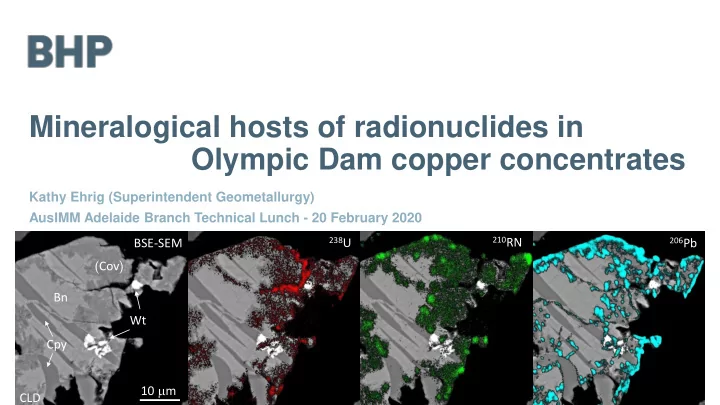
238U
BSE-SEM Bn (Cov) Cpy Wt 10 mm
206Pb 210RN
CLD
Mineralogical hosts of radionuclides in Olympic Dam copper - - PowerPoint PPT Presentation
Mineralogical hosts of radionuclides in Olympic Dam copper concentrates Kathy Ehrig (Superintendent Geometallurgy) AusIMM Adelaide Branch Technical Lunch - 20 February 2020 238 U 210 RN 206 Pb BSE-SEM ( Cov ) Bn Wt Cpy 10 m m CLD
Kathy Ehrig (Superintendent Geometallurgy) AusIMM Adelaide Branch Technical Lunch - 20 February 2020
238U
BSE-SEM Bn (Cov) Cpy Wt 10 mm
206Pb 210RN
CLD
Disclaimer: The views/opinions expressed are solely the presenter’s.
2 20 February, 2020 Mineralogical hosts of radionuclides
BHP Olympic Dam
have worked at Olympic Dam since discovery in 1975. University of Tasmania
Matthew Ferguson, Nathan Chapman
ANSTO (Australian Nuclear Science Technology Organisation) University of Melbourne- Roland Maas CSIRO Land and Water, Adelaide- Mark Raven Geological Survey South Australia- Alan Mauger University of Adelaide
Charos, Sasha Krneta, Danielle Schmandt, William Keyser, Mark Rollog, Liam Courtney-Davies, Marija Dmitrijeva
South Australian Mining and Petroleum Services Centre of Excellence (Department of State Development)
ARC Linkage LP130100438 (UTas) – Kamenetsky & McPhie
“The supergiant Olympic Dam uranium-copper-gold rare earth element ore deposit: towards a new genetic model”
ARC Linkage LP160101497 (Flinders University) – Allan Pring
“Reverse engineering Nature: metal extraction through mineral replacement”
3 20 February, 2020 Mineralogical hosts of radionuclides
Flotation concentrates contain ~1500-3000 ppm U3O8 and associated natural decay products in secular equilibrium. After concentrate leach, U3O8 > 100 ppm with decay products, BUT are no longer in secular equilibrium. OD copper sulfide concentrates (pre- and post-leach) are classified as radioactive. Metallurgical Studies
Simple answer: Uranium minerals don’t host all of the 238U decay chain radionuclides (RNs). In the OD deposit, RNs are partially to completely decoupled from U at the macro- to nano-scale. Sulfuric acid leaching then further decouples U from its RNs… Radionuclide Mineralogy Extensive metallurgical test work conducted to produce Cu-sulfide concentrates which can be processed off-site. Bottom line: lowered the radionuclide activity levels, but not low enough.
We haven’t solved the problem, but at least we now know why.
Part 1: Uranium and the uranium decay series A few definitions - NORM, TENORM, parts per quadrillion (1 in 1015) Part 2: Uranium and its natural decay products – where they occur How does uranium get into our copper concentrates? Concentrate leach – removes most of the U, but not much of the RNs “Metal has no value until it is in a saleable product” (Munro, 2017) And finally, Why we don’t mine copper separate from uranium!
4 20 February, 2020 Mineralogical hosts of radionuclides
5 20 February, 2020 Mineralogical hosts of radionuclides
When an atom decays, energy is released which is trivial to detect and quantify.
Uranium decay series (238U → 206Pb) Actinium decay series (235U → 207Pb) Thorium decay series (232Th → 208Pb)
210RN (210Pb + 210Po) concentrations?
6 20 February, 2020 Mineralogical hosts of radionuclides
210Pb:
0.000000356 ppm 0.000356 ppb 0.356 ppt (per 80.7ppm U)
210Po:
0.00000000604 ppm 0.00000604 ppb 0.00604 ppt (per 80.7ppm U)
Very difficult to measure via chemical methods when concentrations < 1 ppb. Impossible to measure at the scale of an individual mineral, …until recently.
NORM TENORM
It took a long time to fully comprehend and then understand the implications
7 20 February, 2020 Mineralogical hosts of radionuclides
It took a long time to fully comprehend and then understand the implications
8 20 February, 2020 Mineralogical hosts of radionuclides
100 1000 10000 100000 La (ppm) Ce Pr Nd Sm Eu Gd Tb Dy Y Ho Er Tm Yb Lu
RX6763 (group 1) 568 33 Ma boty 470 13 Ma massive
“Unconformity-related”2,3 uraninites
100 1000 10000 100000 La (ppm) Ce Pr Nd Sm Eu Gd Tb Dy Y Ho Er Tm Yb Lu
RX7989 1594.4 8 Ma
It took a long time to fully comprehend and then understand the implications
9 20 February, 2020 Mineralogical hosts of radionuclides
“Intrusive-related”2 uraninites
sample: RX7989
1594.4 ± 8 Ma
sample: RX6763
568 ± 33 Ma 470 ± 13 Ma
1 chondrite values from McDonough and Sun (1995) 2 Meradier et al. (2011), 3 Fremmel et al. (2014)
Chondrite-normalised1 REY Patterns for OD Uraninites
– decouple from U at the mineral scale? – precipitate immediately? – migrate a short distance and then reprecipitate? – are some transported along with U+6?
decoupled from U over 1.6 Ga?
10 20 February, 2020 Mineralogical hosts of radionuclides
11 20 February, 2020 Mineralogical hosts of radionuclides
99% U3O8
Milling and flotation Concentrate leach Smelter & refinery Tailings leach CCD & Solvent extraction
Ore from UG mine ~ +2% Cu 600ppm U3O8 Sulfide concentrate ~ 36-40% Cu 1500ppm U3O8 Flotation tailings ~ 0.15% Cu 550ppm U3O8 Sulfide concentrate ~ 40-46% Cu 150ppm U3O8 U3O8 & Cu in leach liquor
Tailings disposal
Leach liquor & Leach residue
~0.05% Cu <170ppm U3O8
Separate sulfides & gangue Reduce U3O8, F & Fe Remove U3O8 & Cu Convert Cu- sulfides into pure Cu metal Upgrade & purify U3O8
Final residue U-liquors
Cu-cathode Au-Ag bullion
Cu liquors feed into EW refinery
12 20 February, 2020 Mineralogical hosts of radionuclides
*Radionuclide balance in the processing of copper and uranium at Olympic Dam: ANSTO (2008), also reported in the 2009 EIS
What does the mineralogy show? Beyond the limits of technology until ~ 5 years ago.
13 20 February, 2020 Mineralogical hosts of radionuclides
14 20 February, 2020 Mineralogical hosts of radionuclides
ARC Research Hub for Australian Copper-Uranium
Mark Rollog was a PhD student (now completed) within the Hub. He identified the possibility of using nanoSIMS to map the distribution of radionuclides at the mineral scale. nanoSIMS was never used to map RNs prior to this project. He also produced the RN maps presented here. Once the method was established,
NORM material (i.e. ores pre-sulfuric acid leach)
Mineral hosts of uranium
Mineral hosts of the radionuclides
15 20 February, 2020 Mineralogical hosts of radionuclides
Technically not possible until ~ 5 years ago
TENORM material (i.e. ores post-sulfuric acid leach)
Mineral hosts of uranium
Mineral hosts of the radionuclides
16 20 February, 2020 Mineralogical hosts of radionuclides
Technically not possible until ~ 5 years ago
Copper sulfide flotation reagents are not selective for uranium
Uranium recovery (or upgrade) to flotation concentrates is a function
recovery to concentrates.
17 20 February, 2020 Mineralogical hosts of radionuclides
Max U3O8 content in mill feed to produce a ‘non-radioactive’ concentrate?
18 20 February, 2020 Mineralogical hosts of radionuclides
200 400 600 800 1000 1200 1400 1600 1800 2000 200 400 600 800 1000 1200 1400 U3O8 conc grade (ppm) U3O8 in feed (ppm)
U3O8 grade in concentrate at target sulfides in unleached concentrates
OD operating range
80% sulfides 90% sulfides Target = 1Bq/g per radionuclide for the 238U decay chain (total = ~14 Bq/g) 100 ppm U3O8 data source: OD geomet samples
most other Cu- concentrates smelted = <10 ppm U3O8 Vanessa Liebezeit produced this graph
Micro- to nano-scale association of U with Cu minerals, and others…
19 20 February, 2020 Mineralogical hosts of radionuclides
~100 mm ~100 mm
1 10 100 1000 10000 100000 1000000 10000000 100000000 5 10 15 20 25 30 35 40 45 50 55 60 counts time (seconds) S34 Fe57 Cu65 Pb204 Pb206 Pb207 Pb208 U238 Deposit-scale association of U and Cu minerals
20 20 February, 2020 Mineralogical hosts of radionuclides
Cu: -400mRL
total tonnes (no cut) tonnes (<100 ppm U308) Cu grade (no cut) Cu grade (<100 ppm U3O8)
Deposit-scale association of U and Cu minerals
21 20 February, 2020 Mineralogical hosts of radionuclides
Cu: -400mRL >2.4% CuEq
Total tonnes & grade (uncut) UG tonnes & grade (>2.4% CuEq)
Deposit-scale association of U and Cu minerals
22 20 February, 2020 Mineralogical hosts of radionuclides
Cu: -400mRL >2.4% CuEq & <100ppm U3O8
UG tonnes & grade (>2.4% CuEq)
The chemistry of 238U, 230Th, 226Ra, 222Rn, 210Pb, 210Po is different, so the mineralogy will be different
23 20 February, 2020 Mineralogical hosts of radionuclides
Metallurgical Studies Extensive metallurgical test work conducted to produce marketable copper sulfide concentrates Bottom line: lowered the radionuclide activity levels, but not low enough “Metal has no value until it is in a saleable product” (Munro, 2017) Uranium minerals don’t host all of the U238 decay chain radionuclides (RNs). TRANSFORMATIONAL In the OD deposit, RNs are partially to completely decoupled from U at the macro- to nano-scale. Radionuclide Mineralogy