Maximising the value of NVCL HyLogger data: Understanding automated - - PowerPoint PPT Presentation

maximising the value of nvcl hylogger data understanding
SMART_READER_LITE
LIVE PREVIEW

Maximising the value of NVCL HyLogger data: Understanding automated - - PowerPoint PPT Presentation

Maximising the value of NVCL HyLogger data: Understanding automated mineralogical interpretations Belinda Smith, Mark Berman, Ralph Bottrill, Tania Dhu, Suraj Gopalakrishnan, Georgina Gordon, David Green, Jon Huntington, Alan Mauger NORTHERN


slide-1
SLIDE 1

NORTHERN TERRITORY GEOLOGICAL SURVEY

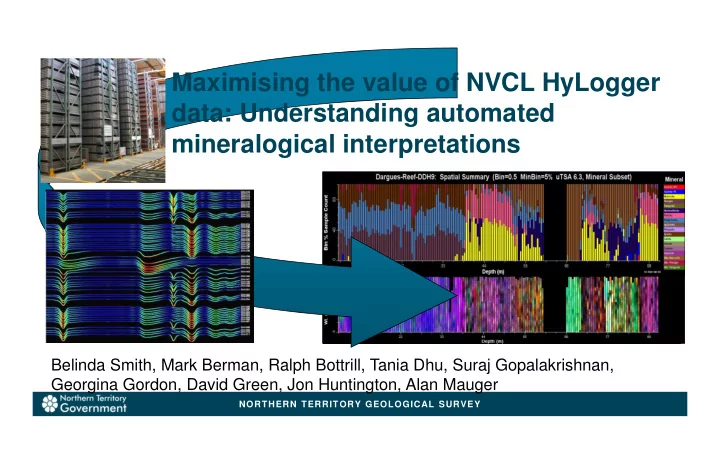
Maximising the value of NVCL HyLogger data: Understanding automated mineralogical interpretations

Belinda Smith, Mark Berman, Ralph Bottrill, Tania Dhu, Suraj Gopalakrishnan, Georgina Gordon, David Green, Jon Huntington, Alan Mauger

slide-2
SLIDE 2

NORTHERN TERRITORY GEOLOGICAL SURVEY

Introduction

  • Aims

– Understanding what the HyLogging NVCL is – New to HyLogging – understanding what it is and what it is telling you – HyLogger User – understanding the different levels of processing – Increase understanding of the methods and processes behind the mineral outputs from TSG.

slide-3
SLIDE 3

NORTHERN TERRITORY GEOLOGICAL SURVEY

  • AuScope NVCL initiative – started

in 2007 – Australia-wide drillcore database comprising high- resolution imagery and mineralogical data from spectroscopic scanning – facilitate geoscience research – data available to the public via a web-based delivery system

National Virtual Core Library (NVCL)

Access Infrastructure Material Infrastructure Infrastructure Technology Infrastructure Human

2 1 3 4

slide-4
SLIDE 4

NORTHERN TERRITORY GEOLOGICAL SURVEY

AuScope Portal

http://portal.auscope.org/portal/gmap.html

slide-5
SLIDE 5

NORTHERN TERRITORY GEOLOGICAL SURVEY

HyLogging basics

  • Produces images of the

core

  • Produces reflectance

spectra (matched to minerals)

  • Improves objectivity of

core logging

  • Enhances geological

understanding

  • Sampling every 8mm x

8mm width for whole length of core

  • Wallara 1 (1668m / 349

core trays) = 218,125 spectra Multiple data streams integrated in TSG software

slide-6
SLIDE 6

NORTHERN TERRITORY GEOLOGICAL SURVEY

  • Voluminous data with 100,000s spectra in a single

drillhole

  • Hundreds of drillholes; thousands of metres

nationwide

  • Automate the mineral matching with;

– TSA (The Spectral Assistant). Refine with; – Restricting minerals in TSA (uTSA) – Creating domains in TSA (dTSA) – Using CLS with domains

Automated Mineralogical Interpretation

slide-7
SLIDE 7

NORTHERN TERRITORY GEOLOGICAL SURVEY

Mineralogical Interpretation of HyLogger Data

The Spectral Assistant (TSA) – System Matches

Algorithm matching to whole spectral library

TSA – User Matches (uTSA) Manual restriction of unlikely minerals

Minerals match across whole hole

sTSA ALL DATASETS Domaining (dTSA) CLS Constrained Least Squares External Validation Creating and using scalars (XRD, petrography, SEM)

uTSA +/- scalars Good for basement / seds drillholes Recommended for TIR spectra processing (non-unique spectra)

Steps are not sequential

slide-8
SLIDE 8

NORTHERN TERRITORY GEOLOGICAL SURVEY

TSA mineral matching

  • ‘Unmixes’ spectral response into mineral

mixes of 2 (SWIR) or 3 (TIR) using an algorithm

  • Only matches to minerals in the library
  • If a mineral isn’t active in that wavelength

range, you won’t see it

  • If there’s more than 2 - 3 (SWIR) or 3 -4

(TIR) minerals per spectrometer you won’t see them

  • It is NOT an assay! You get a indication of

minerals present, NOT an absolute quantifiable modal value.

  • Nonetheless valuable as nothing else is as

fast.

slide-9
SLIDE 9

NORTHERN TERRITORY GEOLOGICAL SURVEY

  • Automated process which can handle (simple) mineral

mixtures very quickly

  • Detailed: mineral match output for each spectrum

(8mm*18mm)

  • Results returned as mineral names (rather than wavelengths)

so outputs easily understood by geoscientists

  • Summary overviews can show bulk mineral changes in the

entire drilled length

Strengths of TSA Mineral Outputs

slide-10
SLIDE 10

NORTHERN TERRITORY GEOLOGICAL SURVEY

Detailed TSA outputs

slide-11
SLIDE 11

NORTHERN TERRITORY GEOLOGICAL SURVEY

TSA results…. sTSA Summary

Black shales, dolomitic quartz sandstones metamorphosed basement dolostones

epidote talc SYSTEM TSA has ‘unsupervised/ unedited’ watermark. Mathematical fit; no geology used.

slide-12
SLIDE 12

NORTHERN TERRITORY GEOLOGICAL SURVEY

TSA results…. uTSA Summary

quartz calcite calcite dolomite chlorite amphibole USER (uTSA) – has been refined to exclude unlikely minerals when spectral matching. BUT sediments show epidote, phlogopite (can’t exclude because they’re in basement). talc gone epidote still present phlogopite

slide-13
SLIDE 13

NORTHERN TERRITORY GEOLOGICAL SURVEY

TSA results…. uTSA Summary DOMAINED

quartz calcite calcite dolomite chlorite amphibole Results have been DOMAINED; no phlogopite, epidote in sediments but is in basement. epidote gone talc, phlogopite removed

epidote still here

slide-14
SLIDE 14

NORTHERN TERRITORY GEOLOGICAL SURVEY

TSG SOFTWARE – mineral matching (TSA)

Well-crystalline kaolinite 100% SRSS = 146

Petermann Sandstone; from LA05DD01

Quartz 100% Does not see kaolinite feature

Appears to be a well-sorted sandstone TSA SWIR response of wx kaolinite only TSA TIR response of quartz only SWIR can’t ‘see’ quartz CLS has quartz AND kaolinite

SWIR & TIR results

93% quartz, 6% kaolinite

black = spectrum blue = modelled spectrum black = spectrum blue = modelled spectrum black = spectrum green = modelled spectrum

slide-15
SLIDE 15

SWIR TSA says..

  • FeMg Chlorite
  • Phengitic mica

TIR Spectra Mixing non-uniqueness

TIR TSA Result

Slide courtesy Andy Green, OTBC Pty Ltd

slide-16
SLIDE 16

NORTHERN TERRITORY GEOLOGICAL SURVEY

  • TSA can’t effectively look at as many mixtures in the TIR

(n=3). CLS can return 6 – 7 mixtures

  • TSA has difficulty with non-unique spectra
  • TSA concentrates on getting the best fit over the whole

spectrum and may miss small features (think kaolinite in Petermann Sandstone)

  • CLS has to use a manually selected Restricted Mineral

Set (optional in TSA)

CLS vs. TSA in the TIR

slide-17
SLIDE 17

NORTHERN TERRITORY GEOLOGICAL SURVEY

  • HyLogger returns voluminous whole-of-drillhole

measurements vs. individual point sampling done with hand-held devices

  • HyLog FIRST, destructive sampling SECOND (when

wanting to compare mineral results from two techniques)

  • HyLogger weakness is quantifiable mineralogy
  • Mineralogy validation ongoing; many Surveys have in-

house XRD facilities

HyLogging vs. other mineralogy outputs: XRD / EDAX / Petrography

slide-18
SLIDE 18

NORTHERN TERRITORY GEOLOGICAL SURVEY

  • Relatively semi-quantitative

– May depend on absorption co-efficient – Linear surface measurement (not whole core) – Does not deal well with complex mixtures – Proportions are RELATIVE…. If a dominant mineral is inactive in that wavelength range, then it won’t be returned as a mineral match from that spectrometer – If a mineral is < 15% of the mineral mix, it won’t be listed (default)

TSA Mineral Mix Proportions

slide-19
SLIDE 19

NORTHERN TERRITORY GEOLOGICAL SURVEY

  • Core quality (look at imagery)
  • Complexity of mineral

assemblage

  • Degree of processing
  • Incorporating scalars into the

processing workflow

  • Domaining
  • External validation

Factors influencing confidence levels of automated mineral modelling

The Spectral Assistant (TSA) – System Matches Algorithm matching to whole spectral library TSA – User Matches (uTSA) Manual restriction of unlikely minerals Domaining (dTSA) CLS Combined Least Squares External Validation Creating and using scalars

slide-20
SLIDE 20

NORTHERN TERRITORY GEOLOGICAL SURVEY

  • Good for voluminous whole-of-drillhole

data

  • Good for mineral matches of 2 – 3

minerals

  • Good for stratigraphic

boundaries/correlations; alteration haloes

  • Increased level of processing (restricted

mineral matching of algorithm using context and common sense) gives increased confidence in the results

  • Need to learn to recognise what is likely,

what is real; what needs validation with external techniques

HyLogger Data – ‘fit for purpose’?

The Spectral Assistant (TSA) – System Matches Algorithm matching to whole spectral library TSA – User Matches (uTSA) Manual restriction of unlikely minerals Minerals match across whole hole Domaining (dTSA) CLS Combined Least Squares External Validation Creating and using scalars

slide-21
SLIDE 21

NORTHERN TERRITORY GEOLOGICAL SURVEY

  • Use of scalars
  • Look at the imagery (core quality)
  • Look at the spectral fit to the algorithm
  • Validate using complementary

techniques (XRD, petrography, etc)

  • Use your geological knowledge:

– ‘am I likely to see that mineral in that geological environment?’ – is that mineral responsive in that wavelength range? (think quartz/ feldspars not showing in SWIR) – is that mineral in the TSA library?

Validate the mineral response

slide-22
SLIDE 22

NORTHERN TERRITORY GEOLOGICAL SURVEY

  • HyLogging is a valuable technique
  • Automated mineralogical interpretation methods are

essential to deal with the volume of data

  • Understanding the methods and processes behind the

mineral outputs will assist geoscientists in applying NVCL HyLogger data to their specific problems with confidence

  • Next speakers can show examples of applying HyLogger

data

Conclusions

slide-23
SLIDE 23

NORTHERN TERRITORY GEOLOGICAL SURVEY

  • Andy Green (OTBC Pty Ltd) has

contributed to much of this work, particularly CLS and TSA modelling work.

Acknowledgements

slide-24
SLIDE 24

NORTHERN TERRITORY GEOLOGICAL SURVEY

slide-25
SLIDE 25

Validation ML48 (2012)

ID TSAT Min1 TSAT Min2 TSAT Min3 TSAS Min1 TSAS Min2 XRD Comments

19301 186.28 Hedenbergite-1 57% Augite-1 43% Aspectral Clinopyroxene, ? , Pyrrhotite, Mica, Plagioclase, Chlorite, Amphibole, Quartz Clinopyroxene matches Na-Esseneite, Plagioclase matches Na-Anorthite, unknown may be sulphide 15530 158.34 Hedenbergite-1 53% Diopside-1 47% Aspectral Clinopyroxene, Pyrrhotite, Amphibole, Plagioclase, Mica, ? , Chlorite Clinopyroxene matches Na-Esseneite, unknown probably Pyrite or Hematite 10915 124.62 Augite-3 59% Diopside-2 23% Grossular 1 8 % Riebeckite 100% Clinopyroxene, Amphibole, Mica, ? , Chlorite Clinopyroxene matches Na-Esseneite, unknown may be Garnet, Amphibole probably not Riebeckite 39495 332.79 Albite-1 64% Quartz LH 36% Paragonite 100% K-Feldspar (35%-50%), Quartz (25%- 35%), Plagioclase (15%-25%), Mica (2%- 5%), Chlorite (2%-5%) K-Feldspar probably Orthoclase, Plagioclase probably Albite, Mica probably Biotite (definitely not Paragonite) 39381 331.96 Quartz LH 58% Anorthoclase-2 42% Muscovite 100% Quartz (35%-50%), K-Feldspar (25%- 35%), Plagioclase (15%-25%), Chlorite (5%-10%), Mica (2%-5%) K-Feldspar probably Orthoclase, Plagioclase probably Albite, no Anorthoclase, Mica probably Biotite 16893 168.37 Ankerite 81% Quartz LH 19% Siderite 100% Calcite, Clinopyroxene, Plagioclase, ? , Quartz Clinopyroxene matches Na-Esseneite, unknown a minor constituent 16680 166.80 Siderite-1 58% Grossular-1 42% Calcite 100% Calcite, Garnet, Vesuvianite, Clinopyroxene Garnet probably Grossular 28913 256.01 Hedenbergite-2 56% Muscovite dbl 44% Muscovite 100% Clinopyroxene, Plagioclase, Mica, Chlorite, Amphibole, Pyrite Clinopyroxene probably Hedenbergite, Mica probably Muscovite 36610 311.93 Microcline-3 69% Albite-1 31% Muscovite 51% Fe-Chlorite 46%Quartz (35%-50%), K-Feldspar (25%- 35%), Plagioclase (15%-25%), Chlorite (5%-10%), Mica (<2%) K-Feldspar probably Orthoclase, Plagioclase probably Albite 38343 324.56 Quartz LH 67% Anorthoclase-2 33% Muscovite 100% Quartz (35%-50%), K-Feldspar (25%- 35%), Plagioclase (15%-25%), Chlorite (5%-10%), Mica (<2%) K-Feldspar probably Orthoclase, Plagioclase probably Albite 38860 328.03 Quartz LH 63% Microcline-1 37% Muscovite 100% K-Feldspar (25%-35%), Quartz (25%- 35%), Plagioclase (25%-35%), Chlorite (5%-10%), Mica (<2%) K-Feldspar probably Orthoclase (definitely not Microcline), Plagioclase probably Albite

Correct mineral Correct group Wrong group
slide-26
SLIDE 26

NORTHERN TERRITORY GEOLOGICAL SURVEY

Sample ID: PU11BRS001 Hole ID: MURD001 Index: 19470

XRD response: Quartz (>80%), K-Feldspar (?microcline) (2%-5%), Dickite

(2%-5%), Mica (2%-5%), Chlorite(<2%), Jarosite13 (<2%). Mica is possibly illite. Chlorite peaks overlap with dickite. Jarosite only detectable in fine fraction

Conclusion: XRD confirmed dickite response. Allowing an extra mixture in TSA did not identify chlorite

Validating dickite

MURD001 has a mixed dickite / muscovite TSA

  • response. The dickite response is quite strong

(approximately 70% dickite; 30% muscovite here; SRSS is around 75) but is this really dickite? Checked with XRD.

slide-27
SLIDE 27

Which wavelength region is best?

slide-28
SLIDE 28

NORTHERN TERRITORY GEOLOGICAL SURVEY

Previous presentation at 2010 AESC (Huntington et al)

– Palygorskite (Lighthouse Gully Qld) found to be zeolite (EDAX and XRD) which was not then in TSA library

Since 2010, ongoing XRD validation carried out by Surveys to add confidence in HyLogger results

Mineralogical Validation of the NVCL via external techniques

slide-29
SLIDE 29

Sample HyLogger mineralogy XRD mineralogy C110564 FeChlorite (60%), Kaolinite PX (40%) Muscovite (65%), Chlorite (35%) C110565 Muscovite (80%), Kaolinite PX (20%) Muscovite (65%), Kaolinite (30%), Chlorite (5%), Goethite C110566A FeMgChlorite (80%), Muscovite (20%) Chlorite (60%), Muscovite (40%) C110566B Kaolinite PX (70%), Muscovite (30%) Halloysite (50%), Muscovite (35%), Chlorite (15%) C110567 FeMgChlorite Chlorite (85%), Muscovite (15%) C110568 Biotite (60%), Muscovite (40%) Muscovite/Biotite (70%), Chlorite (25%), Siderite (5%) C110570 Biotite (60%), Muscovite (40%) Muscovite/Biotite (55%), Chlorite (40%), Siderite (5%) C110571 Kaolinite WX (60%), NH Alunite (40%) Siderite (60%), Kaolinite (25%), Mica (5%), Chlorite (10%) C110573 Dolomite Dolomite C110574 Kaolinite (60%), FeMgChlorite (40%) Mica (40%), Kaolinite (40%), Chlorite (20%), Siderite, Ankerite C110575 FeChlorite Chlorite (50%), Muscovite (50%), Calcite C110576 Muscovite (50%), FeMgChlorite (50%) Muscovite (55%), Chlorite (40%), Calcite (5%) C110577 Phengite (80%), Gypsum (20%) Chlorite, Mica, Rozenite, Gypsum/Melanterite C110578 Muscovite (60%), Gypsum (40%) Muscovite (60%), Kaolinite (30%), Siderite (10%), Chlorite C110579 Kaolinite WX Muscovite (60%), Kaolinite (30%), Siderite (10%) C110580 Dolomite Dolomite (65%), Mica (25%), Kaolinite (10%), Siderite C110581 Calcite Calcite (75%), Mica (20%), Chlorite (5%), Siderite, Mg-Kutnohorite C110582 NH Alunite Mica (60%), Chlorite (40%), Siderite C110583 Dolomite Mg-Kutnohorite C110584 FeMgChlorite (80%), NH Alunite (20%) Chlorite (70%), Calcite (30%) C110586 Calcite Calcite (80%), Chlorite C110587 Dolomite (55%), Muscovite (45%) Mg-Kutnohorite (40%), Chlorite (25%), Mica (15%), Siderite (10%), Calcite (10%)

Validation RUL01 Alberton– MRT

slide-30
SLIDE 30

NORTHERN TERRITORY GEOLOGICAL SURVEY

uTSA compared with XRD – mineral proportions

uTSAS give 66% dolomite, 34% gypsum with SRSS of 74. Enabling an extra mixing level gives: 49% dolomite, 30% gypsum, 21% talc with SRSS of 34. uTSAT gives 65% gypsum, 35% quartz

XRD: anhydrite 65 – 80%; dolomite 15 – 25%; gypsum, quartz, talc (2-5%); chlorite <2%