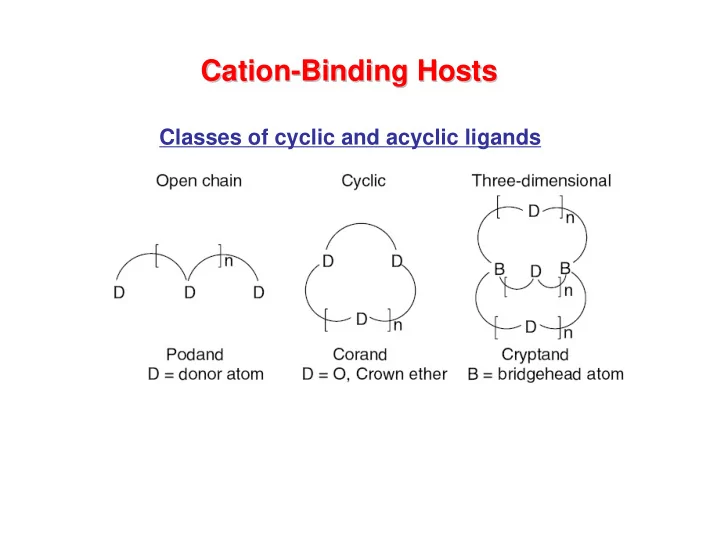
SLIDE 1 Cation Cation-
Binding Hosts
Classes of cyclic and acyclic ligands
SLIDE 3 Azacorands
18<N626corand-6> [18]ane-N6
hexacyclen
14<N42232corand-4> tetraza[14]crown-4 cyclam 18<O3N326corand-6>
- Lariat ethers (corand-podand
hybrids)
BiBLE (bi-bracchial lariat ether)
SLIDE 4
Crypt from the Latin crypta, meaning concealed, private
SLIDE 5
Crown Ethers
Accidental synthesis of the first crown ether, dibenzo[18]crown-6, by Pedersen JACS, 1967, 89, 7017
SLIDE 6
Common crown ethers
Space-filling model of complex between 18-C-6 and K+
SLIDE 7
- Chem. Rev. 2004, 104, 2723-2750
Crown ether-metal ion binding: the hole size relationship
SLIDE 8
X-ray crystal structures of [18]crown-6 containing (a) Na+, (b) K+, (c) Cs+ and (d) two Li+ ions (phenolate salt). Na–O bond lengths are significantly longer than optimal.
SLIDE 9
Methods for synthesizing the crown Methods for synthesizing the crown ethers (R ethers (R – – V are organic linker groups). V are organic linker groups).
SLIDE 10
Lariat Ethers and Podands Podands
The term podand was coined by Vögtle and Weber in 1979, referring to acyclic hosts with pendant binding sites, e.g. X-ray molecular structure of the europium(III) podand complex [Eu(H2O)3(3.12)]3+. Podand hosts generally exhibit less cation affinity than their cyclic analogues, as a result of their lack of preorganisation, but they may adopt similar wrapping conformations to the crown ethers in the presence of suitable metal cations.
SLIDE 11 Endgroup Concept Compared to crown ethers, podands show higher degree of flexibility, allowing them to adopt non-binding open conformations. If the podand is terminated by a rigid functionality (e.g. aryl, ester, amide), however, binding is enhanced by the extra degree of organization given to the podand host by the rigidifying endgroup.
O O O HO OH O O O O O O O Ca2+ N N N N N O O O MeO O O O MeO O O O OMe
SLIDE 12
The term lariat ether (from Spanish la reata, lasso) refers to a crown ether or similar macrocyclic derivative with one or more accompanying appendages designed to enhance metal cation complexation ability by giving some three- dimensionality to the binding, e.g.
SLIDE 13
Examples of lariat ether synthesis
SLIDE 14
Simultaneous four-bond coupling to produce BiBLE ligands
SLIDE 15 A lariat ether-based flouremetric sensor
Log K (M-1) Ca2+ 7.6 Sr2+ 6.8 Ba2+ 6.9
- Org. Lett. 2002, 4, 2641-2644
Measured in CH3CN/CHCl3 (99:1)
(1 : 1 binding)
SLIDE 16 Crown ethers in molecular devices Crown ethers in molecular devices
- A spirobenzopyran-based crown
ether for ion sensing
- A saxitoxin sensor
- A luminescent sensor for ion pairs
SLIDE 17
- A molecular “AND” logic gate
- J. Org. Chem. 2006, 71, 3970-3972.
SLIDE 18
- Viologen-rotaxane switches
SLIDE 19
- Science. 2004, 303, 1845-1849.
- A molecular elevator
SLIDE 20 Feringa, Angew. Chem. 2010, asap article
- A molecular motor with a self-complexing lock