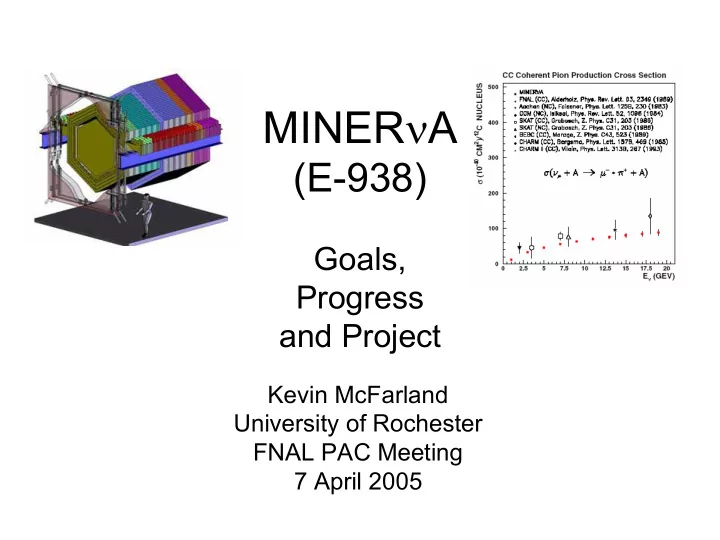
MINER A (E-938) Goals, Progress and Project Kevin McFarland - - PowerPoint PPT Presentation

miner a
SMART_READER_LITE
LIVE PREVIEW

MINER A (E-938) Goals, Progress and Project Kevin McFarland - - PowerPoint PPT Presentation

MINER A (E-938) Goals, Progress and Project Kevin McFarland University of Rochester FNAL PAC Meeting 7 April 2005 MINERvA in a Nutshell MINERvA is a dedicated neutrino cross-section experiment operating in the NuMI near hall in


slide-1
SLIDE 1

MINERνA

(E-938)

Goals, Progress and Project

Kevin McFarland University of Rochester FNAL PAC Meeting 7 April 2005

slide-2
SLIDE 2

7 April 2005

  • K. McFarland, Status of MINERvA

2

MINERvA in a Nutshell

  • MINERvA is a dedicated neutrino cross-section

experiment operating in the NuMI near hall – in a unique position to provide critical input for world neutrino oscillation program

  • “neutrino engineering” for NuMI program et al.

– provides an opportunity for studies of proton structure and nuclear effects in axial current

  • “Jefferson Lab west”

– MINERvA has Stage One approval, and is poised to complete R&D and start construction

slide-3
SLIDE 3

7 April 2005

  • K. McFarland, Status of MINERvA

3

The MINERvA Collaboration

  • D. Drakoulakos, P. Stamoulis, G. Tzanakos, M. Zois

University of Athens, Greece

  • D. Casper#, J. Dunmore, C. Regis, B. Ziemer

University of California, Irvine

  • E. Paschos

University of Dortmund

  • D. Boehnlein, D. A. Harris#, M. Kostin, J.G. Morfin*,
  • A. Pla-Dalmau, P. Rubinov, P. Shanahan,
  • P. Spentzouris

Fermi National Accelerator Laboratory M.E. Christy, W. Hinton, C.E. Keppel Hampton University

  • R. Burnstein, O. Kamaev, N. Solomey

Illinois Institute of Technology

  • S. Kulagin

Institute for Nuclear Research, Russia

  • I. Niculescu. G. Niculescu

James Madison University

  • G. Blazey, M.A.C. Cummings, V. Rykalin

Northern Illinois University W.K. Brooks, A. Bruell, R. Ent, D. Gaskell,

  • W. Melnitchouk, S. Wood

Jefferson Lab

  • S. Boyd, D. Naples, V. Paolone

University of Pittsburgh

  • A. Bodek, R. Bradford, H. Budd, J. Chvojka,
  • P. de Barbaro, S. Manly, K. McFarland*,
  • J. Park, W. Sakumoto, J. Steinman

University of Rochester

  • R. Gilman, C. Glasshausser, X. Jiang,
  • G. Kumbartzki, K. McCormick, R. Ransome#,
  • E. Schulte

Rutgers University

  • A. Chakravorty

Saint Xavier University

  • D. Cherdack, H. Gallagher, T. Kafka, W.A. Mann,
  • W. Oliver

Tufts University J.K. Nelson#, F.X. Yumiceva The College of William and Mary

* Co-Spokespersons # Members of the MINERvA Executive Committee

slide-4
SLIDE 4

7 April 2005

  • K. McFarland, Status of MINERvA

4

HEP/NP Partnership

  • This effort has sparked effort in NP community

beyond our collaborators…

  • JLab approved

experiment (JUPITER)

– data for neutrino cross-section modeling

  • Now it’s our

turn!!

from the JLab homepage today…

slide-5
SLIDE 5

uniqueness…

slide-6
SLIDE 6

7 April 2005

  • K. McFarland, Status of MINERvA

6

NuMI: Unique in the World

no near hall near detectors off-axis in E~700 MeV beam

CNGS J-PARCν NuMI

no near hall, limited energy range tunable, broadband beam energy from resonance to deep inelastic regime, spacious near hall, poised for a long run…

Booν

slide-7
SLIDE 7

relevance…

slide-8
SLIDE 8

7 April 2005

  • K. McFarland, Status of MINERvA

8

MINERvA and Oscillations

The recent APS Multidivisional Neutrino Study Report predicated its recommendations on a set of assumptions about current and future programs including:

support for current experiments, international cooperation, underground facilities, R&D on detectors and accelerators, and

“determination of the neutrino reaction and production cross sections required for a precise understanding of neutrino-oscillation physics and the neutrino astronomy of astrophysical and cosmological sources. Our broad and exacting program of neutrino physics is built upon precise knowledge of how neutrinos interact with matter.”

slide-9
SLIDE 9

7 April 2005

  • K. McFarland, Status of MINERvA

9

Why do we need to know more about neutrino cross-sections?

  • At 1-few GeV neutrino energy (of interest for osc. expt’s)

– Experimental errors on total cross-sections are large

  • almost no data on A-dependence

– Understanding of backgrounds needs

differential cross-sections on target

– Theoretically, this region is a mess…

transition from elastic to DIS

νn→µ–pπ0 νn→µnπ+

slide-10
SLIDE 10

7 April 2005

  • K. McFarland, Status of MINERvA

10

MINERvA and Cross-Sections

  • Measurements unique to MINERvA

– high Q2 axial form factor of nucleon

(complementary to high Q2 vector FF, hot at JLab)

– coherent cross-sections vs. energy

(exploit resolution, fully active containing detector)

– differential dists. for exclusive final states

(multi-purpose containing detector, high statistics)

– A-dependence of:

  • low Q2 elastic (K2K/MiniBooNE “low Q2 problem”?)
  • exclusive final states (nuclear re-interactions)
  • deep inelastic scattering (F2

ν, xF3 ν)

slide-11
SLIDE 11

7 April 2005

  • K. McFarland, Status of MINERvA

11

Sample Expected Results

Sergey Kulagin model

Axial Form Factor at high Q2: two models with MINERvA errors A-dependence of coherent pion production: two models with MINERvA errors F2, Pb/C, with MINERvA errors

slide-12
SLIDE 12

how does this apply to

  • scillations?
slide-13
SLIDE 13

7 April 2005

  • K. McFarland, Status of MINERvA

13

Oscillation Measurements and Neutrino Interaction Uncertainties

  • Current Generation’s Primary Goal:

– Precise ∆m2 measurement from νµ disappearance measurements vs. neutrino energy – Biggest systematic concern: how do you know you’re really measuring the energy correctly?

  • Next Generation’s Primary Goal:

– Search for νµ→νe transitions at one neutrino energy – Biggest systematic concern:

  • Predicting Background accurately
  • At first, claiming discovery based on an excess above background!
  • Later, precision measurements with neutrinos and anti-neutrinos
  • Next Generation’s “guaranteed” measurement

– More precise ∆m2 measurement, if you can understand the backgrounds in narrow band beam

MINOS NOvA, T2K

slide-14
SLIDE 14

7 April 2005

  • K. McFarland, Status of MINERvA

14

How MINOS will use MINERνA

µ

  • Visible Energy in Calorimeter

is NOT ν energy!

π absorption, rescattering final state rest mass π

Nuclear Effects Studied in Charged Lepton Scattering, from Deuterium to Lead, at High energies, but nuclear corrections may be different between e/µ and ν scattering

slide-15
SLIDE 15

7 April 2005

  • K. McFarland, Status of MINERvA

15

How NOνA will use MINERνA Measurements

Process QE RES COH DIS δσ/σ NOW (CC,NC) 20% 40% 100% 20% δσ/σ after MINERνA (CC/NC) 5%/na 5%/10% 5%/20% 5%/10%

Without MINERνA, NOνA risks being limited by cross section uncertainties

slide-16
SLIDE 16

7 April 2005

  • K. McFarland, Status of MINERvA

16

How will T2K use MINERvA measurements

Note that as in NOvA, T2K’s near detector will be a very different mix of events than the far detector. To make accurate prediction, need

  • 1 - 4 GeV neutrino cross sections
  • Energy Dependence of cross

sections MINERvA can provide these with NuMI beamline Low Energy running!

slide-17
SLIDE 17

7 April 2005

  • K. McFarland, Status of MINERvA

17

What about Near Detectors?

  • MINOS Near Detector:

– Can’t test nuclear effect models with only one nucleus!

  • NOvA and T2K Near Detectors:

– Can’t measure energy dependence with only one energy – If near design is same as far, can’t separate backgrounds any better near than far

MINERvA design solves all three of these problems

slide-18
SLIDE 18

the MINERvA detector

slide-19
SLIDE 19

7 April 2005

  • K. McFarland, Status of MINERvA

19

To Accomplish its Goals…

  • MINERvA proposes to build a low-risk detector with

simple, well-understood technology

  • Active core is segmented solid scintillator (K2K SciBar)

– tracking (including low momentum recoil protons) – particle identification – few ns timing (track direction, identify stopped K±)

  • Surrounded by electromagnetic and then hadronic

calorimeters

– photon (π0) and hadron (π±) energy measurement – magnetized for charge, momentum measurement of escaping muons at wide angles

slide-20
SLIDE 20

7 April 2005

  • K. McFarland, Status of MINERvA

20

Basic Detector Geometry

ν ν

Coil

  • Active segmented scint.

detector 5.87 tons

  • ~1 ton of US nuclear

target planes (C, Fe, Pb)

  • DS Cals, Nucl. Targets just add

absorber to scintillator planes

  • Magnetized OD (HCAL) frames
slide-21
SLIDE 21

7 April 2005

  • K. McFarland, Status of MINERvA

21

Extruded Scintillator and Optics

Basic element: 1.7x3.3cm triangular strips. Basic element: 1.7x3.3cm triangular strips. 1.2mm WLS fiber readout in center hole 1.2mm WLS fiber readout in center hole Assemble Assemble into planes into planes

DDK Connectors Scintillator and embedded WLS Clear fiber Cookie M-64 PMT

PMT Box

  • MINERνA optical system
slide-22
SLIDE 22

can one build it?

slide-23
SLIDE 23

7 April 2005

  • K. McFarland, Status of MINERvA

23

MINERvA R&D Progress

  • Completed a vertical slice test (VST1)

– Inner detector scintillator extrusions

  • FNAL, NIU

– WLS fibers to PMT Box (MINOS) and similar PMT

  • Rochester, Tufts, FNAL (MINOS)

– Prototype MINERvA Front-End electronics

  • FNAL, Irvine, Pittsburgh, Rochester
  • Mechanical Design “complete” at concept level
  • Rochester, FNAL, Tufts

– Prototyping cables, steel, PMT box: Tufts, Rutgers, Rochester

  • Hit-Level Simulation
  • Irvine, Pittsburgh

support for this work from FNAL-PPD, DOE HEP university funds, and funds from collaborating universities

slide-24
SLIDE 24

7 April 2005

  • K. McFarland, Status of MINERvA

24

Vertical Slice Test (VST1)

VST1 array, electronics and DAQ

MIP from VST1

8 PE/MIP per doublet

slide-25
SLIDE 25

7 April 2005

  • K. McFarland, Status of MINERvA

25

Current Prototyping

  • Refining scint. extrusion
  • First “trapezoid” of OD steel
  • Prototype PMT box
  • Prototype clear fiber cables in progress
  • 2nd Prototype front-end and

prototype readout electronics

slide-26
SLIDE 26

the MINERvA project

slide-27
SLIDE 27

7 April 2005

  • K. McFarland, Status of MINERvA

27

Status of MINERvA Project

  • We have developed a detailed costing and

schedule model

– basis for our design report and DOE/NSF proposals – costs down to Level-3 at worst, usually Level-4 or -5

  • First FNAL director’s (“Temple”) review 1/05

– generally positive report… they were impressed with

  • ur level of detail in design, cost, safety, etc.

– recommended: formal project management plan, cost

  • vs. physics optimization studies, development of more

detailed resource-loaded cost and schedule model

slide-28
SLIDE 28

7 April 2005

  • K. McFarland, Status of MINERvA

28

MINERvA Costs

as presented to Temple review, Jan ‘05

  • These costs include contingency (~40%), all University G&A

– there is significant missing FNAL G&A. ~$0.5M in model where costs all flow through FNAL

  • Assumes specific task distributions by institution and funds FY05-07
slide-29
SLIDE 29

7 April 2005

  • K. McFarland, Status of MINERvA

29

MINERvA Schedule

  • Have identified critical paths, spending profile
  • Time to complete:

– roughly 24 months from start of “R&D” phase – roughly 18 months from start of “construction funding”

extrusion-plane-module construction path

slide-30
SLIDE 30

7 April 2005

  • K. McFarland, Status of MINERvA

30

Project Management

  • Experiment has proposed and Fermilab

directorate approved

– Project Manager: Deborah Harris – Two co-Deputy Project Managers

  • KSM overseeing University efforts
  • Jorge Morfin overseeing Fermilab efforts
  • Project Management Plan has been drafted by

the executive committee

  • Plan has had first reading by Ed Temple and

Dean Hoffer, iterating with Project Manager and co-Deputy Project Managers

  • WBS has been refined since Temple Review:
slide-31
SLIDE 31

revisiting cost vs. physics

  • ptimization
slide-32
SLIDE 32

7 April 2005

  • K. McFarland, Status of MINERvA

32

Importance of Longitudinal Granularity

Proton Detection Efficiency

  • Proton candidates from quasi-

elastic and 1-pi production defined as hits in 3x, 1u and 1 v planes. Triangular extrusions, with light sharing, already considerably more efficient than rectangular extrusions

Transverse granularity (cm.) Longitudinal Granularity (cm)

Beam

  • Proton detection efficiency shows

minimal dependence to transverse granularity but significant dependence to longitudinal granularity

  • B. Ziemer - UC/Irvine
slide-33
SLIDE 33

7 April 2005

  • K. McFarland, Status of MINERvA

33

The Importance of Barrel Calorimetry

Transverse Energy Containment

  • D. Naples
  • U. Pittsburgh
  • Varying the nominal MINERνA outer detector thickness from 30 cm

thinner to 10 cm thicker results in a factor of five change in the percentage of DIS events with greater than 5% of the hadronic energy leaking out of the outer detector. For the nominal MINERνA design,

  • nly 5% of DIS events lose more than 5% of their hadronic energy.
slide-34
SLIDE 34

conclusions

slide-35
SLIDE 35

7 April 2005

  • K. McFarland, Status of MINERvA

35

MINERvA…

  • Opportunity for unique and critical FNAL role in

world neutrino efforts in a modest-scale project

– construction funds in FY07 means running in FY09 – only possible because of investment in NuMI

  • On track technically to build and use detector

– R&D and prototyping progressing

  • We are doing what projects do…

… including waiting for funding

slide-36
SLIDE 36

backup slides

slide-37
SLIDE 37

7 April 2005

  • K. McFarland, Status of MINERvA

37

Example Events

  • Quasi-elastic νµn→µ–p

– proton and muon tracks are clearly resolved – observed energy deposit is shown as size of hit; can clearly see larger proton dE/dx – precise determination of vertex and measurement of Q2 from tracking

ν p µ

nuclear targets active detector ECAL HCAL

slide-38
SLIDE 38

7 April 2005

  • K. McFarland, Status of MINERvA

38

Example Events (cont’d)

  • π0 Production

– two photons clearly resolved (tracked). can find vertex. – some photons shower in ID, some in side ECAL (Pb absorber) region – photon energy resolution is ~6%/sqrt(E) (average)

ν γ γ

nuclear targets active detector ECAL HCAL

slide-39
SLIDE 39

7 April 2005

  • K. McFarland, Status of MINERvA

39

Old NOvA vs New (TASD) NOvA

What about the change from old NOvA design to new design? Old: FD background was ½ beam νe, ½ other New: FD background is 2/3 beam νe, 1/3 other New: Signal has more resonance contributions, more poorly known process Extrapolating near to far will be easier, but probably by ~30%... Statistical error is about the same (same FOM)

slide-40
SLIDE 40

2 April 2004 40

MINERνA statistics and running

Assume 9x10²⁰ POT: 7.0x10²⁰ in LE ν beam, 1.2x10²⁰ in sME ν beam and 0.8x10²⁰ in sHE ν beam

Typical Fiducial Volume = 3-5 tons CH, 0.6 ton C, ≈ 1 ton Fe and ≈ 1 ton Pb

3 - 4.5 M events in CH 0.5 M events in C 1 M events in Fe 1 M events in Pb

νµ Event Rates per fiducial ton Process CC NC Quasi-elastic 103 K 42 K Resonance 196 K 70 K Transition 210 K 65 K DIS 420 K 125 K Coherent 8.4 K 4.2 K TOTAL 940 K 305 K

Main Physics Topics with Expected Produced Statistics

  • Quasi-elastic - ν+n --> µ−+p - 300 K events off 3 tons CH
  • Resonance Production - e.g. ν+N ---> ν /µ−+∆ 600 K total, 450K 1π
  • Coherent Pion Production - ν+A --> ν /µ−+Α + π, 25 K CC / 12.5 K NC
  • Nuclear Effects - C: 0.6M events, Fe: 1M and Pb: 1 M
  • σT and Structure Functions - 2.8 M total /1.2 M DIS events
  • Strange and Charm Particle Production - (> 60 K fully reconstructed)
slide-41
SLIDE 41

7 April 2005

  • K. McFarland, Status of MINERvA

41

MINERvA Costs (Alternate Roll-up)

as presented to Temple review, Jan ‘05

  • These costs include contingency (~40%), all University G&A

– there is significant missing FNAL G&A. ~$0.5M in model where costs all flow through FNAL

  • Assumes specific task distributions by institution and funds FY05-07
slide-42
SLIDE 42

7 April 2005

  • K. McFarland, Status of MINERvA

42

Vital Statistics of MINERvA

Number of Channels 30992 Channels in ID+CALS 25088 Channels in OD 5904 Volume of Scintillator (m3) 22.5 WLS Fiber (km) 90.7 Clear Fiber (km) 41.6 Number of M-64 PMTs 503 Mass of ID (metric tons) 10.8 Mass of OD in ID region (metric tons) 98.0 Mass of CALS, Nuclear Targets (metric tons) 27.2 Mass of OD in CAL region (metric tons) 62.9 Total MINERvA Mass (metric tons) 199 Plastic Region Mass (metric tons) 5.87 Data Rate (bits/spill) 7.9E+6

slide-43
SLIDE 43

7 April 2005

  • K. McFarland, Status of MINERvA

43

A Brief History of MINERvA

  • December 2002 - Two EOIs for neutrino scattering experiments using the NuMI

beam and similar detector concepts presented to the PAC. PAC suggests uniting efforts and preparing proposal.

  • December 2003 - MINERνA proposal presented to PAC. PAC requests more

quantitative physics studies and details of MINERνA’s impact on Fermilab.

  • January 2004 -Submit proposal for MRI funding support (maximum $2M) of partial

detector to NSF. Rejected due to no guarantee for funding rest of detector.

  • March 2004 - MINERνA Impact Statement submitted to Directorate and presented

to an Impact Review Committee.

  • April 2004 - Proposal addendum containing additional physics studies and report

from the Impact Review Committee presented to PAC. Receive Stage I approval.

  • Summer 2004 - R&D Program concentrating on front-end electronics, scintillator

extrusions and a “vertical slice test”

  • October 2004 - Proposal to NP and EPP of NSF to fund bulk of MINERνA.
  • December 2004 - Proposal to NP and HEP of DOE to fund bulk of MINERνA.
  • January 2005 - First Director’s Review of MINERνA
  • February 2005 – With release of FY06 budget, DOE of budget process crystallizes;

decision that MINERvA must be primarily funded by FNAL budget.

slide-44
SLIDE 44

7 April 2005

  • K. McFarland, Status of MINERvA

44

Fiber Testing and Qualification (pre-VST1)

  • Fiber testing and qualification (Rochester)

– attenuation and light yield of WLS fiber for different dopant concentrations – fiber flexibility and light loss tests