Mindfulness in Education Seattle, WA Oakland, CA San Lorenzo, CA - - PowerPoint PPT Presentation

mindfulness in education
SMART_READER_LITE
LIVE PREVIEW

Mindfulness in Education Seattle, WA Oakland, CA San Lorenzo, CA - - PowerPoint PPT Presentation

Mindfulness in Education Seattle, WA Oakland, CA San Lorenzo, CA Port Chester, NY mindfulschools.org What is Mindfulness? Mindfulness means maintaining a present-moment awareness of our thoughts, feelings, bodily sensations, or surrounding


slide-1
SLIDE 1

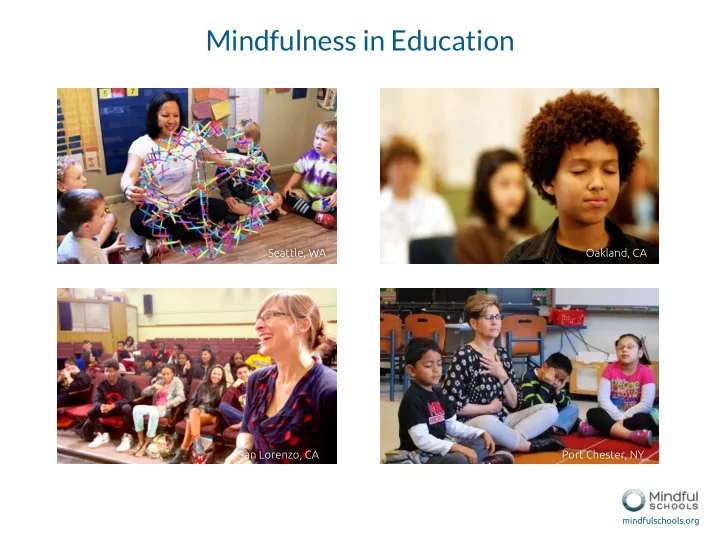
Mindfulness in Education

Oakland, CA Seattle, WA Port Chester, NY San Lorenzo, CA

mindfulschools.org
slide-2
SLIDE 2

What is Mindfulness?

Mindfulness means maintaining a present-moment awareness of

  • ur thoughts, feelings, bodily sensations, or surrounding

environment. It also includes the intentional nurturing of positive states of mind such as kindness and compassion.

mindfulschools.org

Mindful Eating, 4th Grade

slide-3
SLIDE 3

Why Mindfulness is Needed in Education

mindfulschools.org

The Impact of Toxic Stress on School Communities Healthy stress is a natural part of life, including childhood. Children and adults alike need to be challenged in order to grow and develop. However, in the modern education system, healthy stress is frequently displaced by toxic stress. Toxic stress occurs when life’s demands consistently

  • utpace our ability to cope with those demands.

STUDENTS Toxic stress impairs attention, emotion and mood regulation, sleep, and learning readiness daily in American classrooms. Even more troubling, prolonged exposure to childhood toxic stress has lifelong impacts on mental and physical health. EDUCATORS Toxic stress starts as decreased productivity and creativity, escalating to more serious symptoms like frequent anxiety, dissociation, frustration, and, eventually, burnout. Roughly half a million U.S. teachers leave the profession each year – a turnover rate of

  • ver 20 percent.

PARENTS Toxic stress can lead to a parenting style that looks more like a “to-do” list, rather than an empathic, present-centered relationship with a developing child. Exposure to parental stress in early childhood has been shown to impact gene expression even years later in adolescence.

slide-4
SLIDE 4

Research on Mindfulness

Benefits of Mindfulness Solid scientific evidence suggests that mindfulness interventions improve attention, self-control, emotional resilience, memory, and immune response. Here’s a summary of benefits particularly relevant to educators:

mindfulschools.org Source: Reference mindfulschools.org/research

slide-5
SLIDE 5

Impact in Classrooms

Educator Survey Results Thousands of educators that have completed Mindful Schools mindfulness courses report a range

  • f benefits for their students and themselves. Mindful Schools is a non-profit organization that

trains educators to integrate mindfulness into their work with youth.

mindfulschools.org Source: Reference mindfulschools.org/research

Benefits for Educators What Educators See in Their Students

slide-6
SLIDE 6

Mindfulness Integration

Mindfulness programs are being introduced and integrated with a wide range of student support programs to create safe and caring learning environments.

mindfulschools.org

Mindfulness + Yoga + Anti-Bullying

Daniel Webster Elementary, San Francisco, CA

Mindfulness + Restorative Justice

F.H. Collins Secondary School, Yukon, Canada

Mindfulness + Social Emotional Learning

The Cove School, Pre-K to Elementary, Seattle, WA

Mindfulness + Social Emotional Learning

Willard Alternative High School, Missoula, MT

slide-7
SLIDE 7

mindfulschools.org

“Mindful Teaching”

Teach Mindfully vs. Teaching Mindfulness Teaching mindfulness to young people is most effective when teachers have a personal mindfulness practice of their own. Mindfulness is a first-person experience, therefore teachers can model calm, present-awareness and positively impact their students and classrooms even before introducing any formal mindfulness curriculum. “Over the years, it has become so evident to me that no matter what mindfulness ‘tools’ I teach my students, what makes the biggest difference is my presence – for my classroom group and for individual students.”

  • Lisa, Kindergarten Teacher, NY

“Delivering an effective lesson and meeting my students’ needs are competing with each other for my attention. My own mindfulness practice is vital to being compassionate and understanding in the classroom. It helped me find the balance to make teaching the richest job I could ever have.”

  • Crystal, High School Teacher, NY
slide-8
SLIDE 8

mindfulschools.org

K-12 Mindfulness Curriculum

Research-Backed K-12 Mindfulness Curriculum Mindful Schools has developed a K-12 mindfulness curriculum that is adaptable for classrooms, after-school programs, clinical settings, and home. Lesson Modules: Over 50 age-appropriate lessons are provided in the curriculum, such as:

  • Mindful Bodies
  • Mindful Listening
  • Mindful Breathing
  • Body Awareness
  • Generosity

Implementation: Curriculum may be implemented and paced differently for varying

  • environments. For example, a teacher may implement 15 minute lessons 2x per week for 8 weeks,
  • r spread lessons across a full academic year. Some schools have implemented a school-wide

mindful breathing practice for 5 minutes to start each day. Much like a personal practice, mindfulness lessons and practice can be ongoing, repeated, and adapted with students to help them strengthen their skills to focus, emotionally regulate, and manage stress.

slide-9
SLIDE 9

About

mindfulschools.org

Mindful Schools trains educators to bring mindfulness into their work with youth. Since 2007, educators trained by Mindful Schools have impacted over 750,000 students globally. Mindful Schools offers guided online courses, as well as a Year-Long Certification program.

Step 1: Be the Change Mindfulness Fundamentals, an introductory 6-week course, provides the basics to develop a personal mindfulness practice. Step 2: Teach Youth Mindful Educator Essentials, a 6-week course, provides K-12 curriculum and practical skills to introduce mindfulness into your work with youth. Step 3: Become a Leader Year-Long Certification Program, our in-depth, 300-hour, year-long training begins and ends with a week-long retreat.

Group Rates: We believe that both teaching and practicing mindfulness is most successful when it is shared and supported by your community. In support of this, we offer group rates. Learn more at mindfulschools.org

slide-10
SLIDE 10

Fremont, CA

Mindfulness in Education

Potomac, MD Oakland, CA Brooklyn, NY

mindfulschools.org