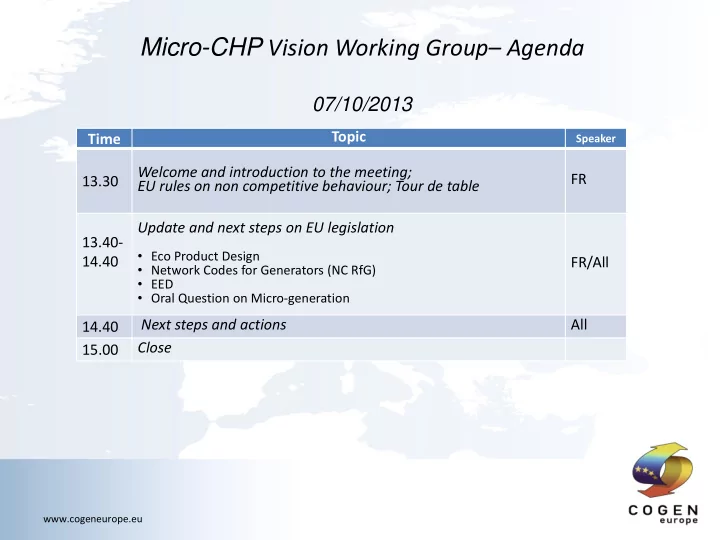
Micro-CHP Vision Working Group Agenda 07/10/2013 Topic Time Speaker - - PowerPoint PPT Presentation

micro chp vision working group agenda
SMART_READER_LITE
LIVE PREVIEW

Micro-CHP Vision Working Group Agenda 07/10/2013 Topic Time Speaker - - PowerPoint PPT Presentation

Micro-CHP Vision Working Group Agenda 07/10/2013 Topic Time Speaker Welcome and introduction to the meeting; FR 13.30 EU rules on non competitive behaviour; Tour de table Update and next steps on EU legislation 13.40- Eco Product


slide-1
SLIDE 1

www.cogeneurope.eu

Time Topic

Speaker

13.30 Welcome and introduction to the meeting; EU rules on non competitive behaviour; Tour de table FR 13.40- 14.40 Update and next steps on EU legislation

  • Eco Product Design
  • Network Codes for Generators (NC RfG)
  • EED
  • Oral Question on Micro-generation

FR/All 14.40 Next steps and actions All 15.00 Close

Micro-CHP Vision Working Group– Agenda

07/10/2013

slide-2
SLIDE 2

www.cogeneurope.eu

Eco Product Design LOT1

  • Implementing Regulations now published in the Official Journal
  • f the EU
  • The methodology for micro-CHP remains unchanged and problematic in

terms of impact (see back-up slides)

  • Highest label to be achieved by micro-CHP, including fuel cells, is A+, with heat

pumps getting an A++

  • Creates inconsistencies even within the micro-CHP class, as some fuel cell

technologies will achieve lower efficiencies than ICE

  • Commission Communication still to be adopted this year
  • To include mathematical formula interpreting the legal text in the Regulations
  • To include transitional calculations methods until adequate harmonised standards

are published

slide-3
SLIDE 3

www.cogeneurope.eu

Eco Product Design LOT1

  • prEN 50465 developed by CEN Cenelec
  • Responds to EC’s request for a standard on micro-CHP to meet lot1

Regulation needs

  • Proposes an adequate methodology to calculate the seasonal heat efficiency of micro-

CHPs

  • Has been internally agreed (adoption is expected soon) & needs EC’s approval to be

harmonised and published in Official Journal of the EU

  • Still some possibilities to intervene:
  • Convince the Commission to approve/harmonise prEN 50465
  • Raise awareness among MEPs/FCH JU/higher EC ranks
  • Ultimately, there’s also the possibility of an early review of the Implementing

Regulations

slide-4
SLIDE 4

www.cogeneurope.eu

European Commission

  • Nov/Dec: Commission Communication on lot1

CEN-Cenelec

  • 20th Nov: CEN CENELEC working group meeting on prEN 50465

Next steps in process and estimated timescale

Eco Product Design LOT1

slide-5
SLIDE 5

www.cogeneurope.eu

  • COGEN Europe to follow up with DG ENER/FCH JU/MEPs the need to

pursue the standards approach.

  • Alert member state representatives to the standard prEN 50465 and

industry strong preference for its use in Ecoproduct design.

VWG Actions

slide-6
SLIDE 6

www.cogeneurope.eu

  • NC RfG pre-comitology stage
  • Positive developments:
  • Micro-CHP class is covered by the “emerging technology” classification

 transitional arrangements for emerging technologies with a limited number non-compliant Type A units allowed to be installed as long as the penetration in any synchronous area does not exceed a level still to be determined. TSO will determine the level.

  • Support for proposal to allow manufacturers of small units to apply for

derogation

  • Still pending:
  • “emerging technology” classification threshold shall be defined in the

NC RfG

  • Getting the “randomised disconnection” approach recognised in NC

RfG to allow for active power reduction of a group of micro-CHPs

Network Codes Requirements for Generators (NC RfG)

slide-7
SLIDE 7

www.cogeneurope.eu

European Commission pre-comitology preparations:

  • Oct. – DNV Kema to submit its final assessment to European Commission
  • Dec. – Commission expected deliver a new draft to Regulatory Committee

Comitology – Q1 of 2014

Next steps in process and estimated timescale

slide-8
SLIDE 8

www.cogeneurope.eu

  • Oct/Nov:
  • Keep pressure on DNV Kema, European Commission, ACER and ENTSO-E regarding

remaining concerns

  • Update on progress and ask for support from MEPs
  • Notify national energy agencies/government contacts (NL, UK, DE) and ask for

support (VWG involvement may be needed)

  • Start building a list of additional national contacts
  • Nov/Dec:
  • Evaluate NC RfG comitology text
  • Draft briefing for national governments on issues still pending

VWG Actions

slide-9
SLIDE 9

www.cogeneurope.eu

Energy Efficiency Directive Implementation How can the micro-CHP sector benefit?

Nov, 2012 Dec, 2015 5 June, 2014 Dec, 2020 2020 Apr, 2017 Apr, 2014 May, 2013

slide-10
SLIDE 10

www.cogeneurope.eu

Energy Efficiency Directive Implementation How can the micro-CHP sector benefit?

Nov, 2012 31 Dec, 2015 5 June, 2014 Dec, 2020 2020 Apr, 2017 Apr, 2014 May, 2013

Art.7:

  • MS are required to introduce an “energy efficiency obligation scheme”

requiring energy suppliers to save 1,5% of the annual energy sales to final consumers (from 2014-2020)

  • Up to 25% of the obligation can be achieved through energy savings from

energy transformation following implementation of Art. 14 & 15  micro-CHP could be eligible

slide-11
SLIDE 11

www.cogeneurope.eu

Energy Efficiency Directive Implementation How can the micro-CHP sector benefit?

Nov, 2012 31 Dec, 2015 5 June, 2014 Dec, 2020 2020 Apr, 2017 Apr, 2014 May, 2013

Art.14:

  • MS to carry out a Comprehensive Assessment of the potential to

introduce HE CHP and DHC by end of 2015 and every 5 years  to include micro-CHP potential as well

  • MS shall support HE CHP if results of the assessment are positive
slide-12
SLIDE 12

www.cogeneurope.eu

Energy Efficiency Directive Implementation How can the micro-CHP sector benefit?

Nov, 2012 Dec, 2015 5 June, 2014 Dec, 2020 2020 Apr, 2017 Apr, 2014 May, 2013

Art.15:

  • Priority of access, dispatch, transmission and distribution of el. from HE

CHP, including micro-CHP

  • MS may facilitate the grid connection of micro-cogeneration units
  • MS shall take steps to encourage a simple notification “install and

inform” process for the installation of micro-cogeneration units

slide-13
SLIDE 13

www.cogeneurope.eu

  • Insist that micro-CHP is not forgotten from in the Comprehensive

Assessment in Art 14 (COGEN Europe/National Associations)

  • Suggest to national regulators/governments to include micro-CHP in the

toolbox of possible measures to meet energy efficiency obligation scheme, e.g. through buildings codes/standards (deadline to notify Commission is 5th of June 2014) (COGEN Europe/National Associations)

  • Convince national regulators/governments to ambitiously implement EED
  • Art. 15 and simplify connection procedures for micro-CHP (COGEN

Europe/National Associations)

VWG Actions

slide-14
SLIDE 14

www.cogeneurope.eu

  • Resolution adopted on 12th September by European Parliament

…mentions micro-CHP as an important technology to save energy in buildings, contributing together with renewables to zero- or positive- energy buildings; …acknowledges micro-CHP as part of the eco-design/energy-labelling framework; …calls on Member States to take a more proactive approach in implementing the Energy Efficiency Directive 2012/27/EU and in particular to remove barriers to the deployment of microgeneration; …stresses need for flexibility in the network codes, to accommodate the specific characteristics of small-scale technologies; …emphasises the future role of aggregators and DSOs to fairly reward microgeneration technologies in supporting the grid and contributing to a balanced electricity market.

European Parliament Oral question & Resolution: “Micro-generation- Small scale electricity and heat generation”

slide-15
SLIDE 15

www.cogeneurope.eu

Other positive outcomes:

  • COGEN Europe met with several MEPs on the occasion of the vote
  • Some press coverage in ENDS Europe, Euractiv & other online news outlets

European Parliament Oral question & Resolution: “Micro-generation- Small scale electricity and heat generation”

slide-16
SLIDE 16

www.cogeneurope.eu

Planning for 2013-2014

  • Ensure Art 7, 14 & 15 are implemented ambitiously to

assess potential and promote micro-CHPs

Energy Efficiency Directive

  • Get the methodology in standard prEN 50465 recognised as

the methodology t to employ for compliance/verification under Ecodesign

Ecodesign

  • Address pending issues in the NC RfG
  • Continue working on the NCs on Demand Connection

&Electricity Balancing

Network Codes

  • Monitor developments in the relevant working group

(Energy efficiency/Buildings)

  • Actively participate in the WG on Energy system

SET Plan Integrated Roadmap

  • Monitor implementation/possible review?
  • Raise awareness on micro-CHP as a viable measure

EPBD

  • (Re-)introduce the micro-CHP sector to incoming

Commission & EP

New Commission & European Parliament

2013-2014 2013-2014 Q4/2013 2014 Q2-Q3/2014 Q4 2013- Q1/2014

slide-17
SLIDE 17

www.cogeneurope.eu

Thank you for your attention!

slide-18
SLIDE 18

www.cogeneurope.eu

Back-up slides Eco-design

slide-19
SLIDE 19

www.cogeneurope.eu

Current EC approach for calculating ηs of cogeneration space heaters

Legal basis:

electrical thermal total in prim y electricit for in prim

  • ut

heat s

Q Q Q η η η ⋅ + = + = 5 , 2

(Source: Draft ommission Communication accompanying ecodesign lot1 Implementing Regulation) (Source: Annex III of the Regulation on Lot 1 ecodesign requirements & Annex VII of the Implementing Regulation on Lot 1 energy labelling)

Legal text interpretation in draft Commission Communication:

slide-20
SLIDE 20

www.cogeneurope.eu

  • Proposed formula in prEN 50465 (originally used before March 2011 in the

working documents of Lot 1) VS.

  • Current EC interpretation of lot1 implementing Regulation (in Commission

Communication, February 2013):

electrical thermal y electricit for in prim total in prim

  • ut

heat y electricit for in prim total in prim

  • ut

y electricit

  • ut

total s

Q Q Q Q Q Q Q η η η ⋅ − = − = − − = 5 , 2 1

electrical thermal total in prim y electricit for in prim

  • ut

heat s

Q Q Q η η η ⋅ + = + = 5 , 2

CEN/CENELEC Recommendation for ηs of cogeneration space heaters

slide-21
SLIDE 21

www.cogeneurope.eu

  • C. Differentiation of the energy labelling within

the “cogeneration family”

Commission communication method:  Lower label values to higher efficient packages!  All µCHP heaters with an A+: no differentiation between higher and lower efficient appliances, both today and in the future  Innovation: no incentive to redesign / develop more efficient µCHP

slide-22
SLIDE 22

www.cogeneurope.eu

Back-up slide on Micro- generation Resolution

slide-23
SLIDE 23

www.cogeneurope.eu

  • E. whereas small-scale and decentralised energy generation represents an opportunity for households and small and medium-sized enterprises,

as well as for communities in both urban and rural areas, to work together to combat climate change by becoming energy producers; whereas consumers should acquire awareness of efficient ways to produce and consume energy; whereas empowering consumers to generate their own electricity and heat can lead to a more sustainable and participative society; whereas the Commission communication on the internal energy market addresses the issue of empowering such ‘prosumers’; whereas there are already many opportunities for consumers to engage actively in efficient energy production and consumption, but there are still challenges to be addressed;

  • 7. Stresses that microgeneration technologies such as micro-CHP and small-scale renewables make it possible to have zero-energy and

positive-energy buildings which feed into the grid surplus electricity generated on the premises;

  • 12. Observes that it is frequently viable to feed the combined heat and power which have been produced to plants, even in the context of

microgeneration, because this often substantially improves energy efficiency;

  • 15. Calls on the Commission to draw up recommendations, based on best practices for regulators and system operators, on how to shorten and

simplify the administrative procedures involved in operating and connecting microgeneration units to the grid, with a particular focus on setting up

  • ne-stop-shop procedures; stresses the need to promote the ambitious implementation of existing guidelines such as the provisions on micro-

cogeneration units in the Energy Efficiency Directive;

  • 31. States that any initiatives in the field of microgeneration should be in line with network codes; notes that the objectives of secondary

electricity legislation, such as the network codes, can be better and more cost-effectively achieved by establishing standards at EU level for most types of microgeneration technology; calls for an active form of distribution system management based on close cooperation between DSOs and transmission system operators (TSOs) and other elements (generation, consumption and storage units) in the grid authorities in order to incentivise innovation and investment in local distribution grids;

  • 39. Calls on the Commission, together with the Member States, to look carefully at the existing cost structures in the energy network and to

provide guidance on means of facilitating permission and grid access for, and operation of, microgeneration units; http://www.europarl.europa.eu/sides/getDoc.do?type=MOTION&reference=B7-2013-388&language=EN

Some positive excerpts from the Micro-generation Resolution