EXCHANGE of FREIGHT WAGONS in EUROPE regarding AVV/CUU/GCU (former - - PowerPoint PPT Presentation

exchange of freight wagons
SMART_READER_LITE
LIVE PREVIEW

EXCHANGE of FREIGHT WAGONS in EUROPE regarding AVV/CUU/GCU (former - - PowerPoint PPT Presentation

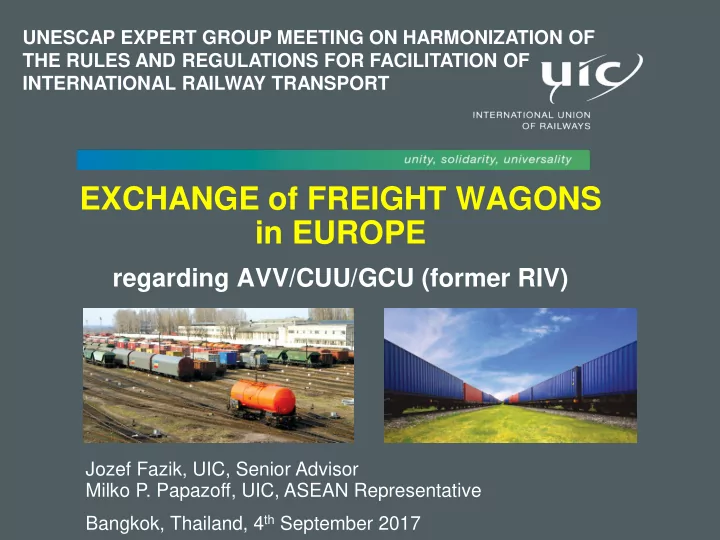
UNESCAP EXPERT GROUP MEETING ON HARMONIZATION OF THE RULES AND REGULATIONS FOR FACILITATION OF INTERNATIONAL RAILWAY TRANSPORT EXCHANGE of FREIGHT WAGONS in EUROPE regarding AVV/CUU/GCU (former RIV) Jozef Fazik, UIC, Senior Advisor Milko P.


slide-1
SLIDE 1

EXCHANGE of FREIGHT WAGONS in EUROPE

regarding AVV/CUU/GCU (former RIV)

UNESCAP EXPERT GROUP MEETING ON HARMONIZATION OF THE RULES AND REGULATIONS FOR FACILITATION OF INTERNATIONAL RAILWAY TRANSPORT Jozef Fazik, UIC, Senior Advisor Milko P. Papazoff, UIC, ASEAN Representative Bangkok, Thailand, 4th September 2017

slide-2
SLIDE 2

2

Historical evolution COTIF // RIV > GCU

OCTI - Office central des transports internationaux ferroviaires 1893 Transformation

  • f RIV 2000

>>>. COTIF – 1999: comes into force, 1st July, 2006

2006

COTIF - Convention relative aux transports internationaux ferroviaires –

Convention concerning International Carriage by RAIL

COTIF & OCTI >>> OTIF

Organisation intergouvernementale pour les Transports Internationaux Ferroviaires – Intergovernmental Organisation for International Carriage by Rail

RIV - Regolamento Internazionale dei Veicoli

1980

UIC - Union Internationale des Chemins de Fer 1922 1922

1985 2006

OTIF : Vilnius Protocol >>> new COTIF

1999

>>> CUU / AVV / GCU.

Harmonization of Rules and Regulations for Facilitation of International Railway Transport – Bangkok, 4 September 2017
General Contract of Use for Wagons

slide-3
SLIDE 3

3 3

➢ COTIF are official documents that have legal force. ➢ These texts are the subject of consensus between the Member States and are the result of work that has been carried out since the Organization was set up to promote and improve international railway transport. ➢ The international Convention, regulations, provisions, circulars, agreements, derogations, declarations, entries and explanations are documents that are available to both the public and professionals.

These texts form the core of OTIF:

Harmonization of Rules and Regulations for Facilitation of International Railway Transport – Bangkok, 4 September 2017

slide-4
SLIDE 4

4

Convention concerning International Carriage by Rail

Appendix A

CIV

Uniform Rules concerning the Contract for International Carriage of Passengers by Rail

Appendix C

RID

Regulations concerning the International Carriage of Dangerous Goods by Rail

Appendix D

CUV

Uniform Rules concerning the Contracts of Use of Vehicles in International Rail Traffic

Appendix E

CUI

Uniform Rules concerning the Contract of Use of Infrastructure In International Rail Traffic

Appendix F

APTU

Uniform Rules concerning the Validation of Technical Standards and the Adoption of Uniform Technical Prescriptions applicable to RM intended to be used in International Traffic Appendix G

ATMF

Uniform Rules concerning the Technical Admission

  • f Railway

Material used in International Traffic

Appendix B

CIM

Uniform Rules concerning the Contract for International Carriage of Freight by Rail

4

COTIF enables legal interoperability to be extended and technical interoperability to be improved and contributes to the development of multimodal transport.

COTIF 1999

Harmonization of Rules and Regulations for Facilitation of International Railway Transport – Bangkok, 4 September 2017

slide-5
SLIDE 5

5 5

COTIF 1999

Harmonization of Rules and Regulations for Facilitation of International Railway Transport – Bangkok, 4 September 2017

slide-6
SLIDE 6

6

Significant alterations between COTIF 1980 >>> 1999 ❖Abolition of line registration ❖Abolition of obligation to carry ❖New transport models ❖New requirements for travel documents and consignment notes ❖More stringent rules concerning liability ❖Approval and registration of the railways vehicles

Harmonization of Rules and Regulations for Facilitation of International Railway Transport – Bangkok, 4 September 2017

slide-7
SLIDE 7

7

Significant principles in UR CUV of COTIF 1999 ▪ Signs and inscriptions on the vehicles (article 3) ▪ Liability in case of loss of or damage to a vehicle (article 4) ▪ Loss of right to invoke the limits of liability

(article 5)

▪ Presumption of loss of a vehicle (article 6) ▪ Liability for loss or damage caused by a vehicle (article7) ▪ Subrogation (article 8) ▪ Liability for servants and other persons (article 9)

Harmonization of Rules and Regulations for Facilitation of International Railway Transport – Bangkok, 4 September 2017

slide-8
SLIDE 8

8 8

Any rolling stock / freight wagon has to fulfill some requirements:

COTIF (Appendixes) / UE Directives TSI and European Standards (EN, …) Specifications for Rolling Stock such as TecRecs or UIC leaflets Operator specific requirements Market specific requirements

>>>Wagon keeper // RU

Harmonization of Rules and Regulations for Facilitation of International Railway Transport – Bangkok, 4 September 2017

slide-9
SLIDE 9

9

► Liberalization of freight transport in the EU,

introducing the disappearance of state border territorial aspects

► The (new) COTIF 1999

  • The disappearance of the obligation to transport,
  • No distinction between WR and WP, etc.

The principal need to change the RIV was required by : ► The transformation of state railways into independent companies (inclusive separation between IM and RU) ► The European Union competition rules on the market

>>> non-discriminatory treatment of all wagons

Harmonization of Rules and Regulations for Facilitation of International Railway Transport – Bangkok, 4 September 2017

slide-10
SLIDE 10

10

T e r m i n a l Information Systems

IM

RU

X

RU

Y

RU

Z

First mile

IM IM

Last mile

Contractor of the train composed of wagons

RU, intermodal operator, transport company, industry etc.

A

Delivery

  • f good

Wagon keeper

Leading RU B

>>> END

Logistics companies / Shippers

START >>>

OPERATIONAL PROCEDURES

T e r m i n a l

loading unloading

Harmonization of Rules and Regulations for Facilitation of International Railway Transport – Bangkok, 4 September 2017

slide-11
SLIDE 11

11

Financial Asset Mean of transport Safety issue

Harmonization of Rules and Regulations for Facilitation of International Railway Transport – Bangkok, 4 September 2017

A freight wagon is at the same time a :

slide-12
SLIDE 12

12

http://www.shop-etf.com/en/technical- documents/loading-guidelines.html

Harmonization of Rules and Regulations for Facilitation of International Railway Transport – Bangkok, 4 September 2017

slide-13
SLIDE 13

13

UR ATMF UR APTU UR CUV Wagon approval Technical status

UE :TSI COTIF

AVV CUU GCU

RIV

Owner / Keeper Railway Undertaking

Harmonization of Rules and Regulations for Facilitation of International Railway Transport – Bangkok, 4 September 2017

slide-14
SLIDE 14

14

UIC, UIP and ERFA work together to develop the General Contract of Use for freight wagons - GCU

 The Sector‘s main Assocations are playing a key role in this process : they are the guardians of the GCU.  The market players have demonstrated that they can organize themselves in an open market, in areas where cooperation is advantageous.  The GCU has entered into force on July 1st, 2006. The European Commission attaches great value to the GCU as a vector for the flexible and concrete implementation of EU legislation / COTIF

Harmonization of Rules and Regulations for Facilitation of International Railway Transport – Bangkok, 4 September 2017

slide-15
SLIDE 15

GCU - Main contract

15

I - OBJECT, SCOPE OF APPLICATION, TERMINATION, FURTHER DEVELOPMENT OF THE CONTRACT, DISCONTINUANCE OF BEING A SIGNATORY (1-6) II - OBLIGATIONS AND RIGHTS OF THE WAGON KEEPER (7-9) III - OBLIGATIONS AND RIGHTS OF THE RUs (10-17) IV - ASCERTAINMENT AND HANDLING OF DAMAGE TO WAGONS IN THE CUSTODY OF A RU (18-21) V - LIABILITY IN THE EVENT OF LOSS OF OR DAMAGE TO A WAGON (22-26) VI - LIABILITY IN THE EVENT OF DAMAGE CAUSED BY A WAGON (27) VII - LIABILITY FOR STAFF AND OTHER PERSONS (28) VIII - OTHER PROVISIONS (29-35)

Harmonization of Rules and Regulations for Facilitation of International Railway Transport – Bangkok, 4 September 2017

slide-16
SLIDE 16

16

1: List of Signatory keepers and RU's 2: Definitions 3: Wagon note 5: Method for calculating the residual value of a wagon 6: Compensation for loss of use 7: Spare parts 8: Internal Regulation for the Application and Further Development of the GCU 9: Conditions for the technical transfer in inspection of wagons 10: Corrective and Preventive Maintenance 11: Inscriptions and signs on wagons (published separately) 12: Catalogue of damage to wagons 13: List of repairs which may be carried out by the RU on the place of immobilization of the wagon or in the nearby vicinity 14: Additional conditions for the use of wagons on ferries and in exchange with railways operating on standard or broad gauge lines

A p p e n d i c e s

4: Wagon damage report

Harmonization of Rules and Regulations for Facilitation of International Railway Transport – Bangkok, 4 September 2017

http://www.gcubureau.org/web/portal/welcome

slide-17
SLIDE 17

17 17

GCU Bureau

Členská základňa

Joint Committee

UIC / UIP / ERFA

Signatory Association

Proposal Recommendation Draft and recommendation Proposal Vote Signatories UIC Dept. Freight (for UIC members) Centre of expertise for railway wagons Proposal

Harmonization of Rules and Regulations for Facilitation of International Railway Transport – Bangkok, 4 September 2017

DECISION-MAKING PROCEDURE of GCU

slide-18
SLIDE 18

18

Main current challenges facing the GCU signatories

Adapting the GCU to the evolution of the EU legislation

➢ Introducing the notion of Wagon Keeper (WK) and of Entity in

Charge of Maintenance (ECM) in the GCU

(recent amendment to the GCU : for the purposes of the contract: WK = ECM)

➢ Directive 2008/110/EC, introducing the ECM - certification ➢ Amended Directive 2004/49/EC : contents related to safety certification ▪ proposal of the Sector for an intermediate solution facilitating the delivery of safety certificates to the RUs ▪ self declaration by the ECM ➢ New marking rules defined in annex P of TSI OPE

  • introduction of “GE” and “CW”

❖ different economic models are possible, the challenge is to keep them compatible

❖ autonomous management of the wagon, including reloading and

empty returns

Harmonization of Rules and Regulations for Facilitation of International Railway Transport – Bangkok, 4 September 2017

slide-19
SLIDE 19

19 Harmonization of Rules and Regulations for Facilitation of International Railway Transport – Bangkok, 4 September 2017

CUU / AVV / GCU. PGV

Technical Specifications for Interoperability (TSIs)

slide-20
SLIDE 20

20 Harmonization of Rules and Regulations for Facilitation of International Railway Transport – Bangkok, 4 September 2017

A few words about TSI (Technical Specifications for Interoperability)

Structure of a TSI

In application of the “new approach process”, the Interoperability Directive fixes essential requirements for : Safety, Reliability and availability, Health Environmental protection Technical compatibility Plus requirements specific to each subsystem The Directive does not ask directly for standards but intermediate mandatory rules : Technical Specifications for Interoperability ‐ TSI

slide-21
SLIDE 21

21 Harmonization of Rules and Regulations for Facilitation of International Railway Transport – Bangkok, 4 September 2017

DIRECTIVES

TSIs

EN Standards (CEN, CENELEC, ETSI

National Standards

TSI >> legal act: Commission decision or regulation >> mandatory >> linked to Essential requirements >> assessment by NoBo (structural TSIs) EN‐Standard / UIC‐Leaflet >> CEN/ CENELEC or UIC >> voluntary (generally) >> can meet Essential requirements or support internal / commercial procedures / issues >> assessment by addressee

Major differences between a TSI and UIC‐Leaflets / EN-Standards

slide-22
SLIDE 22

22 Harmonization of Rules and Regulations for Facilitation of International Railway Transport – Bangkok, 4 September 2017

ASEAN Railway Connectivity

ASEAN Issues : - Joint Traffic Agreement

  • Well-Trained Staff
  • Accounting Settlement

Expansion of Business / United Railway Network of Over 10,000 km / Increase trading opportunity / Reduce gasoline consumption / Reduce GHG Emission / Reduce damage of road accident / Prepare your railway to confront with the new challenges / Link to Archipelagic countries / Improve the regional competitiveness Examples to follow and develop : Lao Cai - Hekou Interchange Malaysian-Thai Border Projects

slide-23
SLIDE 23

23 Harmonization of Rules and Regulations for Facilitation of International Railway Transport – Bangkok, 4 September 2017

Conclusion and Recommendations

  • Need for harmonization of national standards and systems across Asia

(from the responsibility point of view of the various railway stakeholders).

  • Mutual recognition of rules and regulations for facilitation of international

railway transport.

  • Benchmark to be undertaken in Asia on the CUU / AVV / GCU model and

success for more than 10 years now (or PGV equivalent). Responsibility point.

  • Benchmark on COTIF model (and eventually SMGS model of OSJD), to be

adapted to the Asian conditions.

  • UIC and its various partners in Europe are ready to closely cooperate with

theirs colleagues in Asia. Note : a seminar (study group) for wagon users in Europe is scheduled in Warsaw (Poland) between UIC and OSJD on 14-15 September 2017, in order to compare the CUU / GCU model with the latest version of the PGV one, dated 1st July 2017.

slide-24
SLIDE 24

UNESCAP – Expert Group Meeting on Harmonization of Rules and Regulations for Facilitation of International Railway Transport Bangkok, 4th September 2017

Jozef Fazik, UIC fazik@uic.org Milko Papazoff, UIC ASEAN fapmilko@gmail.com www.uic.org

Thank you for your kind attention