Introduction to CHP (Combined Heat and Power) CHP is a type of - - PowerPoint PPT Presentation

introduction to chp combined heat and power
SMART_READER_LITE
LIVE PREVIEW

Introduction to CHP (Combined Heat and Power) CHP is a type of - - PowerPoint PPT Presentation

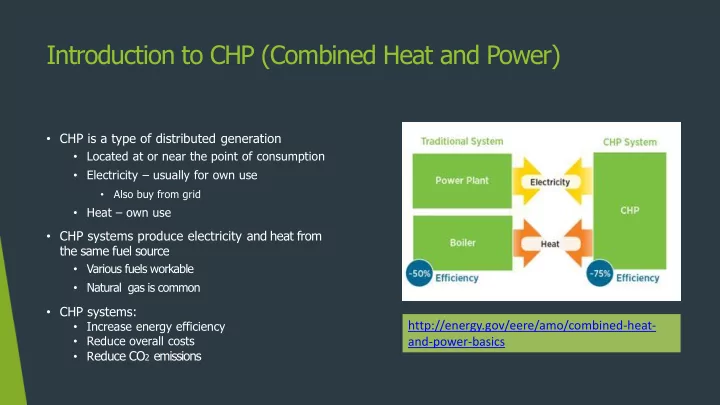
Introduction to CHP (Combined Heat and Power) CHP is a type of distributed generation Located at or near the point of consumption Electricity usually for own use Also buy from grid Heat own use CHP systems produce


slide-1
SLIDE 1

Introduction to CHP (Combined Heat and Power)

  • CHP is a type of distributed generation
  • Located at or near the point of consumption
  • Electricity – usually for own use
  • Also buy from grid
  • Heat – own use
  • CHP systems produce electricity and heat from

the same fuel source

  • Various fuels workable
  • Natural gas is common
  • CHP systems:
  • Increase energy efficiency
  • Reduce overall costs
  • Reduce CO2 emissions

http://energy.gov/eere/amo/combined-heat- and-power-basics

slide-2
SLIDE 2

Who can use CHP Systems?

  • Any facility that:
  • Needs both electricity and heat
  • Functions, on average, more than 10 hours per day
  • Examples:
  • Hospitals
  • Correctional, Industrial, Commercial Facilities
  • Corporate and university campuses
  • Wastewater treatment plants
  • Sizes
  • Pre-packaged: Under 2 MW
  • Custom designed: Greater than 2 MW
slide-3
SLIDE 3

Maryland examples of CHP

  • Baltimore Horseshoe Casino
  • 1.2 MW system – natural gas
  • Expected to more than double overall energy efficiency of

building

  • Univ of Maryland, College Park
  • 27 MW system - natural gas, could use fuel oil
  • Upper Chesapeake Medical Center, Bel Air
  • 2.0 MW system – natural gas
  • Buy electricity from CHP third party owner
  • Expected to save $ 9 million over 20 years
  • Hagerstown Correctional Facility – RFP in 2014
  • Guaranteed Cost Reduction

Horseshoe Casino, Baltimore, 1.2 MW CHP system, installed 2014

slide-4
SLIDE 4

Maryland Incentives for CHP – FY 16

  • Industrial facilities and critical infrastructure facilities
  • (including healthcare, wastewater treatment, and essential

state and local government facilities)

  • Key dates:
  • Open for applications first-come, first-served: Nov 2015
  • Close date: Feb 1, 2016
  • Ground-breaking date: Jan 1, 2017
  • Grants:
  • Cap of $ 500,000 per project
  • For smallest project (under 75 kW): $ 575/kW
  • For largest projects (1 MW and larger): $ 425/kW

Upper Chesapeake Medical Center $ 1.5 million from EmpowerMD http://1.usa.gov/1NyvRxn