Michael Baker Corporation Headquarters Joseph E. Klapheke - - PowerPoint PPT Presentation

michael baker corporation headquarters
SMART_READER_LITE
LIVE PREVIEW

Michael Baker Corporation Headquarters Joseph E. Klapheke - - PowerPoint PPT Presentation

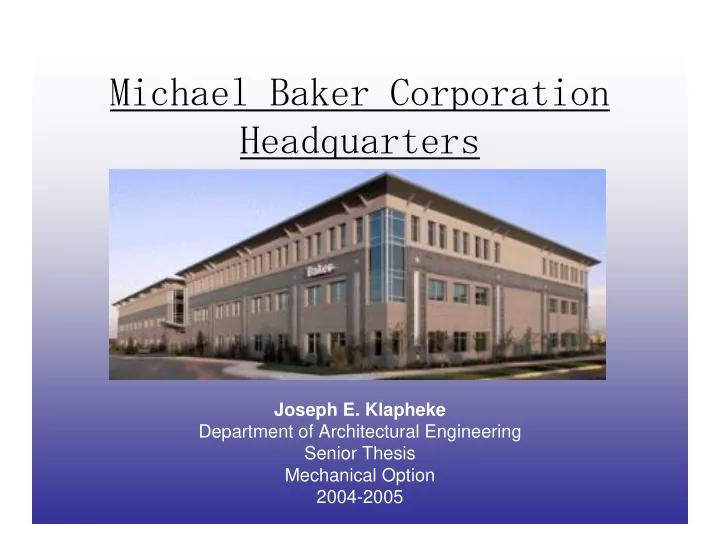
Michael Baker Corporation Headquarters Joseph E. Klapheke Department of Architectural Engineering Senior Thesis Mechanical Option 2004-2005 Building Overview The building is currently part of proposed 6 building business park.


slide-1
SLIDE 1

Michael Baker Corporation Headquarters

Joseph E. Klapheke Department of Architectural Engineering Senior Thesis Mechanical Option 2004-2005
slide-2
SLIDE 2

Building Overview

  • The building is currently part of proposed 6

building business park.

  • The site currently includes one other building

and a parking garage.

  • Façade is composed of tilt-up concrete panels,

glass curtain wall, a metal roof cornice and punched window openings.

  • Designed office furniture and placement of
  • ffice furniture for maximum flexibility and

daylight.

  • 120,000 square foot area with approximately

100,000 square feet in open office space.

  • Indirect lighting system to reduce eye strain

and increase productivity

  • Hand-drawn mural in 2 story lobby
  • Electrical and Telecommunication systems are

ran under a 2” raised floor.

slide-3
SLIDE 3

The 3 P’s

  • Perspective

Corporation Headquarters Location: next door to the Pittsburgh International Airport Flagship of the Airside Business Park Development

  • Productivity

Traditional Overhead VAV system In open office space, 2”raised floor system and movable partitions for easy renovation and remodeling. 525 tenants in about 100,000 square feet of office space. Flexibility is key.

  • Problems

1.5 cfm/sf is used to supply the building throughout the day. Excess energy costs

slide-4
SLIDE 4

Current Design

  • The building is serviced by 6 gas-fired packaged air-handling units. They have gas

heat for A.M. warm-up with 50% 4” pleated filters.

  • The air-handling units supply a range of 3,150 to 20,000 cfm at 55 F. The supply air

leaves the air-handlers and experiences no more than 5.25” of loss.

  • Each air-handling unit is at 50% throw away.
  • The building is comprised of interior and perimeter zones.

The interior zones have cooling-only VAV boxes at about 1/1500 sq. ft. The perimeter zones have fan powered VAV boxes and electric reheat at about 1/1000 sq. ft. There are around 34 zones per floor.

  • Outside design conditions for the summer and winter are 86 F/71 F and 5 F

respectively.

  • The air is maintained at 72 F in the summer and 75 F in the winter.
  • All flow rates meet ASHRAE standards for the prescribed amount of cfm/person,

cfm/area or air changes (whichever is the most demanding)

  • All supplied areas are considered fully-mixed.
slide-5
SLIDE 5

Redesign Considerations

  • Underfloor Air Distribution Systems (UADS)
  • Displacement Ventilation Systems (DVS)
  • Hybrid Ventilation Systems (HVS)
  • Non-Pressurized vs. Pressurized Plenums
  • Displacement Ventilation Systems
  • Lower air velocities (50 fpm), creates 2 zones within

a space due to stratification

  • Higher Indoor Air quality and lack of a draft
  • Potential issues with mold and bacteria growth
  • Hybrid Ventilation Systems
  • Higher air velocities (200-400 fpm), creates a more

mixed space

  • Little stratification and lower chances of mold and

bacteria growth

  • Potential issues with draft and “clear zones”
  • Non-Pressurized vs. Pressurized Plenums
slide-6
SLIDE 6
slide-7
SLIDE 7

Redesign

  • The current system which incorporates a traditional VAV
  • verhead system so operated under the assumption of fully

mixed air conditions.

  • This system requires more air to ventilate the air properly of
  • contaminants. The Michael Baker Corporation Headquarters

currently uses as much as 1.8 cfm/sf to ventilate the air.

  • Using a DVS with a non-pressurized plenum, the underfloor

system can deliver a more conformable, higher quality air supply.

  • Using this system, the Michael Baker Corporation Headquarters

will use about 1.0 cfm/sf.

  • There is also a reduction in cooling necessary to supply the air

using a UADS.

  • Typically, overhead systems uses 55 F supply air to the spaces.

With a UADS, you can use a range from 62 F to 68 F. This redesign will be at 62 F.

slide-8
SLIDE 8

Floorplans

slide-9
SLIDE 9

Floorplans

slide-10
SLIDE 10

Floorplans

slide-11
SLIDE 11

Floorplans

slide-12
SLIDE 12

Cost Comparison

  • Using Carrier’s Hourly Analysis Program (HAP), the current building and the

redesigned building were analyzed.

  • The current building costs an estimated $930,000 to operate annually.
  • Using the redesign building the cost drop to an estimated $800,000 to operate annually.
  • Therefore, net savings annually for the redesigned area equal about $130,000 annually or 1.3

$ per square foot

  • Construction costs also will change.
  • There is currently a 2” raised floor system in place at the Michael Baker Corporation
  • Headquarters. By raising that floor 16” more, a UADS can be installed.
  • However, will a UADS system about 1/3 of the ductwork is necessary.
  • Estimated costs then are $2.15 million for the current building’s raised floor system and

ductwork and $1.7 million for the redesign similarly.

  • Also there is a need for new mechanical equipment including terminal units. The estimated

cost for the current building is $114 thousand and $110 thousand for the redesign.

  • There is also a change in the amount of diffusers and grilles used in the building. The

estimated costs for the current building is $28 thousand and the redesign is $15 thousand.

  • Height reduction of the building from the reduction of overhead plenum space (3’) reduces the
  • verall costs about $53 thousand.
slide-13
SLIDE 13

Cost Comparison Cont.

  • The estimated average savings in

construction cost workouts out to be about $520,000.

  • I got the majority of my quotes from

Means.

  • This equals about 5.2 $ per square

foot.

  • However, it should be noted that

UADS are still relatively new to most construction managers and they will likely bid higher to account for mistakes in construction.

slide-14
SLIDE 14

Mechanical Conclusions

  • The Michael Baker Corporation Headquarters does already achieve the

necessary requirements to serve its occupants effectively.

  • An Underfloor Air Distribution System will effectively serve the tenants while

lower construction and operating costs and improving indoor air quality.

  • Also the flexibility of the building is maintained if not improved.

The tenants can change the location of the diffusers to suit the building’s office furniture. The tenants can also change the rate of air flow leaving the diffusers.

  • Therefore, I would suggest the implementation of a UADS in the Michael

Baker Corporation Headquarters.

slide-15
SLIDE 15

Structural Implications

  • The Michael Baker Corporation Headquarters already has integrated a 2” raised floor

system for there electrical and telecommunication cabling and connections.

  • In order to provide enough room for terminal units, ductwork and the cabling the raised

floor has to have 18” of clearance.

  • With all of this equipment, ductwork and new struts will the beams need to be resized?
  • NO!!!
  • The struts themselves shouldn’t add enough weight per square foot to affect the load and

since all now there will be only 1/3 to 1/2 the ductwork and about the same terminal units.

  • Therefore, the weight will actually decrease if anything. However, this weight loss is

negligible.

  • The beams and girders shouldn’t need to be resized.
slide-16
SLIDE 16

Electrical Implications

  • The terminal boxes in the Michael Baker Corporation Headquarters currently are all

connected to 480Y/277 Volt 3-phase panels. 2 per floor. 1 at 4 Watts, 200 amps the

  • ther at 4 Watts, 100 amps.
  • Currently there are 96 terminal units in use.
  • In the redesign there are 100 terminal units in use.
  • However, they are smaller in size and most required only 208Y/120 Volt 3-phase

connections.

  • Therefore, there are still 2 panels per floor. The first at 480Y/277 Volts 3-phase, 4

Watts, 200 amps and the other at 208Y/120 Volts 3-phase, 4 Watts, 150 amps.

slide-17
SLIDE 17

Acknowledgments

  • It is my privileged and honor to thank the people who helped me over the last eight

months working on this project:

  • Lou Mittelman at Baker & Associates for all opportunity to use the Michael Baker

Corporation Headquarters as my thesis and for all the mechanical information I needed.

  • Keith Williams at Baker & Associates for all of the architectural information he gave

including the costs of the building.

  • The Penn State Architectural Engineering faculty for all of there help and guidance through

my time here.

  • My parents and little sister Robin.

Hi Mom!!!!

  • My friends from here and from home who have helped me keep my sanity.
  • And of course, my colleagues and friends within the major whom are more than I can

mention…you all made this special for me one way or another. Best of luck.

Thank You All!!!!

slide-18
SLIDE 18

Questions????