Metrotown October 12, 2004 Metrotown: : Metrotown Regional Town - - PDF document

metrotown
SMART_READER_LITE
LIVE PREVIEW

Metrotown October 12, 2004 Metrotown: : Metrotown Regional Town - - PDF document

University of Calgary Urban Design Program Urban Design Program Metrotown October 12, 2004 Metrotown: : Metrotown Regional Town Centre Regional Town Centre Before we head out on our walking tour I thought it would be useful to give you


slide-1
SLIDE 1

1 Metrotown Metrotown: :

Regional Town Centre Regional Town Centre

Metrotown

October 12, 2004

University of Calgary Urban Design Program Urban Design Program

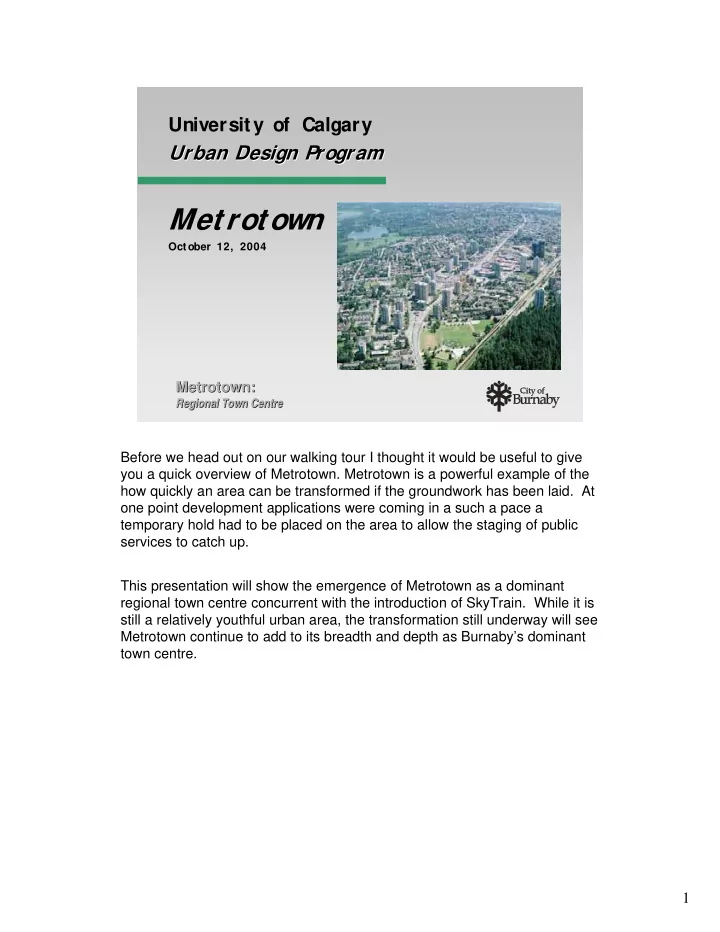
Before we head out on our walking tour I thought it would be useful to give you a quick overview of Metrotown. Metrotown is a powerful example of the how quickly an area can be transformed if the groundwork has been laid. At

  • ne point development applications were coming in a such a pace a

temporary hold had to be placed on the area to allow the staging of public services to catch up. This presentation will show the emergence of Metrotown as a dominant regional town centre concurrent with the introduction of SkyTrain. While it is still a relatively youthful urban area, the transformation still underway will see Metrotown continue to add to its breadth and depth as Burnaby’s dominant town centre.

slide-2
SLIDE 2

2

This presentation is intended to provide an overview of Metrotown and its development from a City perspective.

slide-3
SLIDE 3

3 Metrotown Metrotown: :

Regional Town Centre Regional Town Centre

For comparison purposes, Greater Vancouver area is just over 2 million people with Burnaby being located in the centrally in the region (shown in the highlighted area). In terms of population we represent about 10% of the region’s population. The Greater Vancouver area is expected to experience rapid population growth with an additional one million residents projected to be added over the next 20 years. With the mountains to the north, the ocean to the west and the international boarder with the United States to the south, our growth options for the region are physically quite limited. The current overall growth strategy for the region, some five years in the making, is based on redirecting a high proportion of future growth back into the inner more established areas of the

  • region. This area is called the Growth Concentration Area, which includes

the City of Burnaby in its geographic centre. For Burnaby, the regional strategy meant a new and higher order of growth for the City which from the City’s perspective could only be met with the provision of necessary infrastructure which included a light Rail Transit system to help shape and promote redevelopment in the Growth Concentration Area.

slide-4
SLIDE 4

4

The Greater Vancouver Regional District, the GVRD, pursued a policy program entitled The Livable Region 1976-1986. One of the major strategies of this program was to create a number of Regional Town Centres (shown as the large black dots) within the Growth Concentration Area (shown as white), of which Metrotown was one, in part to provide strong alternative opportunities for major office development and other types of employment outside downtown Vancouver. The linking of these regional town centres by rapid transit (shown as the thick blue and black lines) was an important component of this policy.

slide-5
SLIDE 5

5

The Liveable Region Strategic Plan has a number of components intended to provide for improved growth management and liveability in the region. Town centres are intended to provide focused growth in a more liveable setting supported by rapid transit. In this way development (land use) and SkyTrain reinforce and complement one another in support of the Liveable Region Strategic Plan.

slide-6
SLIDE 6

6 Metrotown Metrotown: :

Regional Town Centre Regional Town Centre

Burnaby is located centrally in the region and is a semi-urban inner, central part of the region, with an area or 35 square miles and a current population estimated at just over 200,000.

slide-7
SLIDE 7

7

Protection of our Environment Opportunities for Growth

The direction for managing growth in Burnaby is contained within our Official Community Plan and based on providing opportunities for growth, while at the same time ensuring the protection and preservation of our most valued environmental resources.

slide-8
SLIDE 8

8

Four Quadrants - Four Town Centres

Burnaby has four quadrants and within each quadrant there is a town

  • centre. Brentwood, Lougheed and Edmonds are all municipal town centres

designed to meet the day-to-day needs of the residents in each quadrant of the city. However, Metrotown is a regional town centre is therefore the most prominent of the four. Each of our four town centres is now served by rapid transit.

slide-9
SLIDE 9

9 Metrotown Metrotown: :

Regional Town Centre Regional Town Centre

Within Burnaby most (56% in 2006) of the new residential units within the City where forecast to be located within town centres.

slide-10
SLIDE 10

10 Metrotown Metrotown: :

Regional Town Centre Regional Town Centre

  • Town Centres will continue to have most of

the jobs (37%) down f rom 40% in 1996 Town Centres will also continue to have most of the jobs (projected to be 37% in 2006) down slightly from 40% in 1996.

slide-11
SLIDE 11

11 Metrotown Metrotown: :

Regional Town Centre Regional Town Centre

  • most new jobs in Metrotown

Of our town centres Metrotown (the only regional town centre) will dominate from an employment persepective.

slide-12
SLIDE 12

12 Metrotown Metrotown: :

Regional Town Centre Regional Town Centre

Metrotown is located approximately mid-way between the Vancouver downtown and the historic City of New Westminster - situated on a high point

  • f land, which is part of a linear escarpment known as the “Kingsway ridge”.
slide-13
SLIDE 13

13 Metrotown Metrotown: :

Regional Town Centre Regional Town Centre

Metrotown covers an area of 735 acres with an east-west dimension of one and a half miles and a north-south dimension of three-quarters of a mile.

slide-14
SLIDE 14

14

In the early 1970’s the core of this area was dominated by two large industrially-oriented underutilized landholdings and a Sears store.

slide-15
SLIDE 15

15 Metrotown Metrotown: :

Regional Town Centre Regional Town Centre

The area surrounding the core was originally developed as a single-family dwelling community.

slide-16
SLIDE 16

16 Metrotown Metrotown: :

Regional Town Centre Regional Town Centre

In the early 1970's, a policy program was pursued to obtain the public perception of the municipality, resulting in a Council-adopted policy report in

  • 1974. At this time, the Kingsway-Sussex Town Centre was designated by

Council as “Metrotown”, a higher level town centre. This dovetailed with the GVRD’s policy program, The Livable Region Strategic Plan (1976-1986).

slide-17
SLIDE 17

17 Metrotown Metrotown: :

Regional Town Centre Regional Town Centre

The resulting major guiding policy document prepared for Metrotown was adopted by Council in 1978. Metrotown with its more intense urban character was intended to broaden the range of residential, commercial, employment and cultural opportunities available within Burnaby. From the

  • utset of the policy review, the City was aware of the proposed development
  • f a Light Rapid Transit system along an largely dormant existing rail right-
  • f-way.

At the time Burnaby staff used this picture of a plaza in New York City to convey the urban feel they were striving for in Metrotown.

slide-18
SLIDE 18

18 Metrotown Metrotown: :

Regional Town Centre Regional Town Centre

In 1908 the BC Electric Railway was built along what is now the alignment used by the Expo SkyTrain line through Metrotown. At the turn of the century, the BC Electric Railway would have been what most people used to travel long distances to New Westminister or Vancouver. At the time you could buy 10 transfers and 10 fares for $0.80. That is less than $0.04/each!

slide-19
SLIDE 19

19 Metrotown Metrotown: :

Regional Town Centre Regional Town Centre

The Metrotown concept was broadly based on a centrally-located mixed-use primary core with an overlapping strong, linear Kingsway commercial

  • corridor. This central commercially-oriented concentration (in orange) is

surrounded by supporting low to high density, multiple-family residential development (in yellow). Two SkyTrain stations were planned to serve the

  • area. Patterson on the western edge and Metrotown in the centre. Royal

Oak Station is just outside the eastern edge of Metrotown and has its own community plan. Forest Gump said “Life is like a box of chocolates.”, but Metrotown is like a donut – I will explain later.

slide-20
SLIDE 20

20 Metrotown Metrotown: :

Regional Town Centre Regional Town Centre

Prior to the development of the main mixed use core of Metrotown the area experienced a steady rate of residential development within the town centre boundaries.

slide-21
SLIDE 21

21 Metrotown Metrotown: :

Regional Town Centre Regional Town Centre

This new residential development added to a large area of two (2) and three (3) storey apartments mostly constructed in the 1950’s and 1960’s south of the core that constitutes the largest concentration of rental housing in Burnaby.

slide-22
SLIDE 22

22 Metrotown Metrotown: :

Regional Town Centre Regional Town Centre

With the introduction of the Expo SkyTrain line in 1986, things within the designated core area began to happen very rapidly. SkyTrain, which diagonally bisects Metrotown ran immediately adjacent to the large underdeveloped properties and provided quick direct access to downtown in about 15 minutes every 4 minutes. A major bus loop serving 11 bus routes is also associated with the Metrotown Station. In Burnaby about half of all bus routes (11 of 23) lead to Metrotown.

slide-23
SLIDE 23

23 Metrotown Metrotown: :

Regional Town Centre Regional Town Centre

The Metrotown SkyTrain Station was directly linked to the bus loop and the primary core by a covered pedestrian bridge across Central Boulevard with the precise location and connection points having been the subject of negotiations with the private sector developers. The Metrotown Station has gone from initially, the seventh busiest to now, consistently the busiest station on the Expo SkyTrain line.

slide-24
SLIDE 24

24 Metrotown Metrotown: :

Regional Town Centre Regional Town Centre

Following the announcement of SkyTrain, development of the 65 acre mixed-use primary core within Metrotown was started somewhat concurrently with three different projects.

slide-25
SLIDE 25

25 Metrotown Metrotown: :

Regional Town Centre Regional Town Centre

Three large industrially-oriented underutilized landholdings in the centre of Metrotown made possible the development of these mega-projects - the Ford Assembly Plant property forming half of the Station Square site, the Kelly Douglas office and warehouse property becoming the site for Metropolis, and the Sears department store and catalogue warehouse property being largely the basis for Metrotown Centre. Three mega-projects totaling 58 acres largely account for this primary core. The westerly project is the 11 acre Station Square, first opened in 1988 and developed by Wesbild Enterprises. The centre project is the 21 acre Metropolis, formerly Eaton Centre, first opened in 1989 and developed by Cambridge Leaseholds. The easterly project is the 26 acre Metrotown Centre, first opened in 1986 and developed by Cal Investments and Manulife. These three (3) projects together comprise the largest shopping complex in British Columbia, with over 500 retail stores and services. The gross leasable commercial retail, and entertainment floor area of the primary core currently totals, some two (2) million square feet with plans approved for an additional 400,000 square feet.

slide-26
SLIDE 26

26 Metrotown Metrotown: :

Regional Town Centre Regional Town Centre

What is now Metropolis, western Canada’s largest shopping mall, started out as two separate malls – the Eaton’s Centre and Metrotown Centre. Each were multi-level internal shopping malls with a pedestrian bridge linking the

  • two. There neighbour to the west - Station Square is an outdoor accessed

shopping centre with only a minor internal mall component. The original pair

  • f Eaton’s Centre and Metrotown Centre within the core was at the time, one
  • f the few examples of such large, adjacent, separately-owned suburban

shopping centres, being required by public policy to be linked and integrated, to function as a single and what is now, a super-regional shopping complex. The two (2) larger properties are now under single ownership and are undergoing a $40 million upgrade primarily intended to vastly improve the connectivity of the two centres. This consolidated property is now know as Metropolis at Metrotown. With over 230 stores Metropolis draws more than 15,000,000 visitors per year.

slide-27
SLIDE 27

27

While growing numbers of shoppers use SkyTrain and bus transit, many acres of free parking have been provided. There are some 10,500 parking spaces in the primary core for retail and office users - over 90% provided underground or in parking structure. Notwithstanding this generous parking provision, approximately 30% of the Metrotown patrons use public transit which compares extremely favourably with the regional average of 11%.

slide-28
SLIDE 28

28 Metrotown Metrotown: :

Regional Town Centre Regional Town Centre

To date, 900,000 square feet of office floor area are provided in the primary core, largely through the first two, 26 and 28 story, Metrotowers in

  • Metropolis. A further 900,000 square feet of office floor area is planned in

three additional office towers.

slide-29
SLIDE 29

29 Metrotown Metrotown: :

Regional Town Centre Regional Town Centre

There have been a number of other notable major developments constructed in recent years in Metrotown primarily along the Kingsway corridor. One of particular note is The Crystal, a 750,000 sq.ft. urban mixed-use development on a 5.5 acre site, adjacent to and west of Station Square and north of the Burnaby Civic Square. Components of The Crystal include a two-level 150,000 sq.ft. retail and restaurant mall, 68,000 sq.ft. of offices, a 283 room full-service Hilton Hotel with major conference facilities, two apartment buildings, an urban church, and a community police station.

slide-30
SLIDE 30

30 Metrotown Metrotown: :

Regional Town Centre Regional Town Centre

Within this 735 acre precinct, there are currently some 13,000 residential units with a population of 22,800. Within 10 years, the residential component will increase to a total of some 14,500 units with a population of 24,500.

slide-31
SLIDE 31

31 Metrotown Metrotown: :

Regional Town Centre Regional Town Centre

A number of public amenities is provided in the primary core. Both the

  • riginal Metropolis and Metrotown Centre have each provided a daycare

centre, a community meeting room, and a public information kiosk. Station Square will also provide a daycare centre with its future office tower phase. Facilities for the RCMP have also been provided at The Crystal.

slide-32
SLIDE 32

32 Metrotown Metrotown: :

Regional Town Centre Regional Town Centre

Major pedestrian plazas have been provided for the enjoyment of the public and are expanding as further redevelopment occurs.

slide-33
SLIDE 33

33 Metrotown Metrotown: :

Regional Town Centre Regional Town Centre

Metrotown has enjoyed the strong confidence of the development

  • community. However, the remarkable previous growth will likely slow to a

still substantial, but more measured pace.

slide-34
SLIDE 34

34 Metrotown Metrotown: :

Regional Town Centre Regional Town Centre

The following sequence of maps are a land use-time sequence which display the evolution of Metrotown from mid 1970s to the mid 1990s. Please note commercial uses are shown in red, low rise residential is shown in yellow and high rise residential will be shown in orange. The growth of Metrotown over time is illustrated by the following four slides. Prior to 1975, the development of low-rise apartments and strip commercial development along Kingsway contributed to the development of Metrotown. From 1975 to 1984, Metrotown experienced significant high-rise apartment development, but still the development pattern could be viewed essentially, as doughnut-shaped with an under-developed centre. Following the opening of the Expo SkyTrain line, from 1985 to 1991, the major growth of the core is evident. The whole of the donut has been filled. It should also be noted that the public assembly of the library/Hilton site and the Bonsor Recreation site (both shown in blue) also were well underway at this time. Since 1991 and for the future, infilling, the development of remaining sites is emphasized.

slide-35
SLIDE 35

35 Metrotown Metrotown: :

Regional Town Centre Regional Town Centre

Metrotown Growth: Pre 1984 to 2015

2,000 4,000 6,000 8,000 10,000 12,000 14,000 16,000 Residential (units) Retail (000s sq. ft.) Office (000s sq. ft.) 2015 2001 Pre 1994

Today, although by no means complete, Metrotown has reached the threshold of maturity and achieved a strong position within the region. Metrotown has an overall retail floor area of 3.5 million square feet, and 2.75 million sq.ft. of office floor area, for a total commercial floor area of 6.25 million square feet with an employment base of some 24,000 people. Within 15 years, the commercial floor area is expected to increase to a total of 9.5 million square feet with an employment base of some 40,000 people.

slide-36
SLIDE 36

36 Metrotown Metrotown: :

Regional Town Centre Regional Town Centre

What else did the Cit y do t o help Metrotown redevelop?

slide-37
SLIDE 37

37 Metrotown Metrotown: :

Regional Town Centre Regional Town Centre

Major Parks

Two major parks were dedicated by the City. Central Park on the west and Deer Lake Park on the east now anchor Metrotown.

slide-38
SLIDE 38

38 Metrotown Metrotown: :

Regional Town Centre Regional Town Centre

On the east side of the primary core is the community level Bonsor Park. The park also accommodates the popular Bonsor Recreational Complex expanded to its current size of 99,000 square feet in 1988. A further 5 smaller neighbourhood parks are also provided.

slide-39
SLIDE 39

39 Metrotown Metrotown: :

Regional Town Centre Regional Town Centre

A major component of the public open space system is B.C. Parkway which is located under the SkyTrain guideway and accommodates a cycling path, a pedestrian walkway and heritage markers.

slide-40
SLIDE 40

40 Metrotown Metrotown: :

Regional Town Centre Regional Town Centre

A civic cultural complex is being developed on the west side of the primary core, on a 4 acre site. This civic area currently accommodates the 61,000 square foot Bob Prittie Metrotown Library, Burnaby’s main resource branch; the Burnaby Civic Square, a formally laid-out public square; and under these facilities, a two level 330 space, public underground parking garage. The civic square is used for community gatherings and celebrations. These facilities were completed in 1991.

slide-41
SLIDE 41

41 Metrotown Metrotown: :

Regional Town Centre Regional Town Centre

2004 saw Burnaby open a $750,000 skateboard park within the Bonsor Recreation complex at Metrotown.

slide-42
SLIDE 42

42 Metrotown Metrotown: :

Regional Town Centre Regional Town Centre

The City also initially lobbied hard for the first few developments in

  • Metrotown. This included dozens of presentations to large property

developers both inside and outside of BC. One such group was the GVRD

  • themselves. They were asked to back up their Livable Region Strategic Plan

by relocating its office headquarters from Vancouver to one of its primary regional town centres. The GVRD and TransLink have both established their headquarter facilities within Metrotown.

slide-43
SLIDE 43

43 Metrotown Metrotown: :

Regional Town Centre Regional Town Centre

Edmonds Town Centre

There are four (4) stations on the Expo Line in Burnaby. The Edmonds Town Centre area incorporates the fourth and only station outside of the Metrotown area. The Edmonds Town Centre area has also received significant development in accordance with Council adopted plans. For example it has the BC Hydro headquarters and the number of residential units will increase from about 2,500 to 3,500 between 1996 and 2006.

slide-44
SLIDE 44

44 Metrotown Metrotown: :

Regional Town Centre Regional Town Centre

Metrotown

To some, Metrotown with its apartments and office towers seemed to spring up overnight. However, its emergence has been a policy objective for the City since the early 70’s when the residents asked for a broader range of urban facilities and services to be focused within a new and higher order town centre. Patient persistence and a strong will by respective Councils combined with the catalytic effect of SkyTrain in 1986 provided the right mix

  • f ingredients to see the emergence of this new form of town centre having

both a regional and town center role.

slide-45
SLIDE 45

45 Metrotown Metrotown: :

Regional Town Centre Regional Town Centre

Metrotown

October 12, 2004

University of Calgary Urban Design Program Urban Design Program

At this point I would welcome a few questions which relate to the presentation material, but would suggest that we can talk in detail as we go along the walking tour – as there is some distance to cover in our remaining time.