Metropolis on the margins Talent attraction and retention to the St. - - PowerPoint PPT Presentation

metropolis on the margins
SMART_READER_LITE
LIVE PREVIEW

Metropolis on the margins Talent attraction and retention to the St. - - PowerPoint PPT Presentation

Metropolis on the margins Talent attraction and retention to the St. Johns city-region Josh Lepawsky Chrystal Phan Rob Greenwood Presentation Outline Hypotheses Conceptual / theoretical difficulties St. Johns


slide-1
SLIDE 1

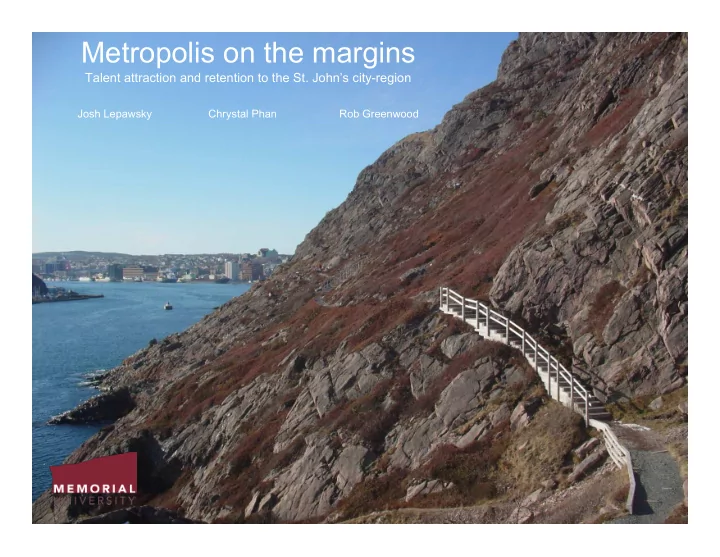
Metropolis on the margins

Talent attraction and retention to the St. John’s city-region

Josh Lepawsky Chrystal Phan Rob Greenwood
slide-2
SLIDE 2

Presentation Outline

  • Hypotheses
  • Conceptual / theoretical ‘difficulties’
  • St. John’s city-region in context
  • Preliminary findings
  • Tentative conclusions
slide-3
SLIDE 3

Hypotheses

  • The social dynamics of city-regions constitute

the foundations of economic success in the global economy.

  • Talented, highly educated individuals will be

attracted to those city-regions that offer a richness of employment opportunity, a high quality of life, a critical mass of cultural activity, and social diversity (low barriers to entry for newcomers)

slide-4
SLIDE 4

Conceptual / theoretical ‘difficulties’

  • Relationality of place
  • Location matters
  • Need to take geographic specificity and contingency seriously
slide-5
SLIDE 5
  • St. John’s city-region in context

Net provincial migration, 1972-2007. Source: Government of NL (2007).

slide-6
SLIDE 6
  • St. John’s city-region in context
slide-7
SLIDE 7
  • St. John’s city-region in context

Population trend for St. John's CMA, 1991-2005. Source: Government of NL (2007).

slide-8
SLIDE 8
  • St. John’s city-region in context

1991 2006 % change 1991-2006

  • St. John’s

104,659 100,646

  • 3.8

Mount Pearl 23,676 24,671 4.2 C B S 17,590 21,966 24.9 Paradis e 7,358 12,584 7 1 Portugal Cove 5,459 6,575 20.4 Torbay 4,707 6,281 33.4

slide-9
SLIDE 9

CBD

slide-10
SLIDE 10

CBD

slide-11
SLIDE 11

CBD

slide-12
SLIDE 12

Preliminary findings

  • 20 completed interviews

– 16 transcribed

  • 8 coded to interview questions
  • Discuss:

– 3 creative workers – 1 employer – 1 intermediary

slide-13
SLIDE 13

Preliminary findings

  • Creative workers (in order of interviews)

– Michael: musician, late 20s, Caucasian, from NL – Jason: film maker, late 20s, Caucasian, from NL – Sarah: film maker, late 20s, Caucasian, from NL

  • Themes arising in interviews:

1. Importance of social networks 2. Loyalty to place, but perception of greater economic

  • pportunities / creative ‘buzz’ elsewhere

3. Lack of perceived link(s) between St. John’s city-region and professional creativity 1, 2, 3 above conditioned by perceptions of the city-region as ‘small’ and ‘disconnected’

slide-14
SLIDE 14

Importance of social networks

Well, I think, obviously, I just have a lot of family here. I mean, my mom and dad are here and they helped me out big time; and, obviously, I just know a lot of people. There’s just like a big social network, so getting a job really wouldn’t be that hard. Just, you know, call my uncles and aunts and, I mean, you know, they have businesses or have brothers who own

  • businesses. I mean, it’s just such a incredible network of
  • people. I mean, I could probably get a job in an hour…
  • -- Michael
slide-15
SLIDE 15

Importance of social networks

I’m not sure what sort of … economic aspects … it’s just a small sort of city that you know everybody, and there’s just these social ties to so many different sectors and so many different

  • businesses. I guess, it’s… I don’t know if it’s specific to this

place because of the culture or because of the isolation, but everyone seems to be just incredibly interconnected, and, you know dozens of people who own things or hire people and put in a word for you, you know. And I don’t know if it’s just the size of the place… probably the isolation and probably the culture – probably everything.

  • -- Michael
slide-16
SLIDE 16

Importance of social networks

What’s so great about this place (St. John’s) is, you know, you become part of this really small community and it’s really wonderful and everybody knows each

  • ther and, you know, everybody supports each other…

… the community that I work in (film making) is relatively small and close-knit, so there’s a kind of… there’s a core group of people who always work on set ... But in terms of like social networks, I mean everybody is extremely supportive of

  • ne another because it is… everybody knows each other, right, and so

everybody is always willing to help out on smaller projects. I would say that for

  • sure. When I was making my first short on my own, you know, I was working

with like the same people who work on the big features because there wasn’t work at that time and everyone is really generous and volunteers their time and works for cheap or for free. So there’s a real support network for making your

  • wn work here in film.
  • -- Sarah
slide-17
SLIDE 17

Loyalty to place, but perception of greater economic opportunities / creative ‘buzz’ elsewhere But we found that it doesn’t really matter where you are … because none of us will move to Toronto, so it’s not really an option. Thinking about moving to Montreal or Halifax or Quebec City or something, but it’s still the same thing. You still have to drive and go away; and the way tours work is that… I mean, eventually, it’s not just going to be GTA that you’re touring, so you’re going to have to be away all the time anyway, so it doesn’t really matter where you’re based if you’re never there, right? You know what I mean? …we’ve all sort of, I think, agree(d) that we’re going to live here (St. John’s). (chuckles) Our bass player refuses to even discuss the option

  • f not living here. He’s like pretty tied to the place. And, you know, I

don’t know, it seems like the older I get the more I feel the same way.

  • -- Michael
slide-18
SLIDE 18

Loyalty to place, but perception of greater economic opportunities / creative ‘buzz’ elsewhere … ideally, I would love to kind of live in St. John’s half of the time. I really like St. John’s and I think I like St. John’s more now than I ever

  • have. I feel like connected to the community here, and I don’t overly

want to… you know, I don’t want to abandon St. John’s, by any means… And, also, I really like big cities. I like Montreal and I like Toronto and so just, personally, I see myself, you know, needing to leave this place for awhile, even just to kind of get more creative inspiration like. You know, I want to meet more people and hear more stories.

  • -- Sarah
slide-19
SLIDE 19

Loyalty to place, but perception of greater economic opportunities / creative ‘buzz’ elsewhere

  • Yeah. I’ll just go by country. (chuckles) In Canada, it would have to be

between Montreal, Vancouver and Toronto – Montreal being my first

  • choice. I’d have to refresh my French, but I wanted to work there. You

know, I’d love to live in New York. If there was any way I could work there or live there or afford to live there, I’d love that. Basically, a big city - like I know this is the complete other side of it. Like this is a small town (St. John’s), but maybe that’s why I would like to live on the extreme for awhile. There’s definitely more opportunity work-wise in bigger cities, but I just think… personally, I know that I would be a lot more… I think I would find a lot more inspiration creatively from big cities, simply because there’s more stuff to look at and learn and talk to and watch, you know.

  • -- Sarah
slide-20
SLIDE 20

Lack of perceived link(s) between

  • St. John’s city-region and professional creativity

I stopped taking pictures when I moved here (St. John’s) a couple of years (ago), for some reason. I was really into photography when I was in Montreal, and I came back here and just like… I don’t know if it’s because I grew up here and so I wasn’t seeing, you know, weird things; but I just… there’s something about… something about big cities, I guess, that I find really nourishing or something less cheesy than that

  • -- Sarah
slide-21
SLIDE 21

Lack of perceived link(s) between

  • St. John’s city-region and professional creativity

I don’t know. I don’t think so. Personally, I think it’s kind of… it’s the individual and the will, I mean, you know, yeah, for me personally.

  • -- Jason

That’s a hard question. I have to say that I do not feel that, no. I don’t feel that there’s anything that enhances creativity. I’m a very reclusive sort of creator or

  • whatever. I usually just like never leave my house, which was why I kind of

wanted to come down here for this interview. So I don’t know. Mostly, it’s all in my head when I’m creative so…

  • -- Michael
slide-22
SLIDE 22

Lack of perceived link(s) between

  • St. John’s city-region and professional creativity

…as much as I’d like, you know, your findings to be that like places really make creativity; and then like the government would be like – ‘oh, let’s make this place sweet (so people) can be creative in (it)’ – I think it’s like… I don’t know – you’re kind of creative wherever you are, I think. It just informs you in different ways.

  • -- Michael
slide-23
SLIDE 23

Preliminary findings

  • Employer

– Jacinta: higher education human resources manager, 30s, Caucasian, from NL

  • Intermediary

– Lawrence: director of health research organization, 60s, Caucasian, not from NL

  • Themes arising in interviews:

1.

  • St. John’s small size and remoteness

2. Structural aspects of the labour market related to taxes and salaries 3. Social divides between ‘insiders’ and ‘outsiders’

slide-24
SLIDE 24
  • St. John’s small size and remoteness

I think one of our strengths is also one our weaknesses, which is our location, being located fairly remotely from everything else within Canada. I think that that’s probably a benefit for people that want to be remotely located, but also a challenge for those that are used to being more centrally located.

  • -- Jacinta

This is a small place on the edge of the continent. There aren’t a lot of jobs kicking around; but, when there are, it’s often hard to find good talent. So you run an ad and get one or two applicants. It really is a problem, and the more specialized you get, the harder it is.

  • -- Lawrence
slide-25
SLIDE 25

Structural aspects of the labour market related to taxes and salaries

One of our challenges, in recruiting any type of an employee new to the market, is our tax system because we do have the highest provincial tax rate, anywhere in Canada. So even if we are bringing someone from the west into… and we’re able to match their salary, their take- home pay is not going to be the same because of our tax rate. So that’s a challenge. That’s really the only thing that I’m aware of in terms of when we bring new people, what are they most concerned

  • about. I think we have the same difficulties in terms of health care,

child care services, education system challenges. I think that those are not unique to Newfoundland. So I don’t see those as being any better

  • r any worse, but they’re certainly not an advantage for us when it

comes to recruiting people.

  • -- Jacinta
slide-26
SLIDE 26

Structural aspects of the labour market related to taxes and salaries

…it’s certainly not that we’re paying decent salaries because, frankly, to go back to... one of the challenges and obstacles is how pathetic the non-academic salaries are. Academic salaries here are not good, but they’re not awful. The non-academic salaries really are not adequate. You can barely pay people. Even though the cost of living here is significantly lower than a lot of places, we really aren’t paying people enough in jobs like program coordinator, research program manager, database manager, to bring people in and keep them here. They will come here (but) (t)hey never come here for the salaries.

  • -- Lawrence
slide-27
SLIDE 27

Structural aspects of the labour market related to taxes and salaries

Well, it’s strictly monetary. The opportunities elsewhere are so good. So the top folks, if they’re at all motivated, monetarily, then – and, I mean, it’s hard not to be. We’re not talking about small increments. We’re talking about huge, huge increments in terms of take-home pay with… particularly, when you figure in taxes and the cost of benefits and those things. So I’d say that that’s the biggest challenge that we face.

  • -- Jacinta
slide-28
SLIDE 28

Jacinta & Lawrence: “Weather”

My house, March 18, 2008.

slide-29
SLIDE 29

Social divides between ‘insiders’ and ‘outsiders’

I think our general reputation within the rest of Canada is probably a weakness. Until people actually experience us, I don’t believe that mainland Canada fully appreciates how well educated, how diverse, how culturally oriented this province is becoming. So maybe that’s probably one of our challenges. We’re still very much an insular community, still very much looking in and remember a lot of our history and… although we’re very friendly, we’re also very… I don’t want to say suspicious, but you still… whenever you sit down… well, whenever I sit down with anyone, I still get the – ‘Who’s your father?’ ‘Where were you born?’ – Right? So we try to trace back our roots to find out… it’s very important to find out how you’re connected to Newfoundland, and I think that that can be a real barrier.

  • -- Jacinta
slide-30
SLIDE 30

Social divides between ‘insiders’ and ‘outsiders’

Well, frankly, there’s a problem. There’s a CFA (Come From Away) problem. I’m one of them. Many academics who come here from elsewhere in Canada or elsewhere, find that the only people they end up hanging around with are other CFA’s, whether Canadian or not. So, unless you have some structural grounds for breaking through that barrier, you often don’t.

  • -- Lawrence
slide-31
SLIDE 31

Tentative Conclusions

  • Certain degree of support for hypotheses
  • Relatively small size and disconnection can be both assets and

liabilities

  • Contingencies and specificities of place emphasize a need to

think city-regions relationally

Mining and oil and gas extraction aids Newfoundland and Labrador “The economy surged 9.1% in Newfoundland and Labrador, far outstripping the other provincial economies. This was well ahead of its 3.3% gain in 2006. Increased oil and mineral extraction, combined with strong world commodity prices, became the catalyst for growth in 2007, more than three-quarters of which could be attributed to mining activities.”

  • -- Stats Canada, 28 April 2008. Provincial and territorial economic accounts.