Configurational-Bias Monte Carlo N interacting particles in volume V - - PowerPoint PPT Presentation

configurational bias monte carlo
SMART_READER_LITE
LIVE PREVIEW

Configurational-Bias Monte Carlo N interacting particles in volume V - - PowerPoint PPT Presentation

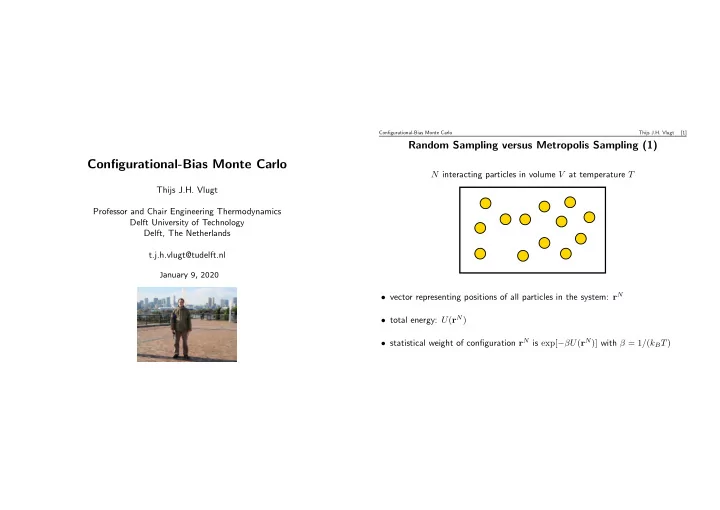
Configurational-Bias Monte Carlo Thijs J.H. Vlugt [1] Random Sampling versus Metropolis Sampling (1) Configurational-Bias Monte Carlo N interacting particles in volume V at temperature T Thijs J.H. Vlugt Professor and Chair Engineering


slide-1
SLIDE 1

Configurational-Bias Monte Carlo

Thijs J.H. Vlugt Professor and Chair Engineering Thermodynamics Delft University of Technology Delft, The Netherlands t.j.h.vlugt@tudelft.nl January 7, 2019

Configurational-Bias Monte Carlo Thijs J.H. Vlugt [1]

Random Sampling versus Metropolis Sampling (1)

N interacting particles in volume V at temperature T

  • vector representing positions of all particles in the system: rN
  • total energy: U(rN)
  • statistical weight of configuration rN is exp[βU(rN)] with β = 1/(kBT)

January 9, 2020

slide-2
SLIDE 2

Configurational-Bias Monte Carlo Thijs J.H. Vlugt [2]

Random Sampling versus Metropolis Sampling (2)

N interacting particles in volume V at temperature T pair interactions u(rij) U(rN) =

N1

X

i=1 N

X

j=i+1

u(rij) = X

i<j

u(rij) Q(N, V, T) = 1 Λ3NN! Z drN exp ⇥ βU(rN) ⇤ F(N, V, T) = kBT ln Q(N, V, T)

Configurational-Bias Monte Carlo Thijs J.H. Vlugt [3]

Random Sampling versus Metropolis Sampling (3)

Computing the ensemble average h· · · i of a certain quantity A(rN)

  • Random Sampling of rN:

hAi = lim

n!1

Pn

i=1 A(rN i ) exp

⇥ βU(rN

i )

⇤ Pn

i=1 exp

⇥ βU(rN

i )

⇤ Usually this leads to hAi =“0”/“0” = ???

  • Metropolis sampling; generate n configurations rN with probability proportional

to exp ⇥ βU(rN

i )

⇤ , therefore: hAi = lim

n!1

Pn

i=1 A(rN i )

n

slide-3
SLIDE 3

Configurational-Bias Monte Carlo Thijs J.H. Vlugt [4]

Simulation Technique (1)

What is the ratio of red wine/white wine in the Netherlands?

Configurational-Bias Monte Carlo Thijs J.H. Vlugt [5]

Simulation Technique (2)

Bottoms up

slide-4
SLIDE 4

Configurational-Bias Monte Carlo Thijs J.H. Vlugt [6]

Simulation Technique (3)

Configurational-Bias Monte Carlo Thijs J.H. Vlugt [7]

Simulation Technique (4)

slide-5
SLIDE 5

Configurational-Bias Monte Carlo Thijs J.H. Vlugt [8]

Simulation Technique (5)

Configurational-Bias Monte Carlo Thijs J.H. Vlugt [9]

Simulation Technique (6)

Bottoms up Liquor store Shoe shop

slide-6
SLIDE 6

Configurational-Bias Monte Carlo Thijs J.H. Vlugt [10]

Metropolis Monte Carlo (1)

How to generate configurations ri with a probability proportional to N(ri) = exp[βU(ri)] ???

  • N. Metropolis, A.W. Rosenbluth, M.N. Rosenbluth. A.H. Teller and E. Teller, ”Equation of State

Calculations by Fast Computing Machines,” J. Chem. Phys., 1953, 21, 1087-1092.

Configurational-Bias Monte Carlo Thijs J.H. Vlugt [11]

Metropolis Monte Carlo (2)

Whatever our rule is to move from one state to the next, the equilibrium distribution should not be destroyed

slide-7
SLIDE 7

Configurational-Bias Monte Carlo Thijs J.H. Vlugt [12]

Move from the old state (o) to a new state (n) and back

new 1 new 2 new 3 new 4 new 5

  • ld

leaving state o = entering state o N(o) X

n

[α(o ! n)acc(o ! n)] = X

n

[N(n)α(n ! o)acc(n ! o)] N(i) : probability to be in state i (here: proportional to exp[βU(ri)]) α(x ! y) : probability to attempt move from state x to state y acc(x ! y): probability to accept move from state x to state y

Configurational-Bias Monte Carlo Thijs J.H. Vlugt [13]

Detailed Balance (1)

Requirement (balance): N(o) X

n

[α(o ! n)acc(o ! n)] = X

n

[N(n)α(n ! o)acc(n ! o)] Detailed balance: much stronger condition N(o)α(o ! n)acc(o ! n) = N(n)α(n ! o)acc(n ! o) for every pair o,n new 1 new 2 new 3 new 4 new 5

  • ld
slide-8
SLIDE 8

Configurational-Bias Monte Carlo Thijs J.H. Vlugt [14]

Detailed Balance (2)

N(o)α(o ! n)acc(o ! n) = N(n)α(n ! o)acc(n ! o)

  • α(x ! y); probability to select move from x to y
  • acc(x ! y); probability to accept move from x to y
  • often (but not always); α(o ! n) = α(n ! o)

Therefore (note that ∆U = U(n) U(o)): acc(o ! n) acc(n ! o) = α(n ! o) exp[βU(n)] α(o ! n) exp[βU(o)] = α(n ! o) α(o ! n) exp[β∆U] In case that α(o ! n) = α(n ! o) acc(o ! n) acc(n ! o) = exp[β∆U]

Configurational-Bias Monte Carlo Thijs J.H. Vlugt [15]

Metropolis Acceptance Rule

General: acc(o ! n) acc(n ! o) = X Choice made by Metropolis (note: infinite number of other possibilities) acc(o ! n) = min(1, X) Note than min(a, b) = a if a < b and b otherwise

  • always accept when X 1
  • when X < 1, generate uniformly distributed random number between 0 and 1

and accept or reject according to acc(o ! n)

slide-9
SLIDE 9

Configurational-Bias Monte Carlo Thijs J.H. Vlugt [16]

Monte Carlo Casino

Configurational-Bias Monte Carlo Thijs J.H. Vlugt [17]

Smart Monte Carlo: α(o ! n) 6= α(n ! o)

Not a random displacement ∆r uniformly from [δ, δ], but instead ∆r = r(new) r(old) = A ⇥ F + δr F : force on particle A : constant δr : taken from Gaussian distribution with width 2A so P(δr) ⇠ exp[(δr2)/4A] P(rnew) ⇠ exp  (rnew (rold + A ⇥ F(o)))2 4A

  • α(o ! n)

α(n ! o) = exp h (∆rA⇥F (o))2

4A

i exp h (∆r+A⇥F (n))2

4A

i

slide-10
SLIDE 10

Configurational-Bias Monte Carlo Thijs J.H. Vlugt [18]

Chain Molecules

Configurational-Bias Monte Carlo Thijs J.H. Vlugt [19]

Self-Avoiding Walk on a Cubic Lattice

  • 3D lattice; 6 lattice directions
  • only 1 monomer per lattice site (otherwise U = 1)
  • interactions only when |rij| = 1 and |i j| > 1
slide-11
SLIDE 11

Configurational-Bias Monte Carlo Thijs J.H. Vlugt [20]

Simple Model for Protein Folding

20 by 20 interaction matrix ∆ij YPDLTKWHAMEAGKIRFSVPDACLNGEGIRQVTLSN (E. Jarkova, T.J.H. Vlugt, N.K. Lee, J. Chem. Phys., 2005, 122, 114904)

2 4 6 8 10 Force (kBT/b) 5 10 15 20 z (b) prot1 prot2 prot3 prot4 2 4 6 8 10 Force (kBT/b) 1 2 3 4 5 6 (dz)

2

b)

Configurational-Bias Monte Carlo Thijs J.H. Vlugt [21]

Number of Configurations without Overlap

Random Chains: hRi = lim

n!1

Pn

i=1 Ri exp[βUi]

Pn

i=1 exp[βUi]

Fraction of chains without overlap decreases exponentially as a function of chainlength (N) N total (= 6N1) without overlap fraction no overlap 2 6 6 1 6 7776 3534 0.454 8 279936 81390 0.290 10 10077696 1853886 0.183 12 362797056 41934150 0.115 13 2176782336 198842742 0.091 14 13060694016 943974510 0.072 15 78364164096 4468911678 0.057 16 470184984576 21175146054 0.045 50 · · · · · · 1.3 ⇥ 105

slide-12
SLIDE 12

Configurational-Bias Monte Carlo Thijs J.H. Vlugt [22]

Rosenbluth Sampling (1)

  • 1. Place first monomer at a random position
  • 2. For the next monomer (i), generate k trial directions (j = 1, 2, · · · , k)

each with energy uij

  • 3. Select trial direction j? with a probability

Pj? = exp[βuij?] Pk

j=1 exp[βuij]

  • 4. Continue with step 2 until the complete chain is grown (N monomers)

Configurational-Bias Monte Carlo Thijs J.H. Vlugt [23]

Rosenbluth Sampling (2)

Pj? = exp[βuij?] Pk

j=1 exp[βuij]

slide-13
SLIDE 13

Configurational-Bias Monte Carlo Thijs J.H. Vlugt [24]

Rosenbluth Sampling (3)

Probability to choose trial direction j? for the i th monomer Pj? = exp[βuij?] Pk

j=1 exp[βuij]

Probability to grow this chain (N monomers, k trial directions) Pchain =

N

Y

i=1

Pj?(i) = QN

i=1 exp[βuij?(i)]

QN

i=1

Pk

j=1 exp[βuij]

= exp[βUchain] Wchain

Configurational-Bias Monte Carlo Thijs J.H. Vlugt [25]

Rosenbluth Sampling (4)

Probability to grow this chain (N monomers, k trial directions) Pchain = QN

i=1 exp[βuij?(i)]

QN

i=1

Pk

j=1 exp[βuij]

= exp[βUchain] Wchain Therefore, weightfactor for each chain i is the Rosenbluth factor Wi: hRiBoltzmann = lim

n!1

Pn

i=1 Wi ⇥ Ri

Pn

i=1 Wi

The unweighted distribution is called the Rosenbluth distribution: hRiRosenbluth = lim

n!1

Pn

i=1 Ri

n Of course: hRiRosenbluth 6= hRiBoltzmann

slide-14
SLIDE 14

Configurational-Bias Monte Carlo Thijs J.H. Vlugt [26]

Intermezzo: Ensemble Averages at Different Temperatures

Ensemble averages at β? can (in principle) be computed from simulations at β: hUi = R drNU(rN) exp[βU(rN)] R drN exp[βU(rN)] = R drNU(rN) exp[β?U(rN)] exp[(β? β) ⇥ U(rN)] R drN exp[β?U(rN)] exp[(β? β) ⇥ U(rN)] = ⌦ U(rN) exp[(β? β) ⇥ U(rN)] ↵

?

hexp[(β? β) ⇥ U(rN)]i? = ⌦ U(rN) exp[∆β ⇥ U(rN)] ↵

?

hexp[∆β ⇥ U(rN)]i? Useful or not???

Configurational-Bias Monte Carlo Thijs J.H. Vlugt [27]

Rosenbluth Distribution Differs from Boltzmann Distribution

Probability distribution for the end-to-end distance r N = 10 N = 100

2 4 6

r

0.1 0.2 0.3 0.4

P(r)

Rosenbluth distribution Boltzmann distribution 5 10 15 20 25 30

r

0.02 0.04 0.06 0.08 0.1

P(r)

Rosenbluth distribution Boltzmann distribution

slide-15
SLIDE 15

Configurational-Bias Monte Carlo Thijs J.H. Vlugt [28]

Distribution of Rosenbluth Weights

−45 −35 −25 −15 −5 ln(W) −10 −8 −6 −4 −2 ln(p(W)) N=50 N=100 N=200 N=300

Of course, Probability(W = 0) 6= 0 (not shown in this figure)

Configurational-Bias Monte Carlo Thijs J.H. Vlugt [29]

Pruned-Enriched Rosenbluth Method (1)

Grassberger (1997); grow chains using Rosenbluth Method: W =

6

X

j=1

exp [βu2j] 6 ⇥

N

Y

i=3 5

X

j=1

exp [βuij] 5 =

N

Y

i=3 5

X

j=1

exp [βuij] 5 Two additional elements:

  • Enriching

If W > Wmax during the construction of the chain, k copies of the chain are generated, each with a weight of W/k. This is a deterministic process. The growth of those k chains is continued.

  • Pruning

If W < Wmin during the construction of a chain, with a probability of 1/2 the chain is pruned resulting in W = 0. If the chain survives, the Rosenbluth weight is multiplied by 2 and the growth of the chain is continued.

slide-16
SLIDE 16

Configurational-Bias Monte Carlo Thijs J.H. Vlugt [30]

Pruned-Enriched Rosenbluth Method (2)

successful pruning enriching unsuccessful pruning

Configurational-Bias Monte Carlo Thijs J.H. Vlugt [31]

Pruned-Enriched Rosenbluth Method (3)

Example: N = 200, k = 2, βµex = ln hWi = 12.14

−40 −30 −20 −10 ln(W) 0.1 0.2 0.3 0.4 p(ln(W)) RR Wmin=−20 Wmax=−5 Wmin=−15 Wmax=−5

slide-17
SLIDE 17

Configurational-Bias Monte Carlo Thijs J.H. Vlugt [32]

Pruned-Enriched Rosenbluth Method (4)

βµex = ln hWi, Ann. Rev. of Phys. Chem. 1999, 50, 377-411

Configurational-Bias Monte Carlo Thijs J.H. Vlugt [33]

Static versus Dynamic Monte Carlo

  • Static Monte Carlo

– create single chain conformations, and use correct weight factor (random insertion, Rosenbluth scheme, PERM) to compute single chain averages – single chain only; no Markov chain

  • Dynamic Monte Carlo

– create Markov chain, accept/reject new configuration, acceptance rules should obey detailed balance – multi-chain system, usable for all ensembles (e.g. Gibbs, µV T) – Configurational-Bias Monte Carlo (CBMC), Recoil Growth (RG), Dynamic PERM (DPERM)

slide-18
SLIDE 18

Configurational-Bias Monte Carlo Thijs J.H. Vlugt [34]

Random Insertion of Chains is Useless

Chain Length Probability without overlaps 1 102 2 104 3 106 · · · · · · 8 1016

Configurational-Bias Monte Carlo Thijs J.H. Vlugt [35]

Configurational-Bias Monte Carlo

  • Generate configurations using the Rosenbluth scheme
  • Accept/Reject these configurations in such a way that detailed balance is
  • beyed
  • Split potential energy into “bonded” (bond-stretching, bending, torsion) and

“non-bonded” (i.e. Lennard-Jones and/or Coulombic) interactions

  • Generate (k) trial positions according to bonded interactions

(unbranched chain: l, θ, φ are independent) Ubonded = Ustretch(l) + Ubend(θ) + Utors(φ) P(l) ⇠ dl l2 exp[βu(l)] P(θ) ⇠ dθ sin(θ) exp[βu(θ)] P(φ) ⇠ dφ exp[βu(φ)]

slide-19
SLIDE 19

Configurational-Bias Monte Carlo Thijs J.H. Vlugt [36]

Generate Trial Configurations: Linear Alkane

CH3 CH2 CH3 CH2

φ l θ u(l) = (kl/2) (l l0)2 u(θ) = (k✓/2) (θ θ0)2 u(φ) =

5

X

i=0

ci cosi(φ) P(l) ⇠ dl l2 exp[βu(l)] P(θ) ⇠ dθ sin(θ) exp[βu(θ)] P(φ) ⇠ dφ exp[βu(φ)]

Configurational-Bias Monte Carlo Thijs J.H. Vlugt [37]

Generate a Random Number from a Distribution (1)

F(y) = Z y p(y0)dy0

slide-20
SLIDE 20

Configurational-Bias Monte Carlo Thijs J.H. Vlugt [38]

Generate a Random Number from a Distribution (2)

F(y) = Z y f(y0)dy0 f(x) > p(x)

Configurational-Bias Monte Carlo Thijs J.H. Vlugt [39]

Generate a Random Number from a Distribution (3)

subroutine bend-tors generate appropriate ✓ and lready=.false do while (.not.lready) call ransphere(dx,dy,dz) random vector on unit sphere x = xold + dx monomer position y = yold + dy z = zold + dz call bend(ubend,x,y,z) bending energy call tors(utors,x,y,z) torsion energy if(ranf().lt.exp(-beta*(ubend+utors))) accept or reject + lready=.true enddo

slide-21
SLIDE 21

Configurational-Bias Monte Carlo Thijs J.H. Vlugt [40]

CBMC Algorithm

  • Generate a trial configuration using the Rosenbluth scheme. k trial segments

{b}k = {b1 · · · bk}, each trial segment is generated according to P(b) ⇠ exp[βubonded(b)]

  • Compute non-bonded energy, select configuration i with a probability

P(bi) = exp[βunonb(bi)] Pk

j=1 exp[βunonb(bj)]

= exp[βunonb(bi)] wl

  • Continue until chain is grown, W(n) = Qn

l=1 wl

  • Similar procedure for old configuration, generate k 1 trial positions (trial

position 1 is the old configuration itself), leading to W(o)

  • Accept/reject according to

acc(o ! n) = min(1, W(n)/W(o))

Configurational-Bias Monte Carlo Thijs J.H. Vlugt [41]

Super-Detailed Balance (1)

Same chain can be grow for different sets of trial directions...

slide-22
SLIDE 22

Configurational-Bias Monte Carlo Thijs J.H. Vlugt [42]

Super-Detailed Balance (2)

Flux of configurations K(o ! n) = X

bnbo

K(o ! n|bnbo) K(n ! o) = X

bnbo

K(n ! o|bnbo) Detailed balance requires K(o ! n) = K(n ! o) Possible solution (super-detailed balance): K(o ! n|bnbo) = K(n ! o|bnbo) for each bnbo.

Configurational-Bias Monte Carlo Thijs J.H. Vlugt [43]

Super-Detailed Balance (3)

Detailed balance for each set bnbo: K(o ! n|bnbo) = N(o) ⇥ α(o ! n|bnbo) ⇥ acc(o ! n|bnbo) = exp[βU(o)] ⇥ C exp[βubonded(n)] ⇥ exp[βunonb(n)] W(n) ⇥ P(bnbo) ⇥ acc(o ! n|bnbo) K(n ! o|bnbo) = exp[βU(n)] ⇥ C exp[βubonded(o)] ⇥ exp[βunonb(o)] W(o) ⇥ P(bnbo) ⇥ acc(n ! o|bnbo) As U = unonb + ubonded therefore acc(o ! n) acc(n ! o) = W(n) W(o)

slide-23
SLIDE 23

Configurational-Bias Monte Carlo Thijs J.H. Vlugt [44]

Branched Molecules (1)

b1 c1 c2 b2

P(b1, b2) ⇠ exp[β[ubend(c1, c2, b1)] + ubend(c1, c2, b2)] + ubend(b1, c2, b2)]]

Configurational-Bias Monte Carlo Thijs J.H. Vlugt [45]

Branched Molecules (2)

Use CBMC to generate internal configurations:

  • Generate nt random trial positions and select one (i) with a probability

P int(i) = exp[βUbonded(i)] Pnt

j=1 exp[βUbonded(j)] = exp[βUbonded(i)]

W int(n)

  • Repeat until k trial orientations are found; these are fed into CBMC leading to

W(n)

  • Repeat procedure for old configuration, leading to W int(o) and W(o).
  • Accept or reject according to

acc(o ! n) = min ✓ 1, W(n) ⇥ W int(n) W(o) ⇥ W int(o) ◆

slide-24
SLIDE 24

Configurational-Bias Monte Carlo Thijs J.H. Vlugt [46]

Significant Speedup: Dual-Cutoff CBMC

0.0 5.0 10.0 15.0

rcut*/[A

  • ]

0.0 0.2 0.4 0.6 0.8 1.0

η

  • Grow chain with approximate (cheaper) potential; W ?
  • Correct for difference later

(δu, difference real and approximate potential for selected configuration) acc(o ! n) = min ✓ 1, W ?(n) W ?(o) ⇥ exp[β[δu(n) δu(o)]] ◆

Configurational-Bias Monte Carlo Thijs J.H. Vlugt [47]

Application 1: Adsorption of Alkanes in MFI-type zeolite (1)

Zeolites:

  • microporous channel structure
  • crystalline, SiO2 building blocks
  • substitution of Si4+ by Al3+ and a cation (Na+ or H+)
  • typical poresize: 4 12˚

A

  • synthetic and natural; >190 framework types
slide-25
SLIDE 25

Configurational-Bias Monte Carlo Thijs J.H. Vlugt [48]

Application 1: Adsorption of Alkanes in MFI-type zeolite (2)

y x z

straight channels (y direction), zig-zag channels (xz plane) and intersections

Configurational-Bias Monte Carlo Thijs J.H. Vlugt [49]

Application 1: Adsorption of Alkanes in MFI-type zeolite (3)

Grand-canonical (µVT) ensemble; number of particles (N) fluctuates

  • system is coupled to particle reservoir at chemical potential µ

and temperature T, statistical weight ⇠ V N exp[βµN βU(rN)]/

  • Λ3NN!
  • trial moves to exchange particles between zeolite and reservoir (using CBMC)
  • equilibrium: µgas = µzeolite; measure average hNi for given µ and β

T µ

slide-26
SLIDE 26

Configurational-Bias Monte Carlo Thijs J.H. Vlugt [50]

Application 1: Adsorption of Alkanes in MFI-type zeolite (4)

10

−4

10

−2

10 10

2

p/[kPa] 0.0 1.0 2.0

N/[mmol/g]

butane exp. butane sim. isobutane exp. isobutane sim.

i−C n−C 4 4

Vlugt et al, J. Am. Chem. Soc., 1998, 120, 5599

Configurational-Bias Monte Carlo Thijs J.H. Vlugt [51]

Application 1: Adsorption of Alkanes in MFI-type zeolite (5)

n-C4, low loading i-C4, low loading i-C4, high loading Vlugt et al, J. Am. Chem. Soc., 1998, 120, 5599

slide-27
SLIDE 27

Configurational-Bias Monte Carlo Thijs J.H. Vlugt [52]

Application 1: Adsorption of Alkanes in MFI-type zeolite (6)

Research Octane Number (RON)

>100 25 73 92

Configurational-Bias Monte Carlo Thijs J.H. Vlugt [53]

Application 1: Adsorption of Alkanes in MFI-type zeolite (7)

Flux n C6 i C6 selectivity pure 179 136 1.3 50%-50% 46 1.9 24 Experiments by J. Falconer, Univ. Colorado

slide-28
SLIDE 28

Configurational-Bias Monte Carlo Thijs J.H. Vlugt [54]

Application 1: Adsorption of Alkanes in MFI-type zeolite (8)

10

  • 01

10

00

10

01

10

02

10

03

10

04

10

05

10

06

Partial pressure, pi /[Pa] 1 2 3 4 5 6 7 8 2 4 6 8 Loading, θ /[molecules per unit cell] n-C6 3MP (b) 50-50 mixture of C6 isomers at 362 K n-C6 3MP CBMC simulations

,

DSL model fits (a) Pure component isotherms

Configurational-Bias Monte Carlo Thijs J.H. Vlugt [55]

Application 1: Adsorption of Alkanes in MFI-type zeolite (9)

blue = branched (i-C6) red = linear (n-C6)

slide-29
SLIDE 29

Configurational-Bias Monte Carlo Thijs J.H. Vlugt [56]

Application 2: Adsorption of CO2 in Na+ containing zeolites

Sofia Calero et al., J. Phys. Chem. C, 2009, 113, 8814-8820

Configurational-Bias Monte Carlo Thijs J.H. Vlugt [57]

Application 3: Gibbs Ensemble Monte Carlo (1)

Heptane (n-C7)

0.0 0.2 0.4 0.6

ρ/[g/cm

3]

400 500 600

T/[K]

Experimental data Scaling relations Simulations

  • B. Smit, S. Karaborni, and J.I. Siepmann, J. Chem. Phys. 102, 2126 (1995)
slide-30
SLIDE 30

Configurational-Bias Monte Carlo Thijs J.H. Vlugt [58]

Application 3: Gibbs Ensemble Monte Carlo (2)

1 10 100

Nc

400 500 600 700 800 900 1000

Tc[K]

simulations experiments

1 10 100

Nc

0.18 0.20 0.22 0.24

ρc [gram/cm

3]

simulations experiments (1) experiments (2)

  • B. Smit, S. Karaborni, and J.I. Siepmann, J. Chem. Phys. 102, 2126 (1995)

Configurational-Bias Monte Carlo Thijs J.H. Vlugt [59]

Application 4: GCMC Histogram Reweighting

J.J. Potoff et al., J. Phys. Chem. B, 2009, 113, pp 14725-14731

slide-31
SLIDE 31

Configurational-Bias Monte Carlo Thijs J.H. Vlugt [60]

Efficiency of CBMC

  • k: number of trial directions
  • a: probability that trial direction has a “favorable” energy
  • growth can continue as long as at least 1 trial direction is “favorable”
  • generate chain of length N successfully

Psuccess = (1 (1 a)k)N = exp[cN]

  • increasing k means increasing CPU time.

Configurational-Bias Monte Carlo Thijs J.H. Vlugt [61]

Dead-End Alley

slide-32
SLIDE 32

Configurational-Bias Monte Carlo Thijs J.H. Vlugt [62]

Recoil Growth: Avoiding Dead-End Alley

Configurational-Bias Monte Carlo Thijs J.H. Vlugt [63]

Recoil Growth Algorithm (1)

  • Place first bead at random position
  • Position (i) can be “open” or closed” depending on the environment (energy

ui); here we use popen = min(1, exp[βui]) and toss a coin.

  • If “open”, continue with next segment
  • If “closed”, try another trial direction up to a maximum of k
  • If all k directions are closed, retract by one step
  • Maximum retraction length: lmax l + 1
  • l: recoil length, lmax: maximum length obtained during the growth of the chain
  • Computed weight W(n) and repeat procedure for old configuration
  • Accept or reject using acc(o ! n) = min(1, W(n)/W(o))
slide-33
SLIDE 33

Configurational-Bias Monte Carlo Thijs J.H. Vlugt [64]

Recoil Growth Algorithm (2)

Example for k = 2 and l = 3

A B C D E F G H I O

Configurational-Bias Monte Carlo Thijs J.H. Vlugt [65]

Super Detailed Balance

In general, N(o) ⇥ α(o ! n) ⇥ acc(o ! n) = N(n) ⇥ α(n ! o) ⇥ acc(n ! o) Therefore, acc(o ! n) = min ✓ 1, exp[β∆U] ⇥ α(n ! o) α(o ! n) ◆ What about α(o ! n) ?

  • Generate a tree tn.
  • Decide which parts of the tree are “open” or “closed” (On).
  • Make a random walk on the tree (rwn)
slide-34
SLIDE 34

Configurational-Bias Monte Carlo Thijs J.H. Vlugt [66]

Random Walk on a Tree (k = 2, l = 3)

closed

  • pen

Configurational-Bias Monte Carlo Thijs J.H. Vlugt [67]

Super-Detailed Balance

K(o ! n|tntoOnOo) = K(n ! o|tntoOnOo) α(o ! n|tntoOnOo) = P(tn)P(On|tn)P(rwn|tnOn) ⇥ P(to|rwo)P(Oo|torwo) α(n ! o|tntoOnOo) = P(to)P(Oo|to)P(rwo|toOo) ⇥ P(tn|rwn)P(On|tnrwn) P(On|tn) P(On|tnrwn) =

n

Y

i=1

pi P(rwn|tnOn) = 1 Qn

i=1 mi

acc(o ! n) = min @1, exp[β∆U] ⇥ Qn

i=1 mi(n) pi(n)

Qn

i=1 mi(o) pi(o)

1 A

slide-35
SLIDE 35

Configurational-Bias Monte Carlo Thijs J.H. Vlugt [68]

Computing the Weight (k = 2, l = 3)

A B C D E F G H I O

m =1

2

m =2

1

A B C D E F G H I O

Configurational-Bias Monte Carlo Thijs J.H. Vlugt [69]

Efficiency of RG Compared to CBMC

2 4 6 8

k

0.2 0.4 0.6 0.8 1

η

CBMC RG; lmax=1 RG; lmax=2 RG; lmax=5

slide-36
SLIDE 36

Configurational-Bias Monte Carlo Thijs J.H. Vlugt [70]

Other Methods

  • Continuous Fractional Component Monte Carlo

– system contains N molecules and one “fractional” molecule – interactions of the fractional molecule are described by order parameter λ – include trial-moves to change λ – “fractional” molecule can become a “real” molecule or disappear – Maginn, J. Chem. Theory Comput., 2007, 3, 451-1463

  • Wormhole move

– create an artificial “hole” in the system – use reptation steps to gradually insert the chain – accept/reject individual reptation steps – move is completed when the whole chain is transferred through the hole – Houdayer, Journal of Chemical Physics, 2002, 116, 1783-1787

Configurational-Bias Monte Carlo Thijs J.H. Vlugt [71]

Continuous Fractional Component Monte Carlo

  • Not inserting whole molecules, but step by step
  • Slowly switching on/off interactions of a “ghost molecule”
  • Maginn and co-workers; Dubbeldam, Vlugt et al., Journal of Chemical Theory

and Computation, 2014, 10, 942-952.

slide-37
SLIDE 37

Configurational-Bias Monte Carlo Thijs J.H. Vlugt [72]

[bmim][Tf2N]

Configurational-Bias Monte Carlo Thijs J.H. Vlugt [73]

[bmim][Tf2N]

slide-38
SLIDE 38

Configurational-Bias Monte Carlo Thijs J.H. Vlugt [74]

Solubility of precombustion gasses in [bmim][Tf2N]

4 8 12 16 0.0 0.2 0.4 0.6 0.8 P/ MPa XGas

Solubility of CO2, CH4, CO, H2 and N2 in [bmim][Tf2N] from MC simulations (open symbols) and experiments (filled symbols) at 333.15 K. CO2 experiments (filled diamonds) and MC data (open diamonds); CH4 experiments (filled squares) and MC data (open squares); CO experiments (filled triangles) and MC data (open triangles); H2 experiments (filled circles) and MC data (open circles), and MC data of N2 (stars). Lines: PR-EOS modeling

Configurational-Bias Monte Carlo Thijs J.H. Vlugt [75]

Henry constants of CO2, CH4, CO, H2, N2, and H2S in Selexol and [bmim][Tf2N] at 333.15 K

solute Hexp.

Selexol/MPa

Hexp.

IL /MPa

Hsim.

IL /MPa

difference/% CO2 6.81a 6.56 7.10 8.2 CH4 40.13a 52.4 53.7 2.5 CO

  • 95

125.9 33.0 H2 193b 199 271.7 36.3 N2 151b

  • 225.7
  • H2S (3S)

1.01c 2.17 1.15 47.0 H2S (4S) 1.01 2.17 1.16 46.5 H2S (5S) 1.01 2.17 1.17 46.1

a Taken from Rayer et al.b Calculated from Gainar et al. c Taken from Xu et al.

slide-39
SLIDE 39

Configurational-Bias Monte Carlo Thijs J.H. Vlugt [76]

Kirkwood-Buff theory for finite systems (1)

Integrals of pair correlation functions (PCFs) are related to fluctuations in the grand-canonical ensemble GV

↵ ⌘ 4π

Z 1 (gµV T

↵ (r) 1)r2dr

= V hN↵Ni hN↵i hNi hN↵i hNi V δ↵ hN↵i Using PCFs from MD: GV

↵ ⇡ ˆ

G↵(R) = 4π Z R (gNV T

(r) 1)r2dr Often used, but is it correct?

Configurational-Bias Monte Carlo Thijs J.H. Vlugt [77]

Kirkwood-Buff theory for finite systems (2)

ˆ G↵(R) = 4π Z R (gNV T

(r) 1)r2dr

  • 500
  • 400
  • 300
  • 200
  • 100

100 200 300 10 20 30 40 50

G22(R)/Å3 R /Å

200 standard 500 standard 5800 standard

slide-40
SLIDE 40

Configurational-Bias Monte Carlo Thijs J.H. Vlugt [78]

Kirkwood-Buff theory for finite systems (3)

ˆ G↵(R) = 4π Z R (gNV T

(r) 1)r2dr ˆ G↵(R) is not a valid approximation for the KB coefficient. For finite volumes, the exact expression is: GV

↵ ⌘ 1

V Z

V

Z

V

(gNV T

(r12) 1)dr1dr2 = 4π Z 2R (gNV T

(r) 1)r2 ✓ 1 3r 4R + r3 16R3 ◆ dr ⌘ G↵(R) One can rigorously show that G↵(R) scales as 1/R.

  • P. Kr¨

uger, S.K. Schnell, D. Bedeaux, S. Kjelstrup, T.J.H. Vlugt, J.M. Simon

  • J. Phys. Chem. Lett., 2013, 4, 235-238.

Configurational-Bias Monte Carlo Thijs J.H. Vlugt [79]

Kirkwood-Buff theory for finite systems (4)

χ = 2 (left) and χ = 20 (right)

2 4 6 8 R, r /

  • 6
  • 4
  • 2

2 G/

3 and h(r)

G

~ R

G

^ R

G

R

h(r) 0.4 0.8 / R

10 20 R, r /

  • 30
  • 20
  • 10

10 20 G/

3 and h(r)

G

~ R

G

^ R

G

R

h(r) 0.05 0.1 0.15 / R

  • 3
  • 2.5
  • 2
  • 1.5

h(r) = g(r) 1 = (

3/2 r/ exp

1r/

cos ⇥ 2π( r

21 20)

⇤ , r

19 20

1, r < 19

20σ.

  • P. Kr¨

uger, S.K. Schnell, D. Bedeaux, S. Kjelstrup, T.J.H. Vlugt, J.M. Simon

  • J. Phys. Chem. Lett., 2013, 4, 235-238.
slide-41
SLIDE 41

Configurational-Bias Monte Carlo Thijs J.H. Vlugt [80]

Kirkwood-Buff theory for finite systems (5)

MD simulations: beware of the finite-size effect of g(r) g1

↵(r) ⇡ gN ↵(r) + c(r)

N

  • 50

50 100 150 200 250 0.1 0.2 0.3

G22(R)/Å3 1/R (Å-1)

200 5800 500-200

  • 500
  • 400
  • 300
  • 200
  • 100

100 200 300 10 20 30 40 50

G22(R)/Å3 R /Å

200 standard 500 standard 5800 standard

Equimolar mixture of methanol and acetone, LJ+electrostatics, 298K, 1atm

Configurational-Bias Monte Carlo Thijs J.H. Vlugt [81]

The End

Questions ??

slide-42
SLIDE 42

1

High loadings are relevant!

David Dubbeldam and co-workers ChemPhysChem, 16 (3), 532-535 ChemPhysChem, 16 (10), 2046-2067

2

What is the maximum pore loading?

slide-43
SLIDE 43

3

Insertion of a whole vs fractional molecule

4

Zero times infinity problem → bad statistics

p(25M€) = (#wins)/(#tickets)

slide-44
SLIDE 44

5

Insertions made easy using fractional molecules

Shi & Maginn, J. Chem. Theory Comput., 2007, 3, 1451–1463

6

CFCMC

Remco Hens – r.hens@tudelft.nl 6

1

No interaction Full interaction

l

slide-45
SLIDE 45

7

CFCMC

Remco Hens – r.hens@tudelft.nl 7

1

No interaction Full interaction

l

8

CFCMC

Remco Hens – r.hens@tudelft.nl 8

1

No interaction Full interaction

l

slide-46
SLIDE 46

9

CFCMC

Remco Hens – r.hens@tudelft.nl 9

1

No interaction Full interaction

l

10

CFCMC

Remco Hens – r.hens@tudelft.nl 10

1

No interaction Full interaction

l

slide-47
SLIDE 47

11

CFCMC

Remco Hens – r.hens@tudelft.nl 11

l = 1 l =

12

Avoid singularities

Remco Hens – r.hens@tudelft.nl 12

l = 1 l =

slide-48
SLIDE 48

13

CFCMC in the grand-canonical ensemble

  • N whole molecules, 1 fractional molecule
  • Fractional molecule has scaled interactions (l)

– l=0: no interactions with surrounding molecules – l=1: full interactions with surrounding molecules

  • Usual trial moves (translation, rotation, volume

change, etc.)

  • New types of trial moves:

– Change value of l – Identity change of the fractional molecule

Shi & Maginn, J. Chem. Theory Comput., 2007, 3, 1451–1463

14

Changes in lambda

  • l(new) between 0 and 1
slide-49
SLIDE 49

15

Changes in lambda

  • l(new) larger than 1: fractional becomes whole

and insert new fractional with l(new) -1

16

Changes in lambda

l(new) smaller than 0: delete fractional molecule, pick random new whole molecule and turn it into a fractional one, and insert new fractional with lambda equals 1+l(new)

slide-50
SLIDE 50

17

Add weight function W(l) (or h(l)) for flat sampling of l

  • Avoid getting stuck in l-space
  • Add weight fractor exp[W(l)] to the partition function
  • Choose W(l) such that the observed pobs(l) is flat (e.g. using the

Wang-Landau method, Phys. Rev. Lett., 2001, 86, 2050-2053)

  • Obtain Boltzmann averages by multiplying with exp[-W(l)] for

each sampled configuration

18

Journal of Chemical Theory and Computation, 2017, 13, 3326-3339.

slide-51
SLIDE 51

19

Journal of Chemical Theory and Computation, 2014, 10, 942-952.

20

Osmotic Ensemble

Simulation box Solvent molecule Solute molecule Gas reservoir Specify: P, T, y Fixed: T, Nsolvent, P = Phydrostatic Variable: V, Nsolute EoS: f(P, T, y)

Computed from EoS Computed from simulations

‘Swap move’

MC moves at fixed T:

  • Translation
  • Rotation
  • Swap move (solute)
  • Volume change
slide-52
SLIDE 52

21

CFCMC in the osmotic ensemble

  • J. Chem. Eng.

Data, 2015, 60, 3039-3045.

22

Journal of Chemical Theory and Computation, 2016, 12, 1481- 1490.

New CFCMC formulation for the Gibbs Ensemble

slide-53
SLIDE 53

23

Journal of Chemical Theory and Computation, 2016, 12, 1481-1490. Molecular Simulation, 2018, 44, 405-414 Molecular Simulation, 2017, 43, 189-195. Trial moves:

  • volume changes
  • translation, rotation etc.
  • change lambda
  • swap molecule
  • change identity

Compute the chemical potential “for free”

24

Add weight function

slide-54
SLIDE 54

25

Do not “count” fractional molecules

26

Journal of Chemical Theory and Computation, 2016, 12, 1481- 1490. water & methanol water

slide-55
SLIDE 55

27

Combining CFCMC and CBMC

Journal of Chemical Theory and Computation, 2014, 10, 942-952 Molecular Simulation, 2015, 41, 1339-1347

28

Take home message

  • Insertions/deletions become more difficult at high

loading / low temperature

  • Ensure that you have a sufficient number of

accepted insertions/deletions

  • Add identity changes for fractional molecules
  • Do not “count” fractional molecules when

computing the loading

  • Use the biasing scheme that works for your

molecule (if needed invent your own scheme)

slide-56
SLIDE 56

29

Take home message

Molecular simulation software always provide “numbers”, but it is your task to check if these numbers actually make sense!

30

RASPA workshop July 1-4 2019 Wroclaw (Poland) www.iraspa.org