
SLIDE 1
Mesopotamia The First Civilizations The first civilizations - - PowerPoint PPT Presentation
Chapter 4 Mesopotamia The First Civilizations The first civilizations developed in the river valleys of Mesopotamia , Egypt, India , and China. The need for water greatly influenced where people settled. The Land Between the Rivers
developed in the river valleys
India, and China.
influenced where people settled.
land between the rivers” in Greek.
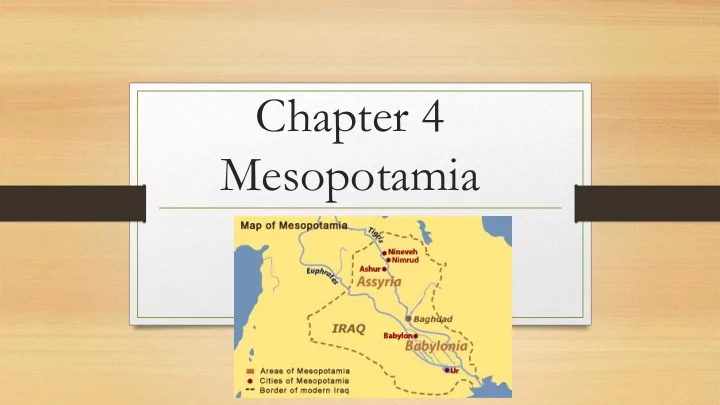
between the Tigris and the Euphrates rivers.
what is known as the Fertile Crescent, which includes parts
Turkey, Syria, Iraq, Lebanon, Israel, and Jordan.
called the fertile crescent?
to settle in Mesopotamia around 7000 B.C. were hunters and herders.
moved to the plains of the Tigris- Euphrates valley and built farming villages along the two rivers.
from rivers to water their crops.
rain and the rivers became very low. Because of this, farmers did not have enough water for their crops.
snow from the northern mountains caused these rivers to
swept away crops, and homes.
silt, or small particles of soil, which were good for farming.
learned to build dams and dig canals to allow the water source into their fields. This method of watering crops is called irrigations.
grow a surplus of food.
surplus of food would have had on one of these ancient communities?
were needed to work at farming, allowing them to pick up other trades and crafts.
people’s lives changed. People began to live together in areas that favored trade and several cities developed in Sumer, a region of Southern Mesopotamia.
Sumerians (Cradle of Civilization).
Southwest Asia, which became centers of civilization and controlled the lower part of the Tigris and Euphrates River Valley.
scorching deserts surrounded Sumer’s cities.
isolation from one another, these cities became independent, and formed their own governments.
around them, city-states were formed.
protected by high walls built from mud from the rivers as their main building material.
another over resources and political borders, but in times of peace, they traded with one another and formed alliances.
many Gods, a practice known as polytheism.
guided various aspects of their lives, and honored the specific god they thought would help with that activity.
Sumerians built large temples called ziggurats in their city-states.
states.
claimed they received the power to rule from the gods.
hereditary, meaning after he died, his son would take over.
into social classes from the time they were born.
government officials
fishermen, artisans
Men:
Women:
wheat, barley, and dates.
the farmland to water crops.
timber.
places such as Turkey, India, and Egypt.
the world was developed.
numbers, and objects.
cuneiform – mostly boys from wealthy families.
wrote documents recording important aspects of everyday life.
people to use the wheel.
donkeys.
warfare.
invented the sailboat.
The wooden plow , potters wheel, and bronze (combining of copper and tin) were other technological advancements.
360 degree circle.
the moon.
positions of the stars.
As the strength of Sumer faded, powerful kingdoms arose in Northern Mesopotamia and built empires. An empire is a group of lands controlled by one ruler.
The kingdom of Akkad developed in Northern Mesopotamia and was ruled by Sargon. Sargon conquered the remaining Sumerian cities. In doing so, he built the world’s first empire. Eventually, his empire would extend to include all people of Mesopotamia.
West of Mesopotamia, was a city called Babylon. Their king, Hammurabi, began conquering the lands north and south, creating the Babylonian Empire.
Hammurabi was best known for creating a set of laws for his empire. These laws dealt with crime and established “an eye for an eye” system of punishment. The laws also protected the less powerful, for example it protected wives from their abusive husbands.
Assyria was an empire which arose about 1,000 years after the empire of Hammurabi and extended into four present day countries: Turkey, Syria, Iran, and Iraq.
The Assyrians built a large and powerful military to defend their territory. The army was made of infantry (foot soldiers), cavalry (horse soldiers) and charioteers. Weapons consisted of slingshots, bows and arrows, swords, and spears. The Assyrians robbed people, set crops on fire, and took tributes or forced payments from conquered people. One of the keys to the success of the Assyrian army was iron weapons. The Hittites, who were located to the North of the Assyrian Empire, mastered the production of iron and shared this technology with the Assyrians.
Assyrian Kings divided their empire into provinces, or political districts. Roads were built to connect each province and the king chose officials to collect taxes and carry out laws in each province.
Lifestyles were built based on what they learned from Mesopotamian people. They had law codes with harsh punishments and their writings were based on Babylonian writing. They worshipped many of the same gods. Assyrians wrote and collected stories and built one of the worlds first libraries. Farming and trade were both very important. They brought in wood and metal from war away to supply their empire with building materials.
In about 650 B.C., fighting broke out to determine who would be the next Assyrian ruler. While Assyria was in turmoil, the Chaldean’s took power with the help
About 1000 B.C., the Chaldeans moved to Southern Mesopotamia and were immediately conquered by the Assyrians. The Chaldeans hated their new rulers and never fully submitted to the Assyrian Empire. Around 627 B.C. another group who wanted to break free from Assyrian rule, the Medes, joined the Chaldeans. In 612 B.C., together they burned the Assyrian capital. The Assyrian empire quickly crumbled. Most of the Chaldeans were descendants of the Babylonians. The city of Babylon was chosen to serve as their capital, and because of this, the Chaldean Empire is sometimes called the New Babylonian Empire.
King Nebuchadnezzar of the Chaldeans rebuilt Babylon making it the largest and richest city in the world. Babylon featured:
roof.
Hanging Gardens, considered one of the seven wonders of the ancient world.
fertile.
maintain his army, Nebuchadnezzar had to collect very high taxes.
Babylonian goods: pottery, cloth, baskets, and jewelry.Trade made Babylon wealthy.
invention of the sundial to tell time, and being the first civilization to follow the seven-day week.
After Nebuchadnezzar died, a series of weak kings ruled the empire. Poor harvests and slow trade further weakened the empire. In 539 B.C. The Persians took advantage and captured Babylon and made Mesopotamia part
maintain their culture.