
SLIDE 1
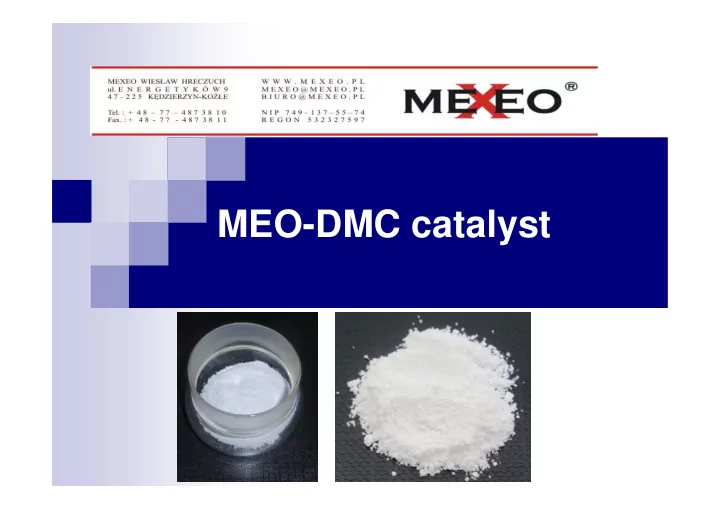
MEO-DMC catalyst Characteristics of conventional polyaddition with - - PowerPoint PPT Presentation
MEO-DMC catalyst Characteristics of conventional polyaddition with alkaline catalysts Conventional polyaddition of low molecular oxiranes has utilized for meny years alkaline type catalysts. However, they exhibited substantial disadvantages,
Conventional polyaddition of low molecular oxiranes has utilized for meny years alkaline type catalysts. However, they exhibited substantial disadvantages, as regards: they exhibited substantial disadvantages, as regards:
Reduction or elimination of polyether chain termination. High molecular weights, not achieved with other methods. Narrow fractional distribution.
Narrow fractional distribution. Extremely high activity:
High selectivity – high quality High unit price but low cost of application.
A highly active DMC type catalyst was succesfully prepared, as MEO-DMC trade name.
ALCALINE CATALYST ACTIVITY (KOH) Catalyst concentration
CKOH= 12 000 ppm
Average rate of PO consumption
RKOH=0,64
g PO/g starter * g cat * h DMC CATALYST ACTIVITY Catalyst concentration
CDMC= 113 ppm
Average rate of PO consumption
RDMC=294
g PO/g starter * g cat * h
alkaline catalyst Meo-DMC
Blue line – feeded PO; Red line – reaction demperature; Green line – overpressure
Meo-DMC Alcaline catatlyst (KOH) Deaeration
DMC CATALYST ACTIVITY Catalyst concentration
CDMC= 28 ppm
Average rate of PO consumption
RDMC=320
g PO/g starter * g cat * h ALCALINE CATALYST ACTIVITY (KOH) Catalyst concentration
CKOH= 3 000 ppm
Average rate of PO consumption
RKOH=0,63
g PO/g starter * g cat * h
Dynamic trends from propoxylation of 100 g PPG450 with 500 g of PO, at 130OC (Nav.=46; Mn=2700)
LOH(theoretical)=41,6 LOH(KOH)=75,7 LOH(DMC)=43,4 !
Meo-DMC KOH
DMC CATALYST ACTIVITY Catalyst concentration
CDMC= 55 ppm
Average rate of EO consumption
RDMC=22,4
g EO/g starter * g cat * h
Blue line – feeded PO; Red line – reaction demperature; Green line – overpressure
Dynamic trends from ethoxylation of C16 alcohol of average polyaddition degree Nav=3, at 130OC
ALCALINE CATALYST ACTIVITY (KOH) Catalyst concentration
CKOH= 944 ppm
Average rate of EO consumption
RKOH=1,1
g EO/g starter * g cat * h
polymerizing alkylene oxides such as propylene oxide and ethylene oxide to yield polether polyols.
certain other alkylene oxides are subject to a competing internal rearrangement that generates unsaturated alcohols. The resulting products will contain allyl alcohol initiated monofunctional impurities. The will contain allyl alcohol initiated monofunctional impurities. The monofunctional impurities tend to reduce the average functionality and broaden the polydispersity of the polyols.
polyether polyols made from the Meo-DMC catalyst have low unsaturations, narrow molecular weight distributions, can have high molecular weight, and are useful in making a variety of polyurethane products,
time of polymerization is reduced largely.
Hreczuch, A. Chruściel, K. Czaja, H. Wojdyła, Przemysł Chemiczny, review Hreczuch, A. Chruściel, K. Czaja, H. Wojdyła, Przemysł Chemiczny, review article, submitted to the Redaction, publication in Sept. 2012.
poliaddycji niskocząsteczkowych epoksydów, otrzymywanych z udziałem katalizatorów dimetalocyjankowych”, A. Chruściel, W. Hreczuch, K. Czaja, J. Janik, H. Wojdyła, VII Kongres Technologii Chemicznej, Kraków, 8-12.07.2012.