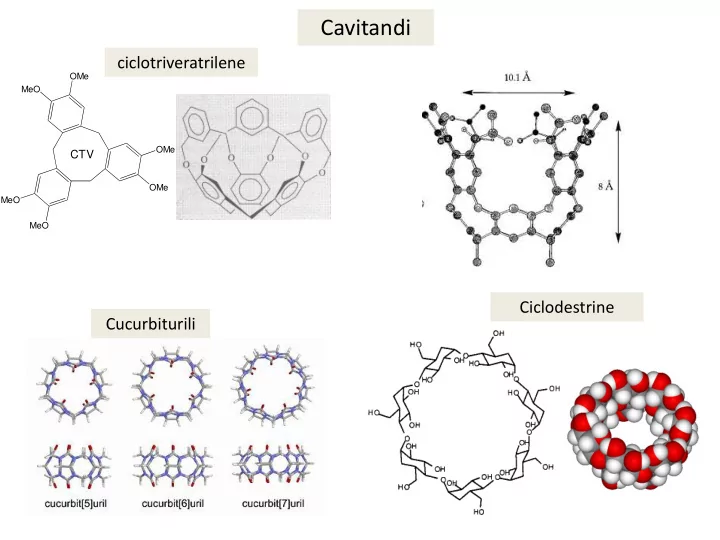
SLIDE 1 Cavitandi
MeO MeO MeO OMe OMe OMe
CTV
ciclotriveratrilene Ciclodestrine Cucurbiturili
SLIDE 2
Capsule Molecolari Pre-organizzazione Protezione dal solvente esterno Rallentamento delle cinetiche di scambio Stabilizzazione di specie reattive Reazioni catalitiche Drug delivery Unione di due cavitandi Connessione covalente Legame idrogeno Legame di coordinazione
SLIDE 3
Carcerando: Contenitore molecolare chiuso (capsula) che definisce cavità sferica, i guest sono intrappolati (all’atto della sintesi) entrata e uscita solo per rottura di legame covalente, i.e. velocità di scambio virtualmente nulla
SLIDE 4
Benzil-tiolo benzil cloruro (o bromuro) Alta dliuz Insolubilità = caratterizz via IR, FAB-MS, analisi elementare, test chimici FAB-MS dei carciplessi Carcerandi
SLIDE 5
fenolo bromo-clorometano Carcerandi
SLIDE 6
SLIDE 7
SLIDE 8
SLIDE 9
SLIDE 10
SLIDE 11
SLIDE 12
SLIDE 13
Emicarcerando: Contenitore molecolare chiuso (capsula) che definisce cavità sferica, i guest sono intrappolati (all’atto della sintesi) - entrata e uscita senza rottura di legame covalente, i.e. velocità di scambio misurabile
SLIDE 14
A OCH2O SCH2S O(CH2)4O O(CH2)5O O(CH2)6O O(CH2)2O(CH2)2O A
SLIDE 15
Intrinisic binding, the free energy of complexation, depends on the magnitude of the noncova- lent interactions between the guest and the host’s inner surface. Constrictive binding, activation energy required for a guest to enter the inner cavity of a hemicarcerand through a size restricting portal in the host’s skin.
SLIDE 16
Constrictive binding: aumenta con le dimensioni del guest, diminuisce con le dimensioni dei portali, e con l’aumento della flessibilità dei linker (T).
SLIDE 17
Gate mechanisms (molecular mechanics calculations) – French door chair-to-boat transition of the methylene bridges, calculated barrier 22 kcal/mol.
SLIDE 18
Gate mechanisms (molecular mechanics calculations) – Sliding door twisting and untwisting of the two host cavitands – measured barrier (VT NMR) 12.6 kcal/mol
SLIDE 19
SLIDE 20
SLIDE 21
SLIDE 22
SLIDE 23
SLIDE 24
SLIDE 25
SLIDE 26
SLIDE 27 The progress of the photodimerization was also monitored by thin-layer chromatography, which showed only one band after completion of the
- photodimerization. Photodimer 4 was purified after photolysis at 350 nm.
In the high-resolution mass spectrum the molecular ion of photoproduct 4 has the same mass as the parent open-state host 3.
SLIDE 28
SLIDE 29
The Ph2O mixture was irradiated at 350 nm for 1 h and then poured into 10 mL of MeOH. The precipitate was dissolved in CDCl3 and the 1H NMR spectrum was recorded (F. 6c). The methyl signal of the guest showed a shift from 3.78 to 0.37 ppm ( = 4.15 ppm), and the anthracene peaks of 3 disappeared (F. 6c). This indicates that after the gate of 3 is closed, a carceplex is formed between the carcerand 4 and the guest. MALDI mass spectra indicate formation of this carceplex. The carceplex 4@G can stay in the dark at ambient temperature more than 4 weeks without detectable release of the guest molecule (F. 6d). As a result, the activation energy for decomplexation in the open state 3@G and the incarcerated guest can egress easily. The gate-opened hemicarcerand is then almost exclusively filled with the solvent CDCl3
SLIDE 30 8K - matrice gas inerte congelato
O O O O h h
O2 O O
Fotolisi a-pirone a lattame, fotolisi a ciclobutadiene a T amb 220° (5min), cicloctatetraene Aldeide maleica
free
SLIDE 31 O O h 77 K O H2O COOH 77 K h
Benzociclobutendione Benzociclopropenone
1H e 13C NMR a bassa T
SLIDE 32
Water soluble octa-acid hemicarcerand: Hydrophobic effect (higher than cyclodextrines)!
SLIDE 33
CH- interactions for isomeric xylenes or dimetoxybenzenes direct the order of affinity: meta > para >> ortho
SLIDE 34
CH- interactions for isomeric xylenes or dimetoxybenzenes direct the order of affinity: meta > para >> ortho
SLIDE 35
SLIDE 36
Tennis-ball
unità glicolurile
V ca. 60 Å3
SLIDE 37
V ca. 60 Å3
SLIDE 38
Molecular Cylinder
V ca. 420 Å3
SLIDE 39
V = 400 Å3 8 H 12 Å 16 Å
SLIDE 40 From molecular mechanics calculations:
the encapsulated guest(s) occupy approximately 55% of the available space (same
- ccupancy inside most weakly interacting organic solvents).
Stability deacreases at higher or lower space occupancy.
SLIDE 41
SLIDE 42
Model structure: incapsulation of coiled alkanes - tetradecane
SLIDE 43
trans-4,4’-dimethylazobenzene (trans-1) (cis-1)
SLIDE 44
SLIDE 45
SLIDE 46
Social Isomers
Cloroformio ed N-metil-para-toluidina, no interconversione
SLIDE 47 Social Isomers:
The orientational preference of
- ne guest depends on the presence
- f the co-guest.
MM optimized structures: cloroformio e para-etiltoluene
SLIDE 48
Constellation Isomers
MM optimized structures: cloroformio e iso-propilcloruro
SLIDE 49
In addition to being able to preserve highly labile species, they may serve as catalysts and accelerate reactions inside their inner cavity by either concentrating the reactants leading to higher effective concentrations or TS stabilization or by preorganising them inside the capsule. They may create a micro-environment in which two encapsulated reactants are held together in a orientation that differs from their most reactive arrangment in solution (or gas phase) leading to products that are disfavoured in equivalent solution phase reactions.
SLIDE 50
Cicloaddizione 1,3 regioselettiva di fenilacetilene e fenilazide
Reattività nelle capsule molecolari
SLIDE 51
SLIDE 52
Cicloaddizione 1,3 regioselettiva di fenilacetilene e fenilazide: Volume definito = [ ] 4M vs mM Tempo di contatto = 1 s vs 1 ns Solvatazione fissa
Reattività nelle capsule molecolari
SLIDE 53
V ca. 400 Å3
Soft Ball
SLIDE 54
Soft Ball
SLIDE 55
Reattività nelle capsule molecolari
SLIDE 56
2 days 20 days
SLIDE 57
Reattività nelle capsule molecolari
Cicloaddizione Diels-Alder acceleraz di ca. 200 volte [ ] = 5M Solvatazione Tempo di contatto
SLIDE 58