Meeting the Challenges of the Worlds Growing Dependence on - - PowerPoint PPT Presentation

meeting the challenges of the world s growing dependence
SMART_READER_LITE
LIVE PREVIEW

Meeting the Challenges of the Worlds Growing Dependence on - - PowerPoint PPT Presentation

Meeting the Challenges of the Worlds Growing Dependence on Groundwater William M. Alley Director, Science and Technology National Ground Water Association 62 nd Annual New Mexico Water Conference Socorro, NM August 15, 2017 Foster and


slide-1
SLIDE 1

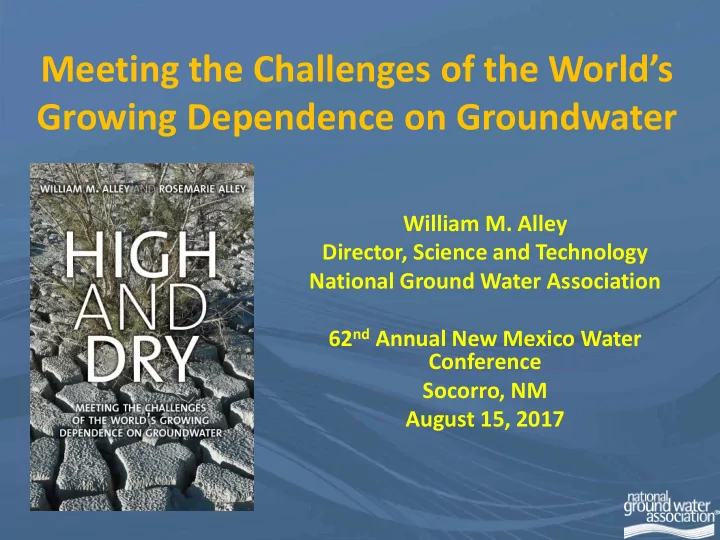
Meeting the Challenges of the World’s Growing Dependence on Groundwater

William M. Alley Director, Science and Technology National Ground Water Association 62nd Annual New Mexico Water Conference Socorro, NM August 15, 2017

slide-2
SLIDE 2

Foster and Chilton (2003)

slide-3
SLIDE 3

Wada et al (2009) remapped by Aeschbach-Hertig and Gleeson (2012)

slide-4
SLIDE 4

Five countries account for 60% of the world’s groundwater use

  • India (25%)
  • United States (11%)
  • China (11%)
  • Pakistan (7%)
  • Iran (6%)
slide-5
SLIDE 5

High Plains Farmer: “We can’t wait another 30 years to get our policy

  • right. The drought in California is

showing what living in denial can do.”

slide-6
SLIDE 6

“Houston, we have a problem,” Apollo 13

NASA photo

slide-7
SLIDE 7

Hydrologic Cooperation: Tribunal de las Aquas de Valencia

slide-8
SLIDE 8

Hydrologic Insubordination: La Mancha, Spain

slide-9
SLIDE 9

The World Bank, ”Deep Wells and Prudence” (2010)

slide-10
SLIDE 10

Northwest India: Groundwater Depletion from GRACE

Rodell et al (2009) Nature

slide-11
SLIDE 11

Main Hydrogeological Provinces of India

slide-12
SLIDE 12

Arsenic in Groundwater

slide-13
SLIDE 13

Making the Great Artesian Basin Great Again

Wikipedia

slide-14
SLIDE 14

Bangkok, Thailand

Buapeng and Foster, 2008

slide-15
SLIDE 15

Bangkok, Thailand

Buapeng and Foster, 2008

slide-16
SLIDE 16

Collaborative Modeling and Citizen Scientists—San Pedro River, AZ

slide-17
SLIDE 17

Upper San Pedro River Basin, AZ

  • Managing the cone of depression vs managing

the riparian system

slide-18
SLIDE 18

Denmark: Aquifer Protection

GEUS: Danish Geological Survey

slide-19
SLIDE 19

Resilience

  • Resilience is the capacity of a groundwater (or

water-resources) system to withstand either short- term ‘shocks’ (e.g., drought) or longer term change (e.g., climate change):

  • -Need to define timeframe
  • -Applies to both water quantity and quality
  • - May be an important part of GW sustainability
slide-20
SLIDE 20

Source: USGS Fact Sheet 2015-3084

But how resilient is groundwater?

slide-21
SLIDE 21

Drought-proofing Groundwater

  • Analyze GW systems for their resilience and vulnerability to

climate perturbations rather than just assuming groundwater is a convenient backup supply

  • Raise awareness about maintaining groundwater as a reserve
  • -Monitoring water use and water levels
  • -Potential for managed aquifer recharge
  • Work toward laws, regulations, and incentives that encourage

use of surface water during wet periods and prepare for increased groundwater use during droughts

(Alley, “Drought-Proofing Groundwater,” Groundwater, May-June 2016)

slide-22
SLIDE 22

Scanlon et al. (2016) Environ. Res. Lett.

slide-23
SLIDE 23

Factors Contributing to Good Groundwater Governance

  • Recognizing surface water and groundwater as

a single resource

  • Active engagement of local stakeholders in the

decision-making process

  • Pressure from external bodies to achieve

suitable and workable solutions

  • Public education on groundwater and its

importance

slide-24
SLIDE 24

Factors Contributing to Good Groundwater Governance (cont.)

  • An emphasis on public guardianship and

collective responsibility

  • Integration of groundwater considerations

into other policies (agriculture, land use, regulation of hazardous substances, etc.)

  • Adequate laws and enforcement
  • Adequately funded and properly staffed

groundwater management agencies

slide-25
SLIDE 25

Factors Contributing to Good Groundwater Governance (cont.)

  • Characterization of major aquifer systems
  • Effective monitoring of groundwater status and

trends by an independent agency

  • Recognizing the long-term response of

groundwater systems

  • Recognizing the feedbacks between groundwater

and climate

  • Community leadership
slide-26
SLIDE 26

Questions?