SLIDE 1
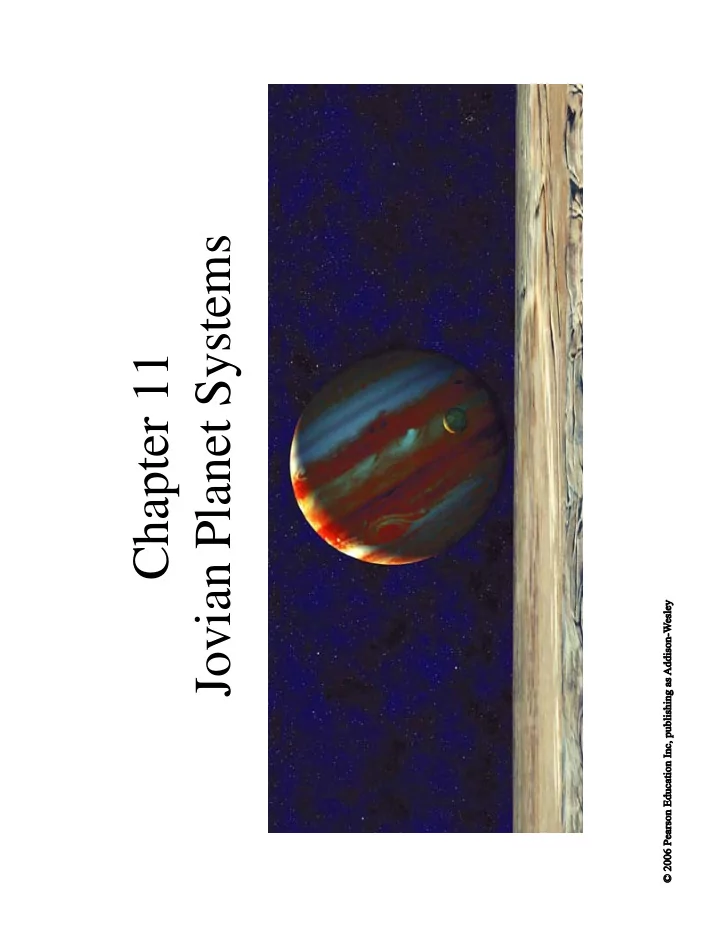
Chapter 11 Jovian Planet Systems
SLIDE 2 11.1 A Different Kind of Planet
- Our goals for learning
- Are jovian planets all alike?
- What are jovian planets like on the inside?
- What is the weather like on jovian planets?
- Do jovian planets have magnetospheres like
Earth’s?
SLIDE 3
Are jovian planets all alike?
SLIDE 4 Jovian Planet Composition
– Mostly H and He gas
– Mostly hydrogen compounds: water (H2O), methane (CH4), ammonia (NH3) – Some H, He, and rock
SLIDE 5 Density Differences
0.5 1 1.5 2 J u p i t e r S a t u r n U r a n u s N e p t u n e Density (g/cc)
are denser than Saturn because they have less H/He, proportionately
SLIDE 6 Density Differences
0.5 1 1.5 2 J u p i t e r S a t u r n U r a n u s N e p t u n e Density (g/cc)
doesn’t work for Jupiter….
SLIDE 7 Sizes of Jovian Planets
jovian planet compresses the underlying gas layers
SLIDE 8 Sizes of Jovian Planets
is why Jupiter is not much larger than Saturn even though it is three times more massive
even more mass can be smaller than Jupiter
SLIDE 9 Rotation and Shape
not quite spherical because of their rapid rotation
SLIDE 10
What are jovian planets like on the inside?
SLIDE 11 Interiors of Jovian Planets
- No solid surface.
- Layers under high pressure and
temperatures.
- Cores (~10 Earth masses) made of hydrogen
compounds, metals & rock
- The layers are different for the different
- planets. WHY?
SLIDE 12 Inside Jupiter
inside Jupiter cause phase of hydrogen to change with depth
metal at great depths because its electrons move freely
SLIDE 13 Inside Jupiter
be made of rock, metals, and hydrogen compounds
size as Earth but 10 times as massive
SLIDE 14 Comparing Jovian Interiors
- Models suggest cores of jovian planets have similar
composition
- Lower pressures inside Uranus and Neptune mean no
metallic hydrogen
SLIDE 15 Jupiter’s Internal Heat
twice as much energy it receives from Sun
comes from slow contraction of interior (releasing potential energy)
SLIDE 16 Internal Heat of Other Planets
- Saturn also radiates twice as much energy it
receives from Sun
- Energy probably comes from differentiation
(helium rain)
- Neptune emits nearly twice as much energy
as it recieves, but the source of that energy remains mysterious
SLIDE 17
What is the weather like on jovian planets?
SLIDE 18 Jupiter’s Atmosphere
compounds in Jupiter form clouds
layers correspond to freezing points of different hydrogen compounds
H2O NH4SH NH3
SLIDE 19 Jovian Planet Atmospheres
have cloud layers similar to Jupiter’s
compounds make clouds of different colors
SLIDE 20 Jupiter’s colors
- Ammonium sulfide clouds (NH4SH) reflect red/brown.
- Ammonia, the highest, coldest layer, reflects white.
SLIDE 21 Saturn’s colors
- Saturn’s layers are similar, but deeper in and
farther from the Sun --- more subdued.
SLIDE 22 Methane on Uranus and Neptune
Neptune and Uranus absorb red light but transmit blue light
- Blue light reflects
- ff methane clouds,
making those planes look blue
SLIDE 23
Jupiter’s Bands
White ammonia clouds form where air rises Coriolis effect changes N-S flow to E-W winds Between white clouds we see deeper reddish clouds of NH4SH Warmer red bands are brighter in IR
SLIDE 24 Jupiter’s Great Red Spot
- A storm twice as wide as Earth
- Has existed for at least 3 centuries
SLIDE 25 Weather on Jovian Planets
- All the jovian planets have strong winds and
storms
SLIDE 26
Do jovian planets have magnetospheres like Earth’s?
SLIDE 27 Jupiter’s Magnetosphere
- Jupiter’s strong magnetic field gives it an enormous
magnetosphere
- Gases escaping Io feed the donut-shaped Io torus
Aurora on Jupiter
SLIDE 28 Other Magnetospheres
planets have substantial magnetospheres, but Jupiter’s is largest by far
SLIDE 29 What have we learned?
- Are jovian planets all alike?
– Jupiter and Saturn are mostly H and He gas – Uranus and Nepture are mostly H compounds
- What are jovian planets like on the inside?
– Layered interiors with very high pressure and cores made of rock, metals, and hydrogen compounds – Very high pressure in Jupiter and Saturn can produce metallic hydrogen
SLIDE 30 What have we learned?
- What is the weather like on jovian planets?
– Multiple cloud layers determine colors of jovian planets – All have strong storms and winds
- Do jovian planets have magnetospheres
like Earth’s?
– All have substantial magnetospheres – Jupiter’s is largest by far
SLIDE 31 11.2 A Wealth of Worlds: Satellites of Ice and Rock
- Our goals for learning
- What kinds of moons orbit jovian planets?
- Why are Jupiter’s Galilean moons so
geologically active?
- What is special about Titan and other major
moons of the solar system?
- Why are small icy moons more geologically
active than small rocky planets?
SLIDE 32
What kinds of moons orbit the jovian planets?
SLIDE 33 Sizes of Moons
– No geological activity
- Medium-sized moons (300-1,500 km)
– Geological activity in past
– Ongoing geological activity
SLIDE 34 Medium & Large Moons
be spherical
amounts of ice.
around jovian planets.
direction as planet rotation.
SLIDE 35 Small Moons
- Far more numerous than the medium and large
moons.
- Not enough gravity to be spherical: “potato-
shaped”
SLIDE 36 Small Moons
- Captured asteroids or comets, so orbits do
not follow usual patterns.
SLIDE 37
Why are Jupiter’s Galilean moons so geologically active?
SLIDE 38 Io’s Volcanic Activity
- Io is the most volcanically active body in the
solar system, but why?
SLIDE 39 Io’s Volcanoes
- Volcanic eruptions continue to change Io’s surface
SLIDE 40 Tidal Heating
Io is squished and stretched as it orbits Jupiter But why is its
elliptical?
SLIDE 41 Orbital Resonances
Every 7 days, these 3 moons line up. The tugs add up over time, making all 3
SLIDE 42
Europa’s Ocean: Waterworld?
SLIDE 43
Tidal stresses crack Europa’s surface ice.
SLIDE 44
Europa’s interior also warmed by tidal heating
SLIDE 45 Ganymede
solar system
geological activity
heat from radio- active decay?
SLIDE 46 Callisto
iceball.
no orbital resonances.
magnetic field !?
SLIDE 47 What is special about Titan and
- ther major moons of the outer
solar system?
SLIDE 48 Titan’s Atmosphere
moon in the solar system to have a thick atmosphere
nitrogen with some argon, methane, and ethane
SLIDE 49 Titan’s Surface
- Huygens probe provided first look at Titan’s surface in
early 2005
- Liquid methane, “rocks” made of ice
SLIDE 50 Medium Moons of Saturn
- Almost all show evidence of past volcanism
and/or tectonics
SLIDE 51 Medium Moons of Uranus
geological activity
large tectonic features and few craters (episode of tidal heating in past?)
SLIDE 52 Neptune’s Moon Triton
larger
geological activity
SLIDE 53
Why are small icy moons more geologically active than small rocky planets?
SLIDE 54 Rocky Planets vs. Icy Moons
temperatures
planets have enough heat for activity
temperatures
melt internal ice, driving activity
SLIDE 55 What have we learned?
- What kinds of moons orbit jovian planets?
– Moons of many sizes – Level of geological activity depends on size
- Why are Jupiter’s Galilean moons so
geologically active?
– Tidal heating drives activity, leading to Io’s volcanoes and ice geology on other moons
SLIDE 56 What have we learned?
- What is special about Titan and other major
moons of the solar system?
– Titan is only moon with thick atmosphere – Many other major moons show signs of geological activity
- Why are small icy moons more geologically
active than small rocky planets?
– Ice melts and deforms at lower temperatures enabling tidal heating to drive activity
SLIDE 57 11.3 Jovian Planet Rings
- Our goals for learning
- What are Saturn’s rings like?
- How do other jovian ring systems compare
to Saturn’s?
- Why do the jovian planets have rings?
SLIDE 58
What are Saturn’s rings like?
SLIDE 59 What are Saturn’s rings like?
- They are made up of numerous, tiny
individual particles
- They orbit over Saturn’s equator
- They are very thin
SLIDE 60
Earth-based view
SLIDE 61
Spacecraft view of ring gaps
SLIDE 62
Artist’s conception of close-up
SLIDE 63 Gap Moons
create gaps within rings
SLIDE 64 Shepherd Moons
- Pair of small moons can force particles into a narrow ring
SLIDE 65 Resonance Gaps
with a larger moon can also produce a gap
SLIDE 66
How do other jovian ring systems compare to Saturn’s?
SLIDE 67 Jovian Ring Systems
- All four jovian planets have ring systems
- Others have smaller, darker ring particles than Saturn
SLIDE 68
Why do the jovian planets have rings?
SLIDE 69 Why do the jovian planets have rings?
- They formed from dust created in impacts
- n moons orbiting those planets
How do we know that?
SLIDE 70 How do we know?
- Rings aren’t leftover from planet formation
because the particles are too small to have survived this long.
- There must be a continuous replacement of
tiny particles.
- The most likely source is impacts with the
jovian moons.
SLIDE 71 Ring Formation
- Jovian planets all have rings because they
possess many small moons close-in
- Impacts on these moons are random
- Saturn’s incredible rings may be an “accident”
- f our time
SLIDE 72 What have we learned?
- What are Saturn’s rings like?
– Made up of countless individual ice particles – Extremely thin with many gaps
- How do other jovian ring systems compare
to Saturn’s?
– Much fainter ring systems with smaller, darker, less numerous particles
- Why do the jovian planets have rings?
– Ring particles are probably debris from moons