SLIDE 1
1
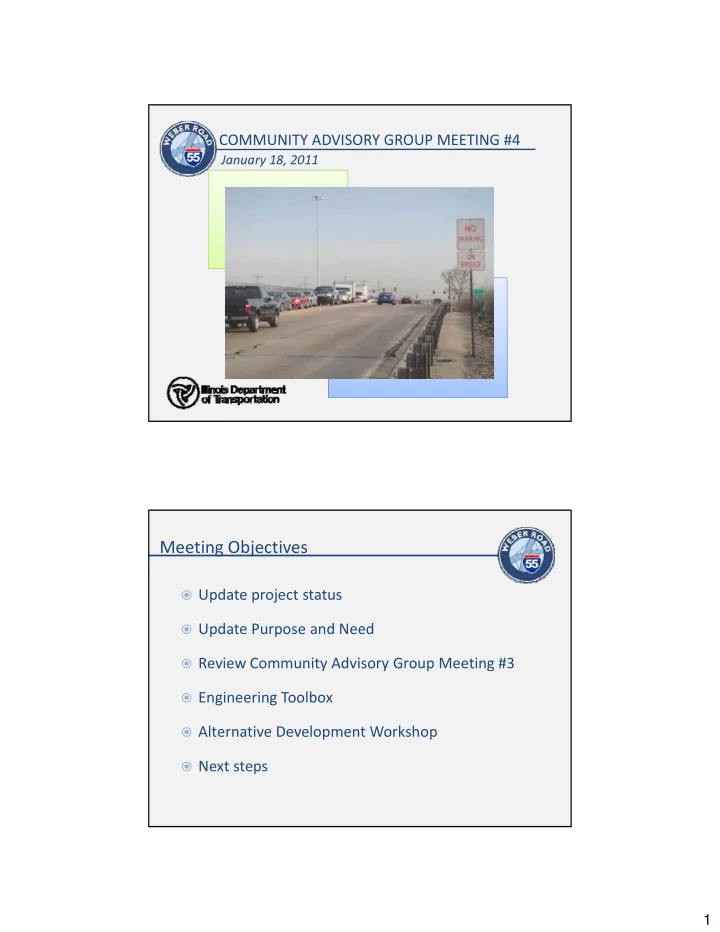
COMMUNITY ADVISORY GROUP MEETING #4
January 18, 2011
Meeting Objectives
Update project status Update Purpose and Need Review Community Advisory Group Meeting #3 Engineering Toolbox Alternative Development Workshop Next steps
SLIDE 2 2
Project Status Purpose and Need Report
PROBLEM STATEMENT
- CAG WORKSHOP
- COMMUNITY CONTEXT SURVEY
ENGINEERING ANALYSIS
CRASH DATA ANALYSIS
PURPOSE AND NEED REPORT
- CRASH DATA ANALYSIS
- TRAFFIC DATA ANALYSIS
PUBLIC AND AGENCY COORDINATION
SLIDE 3 3
WHAT IS THE PURPOSE AND NEED?
Need is a tangible fact based problem ; i e a Need is a tangible fact based problem ; i.e. a transportation deficiency Purpose is an overarching statement of why you are pursuing the project; objectives that will be met to pursuing the project; objectives that will be met to address the transportation deficiency
Purpose and Need Report
Need: Address Operational Deficiencies
Traffic signal delay Unacceptable level of service on Weber Road High volume turn movements Inadequate lane Signals (traffic/ pedestrian) Street lighting/
Technical Analysis Problem Statement Stakeholder Input
service on Weber Road and I‐55 ramps Inadequate lane marking Merging issues Poor signage Traffic signal delay Street lighting/ pedestrian lighting Roadways compatible to existing businesses Roadways compatible to existing commuting patterns
SLIDE 4 4
Purpose and Need Report
Need: Improve Capacity
Projected increase in traffic volumes Substandard geometrics High volume of trucks No alternate north‐ south routes Industrial centers and commercial areas Commuter corridor
Technical Analysis Problem Statement Stakeholder Input
Substandard geometrics (travel lanes, intersections) south routes Inadequate access to I‐ 55 Congestion Commuter corridor Congestion and delay
Purpose and Need Report
Need: Improve Safety
High number of crashes Multi‐modal conflicts Motorist delay Prevents efficient access Traffic Safety Congestion and delay
Technical Analysis Problem Statement Stakeholder Input
High number of rear‐ end and sideswipe collisions Crashes data consistent with congestion No crosswalks or continuous bike paths Congestion Lack of pedestrian, ADA, and bike facilities Improve pedestrian access and bike path continuity Handicap accessibility Sidewalks and pedestrian crossings Bike lanes/recreation facilities
SLIDE 5 5
Project Purpose
The purpose of the proposed action is to address congestion and mobility problems in the Weber Road corridor identified in the study area, improve community connectivity, and improve access for commercial and residential users of I‐55 and Weber Road Road.
Project Purpose
The purpose of the proposed action is to address
capacity and safety deficiencies of the interchange capacity, and safety deficiencies of the interchange at Interstate 55 and Weber Road in Will County, Illinois.
SLIDE 6 6
Project Purpose
The purpose of the proposed action is to address
- perational, capacity, and safety deficiencies of the
interchange at Interstate 55 and Weber Road in Will County, Illinois.
Purpose and Need Report
QUESTIONS
SLIDE 7 7
Alternative Development Process Alternative Development Process
Review CAG #3
Identify Context p Context Define Problem Evaluation Criteria Define and Evaluate Alternatives Identify Stakeholders
Considerations
Preferred Alternative
Considerations
Stakeholder Considerations / Community Assets Environmental Considerations / Compatibility with the Environment Engineering Considerations / Transportation Needs
Alternative Development Process Alternative Development Process
Review CAG #3
Identify Context p Context Define Problem Evaluation Criteria Define and Evaluate Alternatives Identify Stakeholders Preferred Alternative Establish transportation performance measures Inventory existing environmental constraints Identify evaluation metrics
SLIDE 8 8
Alternative Development Process Alternative Development Process
Review CAG #3
Identify Context p Context Define Problem Evaluation Criteria Define and Evaluate Alternatives Identify Stakeholders Preferred Alternative Develop initial alternatives with stakeholders Confirm alternatives meet Purpose and Need and compare
transportation performance
Eliminate low ranked alternatives
Alternative Development Process Alternative Development Process
Review CAG #3
Identify Context p Context Define Problem Evaluation Criteria Define and Evaluate Alternatives Identify Stakeholders Preferred Alternative Detailed engineering and environmental analysis of remaining
alternatives
Evaluate performance, impacts, and costs Recommend preferred alternative
SLIDE 9
9
Engineering Toolbox
Interchange Improvements Weber Road Improvements Non‐Motorized Improvements
Engineering Toolbox
Interchange Improvements Weber Road Improvements Non‐Motorized Improvements
SLIDE 10
10
Interchange Improvements
CLOVERLEAF CLOVERLEAF
Free‐flowing traffic Large footprint Weaving sections Weaving sections Not pedestrian friendly
Interchange Types
I‐55 at Lemont Road
SLIDE 11
11
Interchange Improvements
Diamond Diamond
Signal controlled
intersections
Smaller footprint
Interchange Types
I‐88 at IL‐59
SLIDE 12
12
Interchange Improvements
Partial Cloverleaf Partial Cloverleaf
No weaving Some free‐flowing
movements
Some signal control Smaller footprint in
some quadrants
Interchange Types
I‐80 at La Grange Road
SLIDE 13
13
Interchange Improvements
Split Diamond Split Diamond
Signal controlled
intersections
Access split at two
locations locations
Frontage road system
Interchange Types
I‐290/IL‐53 at Algonquin Road
SLIDE 14
14
Interchange Improvements
Single Point Urban Diamond (SPUDI)
Small footprint One signalized
intersection intersection
Large structure
Interchange Types
I‐55 at Cicero Avenue
SLIDE 15
15
Interchange Improvements
Diverging Diamond Diverging Diamond
Small footprint Accommodates heavy
left turn traffic
Free flow Interstate
entrances
Driver unfamiliarity
Interchange Types
Diverging Diamond Interchange
SLIDE 16
16
Interchange Types
Pioneer Crossing I‐15 to Redwood Road, Utah
Engineering Toolbox
Interchange Improvements Weber Road Improvements Non‐Motorized Improvements
SLIDE 17
17
Weber Road Improvements
Existing Lanes Added Lane Added Lane Lanes
Additional Capacity Weber Road Improvements Lighting
SLIDE 18
18
Weber Road Improvements
Raised Median Median
Access Control Weber Road Improvements
Physically Separated Turn Lanes Turn Lanes
Channelization
SLIDE 19 19
Weber Road Improvements
Additional turn lanes Improved traffic signal
coordination
Turn prohibitions Improved signage/striping
Intersection Improvements p g g p g
Pedestrian/Bicyclist
accommodations
Engineering Toolbox
Interchange Improvements Weber Road Improvements Non‐Motorized Improvements
SLIDE 20
20
Non‐Motorized Improvements
Improved Pedestrian Facilities
Non‐Motorized Improvements
Improved ADA Facilities
SLIDE 21 21
Non‐Motorized Improvements
Improved Bicycle Facilities
Non‐Motorized Improvements
Real‐time traveler information Real time traveler information Variable/dynamic messaging 511 systems Adaptive signal control
Intelligent Transportation Systems (ITS)
Trailblazer signs
SLIDE 22
22
Alternative Development Workshop
Alternative Development Workshop
SLIDE 23
23
Alternative Development Workshop Next Steps
SLIDE 24
24
Thank You!
Community Advisory Group Meeting #5 Range of Alternatives TBD