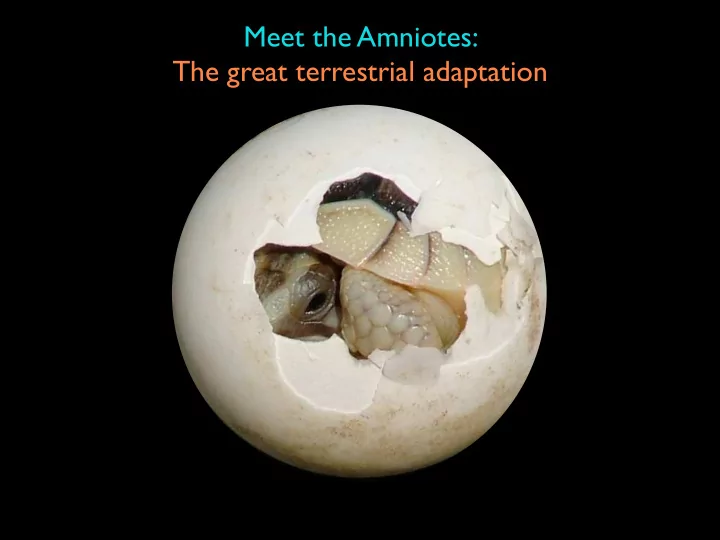
SLIDE 1
Meet the Amniotes: The great terrestrial adaptation
SLIDE 2
Urochordata Cephalochordata Assorted jawless fish Most ‘fishes’ Most ‘amphibians’ Synapsids Anapsids Lepidosaurs Archaic archosaurs Crocodiles Pterosauria Dinosauria
Chordata Vertebrata Gnathostomata Tetrapoda Amniota
Amniotic egg Thick skin Distinctive skulls
SLIDE 3
The cleidoic egg: a private pond
Eggshell: Semipermeable Calcareous or leathery Albumen: Egg cytoplasm Amnion: Protection / Gas transfer Yolk Sac: Nutrient Pool Allantois: Waste Pool
SLIDE 4
Amniotes Synapsida Diapsida Anapsida Eureptilia Lepidosauria Archosauria
First amniotes in record (!!)
SLIDE 5
Walking with Monsters Chapter 2 1:10-5:00
SLIDE 6 Evolution of Eggs?
Some modern amphibians lay eggs on land... why?
- One inner membrane
- 1. escape predation
To deal with longer time periods on dry land, tougher shells were selected for. Gas exchange and waste devices evolved for complete eggtonomy Eggs became larger,
produce larger babies, which had a higher likelihood of survival in a tough world.
SLIDE 7
Evolution of Hair?
Amniotes all have the gene for hair: alpha keratin In birds/lizards, it’s expressed in claws In mammals, it’s used in hair & nails 310 Ma Castorcauda First direct fossil evidence of hair (mid-Jurassic) Thrinaxodon Blood vessel channels on premaxillae, maxillae ~vibrassae (whiskers) (early Triassic)
SLIDE 8
Meet the Amniotes
Upper temporal fenestra Lower temporal fenestra Single temporal fenestra No temporal fenestra fenestra = ‘window’
SLIDE 9
SLIDE 10
The Permian
299-251 Ma
SLIDE 11
SLIDE 12
The Permian 299-251 Ma
SLIDE 13
Convergence of Pangaea
The effects of the landscape on climate: Heat distributed more equally through fluids than solids Oceans slower to warm/cool than continents Pangaea: Rapid warming/cooling ~ more intense than today Temperature extremes Our modern continents are ‘tempered’ by oceans between them. Not Pangaea Gondwana icecap disappeared as continent drifted north
SLIDE 14
Hot, arid terrains formed in the northern hemisphere ~Evaporite deposits Wetland plants mostly replaced by seed- bearing plants and conifers Northern conifer forests Southern glossopterid forests: pteridosperms, or seed-ferns)
SLIDE 15 A bit about seed-ferns:
- A paraphyletic group of seed-bearing extinct
plants
- Refer to members of a group that are fern-
like & seed-bearing, but are not angiosperms, ginkgophytes, conifers, or cycadophytes (distinct by elimination)
- Related to other seed plants
- Flourished during Carboniferous, Permian
- Declined during Cretaceous
- They aren’t ferns
SLIDE 16
Urochordata Cephalochordata Assorted jawless fish Most ‘fishes’ Most ‘amphibians’ Synapsids Anapsids Lepidosaurs Archaic archosaurs Crocodiles Pterosauria Dinosauria
Chordata Vertebrata Gnathostomata Tetrapoda Amniota Archosauria
SLIDE 17
Amniotes Synapsida Diapsida Anapsida Eureptilia Lepidosauria Archosauria
SLIDE 18
Ecological Turnover: Basal tetrapods => amniotes
Capetus Pederpes Mesosaurus Milleretta Captorhinus Exploit the dry land!
SLIDE 19 Synapsida Therapsida Theriodontia
Gorgonopsia Therocephalia Cynodontia
Eupelycosauria
Dinocephalia Dicynodontia Pelycosauria (paraphyletic)
Anapsida Diapsida
Amniota
Eureptilia
Edaphosaurids Sphenacodontids
SLIDE 20 Pelycosauria
- early Permian
- most diverse group (70% of genera)
- basal
Early Pelycosaurs: small, carnivorous Eothyris: early Permian
SLIDE 21 Pelycosauria
- most diverse group (70% of genera)
- caseids
Herbivorous Pelycosaurs: large Cotylorynchus: mid-Permian
- Largest Pelycosaur
- Peg-like Teeth
- Enormous gut cavity
- Angled Jaw
SLIDE 22 Pelycosauria
- most diverse group (70% of genera)
- Varnopseids: small group of carnivorous Pelycosaurs (early Permian)
- Edaphosaurids herbivores (early Permian)
SLIDE 23 Pelycosauria
- most diverse group (70% of genera)
- Sphenacodontids: Large Carnivores, early to mid Permian
Dimetrodon
SLIDE 24
What’s the deal with the sail?
Lanthasaurus Sphenacodon Platyhystrix (Temnospondyl)
Contemporary of Pelycosaurs CONVERGENT EVOLUTION
?
Poikilotherms
SLIDE 25
Walking with Monsters 11:58-18:06
SLIDE 26 Synapsida Therapsida Theriodontia
Gorgonopsia Therocephalia Cynodontia
Eupelycosauria
Dinocephalia Dicynodontia Pelycosauria (paraphyletic)
Anapsida Diapsida
Amniota
Eureptilia
Edaphosaurids Sphenacodontids
SLIDE 27 Therapsids
Tetraceratops Basal Therapsid enlarged temporal fenestra reduction in palatal teeth Biarmosuchus Single prominent Canine tooth
- Basal
- Dinocephalia
- Dicynodontia
- Gorgonopsids
- Mammal Ancest.
SLIDE 28 Therapsids
Late Permian 40 genera Herbivores & Carnivores Titanophoneus Moschops Largest terrestrial animal of the time Placed hind legs directly under body Headbutting?
- Basal
- Dinocephalia
- Dicynodontia
- Gorgonopsids
- Mammal Ancest.
SLIDE 29 Therapsids
- Late Permian
- Basal
- Dinocephalia
- Dicynodontia
- Gorgonopsids
- Mammal Ancest.
Wadiasaurus Kingoria Placerius
‘Pigs’ of the Permian
Herbivorous Horny beak Enlarged temporal fenestra Lystrosaurus
SLIDE 30 Therapsids
- Late Permian
- Basal
- Dinocephalia
- Dicynodontia
- Gorgonopsids
- Mammal Ancest.
Arctognathus
SLIDE 31 Hey Great*107 Grandma!
Therapsids
- Late Permian
- Basal
- Dinocephalia
- Dicynodontia
- Gorgonopsids
- Mammal Ancest.
Cynodontia
SLIDE 32
Amniotes Synapsida Diapsida Anapsida Eureptilia Lepidosauria Archosauria
SLIDE 33 Anapsids
Scutosaurus
Pareiasaurs