SLIDE 1
Mechanisms of Enzyme Action
SLIDE 2
Kinetics of an uncatalyzed chemical reaction: S S* P “Reaction coordinate” Free energy, ΔG Ea is “activation energy”
SLIDE 3
Kinetics of a catalyzed chemical reaction: S + E ES ES* EP E + P “Reaction coordinate” Free energy, G 1. Enzyme does not affect ΔG or ΔGo between S and P (i.e., equilibrium) 2. Enzyme reduces Ea: Ea (catalyzed) < Ea (uncatalyzed)
SLIDE 4
A more complete way of showing the effects of enzymes: Enzymes bind to substrates, so G(ES) < G(E+S). However, if all they did was to bind, then Ea =ΔG(ES*) for the reaction would not be reduced. So when they bind the substrate, they stress It in some way, raising G(ES) for part of the substrate and reducing ΔG(ES*)(=Ea).
SLIDE 5
For reaction A B, V = k[A] k = ( T/h)exp(-Ea/RT) = Boltzman’s constant; h = Plank’s constant, So k and thus V are inversely and exponentially related to Ea and directly related to T: A 6 kJ/mol reduction in Ea gives ca 10x increase in k and V k ~ exp(+6000/8.3*300) ~ 11 (reduction in Ea is an increase from –Ea) V(catalyzed)/V(uncatalyzed) for various enzymes varies from 104 to 1021, meaning Ea is reduced by ca 23 to 126 kJ/mol
Quantitatively, what is the effect of reducing Ea?
SLIDE 6 These effects raise G(ES): cage effect, orientation, steric straining of bonds (stress from H-, Vanderwaal’s, ionic bonds), dislocation of bonding electrons through +/- charges These effects reduce G(ES*): covalent bonds, acid- base catalysis, low-barrier hydrogen bonds, and metal ion catalysis Different classes of enzymes may use different mechanisms:
- 1. Oxidoreductases (oxidation-reduction reactions)
- 2. Transferases (transfer of functional groups)
- 3. Hydrolases (hydrolysis reactions)
- 4. Lyases (addition to double bonds)
- 5. Isomerases (isomerization reactions)
- 6. Ligases (formation of bonds with ATP cleavage)
How do enzymes reduce Ea?
SLIDE 7 Examples: Orientation Strain Charge effects
,
Cage effect
,
Covalent bonds, Acid-base catalysis
SLIDE 8 An example
that sterically strains the substrate: Lysozyme distorts the bonds
sugars in the polysaccharide
cell wall It also places a partial charge on the substrate, making it react more easily with water (hydrolysis). Hydrolysis breaks the polysaccharide chain and weakens the wall so that the cell lyses.
SLIDE 9
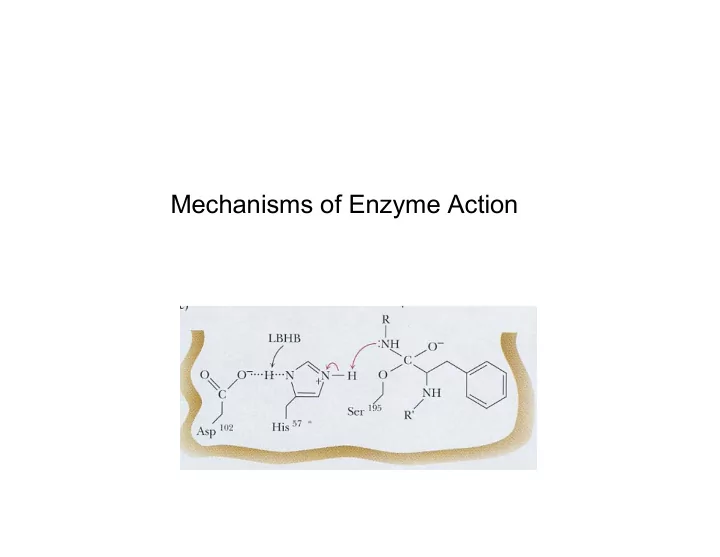
SLIDE 10 Example of an enzyme mechanism using covalent bonds, acid-base catalysis, low-barrier hydrogen bonds Serine protease (e.g., trypsin, chymotrypsin, acetylcholinesterase): hydrolyzes peptide bond of proteins (or acetylcholine), substrate (A-CO-NH-B) + H2O A-COOH + H2N-B
Asp-His-Ser = DHS
SLIDE 11
Low-barrier hydrogen bond: e- movement e- movement
SLIDE 12 (same picture as previous)
SLIDE 13
Cleavage of the peptide bond Release of the amino product
SLIDE 14 (same picture as previous)
SLIDE 15
e- movement e- movement ser-substrate bond breaks
SLIDE 16 (same picture as previous)
SLIDE 17
DHS regenerated
SLIDE 18
Specificity of reaction: depends on DHS in active site Specificity of substrate: geometry of the activity site Note the pH dependence: >6 needed for hiso
SLIDE 19
Summary Enzymes speed reactions by reducing Ea Enzyme reduce Ea by stressing substrate (raising G(ES)) and by reducing G(ES*) Lysozyme and chymotrypsin give examples of enzyme pathways for hydrolysis