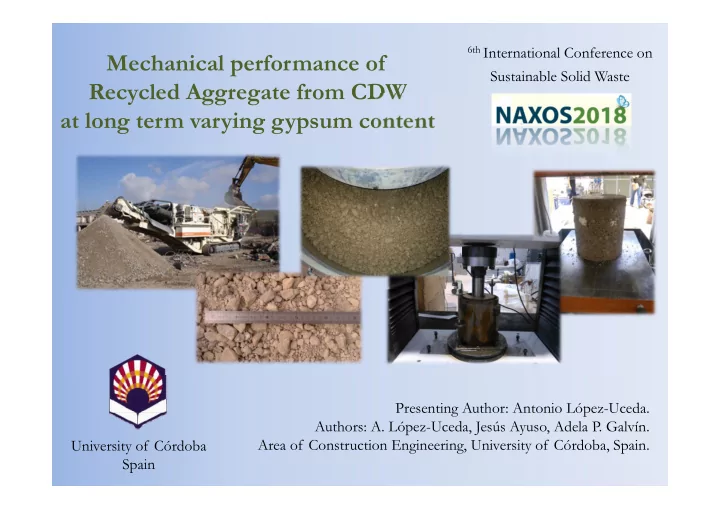
SLIDE 1 Mechanical performance of Recycled Aggregate from CDW at long term varying gypsum content
Presenting Author: Antonio López-Uceda. Authors: A. López-Uceda, Jesús Ayuso, Adela P. Galvín. Area of Construction Engineering, University of Córdoba, Spain.
6th International Conference on
Sustainable Solid Waste University of Córdoba Spain
SLIDE 2 Mechanical performance of Recycled Aggregate from CDW at long term varying gypsum content
Reference: http://ec.europa.eu/eurostat/statistics
EU-28 Waste generation by economic activities and households, 2014
Directive on waste
2008/98/EC
Objective 70% recycling rate
SLIDE 3
Mechanical performance of Recycled Aggregate from CDW at long term varying gypsum content
Reference: http://ec.europa.eu/eurostat/statistics
Waste generation by economic activities and households, 2014 CDW Production > 868 million tonnes EU-28 CDW Production > 20 million tonnes SPAIN
SLIDE 4 Mechanical performance of Recycled Aggregate from CDW at long term varying gypsum content
http://ec.europa.eu/environment/waste/pdf/2011_CDW_Report.pdf Directive on waste
2008/98/EC
Objective 70% recycling rate
Service Contract
(European Comission)
SLIDE 5
Mechanical performance of Recycled Aggregate from CDW at long term varying gypsum content CDW CDW treatment plant From crushing concrete and well graded size range of 32-0 mm RA used
SLIDE 6
Mechanical performance of Recycled Aggregate from CDW at long term varying gypsum content
Ceramic Particles Gypsum elements Natural aggregates Concrete and mortar Wood, glass, paper,… Asphalt CDW composition
SLIDE 7 Mechanical performance of Recycled Aggregate from CDW at long term varying gypsum content
- The RA usually contains a higher sulphate content
than natural aggregates.
- The solubility, hardness and density of gypsum has
a negative effect on the quality of the aggregate.
- Barbudo et al. (2012) stablished good correlations
between the percentage of gypsum in RA and sulphate content, and not with other parameters such as concrete and mortar and ceramic particles.
Gypsum elements
In Spain, restrictions in RA regarding to its use to form road base layers are severe. The maximum sulphur content is 1%, and the acid-soluble sulphate content is 0.8%.
SLIDE 8 Mechanical performance of Recycled Aggregate from CDW at long term varying gypsum content
The aim of this research was to analyze the effect on mechanical properties at long term of gypsum content in
- RA. For this purpose,
- Different RA samples were prepared by adding
different percentages of gypsum (0%, 2% and 4%) previously hydrated and crushed.
- California bearing ratio (CBR) was conducted on the
samples prepared without cement addition, and compressive strength was conducted on the samples prepared with a 3% cement addition. Both tests were conducted at different ages, up to one year of curing.
The aim:
SLIDE 9
Mechanical performance of Recycled Aggregate from CDW at long term varying gypsum content
Samples Cement (CEM II BL 32.5 N) addition Gypsum addition Methods (%) (%) RA+0% CBR (UNE 103502:1995) RA+2% 2 RA+4% 4 CT‐RA+0% 3 Compressive strength (UNE‐EN 13286‐41:2003) CT‐RA+2% 3 2 CT‐RA+4% 3 4
RA Unbound Recycled Aggregate CT-RA Cement treated Recycled aggregate
Materials and methods:
SLIDE 10
Mechanical performance of Recycled Aggregate from CDW at long term varying gypsum content
Samples Cement (CEM II BL 32.5 N) addition Gypsum addition Methods (%) (%) RA+0% CBR (UNE 103502:1995) RA+2% 2 RA+4% 4 CT‐RA+0% 3 Compressive strength (UNE‐EN 13286‐41:2003) CT‐RA+2% 3 2 CT‐RA+4% 3 4
RA CT-RA
Barbudo et al. (2012) 4.4% max. of gypsum to comply with leached sulphates limitations
Materials and methods:
0% 2% 4%
SLIDE 11
Mechanical performance of Recycled Aggregate from CDW at long term varying gypsum content
Samples Cement (CEM II BL 32.5 N) addition Gypsum addition Methods (%) (%) RA+0% CBR (UNE 103502:1995) RA+2% 2 RA+4% 4 CT‐RA+0% 3 Compressive strength (UNE‐EN 13286‐ 41:2003) CT‐RA+2% 3 2 CT‐RA+4% 3 4
RA CT-RA
Materials and methods:
SLIDE 12
Mechanical performance of Recycled Aggregate from CDW at long term varying gypsum content
Results and discussion:
50 100 150 200 250 300 100 200 300 400 CBR Index (%) Age (days) RA+0% RA+2% RA+4%
CBR (UNE 103502:1995)
SLIDE 13
Mechanical performance of Recycled Aggregate from CDW at long term varying gypsum content 50 100 150 200 250 300 100 200 300 400 CBR Index (%) Age (days) RA+0% RA+2% RA+4%
Results and discussion: CBR (UNE 103502:1995)
SLIDE 14
Mechanical performance of Recycled Aggregate from CDW at long term varying gypsum content 50 100 150 200 250 300 100 200 300 400 CBR Index (%) Age (days) RA+0% RA+2% RA+4%
Results and discussion: CBR (UNE 103502:1995)
SLIDE 15
Mechanical performance of Recycled Aggregate from CDW at long term varying gypsum content
Results and discussion:
1 2 3 4 5 6 7 8 100 200 300 400 Compressive strength (MPa) Age (days) CT‐RA+0% CT‐RA+2% CT‐RA+4%
Compressive strength (UNE‐EN 13286‐41:2003)
SLIDE 16
Mechanical performance of Recycled Aggregate from CDW at long term varying gypsum content
Results and discussion:
1 2 3 4 5 6 7 8 100 200 300 400 Compressive strength (MPa) Age (days) CT‐RA+0% CT‐RA+2% CT‐RA+4%
Compressive strength (UNE‐EN 13286‐41:2003)
SLIDE 17
Mechanical performance of Recycled Aggregate from CDW at long term varying gypsum content
Results and discussion:
1 2 3 4 5 6 7 8 100 200 300 400 Compressive strength (MPa) Age (days) CT‐RA+0% CT‐RA+2% CT‐RA+4%
Compressive strength (UNE‐EN 13286‐41:2003)
SLIDE 18 Mechanical performance of Recycled Aggregate from CDW at long term varying gypsum content
Conclusion:
Regarding to the CBR performance with different gypsum content:
- Samples with gypsum addition had a good performance at early ages,
and at long term, no difference was found respect to sample without gypsum addition.
In relation to the compressive strength performance with 3% cement addition and different gypsum content:
- The gypsum presence present a slightly decrease the compressive
strength values respect to that without gypsum addition, but not significantly.
This research supports that sulphate content limits could be restudied to widen the use of RA to form base layers in roads.
SLIDE 19
Mechanical performance of Recycled Aggregate from CDW at long term varying gypsum content The authors would like to thank the European Regional Development´s Fund (ERDF) of the European Union for financial support via the project “Applications of recycled aggregates from CDW for the sustainable development of road infrastructure in central areas of Andalusia”.
Acknowledgements
Thank you for your attention
Antonio López Uceda p62louca@uco.es