Mec echanisms hanisms of Sel electiv ective e Cell ell Vul - - PowerPoint PPT Presentation
Mec echanisms hanisms of Sel electiv ective e Cell ell Vul ulnerability erability in Hum uman an Prion ion Disease ease Christina Sigurdson Department of Pathology UC San Diego Protein misfolding and aggregation is a common feature
Protein misfolding and aggregation is a common feature of neurodegeneration
Alzheimer Parkinson Amyotrophic lateral sclerosis Huntington Creutzfeldt-Jakob
a-synuclein substantia nigra
Modified from Forman et al, Nature Medicine, 2006
PrPSc plaques cerebellum Ubiquitin inclusions spinal cord Amyloid-b plaques cortex Poly-Q inclusions striatum
distinct conformations
Prion conformational subtypes: Distinct disease phenotypes occurring in patients
Subtype 2 Subtype 1
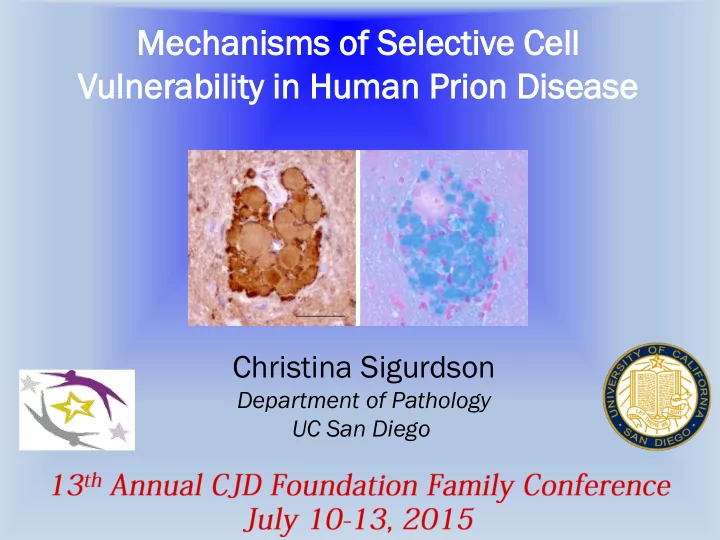
Human prion disease: prion plaques vary in morphology and cells targeted
Sporadic CJD Plaque deposits Perineuronal deposits vCJD Plaques 1 2 3
Prion protein aggregates vary by morphology and cells targeted in mice
mCWD 22L Me7 RML
What mechanism underlies the selective cell vulnerability in prion disease?
Heparan sulfate proteoglycans and prion pathogenesis
OH OH/SO3 CH2OH/SO3 NH/Ac/SO3/H OH/SO3
O O
COOH
Core protein
HS chain
- Diverse glycoproteins on cell surfaces and in
the extracellular matrix
- Promotes the internalization of PrPC and
propagation of PrPSc
- Prolongs prion disease in scrapie-infected
rodents
Hypothesis: PrPSc interaction with heparan sulfate proteoglycans is a major determinant underlying prion cell tropism
Defining the HS molecules associated with the most common human CJD subtypes
1) Purify PrPSc from 3 brain regions
Prion-infected brain purification
* * *
2) Identify the PrPSc bound heparan sulfate by liquid chromatography-mass spectrometry (LC/MS)
Quantify N-SO3, 2-O-SO3, 6-O-SO3 groups and N-acetylated, N-sulfated and N-unsubstituted glucosamine residues
GlcNH2
CAA pos CAA neg 1 2 3
mol (%)
Amyloid β: cerebral amyloid angiopathy (CAA) IHC Congo red HE
How does the sulfation of HS molecules impact prion replication?
Seed PrPSc Increase in PrPSC Sonication PrPC PrPC produced in RK13 cells
- Glycosylated
- GPI-anchored
- 3F4-tag
Amplification
- f misfolding
Detection of new PrPSc using 3F4 tag Fragmentation
- f aggregates
creates new seeds
Heparan sulfate
Different variably sulfated HS
Heparin and pentosan polysulfate enhance prion conversion in a dose-dependent manner
Heparin and PPS lead to a decrease PrPSc levels in persistently prion-infected cells
Demonstrates the paradoxical effect of HS – in cell lysate amplification versus in live cells and in vivo
50% 75%
Challenge with prions Terminal disease Analysis of brain Biochemical properties Histopathology Biological properties
The impact of sulfation of HS chains on prion disease progression
Wild type mice Ext1+/- : shorter HS chain length
Ongoing……
- PrPSc purified for mass spectrometry analysis to
identify the heparan sulfate bound to PrPSc
- Pentosan polysulfate promotes PrPSc formation in vitro
in the PMCA assay
- Heparin and pentosan polysulfate decrease PrPSc