MDPI http://sciforum.net/conference/mol2net- 2net-03 In silico - - PDF document

mdpi
SMART_READER_LITE
LIVE PREVIEW

MDPI http://sciforum.net/conference/mol2net- 2net-03 In silico - - PDF document

MOL2NET, 2017 , 3, doi:10.3390/m 1 10.3390/mol2net-03-xxxx MOL2NET ET, International Conference Series on Multidisc idisciplinary Sciences MDPI http://sciforum.net/conference/mol2net- 2net-03 In silico molecular lar GRIP docking studies of


slide-1
SLIDE 1

MOL2NET, 2017, 3, doi:10.3390/m

MDPI

MOL2NET

In silico molecular potenti

Koushik Bhandar (ba

a School of Medical Sc b SSS Indira College

Graphical Abstract Introduction Tea (Camellia sinensis) belongi Theaceae is one of the most wide beverages of the world and have pr multidimensional health potential actions of several pharmacolog molecules in it (Sen and Bera, 2013 very much preferred in Indian cont flavoring contents and astringency rich in several pharmacolog molecules the catechins, be compounds the theaflavins, meth

  • viz. caffeine, theobromine, theophy

and Bera, 2013; Bhandari et al., 2015 molecular GRIP docking studi understanding the antioxidant pot 10.3390/mol2net-03-xxxx ET, International Conference Series on Multidisc http://sciforum.net/conference/mol2net-

lar GRIP docking studies of an ntials of black tea compounds

dari (k.bhandari51@gmail.com) a, Baishak (baishakhidey123@gmail.com)b*

al Science and Technology, IIT Kharagpur, 721302,

  • llege of Pharmacy, Vishnupuri, Nanded- 431606,

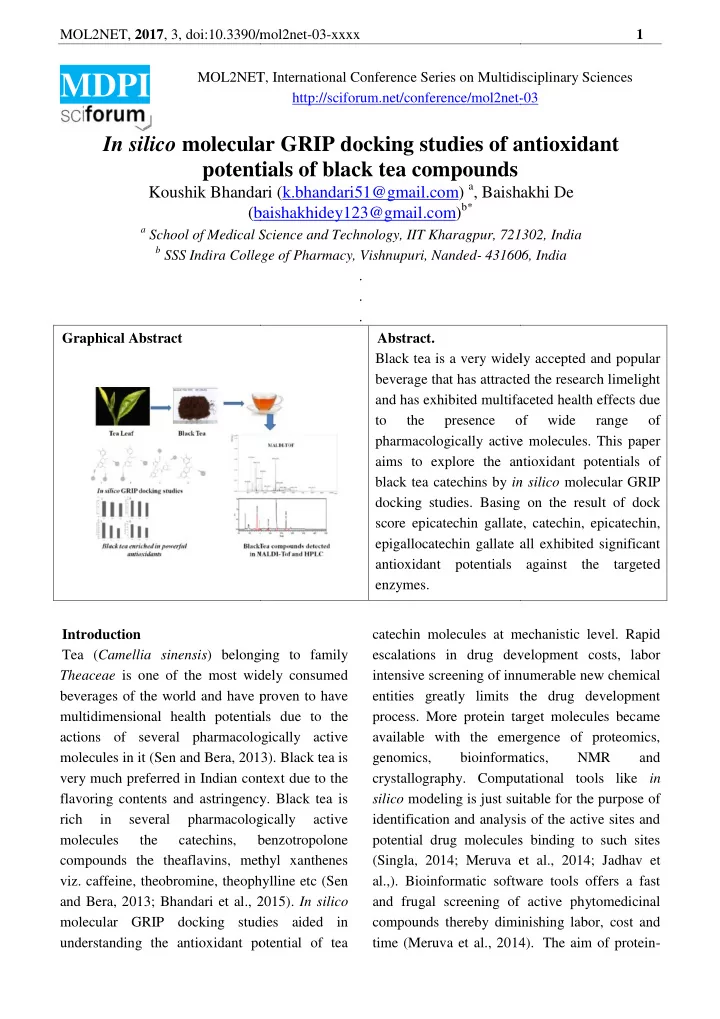
. . . Abstract. Black tea is a very widel beverage that has attracted and has exhibited multifac to the presence

  • f

pharmacologically active aims to explore the an black tea catechins by in docking studies. Basing score epicatechin gallate, epigallocatechin gallate a antioxidant potentials enzymes.

  • nging to family

idely consumed ve proven to have ntials due to the

  • logically active

2013). Black tea is

  • ntext due to the
  • cy. Black tea is
  • gically

active benzotropolone ethyl xanthenes

  • phylline etc (Sen

., 2015). In silico udies aided in potential of tea catechin molecules at me escalations in drug deve intensive screening of innum entities greatly limits t

  • process. More protein tar

available with the emer genomics, bioinforma

  • crystallography. Comput

silico modeling is just suit identification and analysis potential drug molecules (Singla, 2014; Meruva e al.,). Bioinformatic softw and frugal screening of compounds thereby dimini time (Meruva et al., 2014 1 idisciplinary Sciences 2net-03

  • f antioxidant

ds

shakhi De

haragpur, 721302, India 431606, India dely accepted and popular cted the research limelight ifaceted health effects due

  • f

wide range

  • f

ve molecules. This paper antioxidant potentials of in silico molecular GRIP ng on the result of dock ate, catechin, epicatechin, e all exhibited significant s against the targeted mechanistic level. Rapid evelopment costs, labor nnumerable new chemical s the drug development target molecules became ergence of proteomics, matics, NMR and putational tools like in suitable for the purpose of sis of the active sites and ules binding to such sites et al., 2014; Jadhav et software tools offers a fast

  • f active phytomedicinal

minishing labor, cost and 2014). The aim of protein-

slide-2
SLIDE 2

MOL2NET, 2017, 3, doi:10.3390/mol2net-03-xxxx 2 ligand docking is to calculate the binding energy

  • f the protein-ligand reaction complex at given

atomic co-ordinates. The key parameters for flexible docking include energy functions, protein catalytic sites and active residues (Meruva et al., 2014). For rapid, accurate protein-peptide and protein-ligand docking, GRIP™ by V Life software is a novel methodology available for rigid as well as flexible docking purposes. It makes use of a set

  • f ligands with its conformers to be docked into

the receptor cavity. This software helps to search for the active sites, consists of pre-computation

  • f grids and tries to maximize favorable

interaction and minimize unfavorable and repulsive interaction by proving the best possible

  • rientation. GRIP scoring function allows for fast

and precise capturing

  • f

ligand-receptor interactions in the active sites of proteins. In GRIP docking, unique conformers of a set of ligands are considered as input and offers the advantages of wide range of parameterizations, both ligand guided as well as cavity guided docking options, considers hydrogen bonding, repulsions and dispersion interactions with manual, automated and batch mode operations (Jadhav et al.; De et al., 2017). Materials and Methods The Proteins used for GRIP Docking include Copper-zinc superoxide dismutase (4B3E), glutathione peroxidase (3KIJ) and erythrocyte catalase (1DGB) of Homo sapiens were used for the current study. Their PDB structures were taken from RCSB. V life MDS 4.3 is very robust software with inclusion of all the necessary simulation modules. The 2D-structures of catechin (C), epicatechin (EC), epicatechin gallate (ECG), epigallo catechin (EGC) and epigallocatechin gallate (EGCG) the major catechin available in black tea were drawn in the 2D drawing application (2D Draw app) of MDS 4.3, followed by its conversion into 3D form by using default conversion procedure. Their energy minimization was done by using Merck Molecular Force Field (MMFF). MMFF is a class II force field designed to be a transferable force field for pharmaceutical compounds that accurately treats conformational energetics and non-bonded interactions. Molecular docking energy evaluations are usually carried out with the help of scoring function like dock score, PLP score, potential mean force (PMF) score, steric and electrostatic score. PLP score or Piecewise Linear Potential scoring function calculates both the shape and hydrogen bond complementarity of poses to the active site. The PLP score is a pair wise additive scoring function. The PLP function is incorporated by the MDS V Life Science software in the GRIP docking method which calculates the ligand-receptor binding affinity in terms of the PLP score. The PLP score is designed to enable flexible docking of ligands to perform a full conformational and positional search within a rigid binding site. These molecules were docked into the active site of 4B3E (copper-zinc superoxide dismutase), 3KIJ (crystal structure of human peroxidase) and 1DGB (catalase) that can be obtained as co- crystallized with bicarbonate ion or NADPH or by the use of cavities. The parameters fixed for docking simulation were: number of placements is 100, rotation angle at 10o, exhaustive method, ligand-wise results-10, scoring function-PLP

  • score. By rotation angle, ligand would be rotated

inside the receptor cavity to generate different poses of ligand inside the receptor cavity. By placements, the method will check all the 100 possible placements into the active site pocket and will result the best placements out of 100. After docking simulation, the best docked conformer of test molecules and reference ligands were then checked for their interactions with targeted proteins like hydrogen bonding, hydrophobic, pi-staking/aromatic, charge and van der Waal’s interactions (Singla and Bhat, 2010; Singla et al., 2013; Malleshappa and Patel,

slide-3
SLIDE 3

MOL2NET, 2017, 3, doi:10.3390/mol2net-03-xxxx 3 2013; Igoli et al., 2014; Igoli et al., 2014; Singla et al., 2012). Results and Discussion Catechin (C), epicatechin (EC), epicatechin gallate (ECG), epigallocatechin (EGC) and epigallocatechin gallate (EGCG) have undergone binding interactions with different amino acid residues by van der waals interactions, hydrophobic interactions, charge interactions with superoxide dismutase, glutathione peroxidase and catalase. All the mentioned catechins exhibited negative dock scores showing their strong binding affinities with the copper zinc superoxide dismutase. The scoring functions of Catechin, epicatechin, epicatechin gallate, epigallocatechin and epigallocatechin gallate were -48.81, -48.08, -61.67, -52.27, and - 60.24 respectively. EGCG exhibited the highest negative dock score and can as considered as most potent antioxidant though all catechins showed the activities. The potencies of catechin and epicatechin were found to be almost equivalent in terms

  • f

docking score. Considering the binding interactions of the above mentioned black tea catechins with glutathione peroxidase the dock score of the Catechin, epicatechin, epicatechin gallate, epigallocatechin and epigallocatechin gallate were determined to be -60.23, -58.63, -61.19, -57.88 and -60.14

  • respectively. The potent catechin in terms of

dock score was ECG. In this case catechin and EGCG showed to be equipotent in terms of dock

  • score. Considering the case with catalase, ECG

was found to be the most potent with a dock score of about -89.64 followed by EGCG with a dock score of -86.79; catechin and epicatechin were found to be equipotent with dock scores of - 68.58 and -68.01 respectively followed by EGC (-66.66). From the results of in silico GRIP docking studies it is clear that the different catechins of black tea possess significant antioxidant potentials. Oxidative stress is the root cause of several chronic and degenerative

  • diseases. Intake of natural antioxidants that are

available in dietary sources and beverages can serve as an effective adjuvant therapy. However epicatechin gallate with highest affinity towards all proteins was found to be most active in comparison to other catecins. Here it is to be mentioned that the homeostatic condition of the body is disturbed due to oxidative stress and the situation is counteracted due to elevated superoxide dismutase (SOD) level. But in due course SOD level depletes and if potent natural antioxidants like EGCG etc present in black tea be supplemented at this stage it can effectively combat the crisis. Conclusions In silico molecular GRIP docking studies was helpful in the identification of the potent black tea catechins with antioxidant activities at different levels of potencies. References 1) De, B.; Singla, R.K.; Bhandari, K.; Katakam, P.; Adiki, S.K.; Mitra, A. GRIP docking studies to explore the enzyme inhibitory potentialities of a phytocomposite for Type 2

  • diabetes. IJOPILS 2017, 5(3), 34-57.

2) Bhandari, K.; Singla, R.K.; De, B.; Ghosh, B.C.; Katakam, P.; Khushwaha, D.K.; Gundamaraju, R.; Sen, G.; Saha, G.; Mitra, A.; Mitra, A. Chemometrics Based Extraction of polyphenlolics from fresh tea leaves and processed tea showing in-silico docking and anti-oxidative theronostic dietary adjuvant in Alzheimer. Indo Global

  • J. Pharm. Sci. 2015, 5(3), 171-191.

3) Igoli, J.O.; Gray, A.I.; Clements, C.J.; Kantheti, P.; Singla, R.K. Antitrypanosomal activity & docking studies of isolated constituents from the lichen Cetraria islandica: possibly multifunctional scaffolds.

  • Curr. Top. Med. Chem. 2014, 14, 1014-1021.

4) Igoli, N.P., Clements, C.J., Singla, R.K., Igoli, J.O., Uche, N., Gray, A.I. Antitrypanosomal activity & docking studies

  • f components of Crateva adansonii DC
slide-4
SLIDE 4

MOL2NET, 2017, 3, doi:10.3390/mol2net-03-xxxx 4 leaves: novel multifunctional scaffolds. Curr.

  • Top. Med. Chem. 2014, 14, 981-990.

5) Jadhav, K.; Mukhopadhyay, S.; Ajmani, S.; Kakulte, K.; Kulkarni, S.A. GRIP docking: A simple and fast docking method. V Life Sciences Technologies Pvt. Ltd. Pride purple Coronet, 1st floor, S No. 287, Baner Road, Pune 411045, India. 6) Malleshappa, N.N.; Patel, H.M. A comparative QSAR analysis and molecular docking studies of quinazoline derivatives as tyrosine kinase (EGFR) inhibitors: A rationale approach to anticancer drug design.

  • J. Saudi. Chem. Soc. 2013, 17(4), 361-379.

7) Meruva, A.D.; Subbaiah, G.V.; Reddy, K.S. Molecular docking studies of Xanthium indicum bioactive compounds with therapeutic targets of diabetes mellitus. Int. J.

  • Pharm. Sci. Rev. Res. 2014, 29(1), 236-240.

8) Sen, G.; Bera, B. Black tea as a part of daily diet: A boon for healthy living. IJTS 2013, 9(2-3), 51-59. 9) Singla, R.K., Bhat, V.G., Kumar, T.N.V.G. 3D-quantitative structure activity relationship: a strategic approach for in silico prediction of anti-candididal action of 1, 2, 4- triazole derivatives. Indo Global J. Pharm.

  • Sci. 2013, 3(1), 52-57.

10) Singla, R.K., Bhat, V.G. QSAR model for predicting the fungicidal action of 1,2,4- triazole derivatives against Candida albicans. J Enz. Inhib. Med. Chem. 2010, 25(5), 696- 701. 11) Singla, R.K., Paul, .P, Nayak, P.G., Bhat, V.G. Investigation of anthramycin analogs induced cell death in MCF-7 breast cancer

  • cells. Indo Global J. Pharm. Sci. 2012, 2(4),

383-389. 12) Singla, R.K. Mechanistic evidence to support the anti hepatitis B viral activity of multifunctional scaffold and conformationally restricted Magnolol. Natl.

  • Acad. Sci. Lett. 2014, 37(1), 45-50.