May May 9, 9, 2019 2019 9:00 9:00 a.m. a.m. to to 11 11:00 - - PowerPoint PPT Presentation

may may 9 9 2019 2019
SMART_READER_LITE
LIVE PREVIEW

May May 9, 9, 2019 2019 9:00 9:00 a.m. a.m. to to 11 11:00 - - PowerPoint PPT Presentation

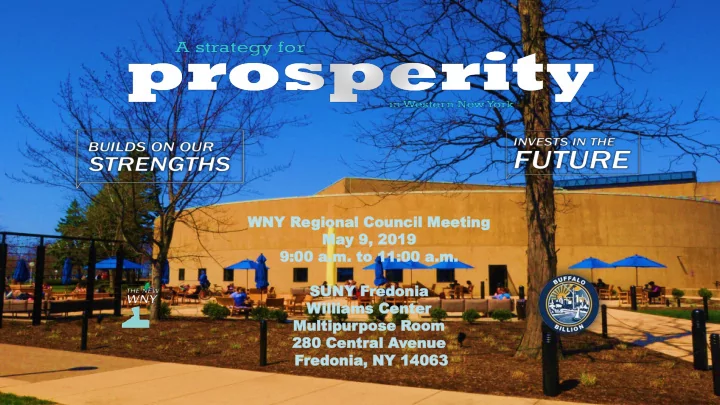
WNY WNY Region gional l Cou ounc ncil il Mee Meeting ting May May 9, 9, 2019 2019 9:00 9:00 a.m. a.m. to to 11 11:00 :00 a.m. a.m. SUNY SUNY F Fred edonia nia Wil illi liams ams Center enter Multipur Multipurpose pose


slide-1
SLIDE 1

WNY WNY Region gional l Cou

  • unc

ncil il Mee Meeting ting May May 9, 9, 2019 2019 9:00 9:00 a.m. a.m. to to 11 11:00 :00 a.m. a.m. SUNY SUNY F Fred edonia nia Wil illi liams ams Center enter Multipur Multipurpose pose Roo

  • om

28 280 0 Cen entr tral al Aven enue ue Fred edonia, ia, NY NY 140 14063 63

slide-2
SLIDE 2

Opening Remarks Jeff Belt & Dr. Virginia Horvath Co-Chairs WNY Regional Economic Development Council

Western New York Regional Council Meeting

slide-3
SLIDE 3

Western New York Regional Council Meeting

Executive Director’s Report Amanda Mays Executive Director WNY Regional Economic Development Council

slide-4
SLIDE 4

Western New York Regional Council Meeting

East Side Corridor Economic Development Fund Overview Laura Quebral Executive Director UBRI

slide-5
SLIDE 5

East Side East Side Corrid Corridor

  • r

Economic Development Fund

slide-6
SLIDE 6

How is Buffalo implementing the Billion?

Strategies for Buffalo East Side Corridor Economic Development Fund

$65M dedicated to the Revitalization efforts on the East Side

slide-7
SLIDE 7

9 Investment Areas in 4 Corridors

Michigan Avenue Corridor Historic Michigan

1 1 2 2

Jefferson Avenue Corridor Jefferson Avenue Commercial District

3 4 5 6 7 8 9 3

Fillmore Avenue Corridor Main and Fillmore

4 Northland 5 MLK Park Business

District

6 Broadway Fillmore

Bailey Avenue Corridor Kensington Bailey Bailey Green Clinton Bailey

7 8 9

slide-8
SLIDE 8

What investments has NYS made since 2011 on Buffalo’s East Side?

Since 2011, NYS invested more than $237 million on the East Side

From 2006-2016, the City

  • f Buffalo invested more

than $184 million on the East Side

slide-9
SLIDE 9

What do we hope to achieve with the East Side Corridor Economic Development Fund?

Promote mixed-use, walkable commercial corridors Invest in regionally significant historical and natural assets Expand opportunities for workforce connections Support and grow new businesses and entrepreneurship Fund projects that have strong community momentum Build on transformational public/private investments

Goals of Fund

slide-10
SLIDE 10

In what types of projects will the East Side Corridor Economic Development Fund invest?

Aligned with the economic development goals

  • f the Fund

Primarily capital Ready to be implemented within five years Spearheaded by organizations that have capacity and expertise to implement

slide-11
SLIDE 11

Actions to Date

Analysis Perspectives from the community and stakeholders

Detailed analysis of data and past investments 42 listening sessions

based on project submission forms

4 stakeholder meetings

with 130 total participants

slide-12
SLIDE 12

Housing: Buffalo Neighborhood Stabilization Fund

Investing in a multi-pronged housing initiative that will increase homeownership, prevent foreclosure, and target zombie properties on the East Side

slide-13
SLIDE 13

Assets

Investing in significant community anchors to ensure they remain accessible, safe and relevant

ML MLK K Pa Park rk Broa Broadway dway Ma Market rket Co Commu mmunity nity Sol Solar ar Ar Arra ray y at at Nort Northla hland nd Buffa Buffalo lo Mu Museu seum m of

  • f

Science Science

slide-14
SLIDE 14

Direct Funding

Investing in mixed-use projects along the corridors that will help spur private investment

Nash Nash Lo Lofts fts To Torn rn Spa Space ce Thea Theater ter Beverl Beverly y Gra Gray Va Varsity rsity Theate Theater Bla Black Ac ck Achievers hievers Mu Museu seum Schreiber Schreiber Brewery Brewery

slide-15
SLIDE 15

Infrastructure

Investing in targeted streetscape and infrastructure improvements that enhance and support the programs and projects in the East Side Corridor Economic Development Fund

Michiga Michigan n Av Ave. e. Fill Fillmore more Ave. Ave. Bailey Bailey Ave. Ave. Jefferson Jefferson Av Ave. e.

slide-16
SLIDE 16

Foundations Investing in people & places.

Why foundations are essential

ESD

slide-17
SLIDE 17

for long term sustainability and transformational change

COMMUNITY-BASED REAL ESTATE DEVELOPMENT TRAINING PROGRAM EAST SIDE MAIN STREETS INITIATIVE BUILDING PRESERVATION FUND MICHIGAN STREET AFRICAN AMERICAN HERITAGE CORRIDOR CENTRAL TERMINAL PROJECT IMPLEMENTATION TEAM

East Side Program Initiatives

slide-18
SLIDE 18

There are many small business enhancement

  • pportunities in core areas

that could help expand neighborhood-serving businesses and increase mixed-use offerings along the East Side’s commercial corridors.

EAST SIDE MAIN STREETS INITIATIVE

Expand the Buffalo Main Streets Initiative to fund building renovations and public space enhancements in three to four East Side target investment areas.

WHAT WE LEARNED THE OPPORTUNITY

slide-19
SLIDE 19

There are East Side community members who own buildings

  • r see real estate and

community development

  • pportunities, but may lack

the expertise to successfully plan and implement a real estate development project.

COMMUNITY-BASED REAL ESTATE DEVELOPMENT TRAINING PROGRAM

Harness the East Side’s human capital and ensure that revitalization is driven by the community through real estate development education.

WHAT WE LEARNED THE OPPORTUNITY

slide-20
SLIDE 20

More than in any other area

  • f the city, the East Side has

historic buildings in danger of demolition by neglect.

BUILDING PRESERVATION FUND

Establish a dedicated funding source to support acquisition and stabilization of at-risk historic buildings in the target investment areas.

WHAT WE LEARNED THE OPPORTUNITY

slide-21
SLIDE 21

There is a need for increased consensus, cooperation and coordination along Michigan Street’s African American Heritage Corridor.

MICHIGAN STREET AFRICAN AMERICAN HERITAGE CORRIDOR

Create a cooperative

  • perating/business model

and plan for capital improvements for a unified tourist destination around Michigan Street’s unique assets.

WHAT WE LEARNED THE OPPORTUNITY

slide-22
SLIDE 22

There is opportunity to leverage over $5M in dedicated public funds and redevelop Broadway Fillmore’s significant landmark building to attract private investment and visitors to the area.

CENTRAL TERMINAL

Plan for the future of the site and create a robust organization to guide capital improvements with the goal to eventually reuse the entire complex.

WHAT WE LEARNED THE OPPORTUNITY

slide-23
SLIDE 23

WHAT WE LEARNED THE OPPORTUNITY

There is a need for an entity to implement an integrated work plan and provide coordination across all programs.

PROJECT IMPLEMENTATION TEAM

Implement an integrated work plan by monitoring and reporting on progress; offering strategic interventions; building

  • rganizational capacity;

providing opportunity for peer- to-peer assistance; and learning from successful national models.

slide-24
SLIDE 24

Foundations

Support from HOUSING ASSETS PROGRAMS FOR FUTURE PROJECTS DIRECT FUNDING INFRASTRUCTURE

BUFFALO NEIGHBORHOOD STABILIZATION FUND MLK PARK DISTRICT BROADWAY MARKET COMMUNITY SOLAR ARRAY AT NORTHLAND MICHIGAN STREET AFRICAN AMERICAN HERITAGE CORRIDOR CENTRAL TERMINAL EAST SIDE MAIN STREETS INITIATIVE COMMUNITY-BASED REAL ESTATE DEVELOPMENT TRAINING PROGRAM BUILDING PRESERVATION FUND DIRECT PROJECT ASSISTANCE INFRASTRUCTURE TO SUPPORT AND ENHANCE INVESTMENTS

ESD Total Investment $10M $25M

COMMUNITY-BASED REAL ESTATE DEVELOPMENT TRAINING PROGRAM EAST SIDE MAIN STREETS INITIATIVE BUILDING PRESERVATION FUND MICHIGAN STREET AFRICAN AMERICAN HERITAGE CORRIDOR CENTRAL TERMINAL PROJECT IMPLEMENTATION TEAM

Total of $8.7M

$12.6M $7.4M $10M

$65M

$10M $7.4M $10M $5.4M $7M $2M $4M $6.6M

slide-25
SLIDE 25

It’s strategic. It’s catalytic. It’s a unique moment in time with incredible leverage.

Why it’s worth considering

Based on what the data and community is telling us. Coordinated and collaborative

  • ver time for

lasting impact.

5 YR collaborative strategy

Meant to address all of the needs we saw in our planning For every $1 of foundation investment, the state is investing $7.50.

slide-26
SLIDE 26

WNY Economic Development Priorities John Maggiore Senior Advisor to the Governor for Upstate Economic Development

Western New York Regional Council Meeting

slide-27
SLIDE 27

Western New York Regional Council Meeting

Workforce Development Initiative Madhuri Kommareddi Director NYS Workforce Development Office

slide-28
SLIDE 28

Workforce Development Initiative

Consolidated Funding Application (CFA)

slide-29
SLIDE 29
  • New $175 million Workforce Development Initiative, with funding from SUNY, CUNY,

ESD, the NYS Department of Labor and the NYS Energy Research and Development Authority

  • Announced in Governor Cuomo’s 2018 State of the State and released in the FY 2019

Enacted Budget

  • New Executive Office of Workforce Development (OWD) created to coordinate, and

improve transparency of, workforce development efforts across state entities

  • Two-phase, NO-DEADLINE funding application process: 1) initial evaluation by

REDC workforce committee; 2) final review by an interagency panel

  • Priority focus on projects that support the regional workforce development strategy,

serve populations with barriers to career advancement, and/or improve the flexibility of workforce systems to address industry needs

Overview

slide-30
SLIDE 30

Consolidated Funding Application (CFA)

  • Serves as a single point of entry for workforce development funding
  • Developed to streamline and expedite the application process for funding
  • Designed to ensure:
  • Less bureaucracy
  • Greater efficiencies
  • Improved community input
  • Enhanced partnerships
slide-31
SLIDE 31

Phase One: REDC Endorsement

  • Applicants submit a general CFA proposal to their local REDC including

information pertaining to:

➢ Workforce problems faced by the region and how project will address it ➢ Local and regional partners involved in the project ➢ Estimated project costs including leveraged funds ➢ Performance targets

  • Proposals reviewed by a newly established Workforce Development Committee

at every REDC

  • Workforce Development Committee makes recommendations to REDC Co-

Chairs

  • Phase 1 concluded by REDC Co-Chairs making final recommendations to Office

for Workforce Development

slide-32
SLIDE 32

REDC Workforce Development Committees

Each REDC is establishing a new Workforce Development Committee by May 15, 2019 to ensure stage one review includes critical members of the local workforce and economic systems. The Committee will include experts from the following fields:

  • Economic Development
  • Higher Education
  • Local Workforce Investment Boards
  • Boards of Cooperative Educational Services (BOCES)
  • Empire State Poverty Reduction Initiative (ESPRI) rep from each region
slide-33
SLIDE 33

Phase Two: Interagency Committee Approval

Phase 2 review conducted by an interagency committee. The Office of Workforce Development will: ➢ Review REDC recommendations on Phase 1 applications and determine the appropriate funding source(s) ➢ Send the applicant the full CFA / Phase 2 application, tied to the identified funding source(s) ➢ Convene the interagency committee, which will evaluate the completed CFA applications and make a final determination NOTE: Applications for statewide or multi-region projects will be submitted to the Office of Workforce Development, which will forward to the interagency committee for Phase 1 and Phase 2 review.

slide-34
SLIDE 34

Eligibility

WEBSITE: www.ny.gov/workforcedevelopment Successful applicants will have a clearly articulated proposal that addresses a workforce problem faced by the region and a comprehensive implementation strategy. In addition, applications may be evaluated based on the following criteria:

  • The role of local and regional partners;
  • Project cost; the extent of leveraged funds;
  • Performance targets that are measurable and achievable;
  • Transferable nature of the training or accreditation;
  • Description of any public/private partnerships and how they will expand

workplace learning.

slide-35
SLIDE 35

Workforce Funding Options

Public-Private Partnerships to Advance 21st Century Skills (SUNY / CUNY)

A mix of capital and operational funding to expand the infrastructure and capacity of SUNY and CUNY to produce skilled talent that meets the needs of regional employers. Four SUNY / CUNY programs that provide funding for:

  • SUNY / CUNY 2020: Capital costs including building of classroom / training lab

space; technology upgrades; equipment purchases

  • Job Linkage: Industry-engaged curriculum development, data analysis, or experiential

learning in regionally significant or growing industries

  • Workforce Development: Business/industry-partnered training workshops
  • Apprenticeship Program: Development and operation of Registered Apprenticeship

programs in growing or in-demand industries

slide-36
SLIDE 36

Workforce Funding Options

Employer-Driven Skills (ESD, DOL, NYSERDA)

Funding will expand employer investment in a skilled workforce pipeline. ESD Employee Training Incentive Program previously was included in REDC CFA process, and incents employers to invest in incumbent worker training NYS Department of Labor (DOL) Unemployed/Underemployed Worker Training program funds efforts to support full or part-time employment for unemployed or underemployed works New York State Energy Research Development Authority (NYSERDA) funds focus on building operations and maintenance programs

slide-37
SLIDE 37

Workforce Funding Options

Workforce Solutions (DOL, Pay for Success)

Provide flexible funding for innovative workforce development projects. Funds will support strategic regional efforts that meet businesses workforce challenges including:

  • Addressing long-term industry needs
  • Improve regional talent pipelines
  • Enhance flexibility and adaptability of local workforce entities, and
  • Expand apprenticeships.

Some funds (Pay for Success) subject to requirement that individuals trained remain in jobs for at least 6 months to receive full state funding.

slide-38
SLIDE 38

Examples of Potential Projects

➢ WEBSITE: www.ny.gov/workforcedevelopment ➢ Workforce development and innovation in college and university settings; ➢ Opportunities for populations which traditionally face barriers to career advancement, including women and young workers, ex-offenders, veterans, immigrants, refugees, and persons with special needs; ➢ Projects addressing worker dislocation due to foreign competition; ➢ Development and operation of programs that award recognized credentials to program graduates (e.g., apprenticeships, certifications, etc.); ➢ Curriculum development for career- or job-specific purposes.

slide-39
SLIDE 39

39

QUESTIONS? WEBSITE: www.ny.gov/workforcedevelopment

slide-40
SLIDE 40

Western New York Regional Council Meeting

Round 9 - Regional Economic Development Council Competition Alison Walsh Vice President Regional Economic Development

slide-41
SLIDE 41

Regional Economic Development Council Round IX Competition Overview

slide-42
SLIDE 42
  • The Regional Economic Development Councils (REDCs) were

created to transform the State’s economic development process from the top down.

  • REDCs re-built the statewide framework for a bottom-up approach

to regional economic growth. Since 2011:

  • Over $6.1 Billion awarded/committed to support over 7,300 projects

statewide.

  • Commitments for 230,000 jobs created/retained.
  • Thousands of businesses have received funding for startup or

expansion.

  • Leveraged additional private investment at a minimum of a 5:1 ratio.

ECONOMIC DEVELOPMENT

slide-43
SLIDE 43

✓$763.2 million awarded statewide ✓1,055 projects received funding ✓10 Downtown Revitalization Initiative winners

2018 HIGHLIGHTS

slide-44
SLIDE 44

2019 COMPETITION BREAKDOWN

  • $150M in Capital Grants and $75M in Excelsior tax credits available
  • In 2019, five Top Performers will be awarded a portion of $100 million

in ESD Capital Grants. The remaining five regions will be awarded a portion of $50 million in ESD Capital grants.

  • Emphasis should be placed on choosing priority projects that align

with your strategic plan, and are strong and ready to go.

  • Over $525M in additional state funding through the Consolidated

Funding Application (CFA) from various state agencies.

  • $10M to each region for Downtown Revitalization Initiative.
slide-45
SLIDE 45

VISIT REGIONALCOUNCILS.NY.GOV

In 2019, Governor Cuomo has made over $525 million available from

  • ver 30 programs across

10 state agencies.

2019 COMPETITION BREAKDOWN

slide-46
SLIDE 46

46

2019 COMPETITION CRITERIA

  • Work with local businesses and communities to identify

childcare needs and develop potential solutions

  • Develop an environmental justice strategy for the region as its

relates to economic development

  • Support Downtown Revitalization Plans and downtown

projects

  • Identify community place making needs and sustainable

community development strategies

  • Track the progress of the strategic plan and CFA projects
slide-47
SLIDE 47

47

LATE FALL ROUND IX AWARDS CEREMONY OCTOBER 1, 2019

REGIONAL COUNCIL UPDATES AND SCORES DUE

JULY 26, 2019

CFA CLOSES AT 4 PM SHARP - NO LATE SUBMISSIONS!

MAY 1, 2019

CFA OPENS

ROUND IX TIMELINE

slide-48
SLIDE 48

48

DOWNTOWN REVITALIZATION INITIATIVE ROUND IV

  • $100M Program - $10M awarded for one community in

each region.

  • Develop strategic plan that will identify economic

development, transportation, housing and community projects.

  • Use investments to reinforce and secure additional public

and private investments.

  • Applications are due May 31, 2019
slide-49
SLIDE 49

49

ONGOING INITIATIVES ✓ Regional Industry Cluster Plans ✓ Opportunity Agenda ✓ Business Incubator and Hot Spot Program ✓ Veteran’s Initiative ✓ Engage Local Governments

Regions are no longer required to report on these initiatives as part of the competition, but may provide updates on progress made around these priorities as it relates to their strategic plan.

slide-50
SLIDE 50

50

STATEWIDE ECONOMIC DEVELOPMENT PRIORITIES

PLACE MAKING is the notion that where investment occurs matters. In order to

attract a talented workforce, our built environment must emphasize creating accessible job centers, sustainable infrastructure and livable communities.

WORKFORCE is the belief that people drive the economy. Targeted job training and

education ensures that jobs in high-paying, in-demand, tradeable sectors are filled in an equitable way.

TRADEABLE SECTORS describes which industries New York State is targeting to

increase export based employment opportunities. They are the industry sectors that are part of a global market like manufacturing, agricultural products, and energy.

INNOVATION is the strategy of investing in creating synergies between research

and commercialization to drive the economy forward.
slide-51
SLIDE 51

51

STATEWIDE ECONOMIC DEVELOPMENT PRIORITIES “Economists argue that the places that get economic development right do so by investing in their assets: infrastructure attractive to both companies and residents, services to help existing companies start and grow, and training the local workforce.”

“The Right Way to Do Economic Development” City and State April 8, 2019

slide-52
SLIDE 52

52

QUESTIONS?

slide-53
SLIDE 53

Western New York Regional Council Meeting

Childcare Strategy Update Monique Owens Empire State Fellow Executive Chamber Beth Starks Executive Director Chautauqua Lake Child Care Center

slide-54
SLIDE 54
slide-55
SLIDE 55

THE BUSINESS CASE FOR CHILD CARE

slide-56
SLIDE 56

OSWEGO

Western NY REDC

✓ There are 18,900 child care providers in NYS ✓ Nearly 800,000 children 6 years of age or younger with parent(s) who work ✓ Approx. 180,000 children receive child care subsidies across NYS ✓ Child care subsidy program in NYS is overseen by OCFS and locally administered by a county’s LDSS

CHILD CARE LANDSCAPE IN NY

slide-57
SLIDE 57

OSWEGO

Western NY REDC

Allegany County 1,539 Cattaraugus County 1,687 Chautauqua County 4,303 Erie County 29,495 Niagara County 4,933

WNY TOTAL 41,957

WNY CHILD CARE LANDSCAPE

SUPPLY- CHILD CARE SLOTS

slide-58
SLIDE 58

OSWEGO

Western NY REDC WNY CHILD CARE LANDSCAPE

DEMAND

37,986 29,917 9,618

slide-59
SLIDE 59

OSWEGO

Western NY REDC

SUPPLY DOES NOT MATCH DEMAND

Supply Gap of 35,564

WNY CHILD CARE LANDSCAPE

slide-60
SLIDE 60

OSWEGO

Western NY REDC

A Lack of Affordable & Quality Child Care Can…

✓ Lead to employee absenteeism, productivity reductions, and turnover leading to cost U.S. businesses an estimated $3 BILLION annually

slide-61
SLIDE 61

OSWEGO

Western NY REDC

During the wage gap hearings for New York’s “Closing the Wage Gap in NYS” Report the most pressing issue was CHILD CARE

✓ Over 40% of respondents with children under the age of 5 had missed work in the past 3 months because of child care issues ✓ Over 70% of non-working, low-income adults with children under 5 cite “taking care of home/family” as the reason they are not working

AND

1 Davis et al. 2017 2 Stevens 2017

slide-62
SLIDE 62

OSWEGO

Western NY REDC ECOMONIC IMPACT

✓Nearly $8.6 billion economic impact ✓Directly and indirectly impacts 172,000 jobs ✓$4.3 billion industry in NY

slide-63
SLIDE 63

OSWEGO

Western NY REDC

Access to Affordable & Quality Child Care Can…

✓ Increase labor force participation ✓ Contribute to higher individual earnings ✓ Support state and regional economic growth

slide-64
SLIDE 64

OSWEGO

Western NY REDC

Every $1 spent on high-quality early childhood programs returns $8 to $16 to society

ECONOMIC IMPACT

AND

Every $1 invested in high-quality early childhood programs earns a $2 to $3 ROI to the state from increased jobs or earnings for state residents

slide-65
SLIDE 65

OSWEGO

Western NY REDC

High Quality Affordable Child Care is Essential Infrastructure for the Economy. With it, children: ✓ Have greater success in education ✓ Reduce special education placement by 50% ✓ Attain hard and soft skills key to future employment

slide-66
SLIDE 66

OSWEGO

Western NY REDC

High Quality Affordable Child Care is Essential Infrastructure for the

  • Economy. With it, parents:

✓ Improve their labor productivity ✓ Miss fewer work days ✓ Work more hours and increase their earnings

slide-67
SLIDE 67

OSWEGO

Western NY REDC

High Quality Affordable Child Care is Essential Infrastructure for the

  • Economy. With it, employers:

✓ Gain a pivotal edge on recruitment. ✓ Parents of young children whose employers offer

  • n-site childcare reported that access to good

childcare was a significant factor in employee recruitment, retention, and productivity

slide-68
SLIDE 68

OSWEGO

Western NY REDC

High-quality affordable child care is essential infrastructure benefitting the local economy:

✓ Higher-quality labor supply. More and better jobs are attracted, leading to higher local earnings. ✓ Added productivity. With participation comparable to Quebec’s, 5.5 million more American women in the labor force help add $500 billion more economic activity. ✓ Higher property values. $1 in annual spending on high-quality pre-K is estimated to raise local property values by $13.

slide-69
SLIDE 69

OSWEGO

Western NY REDC

In 1997, the Canadian province of Quebec launched the “politique familiale” (family policy) ✓ 55 weeks of paid leave ✓ Yearly allowance of $500 to $1,900 per child ✓ Full-day, year-round child care program for all children under 5 subsidized public funding ✓ Families cover part of the costs on a sliding scale (avg. cost $17 per day)

QUEBEC MODEL

slide-70
SLIDE 70

OSWEGO

Western NY REDC

Key Results from Quebec:

✓ labor force participation in Quebec went up by over 16% (from 64 to over 80% for women with kids under 6) ✓ tax revenues from higher earnings and economic activity have more than paid for the program

QUEBEC MODEL

Pierre Fontin. 2018. “Quebec’s Childcare Program at 20: How it was Done and What the Rest of Canada can Learn.”

slide-71
SLIDE 71

HOW THE REDCs CAN HELP

slide-72
SLIDE 72

OSWEGO

Western NY REDC

  • 1. Consider the implications for

businesses in their quest to recruit and retain a skilled and reliable workforce and the needs of families to have access to affordable, high-quality child care

  • 2. Work with child care professionals and

the Child Care Task Force to include child care in CFA applications.

slide-73
SLIDE 73

OSWEGO

Western NY REDC

Develop Tailored Strategies that:

✓ Identify community needs ✓ Leverage & maximize existing funding streams ✓ Child care business development ✓ Workforce development techniques

slide-74
SLIDE 74

OSWEGO

Western NY REDC

“For American business, advancing high-quality childcare is a winning proposition. It’s a wise investment in America’s future – strengthening business today while building the workforce we’ll depend on tomorrow and for decades to come.”

  • U.S. Chamber of Commerce
slide-75
SLIDE 75

Together, we will build

A GREATER WESTERN NEW YORK

for generations to come

slide-76
SLIDE 76

Kerri Neifeld- Asst. Secretary for Human Services-

Kerri.Neifeld@exec.ny.gov

Kelli Owens- Director of Women’s Affairs-

Kelli.Owens@exec.ny.gov

Monique Owens- Empire Fellow-

Monique.Owens@dcjs.ny.gov

Emily Badalamente- Excelsior Fellow-

Emily.Badalamente@exec.ny.gov

slide-77
SLIDE 77
slide-78
SLIDE 78

Western New York Regional Council Meeting

Closing Remarks & Adjourn Jeff Belt & Dr. Virginia Horvath Co-Chairs WNY Regional Economic Development Council

slide-79
SLIDE 79

Western New York Regional Council Meeting

Regional Economic Development Councils Ethics Training Chanel Maddigan Senior Counsel Empire State Development

slide-80
SLIDE 80

5/22/2019

Regional Economic Development Councils Ethics Training

April 2019 Privileged and Confidential

slide-81
SLIDE 81

81

Code of Conduct

  • 1. Conflicts of Interest
  • 2. Confidential Information
  • 3. Unwarranted Privileges

Privileged and Confidential

slide-82
SLIDE 82

82

Conflicts of Interest

  • Members shall avoid actual and potential

conflicts of interest and shall not allow their personal interests, financial or

  • therwise, or those of a Relative, to

interfere with, or appear to interfere with, their independent advice as a Member.

Privileged and Confidential

slide-83
SLIDE 83

83

Examples of Potential Conflicts

  • You (or a relative) are applying for a grant that will come before your REDC.
  • You have received significant gifts or invitations from someone or some entity that has

a matter before your REDC.

  • A business partner or relative has a significant interest in an REDC project or in a

competitor.

  • You have real estate interests that will be directly impacted by an REDC project.
  • You are soliciting funds for an organization, political campaign, or charity, from entities

that are coming before you at the REDC.

  • An client of your organization is applying for a grant and your organization would

benefit financially if the grant application is approved.

Privilegedand Confidential

slide-84
SLIDE 84

84

Recusal

If a Member or his or her Relative has an interest as a board member,

  • wner, officer, employee, Investor, or other financial interest, in an entity
  • r project that is before the REDC (or in a competitor who has a financial

interest), that Member may not:

  • Participate in any Council discussion or vote,
  • Attempt to influence such discussion or vote, or
  • Review materials provided to the Council or distribute materials to

the Council. No Member shall attend such Council discussions or votes, unless such discussions or votes are taking place as part of a public meeting or proceeding. These recusal provisions apply to co-chairs and other non-scoring members. Privileged and Confidential

slide-85
SLIDE 85

85

Documenting Conflicts

  • 1. Statement of Interest Forms

Privileged and Confidential

slide-86
SLIDE 86

86

Documenting Conflicts

  • 2. Documentation Process for Recusals

Privileged and Confidential

slide-87
SLIDE 87

87

Unwarranted Privileges

Members shall not use or attempt to use their position on the Council to secure unwarranted privileges for themselves, any

  • ther person, or any entity.

Privileged and Confidential

slide-88
SLIDE 88

88

Confidential Information

Members shall not disclose information

  • btained as a result of Council membership

that is not otherwise public, and shall not use information to further their own interests or those of another Member or Relative.

Privileged and Confidential

slide-89
SLIDE 89

89

Questions?

At ESD: Goldie Weixel goldie.weixel@esd.ny.gov 212-803-3773 Ethics@esd.ny.gov

Privileged and Confidential