Maximizing Learning From Evaluation Findings for Diverse - - PowerPoint PPT Presentation

maximizing learning from evaluation findings for diverse
SMART_READER_LITE
LIVE PREVIEW

Maximizing Learning From Evaluation Findings for Diverse - - PowerPoint PPT Presentation

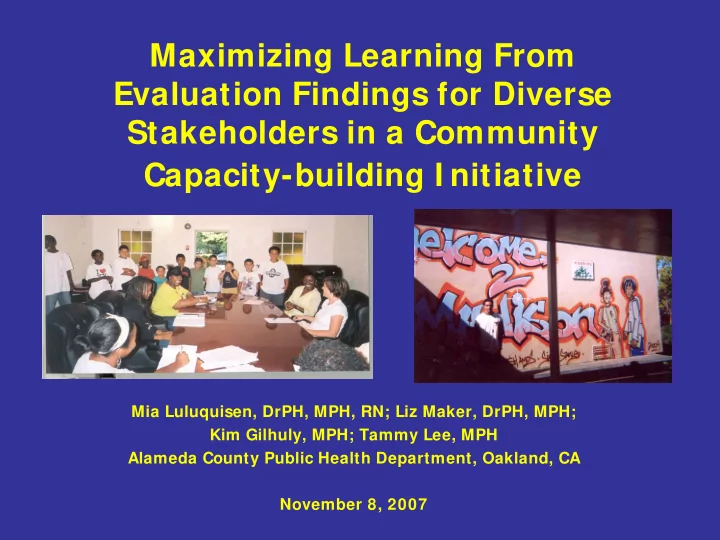
Maximizing Learning From Evaluation Findings for Diverse Stakeholders in a Community Capacity-building I nitiative Mia Luluquisen, DrPH, MPH, RN; Liz Maker, DrPH, MPH; Kim Gilhuly, MPH; Tammy Lee, MPH Alameda County Public Health Department,


slide-1
SLIDE 1

Maximizing Learning From Evaluation Findings for Diverse Stakeholders in a Community Capacity-building I nitiative

Mia Luluquisen, DrPH, MPH, RN; Liz Maker, DrPH, MPH; Kim Gilhuly, MPH; Tammy Lee, MPH Alameda County Public Health Department, Oakland, CA November 8, 2007

slide-2
SLIDE 2

Roundtable Overview

  • Background: City-County Neighborhood

Initiative Intervention strategies Partners and stakeholders Evaluation design and methods Sample Findings

  • Stakeholder needs and how we met them
  • Challenges and Lessons Learned in Meeting

Stakeholder Needs

slide-3
SLIDE 3

I ntervention Strategy: Community Capacity Building/ Empowerment

“Aims to strengthen characteristics of communities to plan, develop, implement & maintain effective community programs that positively affect broader community conditions that determine health and well being”

  • adapted from the W. K. Kellogg Foundation
slide-4
SLIDE 4

Why Build Community Capacity?

  • To address root causes of health inequities
  • To leverage existing city, county and

community resources to solve problems

  • To support organizational and systems

change

  • To build a power-base of residents and staff

who can advocate for equitable distribution of resources

  • To ensure sustainability through partnerships
slide-5
SLIDE 5

History and Background

  • Mobilizing Action for Planning and Partnerships

(MAPP) (2003)

  • City-County Violence Prevention Initiative
  • Grant Proposals to the Centers for Disease

Control for Youth Violence Prevention through Community Capacity-Building (’04, ’05)

  • Creation of the Community

Capacity-Building Leadership Team

slide-6
SLIDE 6

CCNI Stakeholders and Partners

  • Neighborhood Residents
  • Community-Based Organizations and Local

Institutions

  • Community organizers / “line staff” / volunteers
  • Decision-Makers / funders

City of Oakland: Mayor and Human Services Alameda County: Board of Supervisors, Health Care Services Director, Public Health Department Director

  • Knowledge seekers

NACCHO publication; presentations, UC Berkeley, students etc.

slide-7
SLIDE 7
  • Parks and Recreation
  • Human Services
  • Neighborhood Services
  • Community Programs
  • Police Department
  • Office of the Director
  • Community Assessment,

Planning & Evaluation (CAPE)

  • Public Health Nursing
  • Nutrition Services
  • Immunization
  • Community Health Services

Oakland City Council Oakland Unified School District Community-Based Organizations and Grassroots Groups UC Berkeley School

  • f Public Health
  • District 7 – Larry Reid
  • District 3 – Nancy Nadel

Alameda County Public Health Department City of Oakland Sobrante Park and West Oakland Sobrante Park and West Oakland

  • Alcohol Policy Network
  • Attitudinal Healing
  • Healthy Oakland
  • Safe Passages
  • YMCA
  • Pastors group and

Churches

  • Madison Middle School
  • Sobrante Park Elementary School
  • Hoover Elementary School
  • McClymond’s High School
  • Improving Pregnancy

Outcomes Program (IPOP)

  • Interagency Children’s Policy

Council (ICPC)

  • Emergency Medical Services
  • Project YES – Youth Uprising
  • Community and Economic

Development Agency

  • Fire Department
  • Workforce Investment Board
  • Habitat for Humanity
  • Rebuilding Together
  • Community Reformed Church
  • School of Urban Missions
  • Lionel Wilson School
slide-8
SLIDE 8

Community Capacity Building I ntervention

  • Partnership Development
  • Community Mobilization
  • Community surveys and forums
  • Resident action councils/committees
  • Other Interventions

– Leadership development training – Time Banking program – Neighborhood Mini-grant program

  • Population-Based Health Services
slide-9
SLIDE 9

Community Mobilization - Priorities

Sobrante Park

  • Tyrone Carney Park

Improvement

  • Drug dealing/Violence
  • Lack of Youth activities
  • (Added Disaster Prep in

9/05)

West O akland

  • Durant Park

Renovation

  • Blight
  • Improved & Connected

Youth Services

slide-10
SLIDE 10

Evaluation Purpose

Process – Documentation Program improvements So others can follow a similar plan Determine “dose” of activities needed to achieve

  • utcomes

Outcome Did the CCB activities lead to empowerment of residents and groups? Did CCB lead to community-level changes? Did these changes result in reduced health inequities?

slide-11
SLIDE 11

CCNI Evaluation Model

Grassroots community

  • rganizing and

neighborhood development

Community Mobilization Resident Action Councils and Committees Partnership Development Youth programs Accessible Health Services

Residents experience concrete improvements in their lives

Improved neighborhood conditions

Less Violence

Improved health and well-being

Institutions are more responsive to residents

Share power & resources

Residents empowered to speak and act on their own behalf

More Civic Engagement Increased knowledge, skills and leadership Stronger relationships within and outside of neighborhood Greater access to health and social services More youth engagement

Local organizations are stronger Greater resources & linkages

slide-12
SLIDE 12

Evaluation Approach & Plan

  • Matching approach to CCB: Participatory

evaluation

  • Creating an evaluation plan

Describe the project. What are the activities? Create a logic model: Iterative process

  • Input from many stakeholders
  • Draft – Discuss- Draft (repeat)
slide-13
SLIDE 13

CCNI Evaluation Methods

  • Community Surveys

Baseline: 2004 Follow-Up: 2007 Reached 215-230 residents per administration

  • 38 Interviews with

staff and residents

  • Measure Y data on

crime and other neighborhood stressors

slide-14
SLIDE 14

Sample Findings: I ncreased Civic Participation

24% 29% 29% 35% 44% 38%

0% 10% 20% 30% 40% 50% *Attended a BBQ or block party *Met with Neighbors to do something about SP issue Voiced opinon about an issue 2004 Survey 2007 Survey

slide-15
SLIDE 15

Sample Findings: Enhanced Skills & Relationships

(2006 I nterviews)

  • Residents taking on greater leadership roles
  • Increased skills in organizing and advocacy
  • Stronger relationships within and outside of

Sobrante Park

Resident: “Now there is more unity than before between African-Americans and Latinos. Before there was a wall between the groups and more racism and stereotypes. Now we work together more and understand each other’s culture more – for example they like our food. Now we are closer.”

slide-16
SLIDE 16

Sample Findings: Met Neighborhood Priority: I ncreased Emergency Preparedness

26% said they felt prepared for an emergency in 2004

39% in 2007

slide-17
SLIDE 17

Sample Findings: Blight Reduction

  • In ’04 and ’07 surveys, defined blight as: trash,

dumping, abandoned cars, weeds, neglected land or buildings

  • Reduced percent of residents who had called the

City about blight in the past year from 41% in 2004 to 30% in 2007

  • Increased satisfaction to City response to call about

blight from 49% in 2004 to 56% in 2007

slide-18
SLIDE 18

Sample findings: neighborhood improvements made by RACs

  • New design for Tyrone Carney

Park / Streetscape with community input

  • $20 k from the City of Oakland
  • Community clean-ups
  • Earth Days
  • “Mini-Park” Renovation
slide-19
SLIDE 19

Sample Findings: Change in Violent Crime: ’03-’07

21 9 12 12 22 13 18 16 16 22 17 21 5 10 15 20 25

Aug '03 - Jul '04 Aug '04 - Jul '05 Aug '05 - Jul '06 Aug '06 - Jul '07

Rate of Violent Crime per 1,000 population

Sobrante Park Remainder of 31Z Oakland

slide-20
SLIDE 20

Stakeholder Evaluation Needs How met

County Board

  • f Supervisors;

City Council Other decision- makers

Outcomes:

  • Reduction in Violence
  • Concrete improvements
  • “No Fluff”
  • Cost-benefit analysis
  • Presentation with

questions and answers; will return in 6 months with more info

  • Sent Executive

Summary from 40+ page evaluation progress report (update annually)

Staff and partners who work “on the ground”

  • Who did we reach?
  • How effective were we?

Have neighborhood priorities been met?

  • “Success stories.”
  • Challenges and lessons

learned.

  • How can we improve our

work?

  • Group discussion about

evaluation findings

  • Gave full report, which

includes quotes & stories, as well as survey data

  • Presentations on

survey data & written reports

slide-21
SLIDE 21

Stakeholder Evaluation Needs How met

Survey Volunteers (county staff, residents from

  • utside of target

area, city staff)

  • Did their work make a

difference?

  • Was it appreciated by their

colleagues / supervisors?

  • Can they apply any

knowledge to their own work

  • r projects?
  • Volunteer Appreciation

Luncheon & Presentation of Survey Findings

Residents

  • Are conditions better?

Have we met neighborhood priorities?

  • What strategies worked and

why?

  • Has violence been

reduced?

  • Community forums to

present survey findings and discuss action planning based on findings

  • Survey reports

Other health

  • depts. / national

audiences

Best practices; evidence of effectiveness; lessons learned NACCHO Publication Presentations at national conferences (APHA, AEA) Peer-reviewed journals?

slide-22
SLIDE 22

Challenges in Meeting Evaluation Needs

  • How much emphasis to place on qualitative vs.

quantitative data “Stories” speak more to residents & people in the field Decision-makers have asked for more facts and figures

  • How do we make our presentations and reports user-

friendly? Giving the right amount of data Formatting and visual presentation Creative ways to share info with residents

slide-23
SLIDE 23

Challenges in Meeting Evaluation Needs

  • Accurately explaining the limits of our

evaluation design Attributing community change to our interventions

slide-24
SLIDE 24

How we Overcame Challenges

slide-25
SLIDE 25

Discussion Questions for Roundtable