
SLIDE 1
Paul Brandt-Rauf, DrPH, MD, ScD Dean July 19, 2012
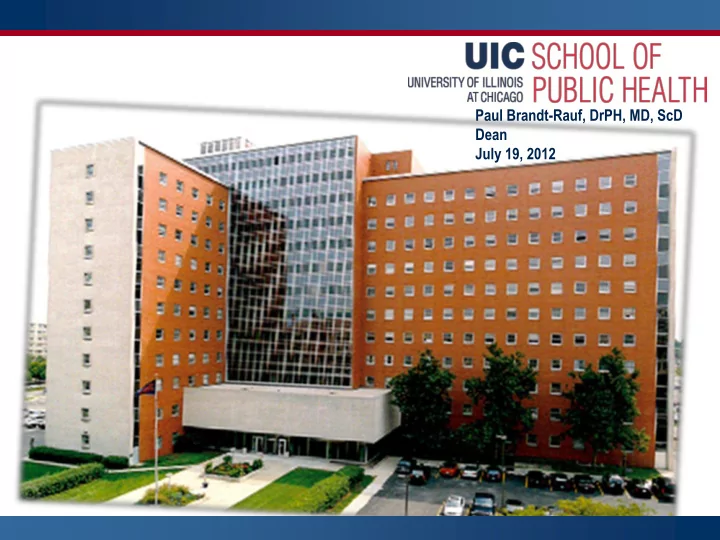
Paul Brandt-Rauf, DrPH, MD, ScD Dean July 19, 2012 UIC SPH Mission - - PowerPoint PPT Presentation
Paul Brandt-Rauf, DrPH, MD, ScD Dean July 19, 2012 UIC SPH Mission Statement The UIC School of Public Health is dedicated to excellence in protecting and improving the health and well-being of the people of the metropolitan Chicago area, the
Paul Brandt-Rauf, DrPH, MD, ScD Dean July 19, 2012
The School of Public Health has global presence through its research, service and educational programs.
= SPH presence
MPH 162 (74%) MS 20 (9%) PhD 18 (8%) MHA 16 (7%) DrPH 2 (1%)
Intervention Projects
Center
Health Disparities
Rank Top 20 Public Health Programs NIH Funding
1 JOHNS HOPKINS UNIVERSITY* $125,452,303 2 HARVARD UNIVERSITY* $119,404,260 3 COLUMBIA UNIVERSITY HEALTH SCIENCES* $57,077,887 4 UNIVERSITY OF NORTH CAROLINA CHAPEL HILL $46,074,069 5 UNIVERSITY OF PITTSBURGH AT PITTSBURGH $45,340,905 6 UNIVERSITY OF WASHINGTON $42,947,723 7 UNIVERSITY OF MINNESOTA TWIN CITIES $37,699,666 8 UNIVERSITY OF MICHIGAN AT ANN ARBOR $34,334,085 9 UNIVERSITY OF ALABAMA AT BIRMINGHAM $22,939,314 10 BROWN UNIVERSITY* $22,278,242 11 UNIVERSITY OF CALIFORNIA BERKELEY $22,082,486 12 EMORY UNIVERSITY* $21,186,047 13 UNIVERSITY OF ILLINOIS AT CHICAGO $16,640,810 14 TULANE UNIVERSITY OF LOUISIANA* $15,973,275 15 BOSTON UNIVERSITY MEDICAL CAMPUS* $15,322,161 16 UNIVERSITY OF CALIFORNIA LOS ANGELES $14,336,590 17 UNIVERSITY OF TEXAS HLTH SCI CTR HOUSTON $12,761,258 18 UNIVERSITY OF IOWA $12,441,154 19 GEORGE WASHINGTON UNIVERSITY* $10,122,356 20 UNIVERSITY OF FLORIDA $8,120,292
Private Boston University Columbia University Emory University George Washington University Harvard University Johns Hopkins University Tulane University Yale University Public University of Alabama--Birmingham University of California—Berkeley University of California--Los Angeles University of Illinois—Chicago University of Michigan--Ann Arbor University of Minnesota--Twin Cities University of North Carolina--Chapel Hill University of Pittsburgh University of Texas--Houston University of Washington
200 400 600 800 1000 1200 1400 1600 1800 2000 2006 2007 2008 2009 2010 UIC Comparative School Average
UIC SPH has experienced an increase in applications consistent with that of comparative schools of public health.
UIC SPH’s male/female applicant ratio is consistent with that of all U.S. schools of public health
500 1000 1500 2000 2500 3000 3500
Enrolled Accepted Applied
The UIC SPH acceptance rate (45.6%) indicates higher selectivity among comparative schools (average, 50%) UIC SPH has a higher enrollment rate after admission offer acceptance (47%) than most comparative schools (average, 43%)
Scholarship, 9.4% Scholarship- External, 1.5% Subsidized Loans, 34.1% Unsubsidized Loans; 32% Waiver, 22.9% Work Study, 0.4%
Average Loan Indebtedness: $23,097
Received Aid; 70% Did Not Receive Aid; 30%
200 400 600 800 1000 1200 1400 1600 1800 2000
Female Male
UIC SPH’s male/female student ratio is consistent with that of all U.S. schools of public health
200 400 600 800 1000 1200 1400 1600 1800 2006 2007 2008 2009 2010
UIC Comp School Average Between 2006-2010 UIC SPH experienced a 13% increase in enrollment compared to a 9.5% average increase among comparative schools.
7.41% Hispanic/ Latino 15.17% Asian 13.62% Black
American 56.90% White 3.45% Two or More 3.45% Race Unknown 4.35% Hispanic/Latino 0.52% American Indian/Alaskan Native 14.87% Asian 9.11% Black or African-American 0.17%Native Hawaiian/Pacific Islander 59.96% White 1.88% Two or More 9.15% Race Unknown
UIC SPH, 2010 Comparable School Average, 2010
0% 5% 10% 15% 20% 25% 30% 21% of UIC SPH’s total enrollment is comprised of underrepresented minority students compared to the comparative institution average of 14.1%
50 100 150 200 250 300 350 400 450 500 2005-2006 2006-2007 2007-2008 2008-2009 2009-2010
UIC Comparative School Average
Between 2005-2010, the number of graduates from UIC SPH increased by 17% compared to the comparative school average increase of 13%
UHDP FUNDING SOURCE FY 08 FY 09 FY 10 FY 11 FY 12 STATE FUNDING $227,486.00 $167,226.00 $147,916.00 $159,741.00 $160,861.00 EXTERNAL FUNDING $547,202.00 $50,000.00 $921,828.00 $921,686.00 $901,081.00 TOTAL FUNDING $774,688.00 $217,226.00 $1,069,744.00 $1,081,427.00 $1,061,942.00
UHDP provides academic enrichment programs and public health traineeships for K-12, College, Graduate students and Professionals to increase the representation
The recruitment, retention, and educational efforts of UHDP are invaluable to achieving and sustaining the ethnic diversity of UIC SPH. The overwhelming majority of underrepresented minority student graduates have received academic or financial support through programs offered by UHDP.
10 20 30 40 50 60 70 2006 2007 2008 2009 2010 Comp Average UIC
The number of underrepresented minority graduates has more than doubled since 2006, surpassing the comparative school average
17% – Yes, new position 28%– Yes, current position 13% – No, but seeking 39% – No, but furthering education 3% – No, not seeking
45.1% of MPH graduates are employed upon graduation in various sectors (shown). 71% of those who are not employed seek to further their education.
Government, 12% Non-Profit, 14% Health Care, 28% Private Practice, 7% University/ Research, 32% Proprietary, 2% Non-Health Related, 5%
How many MPH grads are working? Where are MPH grads working?
Less than $20,000 $20,001-$30,000 $30,001-$40,000 $40,001-$50,000 $50,001-$60,000 $60,001-$70,000 $70,001-$80,000 $80,001-$90,000 $90,001-$100,000 $100,001 and above
Respondent Career Level
FY07 FY08 FY09 FY10 FY11
College Expenditures Rank Expenditures Rank Expenditures Rank Expenditures Rank Expenditures Rank Medicine $125,549 1 $117,714 1 $110,665 1 $126,431 1 $133,381 1 Public Health $27,125 2 $30,243 2 $31,932 2 $32,281 2 $35,354
2
LAS $21,701 3 $20,134 3 $22,584 3 $27,545 3 $32,950 3 Pharmacy $15,469 5 $16,594 5 $18,184 4 $20,483 4 $21,050 4 Engineeri ng $18,311 4 $17,958 4 $17,472 5 $20,285 5 $19,880 5
$0 $50,000,000 $100,000,000 $150,000,000 $200,000,000 $250,000,000 $300,000,000 $350,000,000
UIC SPH ranks #8 in all sponsor funding among public comparative schools of public health
Harvard* Pittsburgh Columbia* Johns Hopkins* Yale* Washington Berkeley UNC UAB UIC Minnesota Michigan Tulane* Emory* UCLA GW* BU* UTexas
UIC SPH earns more research dollars per full-time faculty member than most public health programs in the U.S
White 80% Asian 13% Black/African- American 6% Hispanic/Latino 1% White Asian Black/African-American Hispanic/Latino
$0 $20,000 $40,000 $60,000 $80,000 $100,000 $120,000 $140,000 $160,000 $180,000 $200,000 Assistant Professor Associate Professor Professor Comparative School Average UIC All
State Allocation & Tuition, 17% Indirect Cost Recovery, 4% Gifts; 0.1% Self-Supporting Activities, 3% Continuing Education; 0.4% Research, 56% Training/Student Support; 2% Service, 18% Grants & Contracts; 76%
MPH Revisions
Undergraduate Program
Health Disparities Certificate
Online DrPH