SKOS COMP34512 Sebastian Brandt (Slides by from Sean Bechhofer) - - PowerPoint PPT Presentation

skos
SMART_READER_LITE
LIVE PREVIEW

SKOS COMP34512 Sebastian Brandt (Slides by from Sean Bechhofer) - - PowerPoint PPT Presentation

SKOS COMP34512 Sebastian Brandt (Slides by from Sean Bechhofer) brandt@cs.manchester.ac.uk sean.bechhofer@manchester.ac.uk Friday, 2 May 2014 Terminology Management Consider our original use case Building an index for a childrens

slide-1
SLIDE 1

SKOS

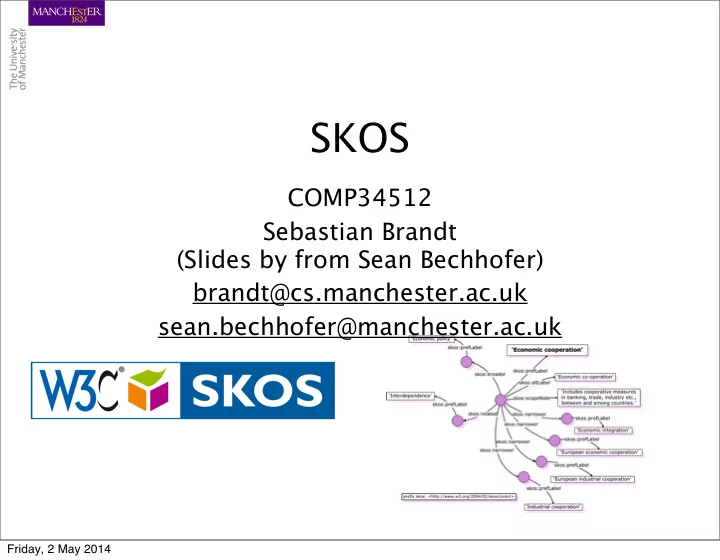
COMP34512 Sebastian Brandt (Slides by from Sean Bechhofer) brandt@cs.manchester.ac.uk sean.bechhofer@manchester.ac.uk

Friday, 2 May 2014

slide-2
SLIDE 2

Terminology Management

  • Consider our original use case

– Building an index for a children’s book on animals – Target: Hierarchical controlled vocabulary

  • I.e., a taxonomy
  • We used an ontology as the development KR

– Terms mapped to classes – The hierarchical relations were mapped to subsumption – The fully classified class graph == the taxonomy

  • Is this representationally adequate

– For all controlled vocabularies? – For our index?

2

Friday, 2 May 2014

slide-3
SLIDE 3

A typical index

3

http://www.anindexer.com/samples/captive/captive1.html

There is hierarchy Are these subsumptions?

Friday, 2 May 2014

slide-4
SLIDE 4

Non-hierarchal relations!

4

http://www.anindexer.com/samples/captive/captive1.html

“Related” terms. Redirect

Friday, 2 May 2014

slide-5
SLIDE 5

Redirect?

5

http://www.anindexer.com/samples/captive/captive1.html

Note that this relation is hierarchal!

Friday, 2 May 2014

slide-6
SLIDE 6

Terminology Management

  • Not all terminologies are the same!

– Data oriented

  • Intended to feed into databases
  • Intended to support statistical analysis
  • Logic seems to do rather well there

– Linguistically oriented

  • Mapping linguistic relations (WordNet)
  • Not very logical!

– E.g., terms have multiple senses

– Navigationally oriented

  • E.g., the Dewey decimal system
  • Cognitively salient relations
  • Many terminologies serve multiple purposes

6

Friday, 2 May 2014

slide-7
SLIDE 7

Navigation vs. Subsumption

  • Subsumption

– Based on the way the world is/model theoretic – Strict inclusion – Amenable to a logical treatment

  • In particular, derivable from features of relational

structures

  • Navigation

– Based on “how we think” – Associative

  • Associations may be “hierarchal” (in some sense) or not

– Generally “brute,” vague, & informal

  • Derivable from patterns of behavior (sometimes)
  • Cognitive cow paths

7

Friday, 2 May 2014

slide-8
SLIDE 8

Desire Paths

8

http://www.flickr.com/photos/bdunnette/6432035825/

Friday, 2 May 2014

slide-9
SLIDE 9

9

Catalogue Terms/ glossary Thesauri Informal is-a Formal is-a Frames Value Restrictions Expressive Logics

A Spectrum of Representation

  • Formal representations are not always the most

appropriate for applications

Friday, 2 May 2014

slide-10
SLIDE 10

10

SKOS

  • SKOS: Simple Knowledge Organisation Scheme
  • Used to represent term lists, controlled vocabularies

and thesauri

  • Lexical labelling
  • Simple broader/narrower hierarchies,

no formal semantics

  • W3C Recommendation

Friday, 2 May 2014

slide-11
SLIDE 11

11

Primary Use Cases/Scenarios

  • A. Single controlled vocabulary used to index and

then retrieve objects

  • Query/retrieval may make use of some structure

in the vocabulary

  • B. Difgerent controlled vocabularies used to index and

retrieve objects

  • Mappings required between the vocabularies
  • Also other possible uses (e.g. navigation)

Friday, 2 May 2014

slide-12
SLIDE 12

12

SKOS Goals

  • to provide a simple, machine-understandable,

representation framework for Knowledge Organisation Systems (KOS)…

  • that has the flexibility and extensibility to cope

with the variation found in KOS idioms…

  • that is fully capable of supporting the publication

and use of KOS within a decentralised, distributed, information environment such as the world wide (semantic) web.

Friday, 2 May 2014

slide-13
SLIDE 13

13

Concept Schemes

  • A concept scheme is a set of concepts, potentially

including statements about relationships between those concepts – Semantic Relationships

  • Broader/Narrower Terms
  • Related Terms

– Lexical Labels

  • Preferred, alternative and hidden labels

– Additional documentation

  • Notes, comments, descriptions

Friday, 2 May 2014

slide-14
SLIDE 14

SKOS Model

Friday, 2 May 2014

slide-15
SLIDE 15

Labelling

  • Lexical Labels associated with

Concepts – Preferred: one per language – Alternate: variants, – Hidden: mis-spellings

  • Labels pairwise disjoint.

Friday, 2 May 2014

slide-16
SLIDE 16

Semantic Relations

  • Hierarchical and Associative
  • Broader/Narrower
  • Loose (i.e. no) semantics

– A publishing vehicle, not a set of thesaurus construction guidelines

  • broader/narrower not (inherently) transitive in SKOS

Friday, 2 May 2014

slide-17
SLIDE 17

Not (necessarily?!) transitive?

  • But, surely

– if A is broader than B – and B is broader than C – that A is broader than C! – i.e., TRANSITIVE!?

  • Consider the Library of Congress Subject Organization

– Vehicles broader than

  • Cars broader than

– Wheels

– Is “Vehicles” necessarily broader than “Wheels”?

  • (Not all wheels are vehicular...spinning wheels, potter’s wheels)
  • We might “fix” this by implicitly making the Wheels, “car wheels”
  • Definitely not subsumptions all the way!

– Vehicle to Cars, yes – Cars to Wheels is partonomic

17

Friday, 2 May 2014

slide-18
SLIDE 18

Mapping Relations

  • Subproperties of Semantic Relations
  • Intended for cross-scheme usage
  • Although no formal enforcement
  • Usually there’s bespoke management code
  • Or things are passed to the user
  • exactMatch similar to EquivalentClasses
  • But again! Transitivity fail
  • or transitivity “caution”
  • broad- and narrowMatch
  • “like” subsumption
  • Much more similar to “see”

– or “see also” – The relationship isn’t reliable

  • In the sense of having a semantics

Friday, 2 May 2014

slide-19
SLIDE 19

19

SKOS and OWL

  • SKOS and OWL are intended for difgerent (but

related) purposes

  • SKOS Concept schemes are not formal ontologies in

the way that, e.g. OWL ontologies are formal

  • ntologies.
  • There is no formal semantics given for the

conceptual hierarchies (broader/narrower) represented in SKOS.

  • Contrast with OWL subclass hierarchies which have a

formal interpretation (in terms of sets of instances).

Friday, 2 May 2014

slide-20
SLIDE 20

20

SKOS and OWL

  • SKOS Concepts not intended for instantiation in the same way

that OWL Classes are instantiated – Leo is an instance of Lion – Born Free is a book about Lions

  • Concept Schemes allow us to capture general statements about

things that aren’t necessarily strictly true of everything – It’s useful to be able to navigate from Cell to Nucleus, even though it’s not the case that all Cells have a Nucleus – Relationships between Polio and Polio virus, Polio vaccine, Polio disease… – Relationships between Accident and Accident Prevention, Accidents in the Home, Radiation Accidents…

  • But we can’t necessarily draw the same kinds of inferences

about SKOS hierarchies. – Broader hierarchy is not transitive.

  • Although mechanisms are available which allow us to query the

transitive closure of the hierarchy.

Friday, 2 May 2014

slide-21
SLIDE 21

21

Annotation

General

  • Labels

– Human readable

  • Textual Definitions

– Scope notes

  • DC style metadata

– authorship

  • Change History
  • Provenance information

Application Specific

  • Entry points for forms
  • Driving User interaction
  • Hiding engineering

aspects of the model

  • Methodological support

Friday, 2 May 2014

slide-22
SLIDE 22

22

SKOS as Annotation

  • SKOS labelling and documentation properties are

defined as OWL Annotation Properties – Preferred/Alternate/Hidden Labels – Documentation/Notes

  • SKOS then provides a standardised vocabulary for

annotating OWL ontologies

  • Leverage existing tooling.

– OWL API – Protégé

Friday, 2 May 2014

slide-23
SLIDE 23

23

SKOS and OWL

  • SKOS and OWL are intended for difgerent purposes.
  • OWL allows the explicit modelling/description of a

domain

  • SKOS provides vocabulary and navigational structure
  • Annotation mechanisms allow them to coexist

– And even interact – A key modelling technique is exploiting OWL knowledge to support SKOS relations

Friday, 2 May 2014

slide-24
SLIDE 24

24

Resources

  • SKOS:

– http://www.w3.org/TR/skos-reference/ – http://www.w3.org/TR/skos-ucr/ – http://www.w3.org/TR/2009/NOTE-skos- primer-20090818/

Friday, 2 May 2014