Lecture 4: Optimization Maximizing or Minimizing a Function of a - - PDF document

lecture 4 optimization
SMART_READER_LITE
LIVE PREVIEW

Lecture 4: Optimization Maximizing or Minimizing a Function of a - - PDF document

3/26/2019 Lecture 4: Optimization Maximizing or Minimizing a Function of a Single Variable Maximizing or Minimizing a Function of Many Variables Constrained Optimization Maximizing a function of a single variable Given a real


slide-1
SLIDE 1

3/26/2019 1

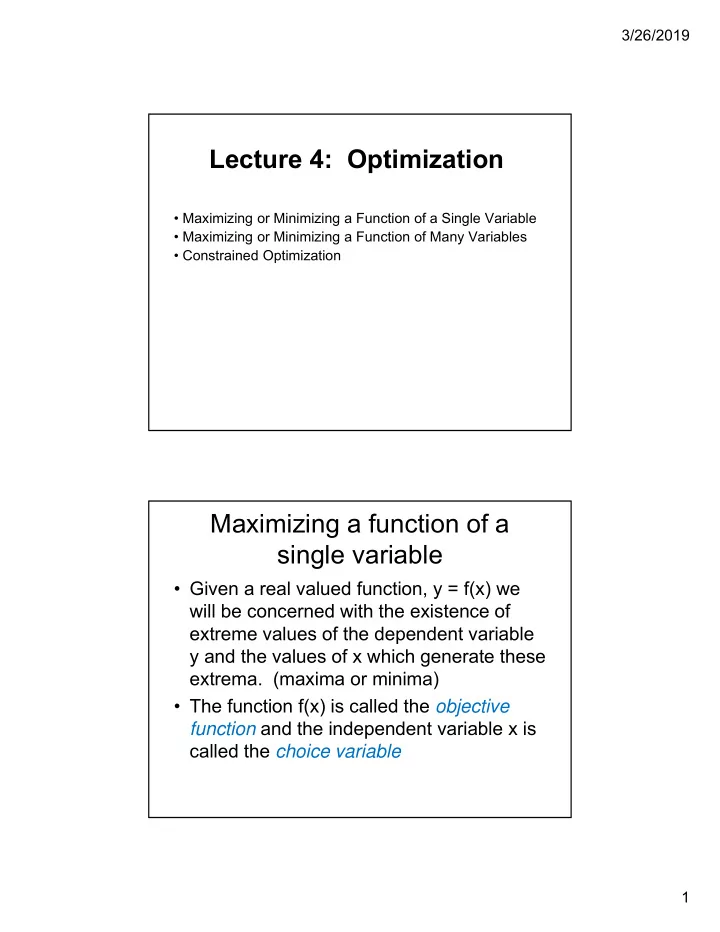
Lecture 4: Optimization

  • Maximizing or Minimizing a Function of a Single Variable
  • Maximizing or Minimizing a Function of Many Variables
  • Constrained Optimization

Maximizing a function of a single variable

  • Given a real valued function, y = f(x) we

will be concerned with the existence of extreme values of the dependent variable y and the values of x which generate these

  • extrema. (maxima or minima)
  • The function f(x) is called the objective

function and the independent variable x is called the choice variable

slide-2
SLIDE 2

3/26/2019 2

Max single variable

  • The problem of finding the value or the set
  • f values of the choice variable which yield

extrema of the objective function is called

  • ptimization.
  • In order to avoid boundary optima, we will

assume that f : X  R, where X is an open interval of R. All of the optima characterized will be termed interior

  • ptima.

Definition of max or min

  • Definition. f has a local maximum

(minimum) at a point x', if for all x in an

  • pen interval (x' - , x' + ), we have that

f(x') > (<) f(x).

f(x) x

slide-3
SLIDE 3

3/26/2019 3

Key result

Proposition 1. Let f be twice differentiable. Let there exists an xo  X such that f '(xo) = 0. (i) If f ''(xo) < 0, then f has a local maximum at xo. If, in addition, f '' < 0 for all x or if f is strictly concave, then the local maximum is a unique global maximum. (ii) If f ''(xo) > 0, then f has a local minimum at xo. If, in addition, f '' > 0 for all x or if f is strictly convex, then the local minimum is a unique global minimum.

Terminology

  • The zero derivative condition is called the

first order condition

  • The second derivative condition is called

the second order condition.

slide-4
SLIDE 4

3/26/2019 4

Examples

#1 Let f = ax - bx

2, a,b > 0 and x > 0. Find a maximum.

Here, f' = 0 implies x' = a/2b. Moreover, f'' = -2b < 0, for all x. Thus, we have a global maximum. #2 Let f = 1 + x

  • 1, where x > 0. Find a minimum.

Here, f' = 0 implies that x

  • 2 = 1, so that x' = 1. In this case, f'' = 2x
  • 3 > 0. Thus, we have a global

minimum. x

Maximizing or Minimizing a Function of Many Variables

  • We consider a differentiable function of many

variables y = f(x1,...,xn).

  • This function has a local maximum

(minimum) at a point x' = (x1,...,xn), if the values of the function are greater than (less than) image values of the function in a neighborhood of x'.

  • The domain of f is thought of as a subset X of

Rn, where each point of X has a neighborhood of points surrounding it which belongs to X. (Interior optima)

slide-5
SLIDE 5

3/26/2019 5

Key Result

  • Proposition 2. If a differentiable function f has a

maximum or a minimum at x'  X, then fi(xo) = 0, for all i.

  • This condition states that at a maximum or a

minimum, all partial derivatives are zero. This depicts the top of a hill or a bottom of a valley.

  • Operationally, the n partial derivative functions

set equal to zero give us n equations in n unknowns to be solved for the extreme point x'. These conditions are called the first order conditions (FOC).

Example

These imply that xi = x and that xi =1/16. At

  • ptimum, we have that y = .125.

Find the maximum of (x1x2)

1/4 - x1 - x2. Computing, we have

.25(x1)

  • .75(x2)

.25 - 1 = 0

.25(x2)

  • .75(x1)

.25 - 1 = 0

slide-6
SLIDE 6

3/26/2019 6

Illustration Example

Find the minimum of z = x2 + xy +2y2. The FOC are 2x + y = 0, x + 4y = 0. Solving for the critical values x = 0 and y = 0.

slide-7
SLIDE 7

3/26/2019 7

Illustration Constrained Optimization

  • One of the most common problems in economics

involves maximizing or minimizing a function subject to a constraint.

  • We are again interested in characterizing interior or

non-boundary constrained optima.

  • The cost minimization problem subject to an output

constraint is an example (Lecture 2).

  • The basic problem is to maximize (minimize) a

function of at least two independent variables subject to a constraint. We write the objective function as f(x1,...,xn) and the constraint as g(x1,...,xn) = 0.

slide-8
SLIDE 8

3/26/2019 8

Constrained Optimization

  • The constraint set is written as C = { x |

g(x1,...,xn) = 0}.

  • We write the problem as
  • For minimization, replace Max with Min.

Max

x xn { ,..., }

1

f(x1,...,xn) subject to g(x1,...,xn) = 0.

Key Result

Proposition 3. Let f be a differentiable function whose n independent variables are restricted by the differentiable constraint g(x) = 0. Form the function L(,x)  f(x) + g(x), where  is an undetermined multiplier. If xo is an interior maximizer or minimizer of f subject to g(x) = 0, then there is a o such that (1) L(o, xo)/xi = 0, for all i, and (2) L(o, xo)/ = 0.

slide-9
SLIDE 9

3/26/2019 9

Discussion

  • L is the Lagrangian function and  is the

Lagrangian multiplier.

  • Conditions (1) and (2) are again called the
  • FOC. They constitute n + 1 equations in n

+ 1 unknowns.

Example

  • Min (p1x1 + p2x2) subject to qt = f(x1,x2).

{x1,x2}

  • Forming the Lagrangian, we have

L = (p1x1 + p2x2) + [qt - f(x1,x2)].

  • FOC

(1) L = qt - f(x1,x2) = 0, (2) L1 = p1 - f1 = 0, (3) L2 = p2 - f2 = 0.

slide-10
SLIDE 10

3/26/2019 10

Example

  • Condition (1) just says that the firm must
  • bey its output constraint
  • Conditions (2) - (3) say that
  • That is, the MRS should equal the price

ratio.

1 2

  • 1
  • 2

.

Numerical Example

  • Let f = x1x2 and let p1 = 2 and p2 = 2. Solve

the cost minimization problem with a target

  • utput of 16.
  • The Lagrangian is

L = 2x1 + 2x2 + ( 16 - x1x2).

  • FOC
  • (1) x1x2 - 16 = 0,
  • (2) 2 - x2 = 0,
  • (3) 2 - x1 = 0.
slide-11
SLIDE 11

3/26/2019 11

Numerical Example

  • Clearly xi = x, so that using (1), x2 =16 and

xi = 4.