
SLIDE 1
William Sandqvist william@kth.se
Maurice Karnaugh
The Karnaugh map makes it easy to minimize Boolean expressions!
Maurice Karnaugh The Karnaugh map makes it easy to minimize Boolean - - PowerPoint PPT Presentation
Maurice Karnaugh The Karnaugh map makes it easy to minimize Boolean expressions! William Sandqvist william@kth.se A function of four variables a b c d. The truthtable consists of 11 "1" and 5 "0". According to earlier, we
William Sandqvist william@kth.se
The Karnaugh map makes it easy to minimize Boolean expressions!
William Sandqvist william@kth.se
Anyone who used the Boolean algebra know that it then follows hard work to produce simpler expressions. Minterms could be combined in many different ways, which all result in different simplified expression - How do we know that we have found the minimal expression? The truthtable consists of 11 "1" and 5 "0". According to earlier, we know that the function can be expressed in the SoP form with 11 mintermer or PoS form with 5 maxtermer.
William Sandqvist william@kth.se
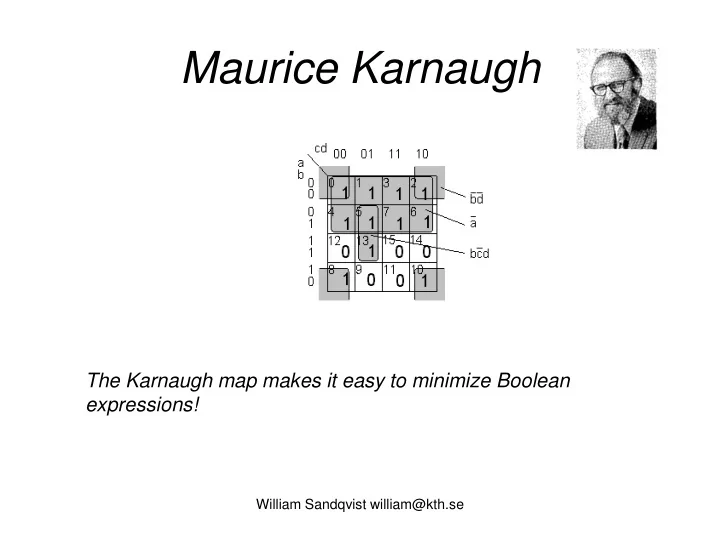
The Karnaugh map is the Truth Table but with the minterms in a different order. Note the numbering! The frames are ordered in such way that only one bit changes between two vertical frames or horisontal frames. This order is called Gray code.
William Sandqvist william@kth.se
The frames "5" and "13" are "neighbors" in the Karnaugh map ( but they are distant from each
They correspond to two minterm with four variables, and the figure shows how, with Boolean algebra, they can be reduced to one term with three variables. What the two frames have in common is that b = 1, c = 0 and d = 1; and the reduced term expresses just that. Everywhere in the Karnaugh map where one can find two ones that are "neighbors" (vertically or horizontally) the minterms could be reduced to "what they have in common". This is called a grouping.
William Sandqvist william@kth.se
Frames "1" "3" "5" "7" is a group
"neighbors" to each other. Here too, the four minterms could be reduced to a term that expresses what is common for the frames, namely that a = 0 and d = 1. Everywhere in Karnaugh map where one can find such groups
William Sandqvist william@kth.se
All groups of 2, 4, 8, (... 2 N ie. powers of 2) frames containing ones can be reduced to a term, with what they have in common, grouping of n.
William Sandqvist william@kth.se
The Karnaugh map should be drawn on a torus (a donut). When we reach an edge, the graph continnues from the opposite side! Frame 0 is the "neighbor" with frame 2, but also the "neighbor" with frame 8 which is "neighbor" to frame 10.
One is looking for the bigest grouping as
there is a grouping with eight ones (frames 0,1,3,2,4,5,7,6). Corners (0,2,8,10) is a group of four ones. Two of the frames (0. 2) has already been included in the first group, but it does not matter if a minterm is included multiple times. All ones in the logic function must either be in a grouping, or be included as a minterm. The "1" in frame 13 may form a group with "1" in frame 5, unfortunately there are no bigger grouping for this "1".
William Sandqvist william@kth.se
William Sandqvist william@kth.se
Is there any incorrect groupings in this Karnaugh diagrams?
William Sandqvist william@kth.se
Groupings should be 2, 4, 8 (= power of two) "neighbors" vertikal or horisontal, not diagonal.
Is there any incorrect groupings in this Karnaugh diagrams?
William Sandqvist william@kth.se
William Sandqvist william@kth.se
William Sandqvist william@kth.se
William Sandqvist william@kth.se
William Sandqvist william@kth.se
William Sandqvist william@kth.se
William Sandqvist william@kth.se
William Sandqvist william@kth.se
William Sandqvist william@kth.se
William Sandqvist william@kth.se
William Sandqvist william@kth.se
The Karnaugh map is also useful for groupings of 0's. The groupings may include the same number of frames as the case of groupings of 1's. In this example, 0: s are grouped together in pairs with their "neighbors". Maxterms are simplified to what is in common for the frames. The simplified expression is the product of three sums it represents a very substantial simplification of the original functins's five maxterms.
William Sandqvist william@kth.se
William Sandqvist william@kth.se
Karnaugh maps with three and two variables are also useful. The Karnaugh map can conveniently be used for functions of up to four variables, and with a little practice up to six variables.
6
William Sandqvist william@kth.se
William Sandqvist william@kth.se
NOR-NOR to OR-AND change ”staight on!
William Sandqvist william@kth.se
) ( ) ( ) , , ( c b c a c b a f + ⋅ + =
William Sandqvist william@kth.se
) ( ) ( ) , , ( c b c a c b a f + ⋅ + =
William Sandqvist william@kth.se
William Sandqvist william@kth.se
b a c c b a f ⋅ + = ) , , (
William Sandqvist william@kth.se
b a c c b a f ⋅ + = ) , , (
William Sandqvist william@kth.se
b a c c b a f ⋅ + = ) , , (
AND-OR NAND-NAND change gates ”straight on”
William Sandqvist william@kth.se
b a c c b a f ⋅ + = ) , , (
No gate on this level
William Sandqvist william@kth.se
b a c c b a f ⋅ + = ) , , ( b a c b a c b a c ⋅ ⋅ = ⋅ + = ⋅ +
Or algebraic: Double invert = standard trick De Morgan
William Sandqvist william@kth.se
William Sandqvist william@kth.se
PLD circuits often have an XOR gate at the output so that they shall be able to invert the function. One can then choose to bring together 0s or 1s after what is most advantageous. When the control signal is a "1" the gates output is b's inverse, when a is "0", the output is equal to b
William Sandqvist william@kth.se
? ? ) 12 , 10 , 8 , 4 , 2 , ( ) , , , (
1 2 3
= = = ∑ f f m x x x x f
William Sandqvist william@kth.se
? ? ) 12 , 10 , 8 , 4 , 2 , ( ) , , , (
1 2 3
= = = ∑ f f m x x x x f
William Sandqvist william@kth.se
? ? ) 12 , 10 , 8 , 4 , 2 , ( ) , , , (
1 2 3
= = = ∑ f f m x x x x f
William Sandqvist william@kth.se
? ? ) 12 , 10 , 8 , 4 , 2 , ( ) , , , (
1 2 3
= = = ∑ f f m x x x x f
William Sandqvist william@kth.se
? ? ) 12 , 10 , 8 , 4 , 2 , ( ) , , , (
1 2 3
= = = ∑ f f m x x x x f
Grouping of ”1” Grouping of ”0”
William Sandqvist william@kth.se
2 1
x x x x f + =
? ? ) 12 , 10 , 8 , 4 , 2 , ( ) , , , (
1 2 3
= = = ∑ f f m x x x x f
Grouping of ”1” Grouping of ”0”
William Sandqvist william@kth.se
2 1
x x x x f + =
? ? ) 12 , 10 , 8 , 4 , 2 , ( ) , , , (
1 2 3
= = = ∑ f f m x x x x f
Grouping of ”1” Grouping of ”0”
William Sandqvist william@kth.se
2 1
x x x x f + =
1 2
} "1" as 0" " { x x x f + = =
? ? ) 12 , 10 , 8 , 4 , 2 , ( ) , , , (
1 2 3
= = = ∑ f f m x x x x f
Grouping of ”1” Grouping of ”0”
William Sandqvist william@kth.se
2 1
x x x x f + =
1 2
} "1" as 0" " { x x x f + = = This time it was advantageous to group 0s and invert the output!
? ? ) 12 , 10 , 8 , 4 , 2 , ( ) , , , (
1 2 3
= = = ∑ f f m x x x x f
Grouping of ”1” Grouping of ”0”
William Sandqvist william@kth.se
? ? ) 15 , 6 ( ) 11 , 7 , 5 , 3 ( ) , , , (
1 2 3
= = + = ∑ f f d m x x x x f
Sometimes, problem is such that certain input combinations is "impossible" and therefore can not occur. Such mintermer (or maxtermer) one denotes man d ("do not care") and use them as ones
possible. (A risk may be that what is thought to be "impossible" still occurs!? Therefore, it may often be better to take care of all combinations.)
William Sandqvist william@kth.se
? ? ) 15 , 6 ( ) 11 , 7 , 5 , 3 ( ) , , , (
1 2 3
= = + = ∑ f f d m x x x x f
Grouping of ”1” Grouping of ”0”
William Sandqvist william@kth.se
? ? ) 15 , 6 ( ) 11 , 7 , 5 , 3 ( ) , , , (
1 2 3
= = + = ∑ f f d m x x x x f
2 3 1
x x x x x f + = Grouping of ”1” Grouping of ”0”
William Sandqvist william@kth.se
? ? ) 15 , 6 ( ) 11 , 7 , 5 , 3 ( ) , , , (
1 2 3
= = + = ∑ f f d m x x x x f
2 3 1
x x x x x f + =
Grouping of ”1” Grouping of ”0”
William Sandqvist william@kth.se
? ? ) 15 , 6 ( ) 11 , 7 , 5 , 3 ( ) , , , (
1 2 3
= = + = ∑ f f d m x x x x f
2 3 1
x x x x x f + =
1 3 1 2
x x x x x f + + =
Grouping of ”1” Grouping of ”0”
William Sandqvist william@kth.se
William Sandqvist william@kth.se
William Sandqvist william@kth.se
William Sandqvist william@kth.se
Only the in-combinations X 0, 1, 3, 7, 15 can occur. All other in- combinations can be used as ”don’t care”. We can directly see from the table that u2 and x3 are same, u2 can be directly connected to x3. u2 = x3. The other expressions are obtained by using their Karnaugh maps.
William Sandqvist william@kth.se
Only the in-combinations X 0, 1, 3, 7, 15 can occur. All other in- combinations can be used as ”don’t care”. We can directly see from the table that u2 and x3 are same, u2 can be directly connected to x3. u2 = x3. The other expressions are obtained by using their Karnaugh maps.
William Sandqvist william@kth.se
William Sandqvist william@kth.se
William Sandqvist william@kth.se
”Pull Up” ”Pull Down”
William Sandqvist william@kth.se
William Sandqvist william@kth.se
William Sandqvist william@kth.se
William Sandqvist william@kth.se
William Sandqvist william@kth.se
William Sandqvist william@kth.se
William Sandqvist william@kth.se
1 1 1 1
William Sandqvist william@kth.se
1 1 1 1 1 1 1
William Sandqvist william@kth.se
A B Y 0 0 0 0 1 1 1 0 1 1 1 1
William Sandqvist william@kth.se
William Sandqvist william@kth.se
When EN = 1 we have an inverter.
William Sandqvist william@kth.se
When EN = 0 the output is totaly disconnected from the supply voltage and ground. A can no longer influence the output value. This is a third output state, "Three State".
Many outputs could be connected to the same line ("bus"). One of the outputs at a time can be active. The otherare in their Three-state condition.
William Sandqvist william@kth.se
William Sandqvist william@kth.se
Construct the "Pull-up" network with P-transistors for the CMOS gate.
William Sandqvist william@kth.se
Pull-down circuit is the inverted function. The Pull-up circuit is the function noninverted:
William Sandqvist william@kth.se
The Pull-up net must therefore consist of A and C in parallel (+) then connected in series (⋅) with B. The use of PMOS transistors inverts the variables A, B and C.
B C A ) ( + B C A B C A B C A Y B C A Y ⋅ + = ⋅ ⋅ = + ⋅ = ⇒ + ⋅ = ) (