Outcomes I can use Karnaugh maps to synthesize combinational - - PowerPoint PPT Presentation

outcomes
SMART_READER_LITE
LIVE PREVIEW

Outcomes I can use Karnaugh maps to synthesize combinational - - PowerPoint PPT Presentation

8.1 8.2 Outcomes I can use Karnaugh maps to synthesize combinational functions with several outputs I can determine the appropriate size and contents of a memory Unit 8 to implement any logic function (i.e. truth table) Implementing


slide-1
SLIDE 1

8.1

Unit 8

Implementing Combinational Functions with Karnaugh Maps

8.2

Outcomes

  • I can use Karnaugh maps to synthesize combinational functions

with several outputs

  • I can determine the appropriate size and contents of a memory

to implement any logic function (i.e. truth table)

8.3

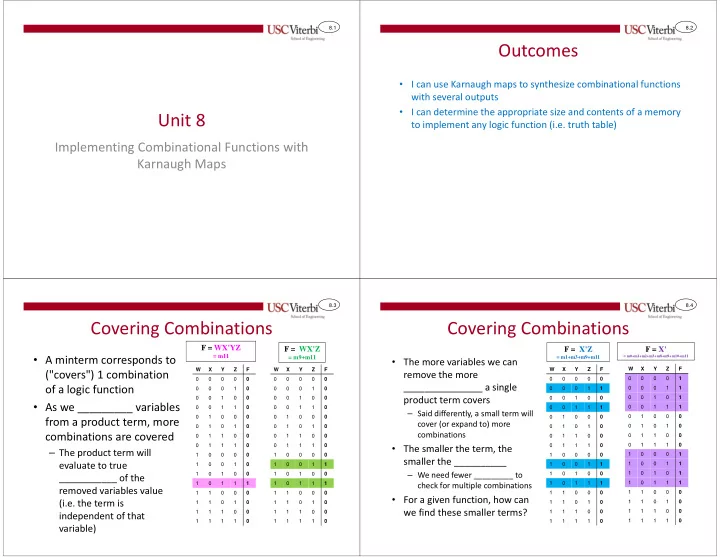
Covering Combinations

  • A minterm corresponds to

("covers") 1 combination

  • f a logic function
  • As we _________ variables

from a product term, more combinations are covered

– The product term will evaluate to true ___________ of the removed variables value (i.e. the term is independent of that variable)

W X Y Z F 1 1 1 1 1 1 1 1 1 1 1 1 1 1 1 1 1 1 1 1 1 1 1 1 1 1 1 1 1 1 1 1 1 1

F = WX'Z

= m9+m11

W X Y Z F 1 1 1 1 1 1 1 1 1 1 1 1 1 1 1 1 1 1 1 1 1 1 1 1 1 1 1 1 1 1 1 1 1

F = WX'YZ

= m11

8.4

Covering Combinations

  • The more variables we can

remove the more _______________ a single product term covers

– Said differently, a small term will cover (or expand to) more combinations

  • The smaller the term, the

smaller the __________

– We need fewer _________ to check for multiple combinations

  • For a given function, how can

we find these smaller terms?

W X Y Z F 1 1 1 1 1 1 1 1 1 1 1 1 1 1 1 1 1 1 1 1 1 1 1 1 1 1 1 1 1 1 1 1 1 1 1 1 1 1 1 1

F = X'

= m0+m1+m2+m3+m8+m9+m10+m11

W X Y Z F 1 1 1 1 1 1 1 1 1 1 1 1 1 1 1 1 1 1 1 1 1 1 1 1 1 1 1 1 1 1 1 1 1 1 1 1

F = X'Z

= m1+m3+m9+m11

slide-2
SLIDE 2

8.5

KARNAUGH MAPS

A new way to synthesize your logic functions

8.6

Logic Function Synthesis

  • Given a function description as a T.T. or canonical form, how

can we arrive at a circuit implementation or equation (i.e. perform logic synthesis)?

  • Methods

– Minterms / maxterms

  • Use _________________ to find minimal 2-level implementation

– Karnaugh Maps [we will learn this one now]

  • Graphical method amenable to human ___________ inspection and can

be used for functions of _____________ variables

  • Yields minimal 2-level implementation / covering (though not necessarily

minimal 3-, 4-, … level implementation)

– Quine-McCluskey Algorithm (amenable to computer implementations – Others: Espresso algorithm, Binary Decision Diagrams, etc.

8.7

Karnaugh Maps

  • If used correctly, will always yield a minimal,

__________ implementation

– There may be a more minimal 3-level, 4-level, 5- level… implementation but K-maps produce the minimal two-level (SOP or POS) implementation

  • Represent the truth table graphically as a

series of adjacent ________ that allows a human to see where variables will cancel

8.8

Gray Code

  • Different than normal binary ordering
  • Reflective code

– When you add the (n+1)th bit, reflect all the previous n-bit combinations

  • Consecutive code words differ by only 1-bit

1 1 1 1

when you move to the next bit, reflect the previous combinations 2-bit Gray code

1 1 1 1

3-bit Gray code differ by

  • nly 1-bit

differ by

  • nly 1-bit

differ by

  • nly 1-bit
slide-3
SLIDE 3

8.9

Karnaugh Map Construction

  • Every square represents 1 input combination
  • Must label axes in Gray code order
  • Fill in squares with given function values

1 1 1 1 1 1 1 1 1 1 1

WX YZ

00 01 11 10 00 01 11 10

1 3 2 4 5 7 6 12 13 14 15 8 9 11 10

1 1 1 1

XY Z

00 01 11 10 1

1 2 3 6 7 4 5

3 Variable Karnaugh Map 4 Variable Karnaugh Map

F=ΣXYZ(1,4,5,6) G=ΣWXYZ(1,2,3,5,6,7,9,10,11,14,15)

8.10

Karnaugh Maps

W X Y Z F 1 1 1 1 1 1 1 1 1 1 1 1 1 1 1 1 1 1 1 1 1 1 1 1 1 1 1 1 1 1 1 1 1 1 1 1 1 1 1 1 1 1 1

1 1 1 1 1 1 1 1 1 1 1

WX YZ

00 01 11 10 00 01 11 10

1 3 2 4 5 7 6 12 13 14 15 8 9 11 10

8.11

Karnaugh Maps

  • Squares with a '1' represent minterms that must be

included in the SOP solution

  • Squares with a '0' represent maxterms that must be

included in the POS solution

1 1 1 1 1 1 1 1 1 1 1

WX YZ

00 01 11 10 00 01 11 10

1 3 2 4 5 7 6 12 13 14 15 8 9 11 10

Maxterm: w’ + x + y + z Maxterm: w’ + x’ + y + z Minterm: w•x’•y•z Minterm: w•x’•y•z’

8.12

Karnaugh Maps

  • Groups (of 2, 4, 8, etc.) of adjacent 1’s will always

simplify to smaller product term than just individual minterms

1 1 1 1 1

XY Z

00 01 11 10 1

1 2 3 6 7 4 5

3 Variable Karnaugh Map

F=ΣXYZ(0,2,4,5,6)

slide-4
SLIDE 4

8.13

Karnaugh Maps

  • Adjacent squares differ by 1-variable

– This will allow us to use T10 = AB + AB’= A or T10’ = (A+B’)(A+B) = A

WX YZ

00 01 11 10 00 01 11 10

1 3 2 4 5 7 6 12 13 14 15 8 9 11 10

XY Z

00 01 11 10 1

1 2 3 6 7 4 5

3 Variable Karnaugh Map 4 Variable Karnaugh Map Difference in X: 010 & 110 Difference in Z: 010 & 011 Difference in Y: 010 & 000 1 = 0001 4 = 0100 5 = 0101 7 = 0111 13 = 1101

Adjacent squares differ by 1-bit

0 = 000 2 = 010 3 = 011 6 = 110

Adjacent squares differ by 1-bit

x’yz’ + xyz’ = yz’ x’yz’ + x’yz = x’y x’yz’ + x’y’z’ = x’z’

8.14

Karnaugh Maps

  • 2 adjacent 1’s (or 0’s) differ by only one variable
  • 4 adjacent 1’s (or 0’s) differ by two variables
  • 8, 16, … adjacent 1’s (or 0’s) differ by 3, 4, … variables
  • By grouping adjacent squares with 1’s (or 0’s) in them, we can come up

with a simplified expression using T10 (or T10’ for 0’s) 1 1 1 1 1 1 1 1 1 1 1

WX YZ

00 01 11 10 00 01 11 10

1 3 2 4 5 7 6 12 13 14 15 8 9 11 10

w•x•y•z + w•x’•y•z = w•y•z w’•x’•y’•z + w’•x’•y•z + w’•x•y’•z + w’•x•y•z = w’•z

w’z are constant while all combos of x and y are present (x’y’, x’y, xy’, xy)

(w’+x’+y+z)•(w’+x’+y+z’) = (w’+x’+y)

8.15

K-Map Grouping Rules

  • Cover the 1's [=on-set] or 0's [=off-set] with ______

groups as possible, but make those groups ________ as possible

– Make them as large as possible even if it means "covering" a 1 (or 0) that's already a member of another group

  • Make groups of ____________, ... and they must be

rectangular or square in shape.

  • Wrapping is legal

8.16

Group These K-Maps

1 1

XY Z

00 01 11 10 1

1 2 3 6 7 4 5

1 1 1 1 1 1 1 1 1

WX YZ

00 01 11 10 00 01 11 10

1 3 2 4 5 7 6 12 13 14 15 8 9 11 10

1 1 1

XY Z

00 01 11 10 1

1 2 3 6 7 4 5

slide-5
SLIDE 5

8.17

Karnaugh Maps

  • Cover the remaining ‘1’ with the largest

group possible even if it “reuses” already covered 1’s

1 1 1 1 1 1 1 1 1 1 1

WX YZ

00 01 11 10 00 01 11 10

1 3 2 4 5 7 6 12 13 14 15 8 9 11 10

8.18

Karnaugh Maps

  • Groups can wrap around from:

– Right to left – Top to bottom – Corners 1 1 1 1

WX YZ

00 01 11 10 00 01 11 10

1 3 2 4 5 7 6 12 13 14 15 8 9 11 10

1 1 1 1 1 1

WX YZ

00 01 11 10 00 01 11 10

1 3 2 4 5 7 6 12 13 14 15 8 9 11 10

F = X’Z’ F = X’Z + WXZ’

8.19

Group This

1 1 1 1 1 1 1 1 1 1 1

WX YZ

00 01 11 10 00 01 11 10

1 3 2 4 5 7 6 12 13 14 15 8 9 11 10

8.20

K-Map Translation Rules

  • When translating a group of 1’s, find the variable

values that are constant for each square in the group and translate only those variables values to a product term

  • Grouping 1’s yields SOP
  • When translating a group of 0’s, again find the

variable values that are constant for each square in the group and translate only those variable values to a sum term

  • Grouping 0’s yields POS
slide-6
SLIDE 6

8.21

Karnaugh Maps (SOP)

1 1 1 1 1 1 1 1 1 1 1

WX YZ

00 01 11 10 00 01 11 10

1 3 2 4 5 7 6 12 13 14 15 8 9 11 10

W X Y Z F 1 1 1 1 1 1 1 1 1 1 1 1 1 1 1 1 1 1 1 1 1 1 1 1 1 1 1 1 1 1 1 1 1 1 1 1 1 1 1 1 1 1 1 F =

8.22

Karnaugh Maps (SOP)

1 1 1 1 1 1 1 1 1 1 1

WX YZ

00 01 11 10 00 01 11 10

1 3 2 4 5 7 6 12 13 14 15 8 9 11 10

W X Y Z F 1 1 1 1 1 1 1 1 1 1 1 1 1 1 1 1 1 1 1 1 1 1 1 1 1 1 1 1 1 1 1 1 1 1 1 1 1 1 1 1 1 1 1 F = Y

Y 8.23

Karnaugh Maps (SOP)

1 1 1 1 1 1 1 1 1 1 1

WX YZ

00 01 11 10 00 01 11 10

1 3 2 4 5 7 6 12 13 14 15 8 9 11 10

W X Y Z F 1 1 1 1 1 1 1 1 1 1 1 1 1 1 1 1 1 1 1 1 1 1 1 1 1 1 1 1 1 1 1 1 1 1 1 1 1 1 1 1 1 1 1 F = Y + W’Z + …

Z W’ 8.24

Karnaugh Maps (SOP)

1 1 1 1 1 1 1 1 1 1 1

WX YZ

00 01 11 10 00 01 11 10

1 3 2 4 5 7 6 12 13 14 15 8 9 11 10

W X Y Z F 1 1 1 1 1 1 1 1 1 1 1 1 1 1 1 1 1 1 1 1 1 1 1 1 1 1 1 1 1 1 1 1 1 1 1 1 1 1 1 1 1 1 1

Z X’

F = Y + W’Z + X’Z

X’

slide-7
SLIDE 7

8.25

Karnaugh Maps (POS)

1 1 1 1 1 1 1 1 1 1 1

WX YZ

00 01 11 10 00 01 11 10

1 3 2 4 5 7 6 12 13 14 15 8 9 11 10

W X Y Z F 1 1 1 1 1 1 1 1 1 1 1 1 1 1 1 1 1 1 1 1 1 1 1 1 1 1 1 1 1 1 1 1 1 1 1 1 1 1 1 1 1 1 1 F =

8.26

Karnaugh Maps (POS)

1 1 1 1 1 1 1 1 1 1 1

WX YZ

00 01 11 10 00 01 11 10

1 3 2 4 5 7 6 12 13 14 15 8 9 11 10

W X Y Z F 1 1 1 1 1 1 1 1 1 1 1 1 1 1 1 1 1 1 1 1 1 1 1 1 1 1 1 1 1 1 1 1 1 1 1 1 1 1 1 1 1 1 1

Y,Z

F = (Y+Z)

8.27

Karnaugh Maps (POS)

1 1 1 1 1 1 1 1 1 1 1

WX YZ

00 01 11 10 00 01 11 10

1 3 2 4 5 7 6 12 13 14 15 8 9 11 10

W X Y Z F 1 1 1 1 1 1 1 1 1 1 1 1 1 1 1 1 1 1 1 1 1 1 1 1 1 1 1 1 1 1 1 1 1 1 1 1 1 1 1 1 1 1 1

Y

F = (Y+Z)(W’+X’+Y)

WX 8.28

Karnaugh Maps

  • Groups can wrap around from:

– Right to left – Top to bottom – Corners 1 1 1 1

WX YZ

00 01 11 10 00 01 11 10

1 3 2 4 5 7 6 12 13 14 15 8 9 11 10

1 1 1 1 1 1

WX YZ

00 01 11 10 00 01 11 10

1 3 2 4 5 7 6 12 13 14 15 8 9 11 10

X’ X’ Z’ Z’

F = X’Z’

X’ X’ Z WX Z’ Z’

F = X’Z + WXZ’

slide-8
SLIDE 8

8.29

Exercises

1 1 1 1 1 1 1

WX YZ

00 01 11 10 00 01 11 10

1 3 2 4 5 7 6 12 13 14 15 8 9 11 10

1 1 1 1 1 1 1

WX YZ

00 01 11 10 00 01 11 10

1 3 2 4 5 7 6 12 13 14 15 8 9 11 10

FSOP= FPOS= P= P=Σ Σ Σ ΣXYZ(2,3,5,7)

8.30

No Redundant Groups

1 1 1 1 1 1 1

WX YZ

00 01 11 10 00 01 11 10

1 3 2 4 5 7 6 12 13 14 15 8 9 11 10

This group does not cover new squares that are not already part of another essential grouping

8.31

Multiple Minimal Expressions

  • For some functions,

______________ groupings exist which will lead to alternate minimal _____________…Pick one

1 1 1 1 1 1 1 1 1

D8D4 D2D1

00 01 11 10 00 01 11 10

1 3 2 4 5 7 6 12 13 14 15 8 9 11 10

Best way to cover this ‘1’??

8.32

5- & 6-VARIABLE KMAPS

slide-9
SLIDE 9

8.33

5-Variable K-Map

  • If we have a 5-variable function we need a 32-square KMap.
  • Will an 8x4 matrix work?

– Recall K-maps work because adjacent squares differ by 1-bit

  • How many adjacencies should we have for a given square?
  • ___!! But drawn in 2 dimensions we can’t have __

adjacencies.

VWX YZ 000 001 011 010 110 111 101 100

00 01 11 10

8.34

5-Variable Karnaugh Maps

  • To represent the 5 adjacencies of a 5-variable function [e.g.

f(v,w,x,y,z)], imagine two 4x4 K-Maps stacked on top of each

  • ther

– Adjacency across the two maps 1 1 1

WX YZ

00 01 11 10 00 01 11 10

1 3 2 4 5 7 6 12 13 14 15 8 9 11 10

1 1

WX YZ

00 01 11 10 00 01 11 10

1 3 2 4 5 7 6 12 13 14 15 8 9 11 10

V=0 V=1

1

These are adjacent Traditional adjacencies still apply (Note: v is constant for that group and should be included) => v’xy’ Adjacencies across the two maps apply (Now v is not constant) => w’xy’

F = v’xy’ + w’xy’

8.35

6-Variable Karnaugh Maps

  • 6 adjacencies

for 6-variables (Stack of four 4x4 maps) 1 1 1

WX YZ

00 01 11 10 00 01 11 10

1 3 2 4 5 7 6 12 13 14 15 8 9 11 10

1

WX YZ

00 01 11 10 00 01 11 10

1 3 2 4 5 7 6 12 13 14 15 8 9 11 10

U,V=1,0 U,V=1,1

1 1

WX YZ

00 01 11 10 00 01 11 10

1 3 2 4 5 7 6 12 13 14 15 8 9 11 10

1 1

WX YZ

00 01 11 10 00 01 11 10

1 3 2 4 5 7 6 12 13 14 15 8 9 11 10

U,V=0,0 U,V=0,1

Not adjacent Group of 4 Group of 2

U,V=0,0 U,V=1,0 U,V=1,1 U,V=0,1

8.36

7-Variable K-maps and Other Techniques

  • Can we have 7-variable K-Maps?
  • No! We would need to see 7

adjacencies per square and we humans cannot visualize 4 dimensions

  • Other computer-friendly minimization

algorithms

– Quine-McCluskey

  • Still exponential runtime
  • Minimization is NP-hard problem

– Espresso-heuristic Minimizer

  • Achieves "good" minimization in far less time

(may not be absolute minimal)

U,V=0,0 U,V=1,0 U,V=1,1 U,V=0,1

slide-10
SLIDE 10

8.37

DON'T CARE OUTPUTS

8.38

Don’t-Cares

  • Sometimes there are certain input combinations that

are illegal (due to physical or other external constraints)

  • The outputs for the illegal inputs are “don’t-cares”

– The output can either be 0 or 1 since the inputs can never

  • ccur

– Don’t-cares can be included in groups of 1 or groups of 0 when grouping in K-Maps – Use them to make as big of groups as possible

Use 'Don't care' outputs as wildcards (e.g. the blank tile in ScrabbleTM). They can be either 0 or 1 whatever helps make bigger groups to cover the ACTUAL 1's

8.39

Invalid Input Combinations

  • Given intermediate functions F1 and

F2, how could you use AND, OR, NOT to make G

  • Notice certain F1,F2 combinations

never occur in G(x,y,z)…what should we make their output in the T.T.

X Y Z F1 F2 G 1 1 1 1 1 1 1 1 1 1 1 1 1 1 1 1 1 1 1 1 1 1 1 1 1 1 F1 F2 X Y Z G F1 F2 G 1 1 1 1 8.40

Invalid Input Combinations

  • An example of where Don't-Cares may come into

play is Binary Coded Decimal (BCD)

– Rather than convert a decimal number to unsigned binary (i.e. summing increasing powers of 2) we can represent each decimal digit as a separate group of 4-bits (with weights 8,4,2,1 for each group of 4 bits) – Combinations 1010-1111 cannot occur!

(439)10

0100 0011 1001

BCD Representation:

This is not the binary representation of 439, it is the Binary Coded Decimal (BCD) representation

Important: BCD represent each decimal digit with a separate group of bits

8 4 2 1 8 4 2 1 8 4 2 1

slide-11
SLIDE 11

8.41

Don’t Care Example

d 1 d 1 1 d d d d

D8D4 D2D1

00 01 11 10 00 01 11 10

1 3 2 4 5 7 6 12 13 14 15 8 9 11 10

D8 D4 D2 D1 GT6 1 1 1 1 1 1 1 1 1 1 1 1 1 1 1 1 1 1 1 1 d 1 1 1 d 1 1 d 1 1 1 d 1 1 1 d 1 1 1 1 d

GT6SOP=

d 1 d 1 1 d d d d

D8D4 D2D1

00 01 11 10 00 01 11 10

1 3 2 4 5 7 6 12 13 14 15 8 9 11 10

GT6POS=

8.42

Don’t Cares

W X Y Z F 1 1 1 1 1 1 1 1 1 1 1 1 1 1 1 1 1 1 1 1 1 1 1 1 d 1 1 1 d 1 1 d 1 1 1 d 1 1 1 d 1 1 1 1 d

d 1 1 d 1 1 1 d d 1 1 d d

WX YZ

00 01 11 10 00 01 11 10

1 3 2 4 5 7 6 12 13 14 15 8 9 11 10

Reuse “d’s” to make as large a group as possible to cover 1,5, & 9 Use these 4 “d’s” to make a group

  • f 8

F = Z + Y

8.43

Don’t Cares

W X Y Z F 1 1 1 1 1 1 1 1 1 1 1 1 1 1 1 1 1 1 1 1 1 1 1 1 d 1 1 1 d 1 1 d 1 1 1 d 1 1 1 d 1 1 1 1 d

d 1 1 d 1 1 1 d d 1 1 d d

WX YZ

00 01 11 10 00 01 11 10

1 3 2 4 5 7 6 12 13 14 15 8 9 11 10

You can use “d’s” when grouping 0’s and converting to POS

F = Y+Z

8.44

A GENERAL, COMBINATIONAL CIRCUIT DESIGN PROCESS

slide-12
SLIDE 12

8.45

Combinational Design Process

  • Understand the problem

– How many input bits and their representation system – How many output bits need be generated and what are their representation – Draw a block diagram

  • Write a truth table
  • Use a K-map to derive an equation for

EACH output bit

  • Use the equation to draw a circuit for

EACH output bit, letting each circuit run in parallel to produce their respective output bit

X2 X1 X0 Z2 Z1 Z0

8.46

Designing Circuits w/ K-Maps

  • Given a description…

– Block Diagram – Truth Table – K-Map for each output bit (each output bit is a separate function of the inputs)

  • 3-bit unsigned decrementer (Z = X-1)

– If X[2:0] = 000 then Z[2:0] = 111, etc.

3-bit Unsigned Decrementer 3 X[2:0] Z[2:0] 3

8.47

3-bit Number Decrementer

X2 X1 X0 Z2 Z1 Z0 1 1 1 1 1 1 1 1 1 1 1 1 1 1 1 1 1 1 1 1 1 1 1 1

1 1 1 1

X2X1 X0

00 01 11 10 1

1 2 3 6 7 4 5

Z2 = X2X0 + X2X1 + X2’X1’X0’

1 1 1 1

00 01 11 10 1

1 2 3 6 7 4 5

Z0 = X0’

1 1 1 1

00 01 11 10 1

1 2 3 6 7 4 5

Z1 = X1’X0’ + X1X0

X2X1 X0 X2X1 X0 X2 X1 X0 Z2 Z1 Z0 8.48

Squaring Circuit

  • Design a combinational circuit that accepts a 3-bit

number and generates an output binary number equal to the square of the input number. (B = A2)

  • Using 3 bits we can represent the numbers from

______ to _____ .

  • The possible squared values range from ______ to

______ .

  • Thus to represent the possible outputs we need how

many bits? _______

slide-13
SLIDE 13

8.49

3-bit Squaring Circuit

Inputs Outputs A A2 A1 A0 B5 B4 B3 B2 B1 B0 B=A2

A2A1 A0

00 01 11 10 1

1 2 3 6 7 4 5

B5 =

A2A1 A0

00 01 11 10 1

1 2 3 6 7 4 5

B4 =

A2A1 A0

00 01 11 10 1

1 2 3 6 7 4 5

B0 =

8.50

3-bit Squaring Circuit

A2 A1 A0 B2 B1 B0 B3 B4 B5

8.51

FORMAL TERMINOLOGY FOR KMAPS

If time permits…

8.52

Terminology

  • Implicant: A product term (grouping of 1’s) that

covers a subset of cases where F=1

– the product term is said to “imply” F because if the product term evaluates to ‘1’ then F=‘1’

  • Prime Implicant: The largest grouping of 1’s (smallest

product term) that can be made

  • Essential Prime Implicant: A prime implicant

(product term) that is needed to cover all the 1’s of F

slide-14
SLIDE 14

8.53

Implicant Examples

1 1 1 1

WX YZ

00 01 11 10 00 01 11 10

1 3 2 4 5 7 6 12 13 8 9

An implicant

1 1

14 15 11 10

1 1

Not PRIME because not as large as possible W X Y Z F 1 1 1 1 1 1 1 1 1 1 1 1 1 1 1 1 1 1 1 1 1 1 1 1 1 1 1 1 1 1 1 1 1 1 1 1 1 1 1 1

8.54

Implicant Examples

1 1 1 1

WX YZ

00 01 11 10 00 01 11 10

1 3 2 4 5 7 6 12 13 8 9

An implicant

1 1

14 15 11 10

1 1

Not PRIME because not as large as possible An implicant W X Y Z F 1 1 1 1 1 1 1 1 1 1 1 1 1 1 1 1 1 1 1 1 1 1 1 1 1 1 1 1 1 1 1 1 1 1 1 1 1 1 1 1

8.55

Implicant Examples

1 1 1 1

WX YZ

00 01 11 10 00 01 11 10

1 3 2 4 5 7 6 12 13 8 9

An essential prime implicant (largest grouping possible, that must be included to cover all 1’s) An implicant

1 1

14 15 11 10

1 1

Not PRIME because not as large as possible An implicant An essential prime implicant W X Y Z F 1 1 1 1 1 1 1 1 1 1 1 1 1 1 1 1 1 1 1 1 1 1 1 1 1 1 1 1 1 1 1 1 1 1 1 1 1 1 1 1

8.56

Implicant Examples

1 1 1 1

WX YZ

00 01 11 10 00 01 11 10

1 3 2 4 5 7 6 12 13 8 9

An essential prime implicant (largest grouping possible, that must be included to cover all 1’s) An implicant

1 1

14 15 11 10

1 1

Not PRIME because not as large as possible An implicant An essential prime implicant An essential prime implicant W X Y Z F 1 1 1 1 1 1 1 1 1 1 1 1 1 1 1 1 1 1 1 1 1 1 1 1 1 1 1 1 1 1 1 1 1 1 1 1 1 1 1 1

slide-15
SLIDE 15

8.57

Implicant Examples

1 1 1 1

WX YZ

00 01 11 10 00 01 11 10

1 3 2 4 5 7 6 12 13 8 9

A prime implicant, but not an ESSENTIAL implicant because it is not needed to cover all 1’s in the function An essential prime implicant (largest grouping possible, that must be included to cover all 1’s) An implicant

1 1

14 15 11 10

1 1

Not PRIME because not as large as possible An implicant An essential prime implicant An essential prime implicant W X Y Z F 1 1 1 1 1 1 1 1 1 1 1 1 1 1 1 1 1 1 1 1 1 1 1 1 1 1 1 1 1 1 1 1 1 1 1 1 1 1 1 1

8.58

Implicant Examples

1 1 1 1 1 1 1 1 1 1 1

WX YZ

00 01 11 10 00 01 11 10

1 3 2 4 5 7 6 12 13 14 15 8 9 11 10

An implicant, but not a PRIME implicant because it is not as large as possible (should expand to combo’s 3 and 7) W X Y Z F 1 1 1 1 1 1 1 1 1 1 1 1 1 1 1 1 1 1 1 1 1 1 1 1 1 1 1 1 1 1 1 1 1 1 1 1 1 1 1 1 1 1 1 An essential prime implicant (largest grouping possible, that must be included to cover all 1’s) An essential prime implicant

8.59

K-Map Grouping Rules

  • Make groups (implicants) of 1, 2, 4, 8, ... and they

must be rectangular or square in shape.

  • Include the minimum number of essential prime

implicants

– Use only essential prime implicants (i.e. as few groups as possible to cover all 1’s) – Ensure that you are using prime implicants (i.e. Always make groups as large as possible reusing squares if necessary)