Matthew Mckeague 19 th September 2018 www.ahfund.org.uk Who owns - - PowerPoint PPT Presentation

matthew mckeague 19 th september 2018
SMART_READER_LITE
LIVE PREVIEW

Matthew Mckeague 19 th September 2018 www.ahfund.org.uk Who owns - - PowerPoint PPT Presentation

Community asset transfer in the heritage sector Matthew Mckeague 19 th September 2018 www.ahfund.org.uk Who owns and controls the places in which social capital is accumulated and formed? Whether bowling alleys, football clubs, churches or


slide-1
SLIDE 1

www.ahfund.org.uk
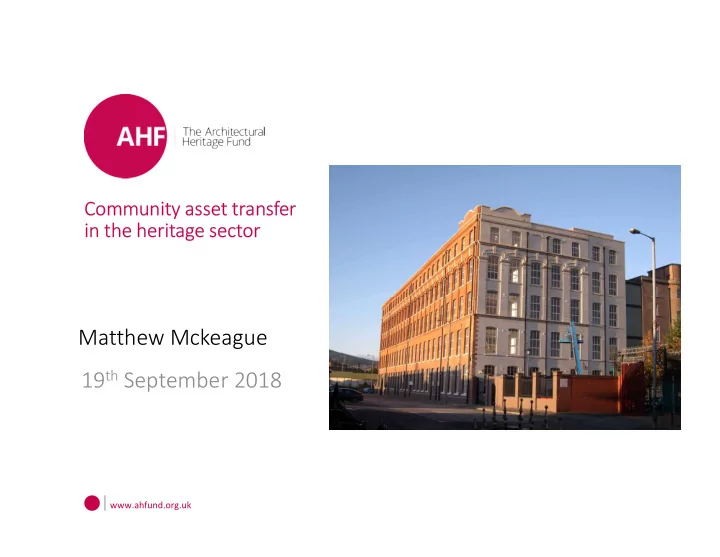
Community asset transfer in the heritage sector

Matthew Mckeague 19th September 2018

slide-2
SLIDE 2

www.ahfund.org.uk

“Who owns and controls the places in which social capital is accumulated and formed? Whether bowling alleys, football clubs, churches or digital hangouts, these assets support the flow of social activity, care, fun and

  • friendships. They are the ‘civic operating system’ that fosters togetherness

and provides a vital platform for social co-operation. But are we maintaining and investing in these assets?” Dan Gregory, ‘Skittled Out’, Big Local Trust

slide-3
SLIDE 3

www.ahfund.org.uk

Who we are

  • AHF set up as a result of a 1971 Civic Trust

study and 1975 European Year of Architectural Heritage

  • Advice, grants and loans, plus lobbying and

capacity building

  • Promote the role of historic buildings in

regeneration

  • Ongoing support to >500 projects a year
  • Network of support officers throughout

England and Scotland, and Wales and Northern Ireland

3

slide-4
SLIDE 4

www.ahfund.org.uk

Our work in Northern Ireland

  • Support Officer: Rita Harkin
  • Support to long established Building Preservation Trusts e.g Hearth Historic

Buildings Trust

  • ‘Community Enterprise through Heritage’ programme, funding support from the

Department of Communities Northern Ireland and Pilgrim Trust

  • Working with partners including the Heritage Trust Network to increase skills and

capacity within community and social enterprises to develop projects leading to the reuse of historic buildings

  • Supporting community asset transfer projects, including Bangor Court House

4

slide-5
SLIDE 5

www.ahfund.org.uk

The AHF client

1980s/1990s

  • Revolving fund Building Preservation Trusts

(BPT), some set up and resourced by local authorities.

  • Market purchase of historic building at risk.
  • Repair costs mainly financed by a short-term

AHF loan.

  • Additional grants from statutory agencies and

local authorities.

  • Building sold to private buyer on project

completion for moderate profit.

  • Requires skills in delivery of a capital repair

project.

2017

  • Single project BPT or other community organisation, or

partnership between BPT and social enterprise.

  • Historic buildings increasingly acquired through asset

transfer.

  • Repair costs mainly financed by HLF grant with

supplementary AHF loan to make up shortfall.

  • Additional funds increasingly raised through social

investment – e.g. community shares.

  • Building retained on project completion and run as a

community business.

  • Requires skills in delivery of a capital repair project AND

running a business.

  • AHF loan term longer and increasingly reliant on trading

to repay capital debt rather than sale.

5

slide-6
SLIDE 6

www.ahfund.org.uk

Our work with asset transfer projects

  • A significant proportion of our investment and

support goes into supporting asset transfer projects

  • Approximately 50% of grant awards in England last

year were to asset transfer projects; similar level rest

  • f UK.
  • Historic buildings can often be seen as ‘challenging’ by

local authorities wanting to save money – often have a significant ‘conservation deficit’

  • Support Officers provide advice and guidance, as well

as access to funding support, on the process and challenges faced by organisations looking to acquire buildings through asset transfer

6

slide-7
SLIDE 7

www.ahfund.org.uk

Asset transfer: guidance and policy

slide-8
SLIDE 8

www.ahfund.org.uk

8

slide-9
SLIDE 9

www.ahfund.org.uk

9

Glasgow City Council Asset Transfer flow chart

slide-10
SLIDE 10

www.ahfund.org.uk

Tales of a few asset transfers

slide-11
SLIDE 11

www.ahfund.org.uk

Circomedia, St Paul’s, Bristol

slide-12
SLIDE 12

www.ahfund.org.uk

All Souls Bolton

slide-13
SLIDE 13
slide-14
SLIDE 14

www.ahfund.org.uk

Clevedon Pier

14

  • Built in 1869 using discarded rails from Brunel’s

broad-gauge South Wales Railway, Clevedon Pier is the only intact Grade I listed pier in the UK.

  • Partially collapsed in 1970, acquired by Trust in

1990 and reopened in 1989.

  • Annual maintenance cost of £200,000.
  • Refurbished in 1998, but new investment

required only 10 years later.

  • AHF advised on Community Share scheme, and

purchased £80k worth of shares. £250k raised from other shareholders. Refinance 2018.

  • Pier is now owned by local people.
  • Winner of 2016 Heritage Angel Awards

“People’s vote”.

slide-15
SLIDE 15

www.ahfund.org.uk

Hastings Pier

15

  • AHF support to The Hastings

Pier Charity since formation

  • Compulsory purchase by the

local authority and transfer to the charity

  • Reopened in 2016
  • Loan financing for working

capital and capital works

  • Stirling Prize winner
  • Difficult trading conditions in

the initial period

  • Charity went into

administration in 2017

  • Sold to a private operator in

2018

slide-16
SLIDE 16

www.ahfund.org.uk

Bangor Court House

16

  • Building fitted an existing

concept and plan for the town

  • Existing track record of Open

House

  • Strong political support
  • Evidence of social and

community impact

  • Support from partners
slide-17
SLIDE 17

www.ahfund.org.uk

Lessons and thoughts for charities and social enterprises

17

  • How opportunistic should we be? As well as government’s strategy for asset transfer,

what is ours?

  • Effort vs likely outcome? What’s the opportunity cost? What do we miss?
  • Plans for a place vs plans for a building
  • Liability or asset?
  • What assets do we need in addition to the building? Parking, land, rights.
  • Political support
  • Capacity and skills
  • Three pillars of operational success: business planning, governance, financing
  • Maintenance
slide-18
SLIDE 18

www.ahfund.org.uk

Meanwhile(use)….

slide-19
SLIDE 19

www.ahfund.org.uk

slide-20
SLIDE 20

www.ahfund.org.uk

Great Yarmouth Preservation Trust – a place and enterprise based approach

20

slide-21
SLIDE 21

www.ahfund.org.uk

21

slide-22
SLIDE 22