Math 211 Math 211 Lecture #31 Higher Order Equations Harmonic - - PDF document

math 211 math 211
SMART_READER_LITE
LIVE PREVIEW

Math 211 Math 211 Lecture #31 Higher Order Equations Harmonic - - PDF document

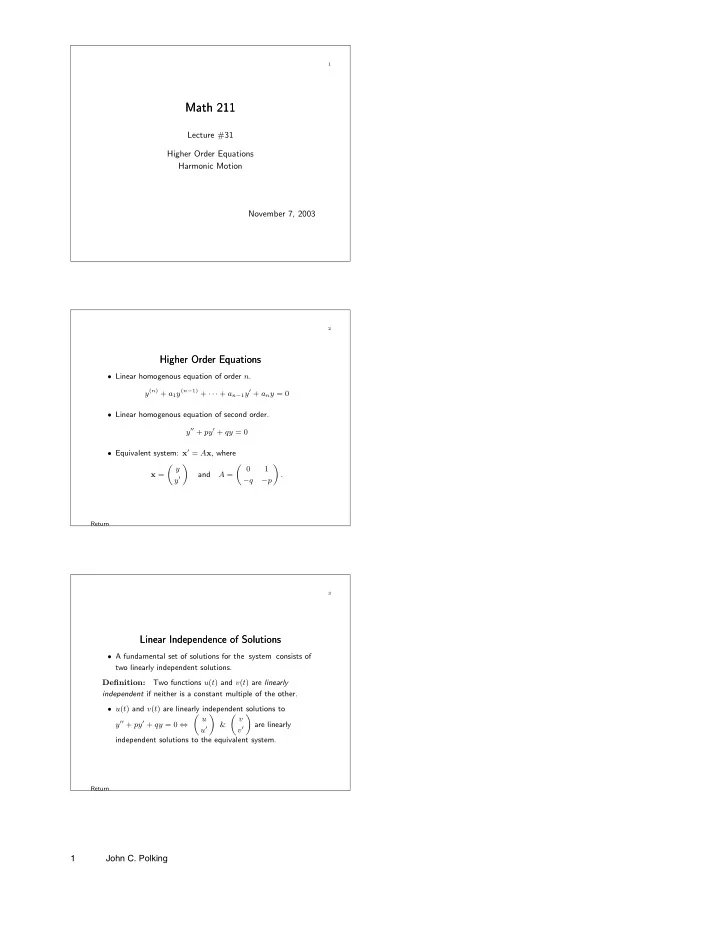
1 Math 211 Math 211 Lecture #31 Higher Order Equations Harmonic Motion November 7, 2003 2 Higher Order Equations Higher Order Equations Linear homogenous equation of order n . y ( n ) + a 1 y ( n 1) + + a n 1 y + a


slide-1
SLIDE 1

1

Math 211 Math 211

Lecture #31 Higher Order Equations Harmonic Motion November 7, 2003

Return

2

Higher Order Equations Higher Order Equations

  • Linear homogenous equation of order n.

y(n) + a1y(n−1) + · · · + an−1y′ + any = 0

  • Linear homogenous equation of second order.

y′′ + py′ + qy = 0

  • Equivalent system: x′ = Ax, where

x =

  • y

y′

  • and

A =

  • 1

−q −p

  • .

Return

3

Linear Independence of Solutions Linear Independence of Solutions

  • A fundamental set of solutions for the system consists of

two linearly independent solutions. Definition: Two functions u(t) and v(t) are linearly independent if neither is a constant multiple of the other.

  • u(t) and v(t) are linearly independent solutions to

y′′ + py′ + qy = 0 ⇔

  • u

u′

  • &
  • v

v′

  • are linearly

independent solutions to the equivalent system.

1 John C. Polking

slide-2
SLIDE 2

Return LI System

4

General Solution General Solution

Theorem: Suppose that y1(t) & y2(t) are linearly independent solutions to the equation y′′ + py′ + qy = 0. Then the general solution is y(t) = C1y1(t) + C2y2(t). Definition: A set of two linearly independent solutions is called a fundamental set of solutions.

Return

5

Solutions to y′′ + py′ + qy = 0. Solutions to y′′ + py′ + qy = 0.

  • The equivalent system has exponential solutions.
  • Look for exponential solutions to the 2nd order equation of

the form y(t) = eλt.

  • Characteristic equation: λ2 + pλ + q = 0.

Characteristic polynomial: λ2 + pλ + q. Same for the 2nd order equation and the system. If λ is a root of the characteristic polynomial then

y(t) = eλt is a solution.

Return General solution

6

Roots and Solutions Roots and Solutions

  • If the characteristic polynomial has two distinct real roots

λ1 and λ2, then y(1t) = eλ1t and y2(t) = eλ2t are a fundamental set of solutions.

  • If λ is a root to the characteristic polynomial of multiplicity

2, then y1(t) = eλt and y2(t) = teλt are a fundamental set

  • f solutions.
  • If λ = α + iβ is a complex root of the characteristic

equation, then z(t) = eλt and z(t) = eλt are a complex valued fundamental set of solutions.

x(t) = eαt cos βt and y(t) = eαt sin βt are a real valued

fundamental set of solutions.

2 John C. Polking

slide-3
SLIDE 3

Return General solution Roots and Solutions

7

Examples Examples

  • y′′ − 5y′ + 6y = 0, with y(0) = 0 and y′(0) = 1.
  • y′′ + 4y′ + 13y = 0, with y(0) = −1 and y′(0) = 14.
  • y′′ + 4y′ + 4y = 0, with y(0) = 2 and y′(0) = 0.
  • y′′ + 25y = 0, with y(0) = 3 and y′(0) = −2.

Return

8

The Vibrating Spring The Vibrating Spring

Newton’s second law: ma = total force.

  • Forces acting:

Gravity mg. Restoring force R(x). Damping force D(v). External force F(t).

  • Including all of the forces, Newton’s law becomes

ma = mg + R(x) + D(v) + F(t)

Return

9

  • Hooke’s law: R(x) = −kx. k > 0 is the spring constant.

Spring-mass equilibrium x0 = mg/k. Set y = x − x0.

Newton’s law becomes my′′ = −ky + D(y′) + F(t).

  • Damping force D(y′) = −µy′. µ ≥ 0 is the damping
  • constant. Newton’s law becomes

my′′ = −ky − µy′ + F(t),

  • r

my′′ + µy′ + ky = F(t),

  • r

y′′ + µ my′ + k my = 1 mF(t).

  • This is the equation of the vibrating spring.

3 John C. Polking

slide-4
SLIDE 4

Return Vibrating spring equation

10

RLC Circuit RLC Circuit

L C R

E

+ − I I

LI′′ + RI′ + 1 C I = E′(t),

  • r

I′′ + R L I′ + 1 LC I = 1 LE′(t).

  • This is the equation of the RLC circuit.

Return

11

Harmonic Motion Harmonic Motion

  • Spring: y′′ + µ

my′ + k my = 1 mF(t).

  • Circuit: I′′ + R

L I′ + 1 LC I = 1 LE′(t).

  • Essentially the same equation. Use

x′′ + 2cx′ + ω2

0x = f(t).

We call this the equation for harmonic motion. It includes both the vibrating spring and the RLC

circuit.

Return

12

The Equation for Harmonic Motion The Equation for Harmonic Motion

x′′ + 2cx′ + ω2

0x = f(t).

  • ω0 is the natural frequency.

Spring: ω0 =

  • k/m.

Circuit: ω0 =

  • 1/LC.
  • c is the damping constant.

Spring: 2c = µ/m. Circuit: 2c = R/L.

  • f(t) is the forcing term.

4 John C. Polking

slide-5
SLIDE 5

Return

13

Simple Harmonic Motion Simple Harmonic Motion

No forcing , and no damping. x′′ + ω2

0x = 0

  • p(λ) = λ2 + ω2

0, λ = ±iω0.

  • Fundamental set of solutions: x1(t) = cos ω0t &

x2(t) = sin ω0t.

  • General solution: x(t) = C1 cos ω0t + C2 sin ω0t.
  • Every solution is periodic with the natural frequency ω0.

The period is T = 2π/ω0.

Return

14

Amplitude and Phase Amplitude and Phase

  • Put C1 and C2 in polar coordinates:

C1 = A cos φ, & C2 = A sin φ.

  • Then x(t) = C1 cos ω0t + C2 sin ω0t

= A cos(ω0t − φ).

  • A is the amplitude; A =
  • C2

1 + C2 2.

  • φ is the phase; tan φ = C2/C1.

Return Amplitude & phase

15

Examples Examples

  • C1 = 3, C2 = 4 ⇒ A = 5, φ = 0.9273.
  • C1 = −3, C2 = 4 ⇒ A = 5, φ = 2.2143.
  • C1 = −3, C2 = −4 ⇒ A = 5, φ = −2.2143.

5 John C. Polking

slide-6
SLIDE 6

Return Amplitude & phase

16

Example Example

x′′ + 16x = 0, x(0) = −2 & x′(0) = 4

  • Natural frequency: ω2

0 = 16 ⇒ ω0 = 4.

  • General solution: x(t) = C1 cos 4t + C2 sin 4t.
  • IC: −2 = x(0) = C1, and 4 = x′(0) = 4C2.
  • Solution

x(t) = −2 cos 2t + sin 2t = √ 5 cos(2t − 2.6779).

6 John C. Polking