Eddies: Continuously Reordability of plans Adaptive Query - - PDF document

eddies continuously
SMART_READER_LITE
LIVE PREVIEW

Eddies: Continuously Reordability of plans Adaptive Query - - PDF document

Outline Introduction Eddies: Continuously Reordability of plans Adaptive Query Processing Rivers and Eddies Routing tuples in Eddies Ran Avnur, Jesepth M. Hellestein Summary University of California, Berkeley CPSC 405 Data Management


slide-1
SLIDE 1

1

Eddies: Continuously Adaptive Query Processing

Ran Avnur, Jesepth M. Hellestein University of California, Berkeley

CPSC 405 Data Management Presented by Hongrae Lee

Outline

Introduction Reordability of plans Rivers and Eddies Routing tuples in Eddies Summary

Static Query Processing

Traditional query processing scheme

  • 1. Optimizing a query
  • 2. Executing a static query plan

This traditional scheme is not appropriate for Large scale widely-distributed information resources or Massively parallel database systems !

New Requirements

Increased complexity in large-scale system

– Hardware and workload – Data – User interface

We want query execution plans

– To be reoptimized regularly during query processing – Allowing the system to adapt dynamically to fluctuations in computing resources, data characteristics, and user preferences

Discussion Question 1

The Philosophy: “We Favor adaptivity Over Best-case Performance”

Consider if adaptivity is needed only when th e best-case missing (unable established for l ack of statistics, or non-existence because of changing environment) or could also be a ge neral strategy in regular query processing. Do you think it is good or b ad to apply it in the traditional query processi ng? Why? Please give reasons or use exam ples to support your opinions.

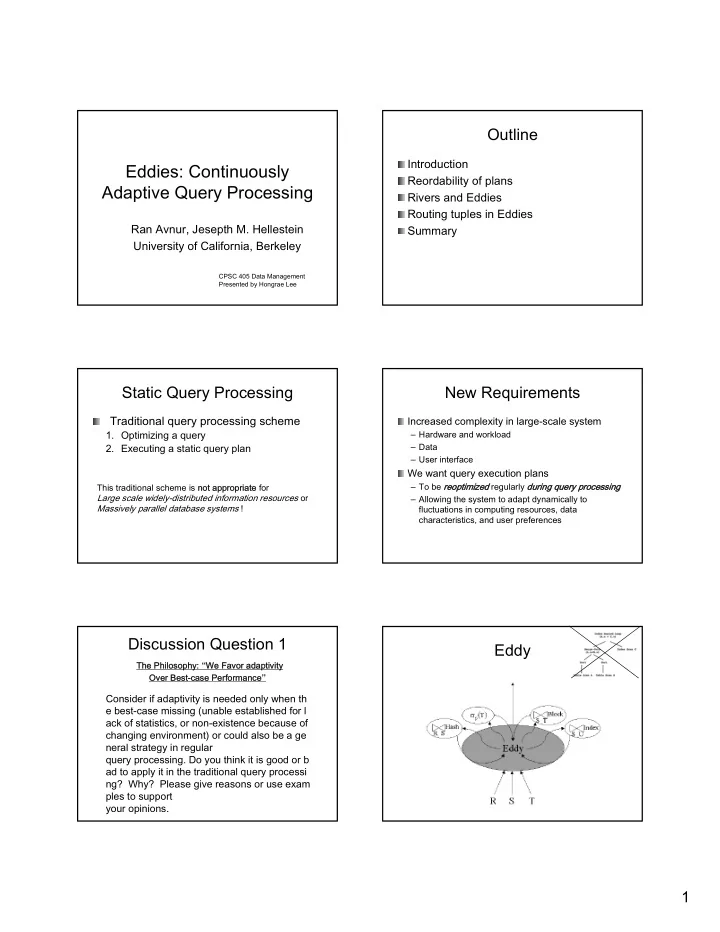
Eddy

slide-2
SLIDE 2

2

Two Challenges for This Scheme

How can we reorder operators?

– Reorderability of plans

How should we route tuples?

– Routing tuples in Eddies

A Brief Review on Join

R ▷◁ S

… … … Basic nested loop join Grid view of nested loop join R S R S

▷◁ ▷◁

R S T

Pipelining

Reorderability of Plans

Synchronization Barriers

– One task waits for other tasks to be finished

Moments of Symmetry

– The barrier where the order of the inputs to a join can be changed without modifying any state in the join

Reordering of Inputs Using Moments on Symmetry

Moments on symmetry

– Allow reordering of the inputs to a single binary operator

R ▷◁ S ↔ S ▷◁ R

Generalization

– N-ary join view – (R▷◁1S)▷◁2T (R▷◁2T)▷◁1S – (T▷◁2R)▷◁1S

Commutativity + moments of symmetry aggressive reordering of a plan is possible

Join Algorithms and Reordering

Constraints on reordering

– Unindexed join input is ordered before the indexed input – Preserving the ordered inputs – Some join algorithms work only for equijoins

Join algorithms in Eddy

– We favor join algorithms with

Frequent moments of symmetry Adaptive or nonexistent barriers Minimal ordering constraints Rules out hybrid hash join, merge joins, and nested loops joins

– Choice: Ripple Join

Frequently-symmetric versions of traditional iteration, hashing and indexing schemes

– Favors adaptivity over best-case performance

Ripple Join

Get tuples from each relation Compare them with tuples seen until now
slide-3
SLIDE 3

3

Ripple Joins

Ripple joins

– Have moments of symmetry at each corner – Are designed to allow changing rates for each input Offer attractive adaptivity features at modest overhead

Block Index Hash

Rivers and Eddies

River

– A shared-nothing parallel query processing framework – Pre-optimization

Choose how to initially pair off relations into joins

An eddy in the River

– Is implemented via a module in a river – Encapsulates the scheduling of its participating operators – Explicitly merges multiple unary and binary operators into a single n-ary operator – A tuple is associated a vector of Ready and Done bits

Routing Tuples in Eddies

An eddy module

– Directs the flow of tuples from the inputs through the various operators to the output – Providing the flexibility to allow each tuple to be routed individually through the operators – The routing policy determines the efficiency

Naïve eddy

Naïve eddy

– Tuples enter the eddy with low priority, and when they are returned to the eddy from an operator they are given high priority

Tuples flow completely through the eddy before new tuples Prevents being ‘clogged’ with new tuples

– Fixed-size queue: back-pressure

Production along the input to any edge is limited by the rate

  • f consumption at the output

Tuples are routed to the low-cost operator first

– Cost-aware policy – Selectivity-unaware policy

Learning Selectivity : Lottery Scheduling

To track both

– Consumption (determined by cost) – Production (determined by cost and selectivity)

Lottery Scheduling

– Maintain ‘tickets’ for an operator – An operator’s chance of receiving the tuple

∝The counts of tickets

– The eddy can track (learn) an ordering of the

  • perators that gives good overall efficiency

Debit Credit

Eddy Operator Eddy Operator

Some Experimental Results

slide-4
SLIDE 4

4

Summary

Eddies are

– A query processing mechanism that allow fine- grained, adaptive, online optimization – Beneficial in the unpredictable query processing environments

Challenges

– To develop eddy ‘ticket’ policies that can be formally proved to converge quickly – To attack the remaining static aspects – To harness the parallelism and adaptivity available to us in rivers – To explore the application of eddies and rivers to the generic space of dataflow programming

Discussion Question 2

Comparison among traditional query processing, Tukwila, and Eddy

The adaptivity and complexity of Eddy, Tukwil a, and traditional query processing vary. Each

  • f them has its beauties and can not be repla

ced by others. As a designer of query processing and optimi zation, which one would you like to use? Why ?

Thank you