
SLIDE 1
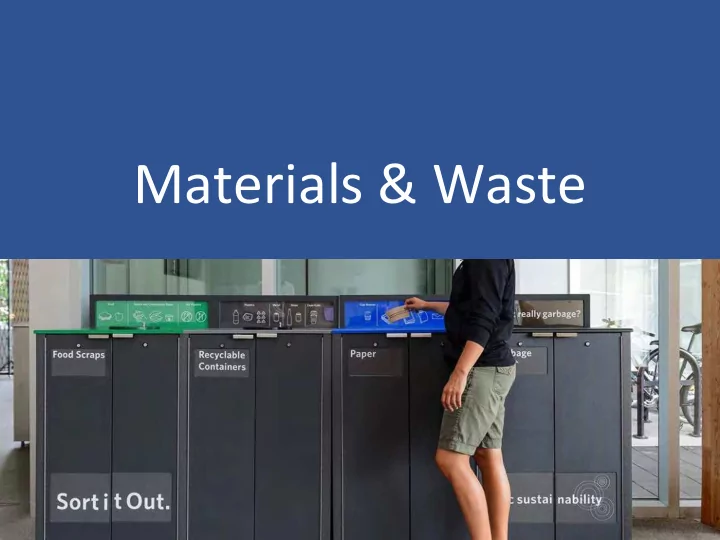
Materials & Waste Policy Overview UBC Zero Waste Ac3on Plan - - PowerPoint PPT Presentation
Materials & Waste Policy Overview UBC Zero Waste Ac3on Plan (2014) Target: divert 80% of waste from landfill by 2020 UBC currently diverts 67% of all campus waste from the landfill Metro Vancouver Solid Waste Management Plan (2010)
Policy Overview
UBC Zero Waste Ac3on Plan (2014)
landfill by 2020
campus waste from the landfill Metro Vancouver Solid Waste Management Plan (2010)
material recovery
waste stream aQer material recycling
in landfill, aQer material recycling and energy recovery
http://consult.torridge.gov.uk/events/18097/popimage_d31379e8718.html
➜ COMPOST - food & landscaping materials ➜ SEWAGE ➜ RECYCLING - mixed paper, recyclable containers, cardboard ➜ REUSABLES - surplus furniture & supplies ➜ GARBAGE ➜ CONSTRUCTION / BUILDING ➜ ELECTRONIC - “e-waste” ➜ HAZARDOUS
2. ImplicaQons for CharreTe:
➜ GOAL & INDICATORS ➜ PRECEDENTS ➜ PRINCIPLES
fer3lizers and topsoil for campus landscapes
COMPOST - UBC’s In-Vessel Composter
Ohio University
COMPOST
Green Bin Contamina3on
Styrofoam, plas.c bags, plas.c cutlery and plas.c plates, metal cutlery, glass bo6les, metal cans
Opera3ng Near Capacity
Capable of processing 5 tonnes a day
https://www.youtube.com/watch?v=yaERGvmH9e8&t=98s http://ibis.geog.ubc.ca/courses/geob479/classof07/composting/
COMPOST - on campus
RECYCLING
RECYCLING
REUSE
REUSE
GARBAGE
Problem
CONSTRUCTION / BUILDING WASTE
Problem
Project Timeline for projects with salvaged material (GVRD 2002, p.21)
E-WASTE
Problems
waste management system is monitored
unusable e-waste
available for personal electronics
Photo taken at Totem Park Residence lane on 27-Jun-2017
HAZARDOUS
Photo taken at Totem Park Residence lane on 27-Jun-2017 Photo taken at back of MacMillan Building on 27-Jun-2017 Photo taken at Memorial Rd. and Mathematics Rd. on 27- Jun-2017 Photo taken at back of Auditorium Annex on 27-Jun-2017
Michigan State University | Surplus Store
image source: h\ps://mail.google.com/mail/u/0/#inbox/15d11324ac7387da?projector=1
Oregon State University | Surplus Store
image source: h\p://oregonstate.edu/dept/ncs/lifeatosu/2014/osused-store-surplus-sale/
Lion’s Park Playscape | Greensboro, Alabama | 2010 | 5th year project
Lion’s Park Playscape | Greensboro, Alabama | 2010 | 5th year project
The Loop de Loop Bench | Eugene, OR |Bring Recycling Center
image source: <h\p://www.firespeaking.com/wp-content/uploads/2010/10/IMG_4074.jpg>
Temple of Second Chances | Eugene, OR |Bring Recycling Center
image source: <h\ps://s-media-cache-ak0.pinimg.com/originals/d0/5c/3e/d05c3eaf5ee3b80e9622c170ba0ec378.jpg>
Store | Eugene, OR |Bring Recycling Center
image source: <h\p://crea3veupcycling.blogspot.ca/2012/07/more-upcycling-in-eugene.html>
Map
Guiding Principles
lab and educa3onal facility.
exchange.