Materials Security, Productivity and New Business Models Nicholas - - PDF document

materials security productivity and new business models
SMART_READER_LITE
LIVE PREVIEW

Materials Security, Productivity and New Business Models Nicholas - - PDF document

Materials Security, Productivity and New Business Models Nicholas Morley Bonn, 29 th October 2012 Policy Context Sources: KITECH, US Dept. of Energy, EU RMI, EC JRC IET Materials Criticality across all Strategic Energy Technologies Element Rating


slide-1
SLIDE 1

Materials Security, Productivity and New Business Models

Nicholas Morley Bonn, 29th October 2012

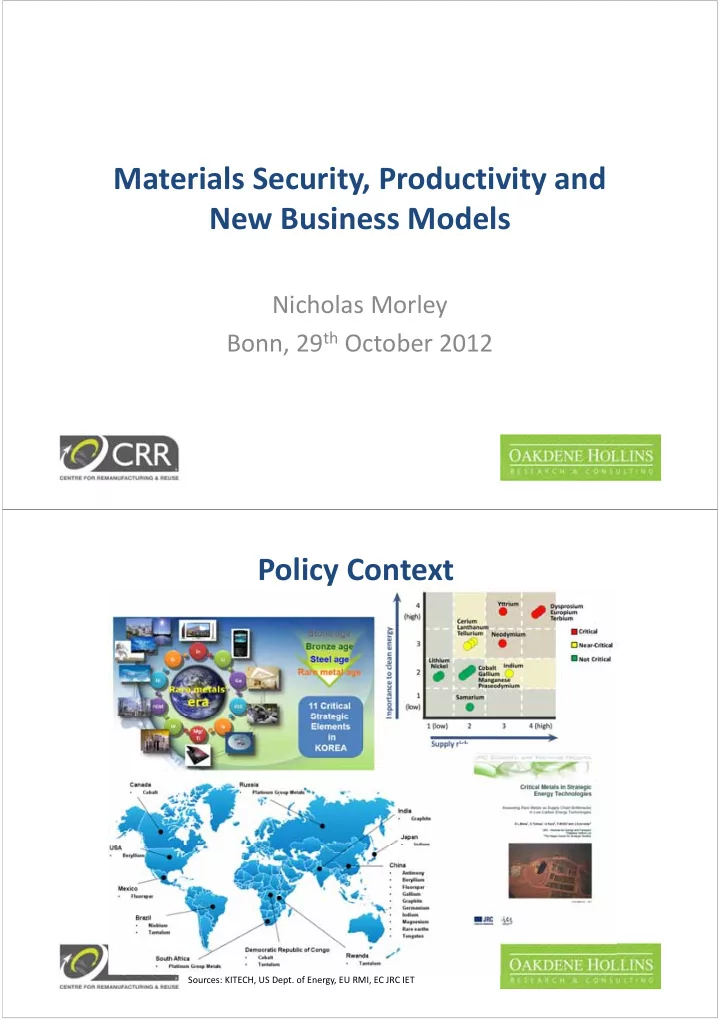
Policy Context

Sources: KITECH, US Dept. of Energy, EU RMI, EC JRC IET
slide-2
SLIDE 2

Materials Criticality across all Strategic Energy Technologies

Element Rating Rare Earths: Dy, Eu, Tb, Y High Rare Earths: Pr, Nd High Gallium High Tellurium High Graphite High‐Medium Rhenium High‐Medium Indium High‐Medium Platinum High‐Medium Rare Earths: La, Ce, Sm, Gd Medium Cobalt Medium Tantalum Medium Niobium Medium Vanadium Medium Tin Medium Chromium Medium Selenium Medium‐Low Lithium Medium‐Low Hafnium Medium‐Low Molybdenum Medium‐Low Silver Medium‐Low Nickel Low Gold Low Copper Low Cadmium Low Source: Oakdene Hollins Estimates

Significance Screening Results

0% 1% 2% 3% 4% 5% 6% 7% 8% 9% 10%

Te In Sn Hf Ag Dy Ga Nd Cd Ni Mo V Nb Cu Se Pb Mn Co Cr W Y Zr Ti % of 2010 World Supply

Metals Demand of SET‐Plan in 2030

19% 50%

Source: Oakdene Hollins/HCSS for EC JRC

slide-3
SLIDE 3

Cti

Critical Materials in PV in the UK, 2011

Source: Oakdene Hollins

slide-4
SLIDE 4

Data collection and dissemination Resource efficiency strategies (e.g. recycling) Primary production Trade and international co‐operation Design and innovation Procurement and stockpiling

Responses to Materials Criticality

Source: Oakdene Hollins

slide-5
SLIDE 5

Policies for the recovery of strategic materials

  • Improved collection
  • Advanced sorting techniques
  • Implementation of new recycling technology
  • Linking agents within the supply chain
  • Design for disassembly
  • More sophisticated waste recovery targets
  • Alignment and enforcement of regulations
  • Remanufacturing and reuse

Antimony Beryllium Cobalt Fluorspar Gallium Germanium Graphite Indium Magnesium Niobium PGMs REEs Tantalum Tungsten Auto/aero components Batteries Catalysts Cemented carbide tools Chemicals Construction Electrical equipment Electronics/IT Flame retardants Optics Packaging Steel & steel alloys

Key product groups for the “EU Critical 14”

Source: Oakdene Hollins Red = product life extension practices in use

slide-6
SLIDE 6

Which metals and where?

Component Element Global recycling rate Printed Circuit Boards Antimony 1‐10% Beryllium <1% Copper >50% Gallium <1% Germanium <1% Gold >50% Silver >50% Platinum Group Metals >50% Tantalum <1% Flat Panel Displays Indium <1% Hard Disk Drives Ruthenium (PGM) 10‐25% Rare Earth Elements <1%

Source: Oakdene Hollins for

Recycling

Source: UNEP/EU Working document

slide-7
SLIDE 7

Metal Content?

  • Example of mobile phone (excluding

batteries):

– 12.6% Copper – 0.35% Silver – 340g/t Gold – 144g/t Palladium – Also Iron, Aluminium, Nickel, Tin, Zinc…

  • Far richer than conventional ores
  • Need for improved collection

Source: OECD

Precious Metals: Example of Boliden

  • Copper Smelters:

– Rönnskär (Sweden) – Harjavalta (Finland)

  • Rönnskär processed

60kt electronic scrap in 2011

  • Expanding to 120kt

capacity – become world’s largest

  • Focus on copper and

precious metal recovery

Source: Boliden Annual Report 2011

slide-8
SLIDE 8

Precious Metals: Example of Boliden

Cathode copper, 69% Gold , 15% Silver , 13% Zinc, 1.2% Palladium, 0.8% Lead, 0.6% Se, 0.21% Te, 0.16% Others, 3.0%

Boliden Copper/WEEE Smelting Revenues, 2011e, ($m)

Source: Oakdene Hollins for ILZSG/ICSG/INSG

Analysis of WEEE Recovery Opportunities

  • Many metals used in very small quantities on a

PCB

  • Current practice of shredding for recovery:
  • Copper and precious metals already recovered
  • Rare earths lost in ferrous fraction
  • Others are quite reactive – lost in slag
  • Some niche opportunities are possible:
  • Rare earth magnets in hard disk drives
  • Rare earth phosphor lighting
  • Indium in flat panel displays

Source: Oakdene Hollins for

slide-9
SLIDE 9

Rare Earth Magnet Recovery

  • Hard disk drives (HDD) account

for 1/3 of RE magnet demand

  • Processes to cut HDD & remove

RE magnets for recycling

  • Need to segregate, not

shred with WEEE to recover RE

  • Data security as economic

incentive for collection & sorting

  • Wind Turbines & (H)EVs in long

term due to length of lifetimes

Source: Oakdene Hollins for

Indium Recovery from Flat Panel Displays

  • Over half of primary Indium

used to make FPDs

  • Recycling of Indium process

waste common and efficient

  • Easy to separate FPDs from

WEEE as easily recognisable and need to remove mercury

  • Pilot scale technologies being

developed to remove ITO – dismantling and dissolution

  • Medium timeframe for FPDs

in waste; solar PV for long term

Source: Valpak

Source: Oakdene Hollins for

slide-10
SLIDE 10
  • Resource opportunities:

– Use of others’ waste & typically low cost feedstock – Protect against fluctuating resource markets – Utilise difficult to recover materials

  • Whole life service:

– Encourages long term customer base – Value added business model

  • Environmental / Social benefits:

– Energy, material and water costs reduced – Cost reduction for procurers – Carbon savings – Green growth and skilled job creation

Beyond Recovery to Reuse Remanufacturing

  • A long industrial history
  • Origins in the military
  • Worth c. £5bn, 50,000 people in UK
  • Policy drivers in waste prevention

“The practice of taking an end‐of‐life artefact and returning it to as‐new condition, with warranty to match” Ijomah

slide-11
SLIDE 11

Value of remanufacturing and reuse in the UK

100 200 300 400 500 Automotive Catering and Food Industry Construction ICT Equipment Industrial Tooling Ink and TonerCartridges Lifting and Handling Equipment Medical, Precision and Optical Equipment Office Furniture Offroad Equipment Pumps and Compressors Rail Industry Textiles Tyre Retreading White Goods Sectoral Value (£ millions) Remanufacturing Refurbishment Other Reuse Source: Oakdene Hollins, 2010

Reuse of ICT equipment in the UK, 2009

Type Units sold (000) Refurbished (000) Reused (000) Desktops 2,750 49.5 764** Home Users 917 Business Users 1,833 Laptops 8,250 148.5 382 Home Users 4,950 Business Users 3,300 Servers 3,678 183 Total 11,000 220 1,150

Source: ONS Product sales and trade, 2009 ** this number includes monitors and base units sold separately

slide-12
SLIDE 12

Remanufacturing potential in wind power

Source: CRR 2008

Potential for remanufacture

Beneficial Features Detrimental Features High intrinsic value Poor design for assembly/disassembly Good durability Proliferation of materials in construction Low to moderate technological evolution Status-dependant, fashionable items Cores readily available Poor perception of standards/branding Integrated sales/service/upgrade options Low price of new goods Design information available Craft skill shortage

“Four Golden Rules of Remanufacturing”

  • Determine optimal mix of: rate of product evolution,

value, and re‐constructability

  • Remanufacturing is at its most successful when most hidden
  • Reduce customer risk e.g. use standards
  • Recovery of core is key to growth
slide-13
SLIDE 13

Remanufacturing decision tool Conclusions

  • Raw material concerns will remain part of the policy mix,

extending to biotic as well as abiotic materials

  • These concerns will give increased impetus to

traceability/provenance innovations and to closed loop business models close to country markets

  • Recycling methods for some critical materials exist but are
  • ften underdeveloped
  • Many product groups using critical materials are suitable for

product life extension and remanufacturing/reuse

  • Remanufactured products are often best embedded in service

business models and use standards to encourage reuse whilst help conserve resources and create green growth