High assurance systems Rami Melhem (U. of Pittsburgh) Ensures that - - PowerPoint PPT Presentation
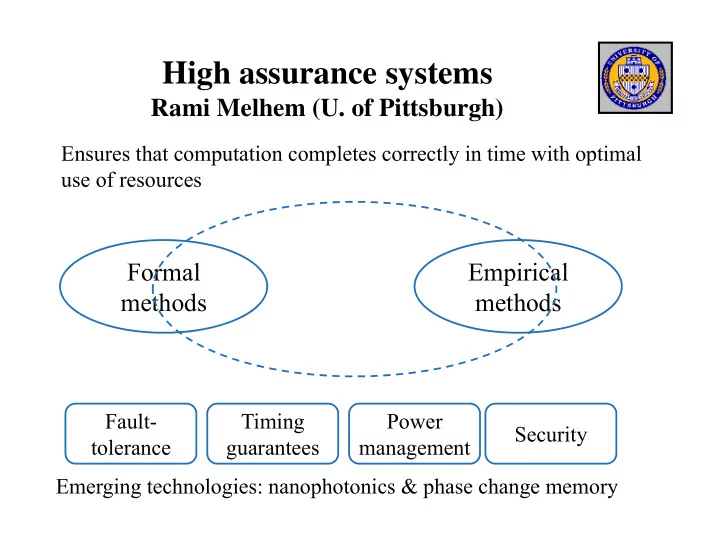
High assurance systems Rami Melhem (U. of Pittsburgh) Ensures that computation completes correctly in time with optimal use of resources Formal Empirical methods methods Fault- Timing Power Security tolerance guarantees management
Light wavelength channels λ1…λn μring modulator encode λm μring filter decode λm Photo detector Off-chip laser Waveguide
Can’t receive signal!
Digital signal 0111…0010
Challenge: Tolerance to process and temperature Variation (PV)
Phase Change Memory (PCM)
A power saving memory technology
- Solid State memory made of germanium-antimony alloy
- Switching states is thermal based (not electrical based)
- Samsung, Intel, Hitachi
and IBM developed PCM prototypes (to replace Flash).
- 2. New error correction schemes
for stuck at faults
Properties of PCM
- Non-volatile but faster than Flash
- Byte addressable but denser and cheaper than DRAM
- Low power read and standby
- Not susceptible to single event upsets and hence do not
need ECC
- Errors may occur only during write (not read)
- Scalable: at least to 32nm and beyond (9nm)
Sounds wonderful – but where is the catch?
The Catch!!
- Slower than DRAM, especially for write
- Low endurance: a cell fails after 107 writes (1015 for DRAM)
- Asymmetric Read/Write energy consumption
- Asymmetry of writing 0’s and 1’s
Time (hence bandwidth) Current (hence power)
Ongoing work
- Identify a set containing the stuck-at-wrong cells
– Some non-faulty(NF) cells could possibly be members of the set but none of the stuck-at-right cells
- At read time, invert the values read from the
identified set
- An error correction scheme for stuck-at fault models
– Worn-out cells get stuck at 0/1 but can still be read – A worn-out cell can be classified as either stuck-at- right(SA-R) or stuck-at-wrong(SA-W) depending on the data pattern
CPU
Memory Controller
DRAM CPU
AEB MM
PCM
Traditional architecture Hybrid architecture Advantages: cheaper + denser + lower power consumption Challenges: endurance, asymmetry, delay
A Storage Class Memory Architecture for Energy Efficient Data Centers
A cross-layer approach
Virtual Machine
Application Operating System Logic Hardware
Virtual Machine
Application Operating System Logic Hardware
Hypervisor
Conventional VMM
Chip multiprocessor I/O controller
HD SSD
Storage system
DRAM
Main Memory
1) OPRAM (optimized PRAM)
Virtual Machine
Application Operating System Logic Hardware
Virtual Machine
Application Operating System Logic Hardware
Hypervisor
Conventional VMM
Chip multiprocessor I/O controller
HD SSD
Storage system Main Memory
DRAM Optimized PRAM
1) OPRAM (optimized PRAM)
Main Memory
DRAM Optimized PRAM
- Optimization of PCM for main memory
- Manage reliability (faults and wear)
- Manage write latency
- Manage asymmetric read/write power
- Novel interfaces with controller
- Run-time monitoring
Virtual Machine
Application Operating System Logic Hardware
Virtual Machine
Application Operating System Logic Hardware
Hypervisor
Conventional VMM
Chip multiprocessor
MemVisor
I/O controller
HD SSD
Storage system
DRAM Optimized PRAM
Main Memory
2) MemVisor
Hypervisor
Conventional VMM MemVisor
2) MemVisor
- The Memory Resource Advisor to the Hypervisor
- Allocates memory resources to virtual machines
- Maps data and code to the components of main memory
- Considers performance, energy, safety and endurance
- Each VM will be managed differently based on Service
Level Agreements as well a system wide goals.
Virtual Machine
Application Operating System Logic Hardware
Virtual Machine
Application Operating System Logic Hardware
Hypervisor
Conventional VMM
Chip multiprocessor I/O controller
HD SSD
Storage system
Hybrid memory controller
DRAM Optimized PRAM
Main Memory
3) Intelligent Hybrid controller
MemVisor
Hybrid memory controller
DRAM Optimized PRAM
Main Memory
3) Intelligent Hybrid controller
- Dynamically allocates PRAM and DRAM resources
- Accepts commands and hints from MemVisor
- Monitors usage of memory resources and performance
- Provides feedback to MemVisor
- Collaborates with MemVisor to improve PRAM endurance
- Example: endurance aware cache replacement
Virtual Machine
Application Operating System Logic Hardware
Virtual Machine
Application Operating System Logic Hardware
Hypervisor
Conventional VMM
Chip multiprocessor
MemVisor
I/O controller
HD SSD
Storage system
Hybrid memory controller
DRAM Optimized PRAM
Main Memory
SCMA (a cross-layer approach)
- 3. Immunity Inspired Cyber
Security
Body immune system Defense of complex information infrastructures
- Highly distributed information
processing system
- Self protecting
- Dynamic
- Diverse
- Error tolerant
- Learn and retain information for future actions
- Local components that interact globally
- Individual components are continually created to
improve the system’s defense
- dangerous components are destroyed and
eliminated from the body
Desirable properties to mimic
Is it a good idea to mimic natural systems??
- - planes do no fly by flapping wings
- - cameras??
Concepts already borrowed from biology:
- Anomaly detection
- Neural networks
- Autonomic computing
Is research on protecting critical infrastructures adequate? Is the human factor the "weakest point" in high- assurance systems? Fostering collaboration? Research on critical infrastructures without having access to real systems?
Is research on protecting critical infrastructures adequate?
- Threat is over-stated?
- Preparation is inadequate?
- Opportunity to advance knowledge is always a good thing
- - no research is useless (putting a man on the moon??)
- - new discoveries are made unexpectedly
- - revolutionary Vs evolutionary research