Mass Storage & IO - II RAID: Redundant Array of Inexpensive - - PDF document

mass storage io ii
SMART_READER_LITE
LIVE PREVIEW

Mass Storage & IO - II RAID: Redundant Array of Inexpensive - - PDF document

CSE 421/521 - Operating Systems RAID Structure Fall 2011 As disks get cheaper, adding multiple disks to the same system provides increased storage space, as well as Lecture - XX increased reliability and performance. Mass Storage & IO


slide-1
SLIDE 1

1

CSE 421/521 - Operating Systems Fall 2011

Tevfik Koşar

University at Buffalo

November 10th, 2011

Lecture - XX

Mass Storage & IO - II

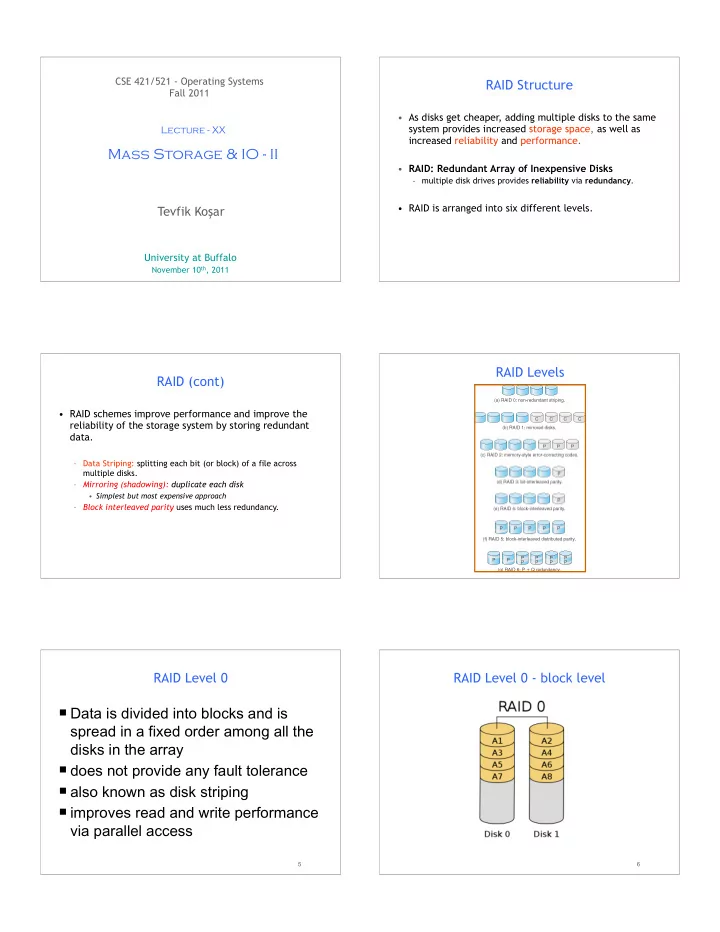
RAID Structure

  • As disks get cheaper, adding multiple disks to the same

system provides increased storage space, as well as increased reliability and performance.

  • RAID: Redundant Array of Inexpensive Disks

– multiple disk drives provides reliability via redundancy.

  • RAID is arranged into six different levels.

RAID (cont)

  • RAID schemes improve performance and improve the

reliability of the storage system by storing redundant data.

– Data Striping: splitting each bit (or block) of a file across multiple disks. – Mirroring (shadowing): duplicate each disk

  • Simplest but most expensive approach

– Block interleaved parity uses much less redundancy.

RAID Levels RAID Level 0

5

!

  • !

! !

  • RAID Level 0 - block level

6

slide-2
SLIDE 2

RAID Level 1

!

  • !
  • !

! !

  • 7

RAID Level 1 - block level

8

RAID Level 2

!

  • !
  • !

! !

! !

9

RAID Level 2 - bit level

10

RAID Level 3

!

  • !

!

  • !
  • !
  • 11

RAID Level 3 - byte level

12

slide-3
SLIDE 3

RAID Level 4

!

  • !
  • !
  • 13

RAID Level 4 - block level

14

RAID Level 5

! ! !

  • !
  • !
  • !
  • 15

RAID Level 5

16

RAID Level 6

!

  • !

– more reliability versus less data space

!

17

RAID Level 6

18

slide-4
SLIDE 4

RAID (0+1) and (1+0)

! !

  • 19

RAID (0+1) and (1+0)

20

RAID (0+1) and (1+0)

21

RAID 1+0 RAID 0+1

21

Any Questions?

Hmm. .

23

Acknowledgements

  • “Operating Systems Concepts” book and supplementary

material by A. Silberschatz, P . Galvin and G. Gagne

  • “Operating Systems: Internals and Design Principles”

book and supplementary material by W. Stallings

  • “Modern Operating Systems” book and supplementary

material by A. Tanenbaum

  • R. Doursat and M. Yuksel from UNR