
SLIDE 1
1
CSE 421/521 - Operating Systems Fall 2011
Tevfik Koşar
University at Buffalo
November 8th, 2011
Lecture - XIX
Mass Storage & IO - I
Overview of Mass Storage Structure
- Magnetic disks provide bulk of secondary storage of modern computers
– Drives rotate at 90 to 300 times per second – Transfer rate is rate at which data flow between drive and computer – Positioning time (random-access time) is time to move disk arm to desired cylinder (seek time) and time for desired sector to rotate under the disk head (rotational latency) – Head crash results from disk head making contact with the disk surface
- That’s bad
- Disks can be removable
- Drive attached to computer via I/O bus
– Busses vary, including EIDE, ATA, SATA, USB, Fibre Channel, SCSI – Host controller in computer uses bus to talk to disk controller built into drive
- r storage array
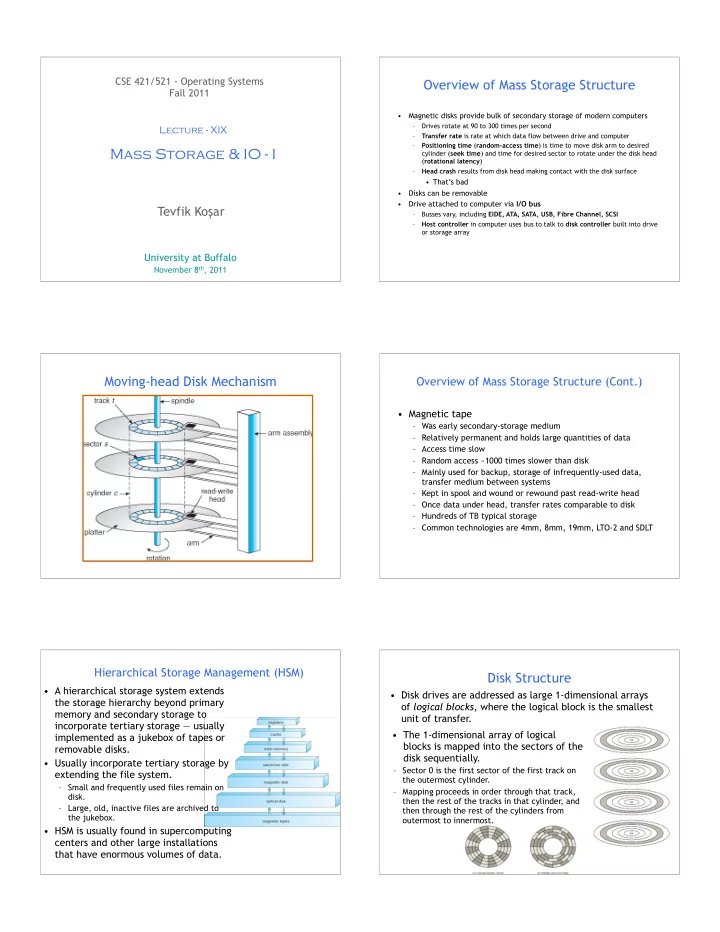
Moving-head Disk Mechanism
Overview of Mass Storage Structure (Cont.)
- Magnetic tape
– Was early secondary-storage medium – Relatively permanent and holds large quantities of data – Access time slow – Random access ~1000 times slower than disk – Mainly used for backup, storage of infrequently-used data, transfer medium between systems – Kept in spool and wound or rewound past read-write head – Once data under head, transfer rates comparable to disk – Hundreds of TB typical storage – Common technologies are 4mm, 8mm, 19mm, LTO-2 and SDLT
Hierarchical Storage Management (HSM)
- A hierarchical storage system extends
the storage hierarchy beyond primary memory and secondary storage to incorporate tertiary storage — usually implemented as a jukebox of tapes or removable disks.
- Usually incorporate tertiary storage by
extending the file system.
– Small and frequently used files remain on disk. – Large, old, inactive files are archived to the jukebox.
- HSM is usually found in supercomputing
centers and other large installations that have enormous volumes of data.
Disk Structure
- Disk drives are addressed as large 1-dimensional arrays
- f logical blocks, where the logical block is the smallest
unit of transfer.
- The 1-dimensional array of logical
blocks is mapped into the sectors of the disk sequentially.
– Sector 0 is the first sector of the first track on the outermost cylinder. – Mapping proceeds in order through that track, then the rest of the tracks in that cylinder, and then through the rest of the cylinders from
- utermost to innermost.