Mary Jane Wilson Background and Experience Education-Stanford - - PowerPoint PPT Presentation

mary jane wilson
SMART_READER_LITE
LIVE PREVIEW

Mary Jane Wilson Background and Experience Education-Stanford - - PowerPoint PPT Presentation

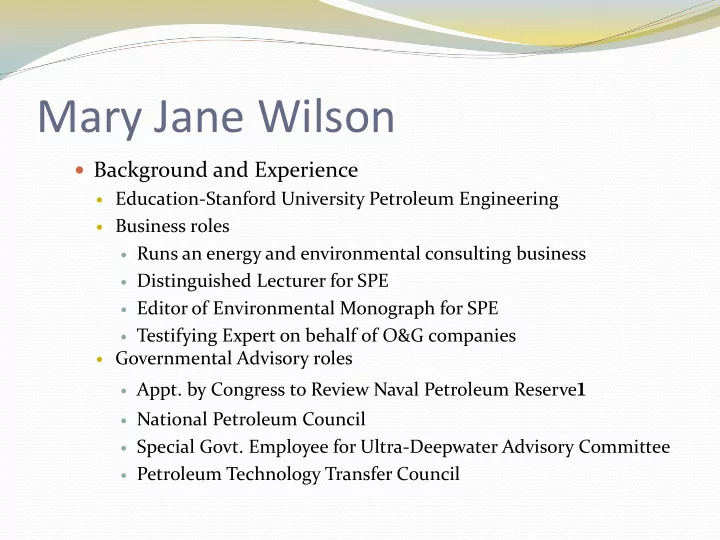
Mary Jane Wilson Background and Experience Education-Stanford University Petroleum Engineering Business roles Runs an energy and environmental consulting business Distinguished Lecturer for SPE Editor of Environmental


slide-1
SLIDE 1

Mary Jane Wilson

 Background and Experience

 Education-Stanford University Petroleum Engineering  Business roles

 Runs an energy and environmental consulting business  Distinguished Lecturer for SPE  Editor of Environmental Monograph for SPE  Testifying Expert on behalf of O&G companies

 Governmental Advisory roles

 Appt. by Congress to Review Naval Petroleum Reserve1  National Petroleum Council  Special Govt. Employee for Ultra-Deepwater Advisory Committee  Petroleum Technology Transfer Council

slide-2
SLIDE 2

2014 Rulemaking for Oil and Gas

 WZI participated as a technical expert in this rule

making at the request of EDF

 Summary of Key Findings:

 CDPHE used accepted methodology:

 In establishing the emission inventory  In assigning emissions reductions for proposed alternatives  In calculating the cost-effectiveness of program alternatives

 CDPHE cost estimates are reasonable and show

program will be cost effective in reducing VOC and methane

slide-3
SLIDE 3

LDAR

 Historically, LDAR has been in place in numerous

facilities and air basins in various forms since the 80’s

 LDAR interfaces well with Planned Maintenance cycles

which are focused on anticipating equipment failure and proactive maintenance

 LDAR programs in various forms have proven cost

effective in reducing emissions

 Our opinion is that LDAR contributes to overall

improvement of facility operations

slide-4
SLIDE 4

CDPHE Proposed LDAR

 Tier-based approach results in sliding costs with

lowest emitters bearing the least cost

 The CDPHE proposed reporting framework has a

relatively minimal paperwork burden as compared to

  • ther LDAR programs

 The proposed LDAR program balances diminishing

returns on emission reductions with industry costs

slide-5
SLIDE 5

Louis Berger Group Program Economic Analysis: Key flaws

Inflated Costs for:

 LDAR  STEM  Flares

Incorrect Methodology for cost

effectiveness

slide-6
SLIDE 6

Inflated Costs

 LDAR

 LDAR equipment maintenance and training  Component Repair (10 times expected values)  Repaired Component Re-inspection (twice as

high as complete facility inspections- done 12 times per year)

 Findings are contrary to Economy-of-Scale

expectations

slide-7
SLIDE 7

Repairs: 1784

Comparative Example-

slide-8
SLIDE 8

Buffer Bottles as control devices

Separator Buffer Bottle

slide-9
SLIDE 9

Inflated Costs

 STEM

 Buffer Bottle Capital Costs and Maintenance Costs are

  • verstated

 Similar errors as shown in prior LDAR discussion

 Flares

 Inflated Costs  Useful life is understated  Overstated Maintenance Costs

 STEM and Flares are still cost effective regardless of

  • verstatement of costs
slide-10
SLIDE 10

Incorrect Methodology

 Berger developed a sliding emissions inventory year-

to-year

 EPA cites the use of a fixed datum (baseline)

 Baseline is established as a pre-rule inventory condition  Program effectiveness is tied to the pre-rule minus post-

rule emissions inventories

 Incremental reductions year-to-year simply

underscore the degree of progress (trajectory) toward the final program control effectiveness

 Berger costs are skewed by levelized NPV calculations

slide-11
SLIDE 11

Best Management Practices

 Best Management Practices for well maintenance such

as swabbing and liquids unloading has been and will continue to be a general oil and gas industry practice.

 Examples:

 When swabbing in a well, use temporary or permanent equipment

to

 Capture gas and send to gas treatment system or reinject  Flare gas to permanent or temporary flare

 Limit unloading frequency and duration  Install lift equipment or automatic controls that reduces or

eliminates the need for unloading

 Correct problems with well completion and infrastructure

slide-12
SLIDE 12

Conclusion

 CDPHE proposal is practical and applies common

sense and reasonable approaches to control emissions from oil and gas operations

 Program is carefully tailored so that sites with fewer

emissions have fewer requirements

 Program is cost effective  Program will achieve large reductions in emissions