
SLIDE 1
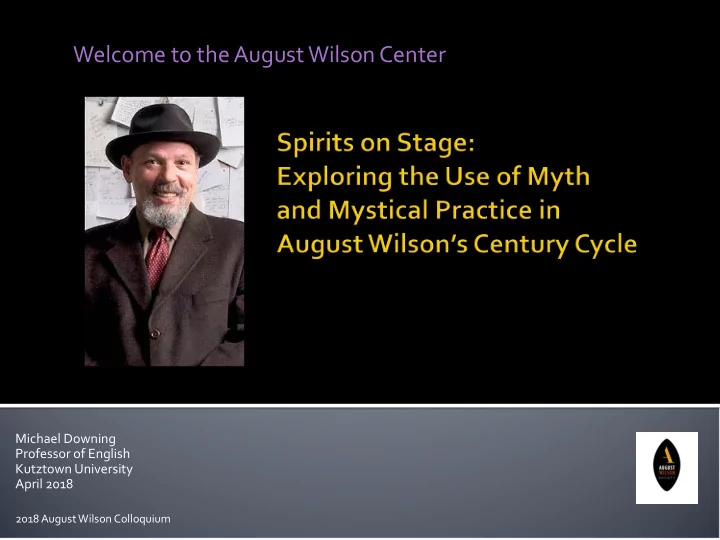
Michael Downing Professor of English Kutztown University April 2018
Welcome to the August Wilson Center
2018 August Wilson Colloquium
Welcome to the August Wilson Center Michael Downing Professor of - - PowerPoint PPT Presentation
Welcome to the August Wilson Center Michael Downing Professor of English Kutztown University April 2018 2018 August Wilson Colloquium 2018 August Wilson Colloquium Question: How did August Wilson, as a writer, develop a sense of
Michael Downing Professor of English Kutztown University April 2018
Welcome to the August Wilson Center
2018 August Wilson Colloquium
2018 August Wilson Colloquium
2018 August Wilson Colloquium
2018 August Wilson Colloquium
2018 August Wilson Colloquium
2018 August Wilson Colloquium
2018 August Wilson Colloquium
"Jitney was the first play where I actually listened to the dialogue rather than trying to force it into the mouths of the
it was difficult to shut them up.“
August Wilson, The Ground on Which I Stand, PBS American Masters Documentary, 2015
2018 August Wilson Colloquium
2018 August Wilson Colloquium
2018 August Wilson Colloquium
2018 August Wilson Colloquium
2018 August Wilson Colloquium
2018 August Wilson Colloquium
2018 August Wilson Colloquium
2018 August Wilson Colloquium
2018 August Wilson Colloquium
The difference between transforming the mundane into the sacred and transforming stereotype to archetype is that stereotypes are “charged” forms, while “mundane” items are not. For example, while the ham in Two Trains Running is certainly a potent symbol of exclusion, the ham itself is not a pre-existing, pejorative, racist stereotype. On the other hand, the watermelon in The Piano Lesson are charged coming into the play, as is Seth Holly’s description of Bynum as performing “old, mumbo jumbo nonsense,” which taps directly into pre-existing stereotypes related to “witch doctors.”
2018 August Wilson Colloquium
In August’s own words: “I happen to think that the content of my mother's life—her myths, her superstitions, her prayers, the contents of her pantry, the smell of her kitchen, the song that escaped from her sometimes parched lips … are all worthy of art." (Note from Seven Guitars) Chris Rawson: "The amazing thing to me about the language is that it's got a kind of gritty, earthy reality to it, but it has been injected with some kind of ten percent super reality, even though it's the most mundane things they're talking about.“ (PBS American Masters)
2018 August Wilson Colloquium
2018 August Wilson Colloquium
2018 August Wilson Colloquium
I personally believe that August Wilson has given us a black mythology
authors all created detailed and spirit-filled mythological worlds that provide sustenance to the cultures they speak to. And despite the fact that The Century Cycle might not prove as monetarily successful as GoT, I think we need to brace ourselves for unexpected and possibly rapid expansion of August’s artistic legacy into the mainstream. And if you look around the room, I think it’s already happening.
2018 August Wilson Colloquium
2018 August Wilson Colloquium
Then, in 1988, I encountered a book by Henry Louis Gates, Jr. called Figures in Black: Words, Signs, and the "Racial" Self, which asked the question: "What is the role of the black poet?" I was now in graduate school at Clarion, pursuing a master’s degree in English, and when I first encountered that question, it made an impression on me as a young scholar. I had studied mythology in my youth and was interested in the idea of a collective unconscious, or “waking dream,” shared by many people, lying just below the surface of our shared, daily interactions and conversations. Fortunately, Dr. Gates didn't leave me hanging, as he answered his own question in a way that further pulled me in: "By forging value, by solidifying meaning, the black poet, in his or her own way, forges myth."
Henry Louis Gates Jr. currently serves as Professor and Director of the Hutchins Center for African and African American Research at Harvard University. He is also known for the series Finding Your Roots on PBS.
2018 August Wilson Colloquium
Joseph Campbell: "Mythology…is not an outmoded quaintness of the past, but a living complex of archetypal, dynamic images … fundamental [to] the human psyche. And that stratum is the source of the vital energies of our being. Out of it proceeds all the fate-creating drives and fears of our lives. While our educated, modern waking- consciousness has been going forward on the wheels and wings of progress, this recalcitrant, dream-creating, wish-creating, under-consciousness has been holding to its primeval companions all the time, the demons and the gods.“ — The Ecstasy of Being, a collection of Campbell's works on Mythology and Dance from JCF and our partners at New World Library.
2018 August Wilson Colloquium
In written order: 1979 - Jitney 1982 - Ma Rainey's Black Bottom 1983 - Fences 1984 - Joe Turner's Come and Gone 1986 - The Piano Lesson 1990 - Two Trains Running 1995 - Seven Guitars 2001 - King Hedley II 2003 - Gem of the Ocean 2005 - Radio Golf
2018 August Wilson Colloquium
2018 August Wilson Colloquium
Jitney TURNBO: But Sarah Vaughan got more nature... got a prettier smile...got more personality... and she can sing better. Ma Rainey LEVEE: I done give Mr. Sturdyvant some of my songs I wrote and he say he's gonna let me record them when I get my band together. Fences TROY (Singing): Hear it ring! Hear it ring! I had a dog his name was Blue. You know Blue was mighty true. Joe Turner BYNUM: Told me he was gonna show me how to find my song. Piano Lesson (Wining Boy sits down at the piano and plays and sings.) Two Trains Running WEST: I done buried people with Bibles, canes, crutches, guitars, radios, baby dolls. Seven Guitars CANEWELL: There's a song what go (Singing:) He'll come to your house/ He won't stay long/ You look in the bed/ Find your mother gone King Hedley II RUBY: That was King's favorite song. He used to walk around saying, "Sing 'Red Sails,' Mommy. Sing "Red Sails.'" Gem of the Ocean (Citizen begins to sing an African lullaby to himself, a song his mother taught him.) Radio Golf Old Joe: I used to go around singing songs and the people like that. They take care of me. If I had my guitar I'd sing one for you.
Music/ musical references in every play
2018 August Wilson Colloquium
August told Vera Sheppard that he didn't read the great Western playwrights (although he does admit to reading Ed Bullins and Amiri Baraka).
In his own words: “I stood around in Pat's place and listened to [the elders of the community]. They talked philosophy, history ... the newspapers, the politics of the city, baseball games, and invariably they would talk about themselves and their lives when they were young men … a lot of what I know of the history of blacks … I picked up standing there in Pat's Place."
Vera Sheppard, Conversations with August Wilson
2018 August Wilson Colloquium
August told Vera Sheppard that he didn't read the great Western playwrights (although he does admit to reading Ed Bullins and Amiri Baraka).
In his own words: “I stood around in Pat's place and listened to [the elders of the community]. They talked philosophy, history ... the newspapers, the politics of the city, baseball games, and invariably they would talk about themselves and their lives when they were young men … a lot of what I know of the history of blacks … I picked up standing there in Pat's Place."
Vera Sheppard, Conversations with August Wilson
2018 August Wilson Colloquium
Listening to voices in his head—mostly voices of Pittsburghers—conjuring them from afar, and bringing them to life on stage.
2018 August Wilson Colloquium
Instead, it is:
2018 August Wilson Colloquium
It is not:
2018 August Wilson Colloquium
Africa, Portable Vodun Altar - Fon people - Benin,
mirror, 19.5 x 14 x 6.5 inches, Af 354