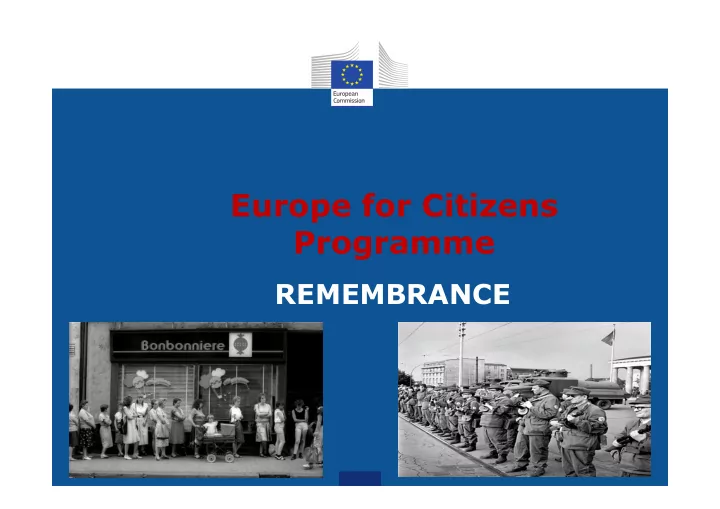
SLIDE 1
Europe for Citizens Programme
REMEMBRANCE
SLIDE 2 2007-2013 Programme
- 1. Active Citizens for Europe
- 2. Active Civil Society in Europe
- 3. Together for Europe
- 4. Active European Remembrance
SLIDE 3
Nazism and Stalinism
Preservation Commemoration Reflection Networking
approximately 4 - 8% of total (2007-2013) programme budget
SLIDE 4 Areas of support
- Preservation of individual and collective memory of
Holocaust, Nazism and Stalinism
- Commemoration of victims of mass deportation and
- ther large-scale martyrdom of Nazism and Stalinism
- Encouraging reflection on the origins and the values
underpinning European integration
- Promotion of reconciliation, tolerance and pluralism
SLIDE 5
Funding allocated 2007-2013
2007 : allocated budget : € 1,1 mio (36 projects) 2008 : allocated budget : € 1,7 mio (49 projects) 2009 : allocated budget : € 2,1 mio (56 projects) 2010 : allocated budget: € 1, 9 mio (64 projects) 2011 : allocated budget: € 1,8 mio (49 projects) 2012 : allocated budget: € 2,4 mio (37 projects) 2013 : allocated budget: € 2,4 mio (31 projects) IN TOTAL: 322 projects/€ 13,4 mio funding
SLIDE 6 In addition
Operating grants : max. 100.000 € per organisation
civil society organisations dedicated to remembrance of the
- rigins of the European integration
Mémorial de la Shoah Yahad in Unum
- Support to Auschwitz-Birkenau State Museum "Preserving
Authenticity – 9 tasks for years 2012-2015” : € 4 million provided from 2012-2015 for restoration, protection and preservation of historical structures and objects
SLIDE 7 Other developments
Launch of networking meetings May 2011 first meeting in Brussels and Mechelen April 2012 second meeting in Copenhagen in cooperation with FRA April 2013 third meeting in Erfurt in partnership with EUROCLIO April 2014 fourth meeting in Prague in cooperation with European Network
- f Remembrance and Solidarity (ENRS)
May 2015 fifth meeting in Tallinn
- Since 2010 cooperation with the Fundamental
- Rights Agency (FRA) on “Holocaust and Human
- Rights Education”
October 2010 conference in Terezin October 2011 conference in Anne Frank House Commemoration of International Holocaust Remembrance Day at the European Commission since 2012
SLIDE 8 2014-2020 Europe for Citizens programme
the two Strands (instead of four Actions)
- Budget increase from 4% to 20% of the
- verall programme budget for 2014-2020
SLIDE 9 2014-2020 continued
- Broadening the scope of the Remembrance
Strand to include:
- "reflecting on causes of totalitarian regimes
in Europe's modern history as well as other defining moments and reference points in the recent European history"
SLIDE 10 2014-2020 continued
- Historical moments commemorated in 2017
in particular
- 1917 The social and political revolutions, the fall of empires
and their impact on Europe's political and historical landscape
- 1957 The Treaty of Rome and the beginning of European
Economic Community
SLIDE 11 2014-2020 continued
- Funding
- On average 35 projects per year in the value
- f € 3 million
- +
- € 1,4 million for operational (institutional
grants) for European Remembrance
- rganisations such as Mémorial de la Shoah
SLIDE 12 Some project examples concerning Holocaust Remembrance and Education
- Holocaust Documentation Centre Slovakia "The Fingerprints of Gisi
Fleischmann"
The Holocaust Documentation Centre prepared a project aimed at introducing, to the young audience in particular, the destiny of Gisi Fleischmann and her effort as the head
- f underground Working Group to change the fate of Jews in Slovakia and later in other
European countries during the Second World War. The series of film screenings and lectures primarily aimed at secondary school students, with the participation of historians and Holocaust survivors. The activities of the projects were complemented by the performance of the play about Gisi Fleischmann "Rabinka – Rabbi woman" in the Slovak National Theatre by Anna Gruskova. The heroic example of Gisi Fleischmann was discussed against the background of humanism, European values and gender in the history of Europe.
SLIDE 13
Seminar for teachers and other history educators from Sarajevo and Bosnia and Herzegovina Mémorial de la Shoah Holocaust history - a particular resonance (in the context of conflict 1992-1995) Therefore a need to promote without any taboo a shared reading of the tragic 20th century history
SLIDE 14 Project examples – continued
aspects of Nazi ideology
evolution of genocidal practices
Holocaust in Bosnia and Herzegovina
Holocaust in France
Mass crimes, transitional justice and remembrance process
How to convey the history of Holocaust (teaching and art)
SLIDE 15
"Neighbours who disappeared"
Jewish Museum Prague
Project addresses young people aged 12 – 18 to work independently on the stories of the life of Jewish children in the same schools/neighbourhoods/regions they live in today.
SLIDE 16
"Ponar Lullaby (Being a Jew)"
Public Institution Vilko valia with partners in Sweden, Latvia and Poland To learn about Jewish religion, culture and life in general and in Vilnius before WWII in particular. To learn about the 70, 000 Jews killed in Ponary near Vilnius during Holocaust and Holocaust as such.
SLIDE 17 "Ponar Lullaby (Being a Jew)"
- "Can a resident of Vilnius live peacefully without knowing
what took place during the war in the old town basements, where hundreds were hiding from police, and without knowing what did Ponar mean for tens of thousands of people locked in ghetto?
walk through the same courtyards in which someone got a ticket to freedom but had to choose whom to take along: mother or wife? And which two children to save and which to leave in ghetto to be taken to Ponar to kill?
Andrius Uzkalnis (participant in the project)
SLIDE 18 "Ponar Lullaby (Being a Jew)"
- Achievements of the project:
- Reconstructing the local memory
- Initiating public debate – Lithuanian National Television
produced a 20 minute documentary about the project which was later broadcasted
- Taken up by the community – as a result of the project
Vilnius City approached Vilnius schools to organise similar events to learn about Jewish past of Vilnius and Holocaust
SLIDE 19 Town of Piestany "Memories within us"
The goal of the project was to remember the tragic history of the Holocaust. Pupils from the 9th grade
the elementary school visited Auschwitz, a commemoration service took place by the Holocaust monument in Piestany, Slovakia. An international conference was held, an exhibition of photographs was organised and the book "Piestany and Trencin during the Holocaust" was published. More than 400 pupils took part in the project activities.
SLIDE 20 Examples of other projects
“Seeking the Truth” Nation's Memory Institute, Slovakia “Mosaic of Memory” Terezin Initiative, the Czech Republic “The Dossiers behind Faces” Kazerne Dossin – Memorial Museum and Documentatation Centre on Holocaust and Human Rights, Mechelen, Belgium “An innovative teaching tool based on testimonies from survivors of Holocaust” Swedish Committee against antisemitism