Maritime Administration 1200 New Jersey Ave., SE | Washington, DC | 20590 w w w . d o t . g o v
Maritime Administration Port Infrastructure Development Grant - - PowerPoint PPT Presentation
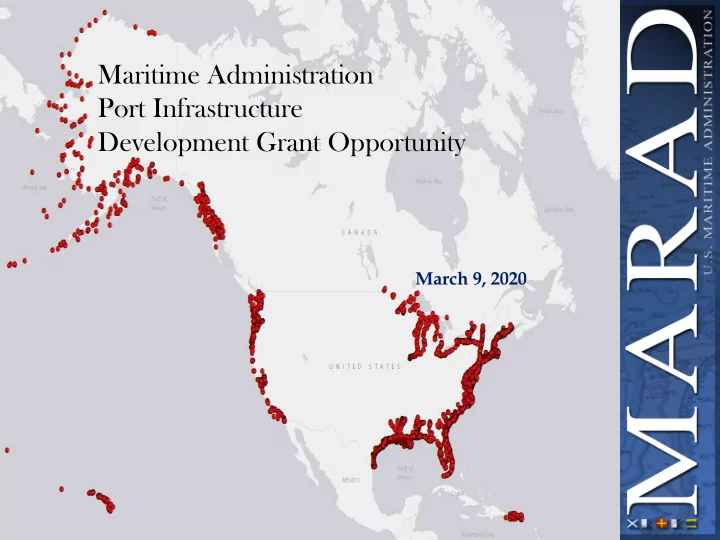
Maritime Administration Port Infrastructure Development Grant Opportunity March 9, 2020 Maritime Administration 1200 New Jersey Ave., SE | Washington, DC | 20590 w w w . d o t . g o v Port Infrastructure Development Grant Overview
Port Infrastructure Development Grant Overview
- Port Infrastructure Development Program Grant Opportunity
- Grants provide Federal assistance to improve port facilities within, or
- utside of and directly related to, operations of coastal seaports,
inland river ports, and Great Lakes ports.
- $225 million authorized for FY20.
- At least $200 million shall be for coastal seaports or Great Lakes
ports
- Discretionary grants on a competitive basis for projects that will
improve the safety, efficiency or reliability of the movement of goods into, out of, around, or within a port
- Application submittal deadline is 8 p.m. EDT, May 18, 2020.
- Applications must be submitted through www.grants.gov.
2
Port Infrastructure Development Grant Overview (cont’d)
- Federal Award Information
- Guidance here is in Section B of the Notice of Funding Opportunity
(NOFO)
- Award size.
- Minimum award size is $1 million. No maximum (but see “Restrictions on Funding”).
- Restrictions on funding.
- These restrictions come from the authorization and appropriations acts for this year’s
funding opportunity.
- A maximum of $56.25 million can be awarded to a single state.
- $56.25 million is reserved for projects requesting exactly $10 million in PIDP funds
(although the Department could award such an applicant less than that amount and count it against the reserved sum of money).
- No more than $22.5 million may be awarded for development phase activities.
- Availability of funds.
- Goal is to obligate funds not later than September 30, 2023. Obligation occurs upon
signing of a written grant agreement.
- Various
administrative requirements, including transportation planning and environmental reviews, must be completed before a grant agreement can be completed.
- Goal is to expend funds within five years of obligation.
- A project’s likelihood to be ready for obligation of funds by September 30, 2023 and
liquidation of the funds within five years of obligation will be considered during the review process.
3
PIDP Grant Application Details - Eligibility
- Eligible Applicants
– A port authority, a commission or its subdivision or agent under existing authority; – A State
- r
political subdivision
- f
a State
- r
local government; – A Tribal government – A public agency or publicly chartered authority established by one or more States; – A special purpose district with a transportation function; – A multistate or multijurisdictional group of entities, or – A lead entity described above jointly with a private entity or group of private entities.
4
PIDP Grant Application Details - Eligibility
- Cost Sharing and Matching
– Guidance here is in Section C.2. of the NOFO – In general, Federal share may not exceed 80 percent of the cost of the project
- Secretary may waive that requirement for grant awards less than $10
million
– Application should demonstrate sources of non-Federal funds being committed to the project. – Matching funds may . . .
- Be from State funds, local funds or private funds.
- Come from TIFIA or RRIF loans as long as the loan is repayable from
non-Federal funds
– Matching funds may not . . .
- Be counted as the non-Federal share for both this program and another
Federal grant program.
- Consist of previously-incurred costs or previously-expended funds
5
PIDP Grant Application Details - Eligibility
- Eligible projects
– Must be within the boundary of a port, or outside the boundary and directly related to port operations or to an intermodal connection to a port – Eligible projects are limited to . . .
- Port gate improvements
- Road improvements both within and connecting to the port
- Rail improvements both within and connecting to the port
- Berth improvements (including but not limited to: docks, wharves, piers and dredging incidental to
the improvement project)
- Fixed landside improvements in support of cargo operations (such as silos, elevators, conveyors,
container terminals, Ro/Ro structures including parking garages for intermodal freight transfer, warehouse including refrigerated facilities, cargo lay down areas, transit sheds and other such facilities)
- Utilities necessary for safe operations (including but not limited to: lighting, storm water and other
such improvements that are incidental to a larger infrastructure project)
- A combination of activities described above
6
PIDP Grant Application Details - Eligibility
- Eligible projects (cont’d)
– If they support an eligible project: environmental mitigation measures, freight intelligent transportation systems or digital infrastructure systems – If they support an eligible project: development phase activities
- However, funding prioritized for projects that will move into construction phase w/in the grant’s
performance period
– Specifically not eligible: vessel construction, projects within a small shipyard
- Determinations
– Before selecting a project for an award, the Department must make certain determinations about the applicant and the project. – Section C.3.b. explains the six determinations. Applicants should include information that will help the reviewers make these determinations in the project narrative.
7
PIDP Grant Application Details - Eligibility
8
- Project Components (Section C.3.c. of the NOFO)
- Application may describe multiple components
- Department may award funds for a component if it would other qualify for
funding (meets minimum award amount, aligns w/ merit criteria, has independent utility)
- Project components in a single application must have a relationship
between them
- Applicability to the set-aside for applicants requesting exactly $10 million
(include project alternatives for less, or more, than $10 million along w/ requested information)
- Definitions (Section C.3.e. of the NOFO)
- Coastal port
- Development phase activities
- Great Lakes port
- Rural area
How to apply
- Submission date
– Due by 8:00 pm EDT on Monday, May 18, 2020 – Must be submitted thru Grants.gov
- Content and form of submission
– Standard Form 424 (Application for Federal Assistance) – Cover page
- Consider: succinct description of the project (including its location), why it is needed and its benefits
– Project narrative
- Project narrative should follow this basic outline
– Project description (D.2.I. of the NOFO) – Project location (D.2.II.) – Grant funds, sources and uses of project funding (D.2.III.) – Merit criteria (D.2.IV.) – Project readiness (D.2.V.) – Domestic preference (D.2.VI.)
How to apply (cont’d)
- Project Description
– Include a concise description of the project, the challenges it is intended to address and how it will resolve those challenges. – Use this section to put the project in a broader context: How does it relate to other capital development initiatives the applicant is pursuing? Does it support or enhance other projects in the area (in particular, other Federal investments)?
- Project Location
– Describe the project location precisely
- Consider including maps and other geospatial data so that the reviewer can understand
how it connects to existing infrastructure
– Identify if the project is
- In a qualified opportunity zone
- In a rural area
- A Great Lakes port project
- A project for a Coastal Port
How to apply (cont’d)
- Grant Funds, Sources and Uses of Project Funds . . . include
– Project costs – Sources and amount of funds – Documentation of non-Federal funding commitments – Information on the require non-Federal match for Federal funds – A budget that shows how each source of funds will be spent
- Merit Criteria. Address each of the following merit criteria . . .
– Effect on the Movement of Goods – Leverage of Federal funding
- Describe how you have worked to improve the non-Federal share
– Net Benefits
- Summarize the results of the benefit-cost analysis of the project
- BCA should be submitted as an appendix to the project narrative. Appendix . . .
– should identify present value estimates of project’s benefits and costs (relative to a no-build baseline); – may include other categories of benefits that are more difficult to quantify; – should tie all benefits to the expected outcomes of the project; and, – should include the full costs of developing, constructing, operating and maintaining the project.
How to apply (cont’d)
- Project readiness
– Focus is on helping the evaluators assess the likelihood of a successful project. – Two elements of project readiness: technical capacity and environmental risk – Technical capacity
- Prior experience working w/ Federal agencies
- Experience, if any, w/ BUILD, INFRA or PIDP grants
- Technical experience with similar projects
- Feasibility of the project and how it will comply w/ applicable Federal
requirements
– Environmental risk. Two components . . .
- Project schedule: include a project schedule that identifies all major
project milestones – NEPA status (any ongoing reviews?) – Other required approvals (permits from other agencies?)
- Assessment of project risks and mitigation strategies
How to apply (cont’d)
- Domestic preference
– Whether materials and manufactured products that will be used in the project are produced or manufactured domestically
- Include an assessment of whether items to be used in the project might
require a waiver of the Buy American Act provisions (Section F.2. of the NOFO)
– As appropriate, applications should include an effective plan to maximize domestic content.
Application review
14
Intake phase Technical review phase Senior Review Team Secretarial decision
Application review – criteria
15
Merit criteria: movement of goods Merit criteria: leverage of Federal funding Merit criteria: net benefits Project Readiness Domestic Preference Additional Considerations
Application Review – Merit Criteria
- Movement of goods
– Extent to which project will improve the safety, efficiency or reliability
- f the movement of goods thru a port or intermodal connection to a
port – Projects that improve the movement of goods satisfy this criteria
- Leveraging of Federal funding
– Projects rated based on Federal vs. non-Federal share of costs – Projects ranked on non-Federal leverage percentage from highest to lowest and assigned a rating based on the quintile they fall in
- Net Benefits
– Evaluators will rely on quantitative, data-supported analyses – Projects grouped by benefits-costs ration (BCR) and net present value (NPV) – Potential applicants are strongly encouraged to participate in the upcoming webinar on preparing a benefit-cost package
Application Review – Criteria and Add’l Considerations
- Project Readiness
– Evaluators will consider significant risks to successful completion of the project. – Risks include: environmental review, permitting, technical feasibility, funding, capacity to manage the project – Applications should include achievable risk mitigation strategies
- Domestic Preference
– Whether materials and manufactured products to be used in the project are produced or manufactured domestically
- Additional considerations
– Opportunity zones – R.O.U.T.E.S. Initiative – Projects awarded less than $10 million
- Priority consideration is given to ports that handled less than 10,000,000 short tons of
cargo in 2017 (as identified by the Army Corps of Engineers)
Application Review – Determinations
- Authority to carry out the project
– Provide citations of authority or other supporting documentation
- Unreasonable delay
– Demonstrate that the project is reasonably expected to begin construction within 18 months of funds obligation (e.g., grant agreement) – Show that it will be fully completed w/in 5 years of obligation
- Sufficient matching funds
– Show sufficient funding, dedicated to the proposed purposes, is available to meet matching requirements
- Need for financial assistance
– Describe the impacts on the project if Federal funding or financial assistance is not available for the project – Show how the project cannot be easily or efficiently completed without the Federal assistance
Additional Information
- Development phase grant applications
– Evaluated against the same criteria (as applications for capital construction projects) – Prioritized with those proposing to move into construction within the period of obligation being more competitive than those that cannot
- Risk assessment prior to grant award
– Applies to each applicant selected for an award – Performed by Department staff – Assesses prospective awardee’s integrity, business ethics and record of performance under Federal awards – Relies upon information in Federal Awardee Performance and Integrity Information System (FAPIIS)
Administration Information
- Award notifications
– Posted on www.transportation.gov/Portgrants – MARAD representative will then reach out to POC listed in SF 424
- Grants are reimbursement grants
– In addition, only expenses incurred after the successful applicant and the Maritime Administration enter into a grant agreement are eligible for reimbursement
- Uniform Administrative Requirements, Cost Principles and
Administrative Requirements for Federal Awards (2 CFR Part 200) governs
- Grantee’s Compliance with Federal law
– See sample terms and conditions for BUILD 2019 awardees
- Reporting
– Progress Reporting on Grant Activities – Outcome Performance Reporting – Port Performance Reporting – FAPIIS
- Read the NOFO carefully and tailor your narrative to the suggested
- rganization structure and content
- Present a project timeline that is realistic and considers . . .
– A period between award and the grant agreement – A realistic timeframe post-grant agreement for final design (if applicable) and construction
- Be able to complete project work and related expenditures w/in five years of the signed grant agreement
- Pay careful attention to the BCA process
– Purpose – Summary in project narrative – Supporting documentation (including file showing how calculations were made) – Listen to Wednesday’s webinar, even if you have previously submitted an application for discretionary grant funds.
- Identify which pool of applicants and which funding consideration you
believe your project is eligible for
– Doesn’t eliminate the project from consideration under other components
Suggestions for a More Effective Application
Location, location, location!
Can the reviewer tell from your application where the project is located, and what market it may serve? Is the project in an Opportunity Zone?
- Find OZ Resources at:
– https://www.cdfifund.gov/Pages/Opportunity-Zones.aspx – https://www.irs.gov/newsroom/opportunity-zones- frequently-asked-questions
22
Suggestions for a More Effective Application
Port Infrastructure Development Resources
Port Infrastructure Development Program Grants Webpage: https://www.maritime.dot.gov/PIDPgrants Department of Transportation guidance on preparing a benefit-cost analysis: https://www.transportation.gov/office-policy/transportation-policy/benefit- cost-analysis-guidance Build America Bureau website: https://www.transportation.gov/buildamerica
23
A webinar on preparing a benefit-cost package will be offered
- n