Marine Energy Conversion Technologies: Lowering the Levelized Cost - - PowerPoint PPT Presentation

marine energy conversion technologies
SMART_READER_LITE
LIVE PREVIEW

Marine Energy Conversion Technologies: Lowering the Levelized Cost - - PowerPoint PPT Presentation

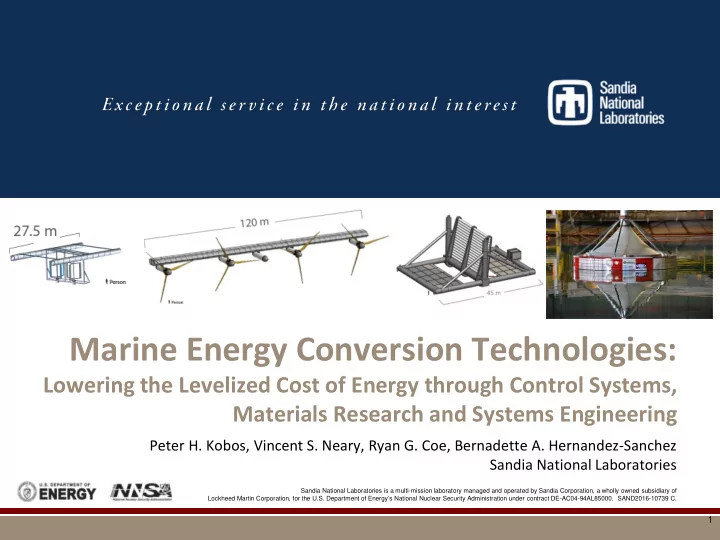
Marine Energy Conversion Technologies: Lowering the Levelized Cost of Energy through Control Systems, Materials Research and Systems Engineering Peter H. Kobos, Vincent S. Neary, Ryan G. Coe, Bernadette A. Hernandez-Sanchez Sandia National


slide-1
SLIDE 1

Sandia National Laboratories is a multi-mission laboratory managed and operated by Sandia Corporation, a wholly owned subsidiary of Lockheed Martin Corporation, for the U.S. Department of Energy’s National Nuclear Security Administration under contract DE-AC04-94AL85000. SAND2016-10739 C.

Marine Energy Conversion Technologies:

Lowering the Levelized Cost of Energy through Control Systems, Materials Research and Systems Engineering

Peter H. Kobos, Vincent S. Neary, Ryan G. Coe, Bernadette A. Hernandez-Sanchez Sandia National Laboratories

1

slide-2
SLIDE 2

Outline*

  • Marine Hydrokinetics Technology
  • Reference Model Project
  • LCOE development for various devices
  • Advanced Controls
  • Increased performance from various controls

strategies

  • Advanced Materials
  • Example Applications
  • Concluding remarks

* Select presentation materials adapted from Neary et al., 2016.

2

slide-3
SLIDE 3

MHK Research Focus Areas at Sandia National Labs

Materials & Coatings Rotor Design & Testing Performance Modeling Hydro-Acoustics

x

x′ ( , )

i

v x t ξ ζ ( , , ) p t ξ ζ τ −

Water Tunnel (PSU/ARL) Coupled Device Array and Environmental Analysis Hydrofoil Design/Analysis Cavitation

Components Sub-systems System Testing Deployment

Columbia Power 1/15th Scale Test (OSU) SNL EFDC

Technology Development Cycle

Power Takeoff Testing

3

slide-4
SLIDE 4

Reference Model Project

  • Motivation:
  • Marine energy renewable, low-carbon resource
  • Dozens of proprietary design concepts
  • Objectives
  • Design non-proprietary MEC devices for R&D
  • Benchmark cost of energy
  • Identify knowledge gaps, cost drivers

wave energy converters (WEC) current energy converters (CEC)

4

slide-5
SLIDE 5

Reference Models

  • Non-Proprietary Devices
  • 3 Current Energy Converters

(CECs)

  • 3 Wave Energy Converters

(WECs)

  • Point Designs
  • Reference resource site
  • Utilizing “today’s” technology
  • http://energy.sandia.gov/rmp

5

slide-6
SLIDE 6

Methodology

6

slide-7
SLIDE 7

LCOE Formula

  • Levelized Cost of Electricity
  • Denotes “Break Even” cost assuming

minimum rate of return.

  • 4 Primary Inputs
  • Capital Expenditures (CapEx)
  • Year 0 costs
  • Operational Expenditures (OpEx)
  • Year 1 to n costs
  • Average Annual Energy Production (AEP)
  • Fixed Charge Rate (FCR)
  • 10.8%
  • Lumped financing term including

discount rate, inflation, taxes, depreciation, and project life.

  • Analysis Performed for 1, 10, 50 and

100 – unit arrays

7

slide-8
SLIDE 8

LCOE Formula (CapEx Categories)

  • Development
  • Infrastructure
  • Mooring/Foundation
  • Device Structural Components
  • Power Take Off (PTO)
  • Subsystem Integration & Profit Margin
  • Installation
  • Contingency

8

slide-9
SLIDE 9

LCOE Formula (OpEx Categories)

  • Marine Operations & Maintenance (O&M)
  • Shore-side Operations & Maintenance

(O&M)

  • Post Installation Environmental O&M
  • Replacement Parts
  • Consumables
  • Insurance

9

slide-10
SLIDE 10

Results - LCOE Overview

  • CECs
  • WECs

$- $1.00 $2.00 $3.00 1-unit 10-unit 50-unit 100-unit

CEC LCOE ESTIMATES

RM1 RM2 RM4 average $- $2.00 $4.00 $6.00 1-unit 10-unit 50-unit 100-unit

WEC LCOE ESTIMATES

RM3 RM5 RM6 average

1-unit 10-unit 50-unit 100-unit RM1 $ 1.99 $ 0.40 $ 0.20 $ 0.17 RM2 $ 2.67 $ 0.78 $ 0.42 $ 0.35 RM4 $ 0.67 $ 0.24 $ 0.17 $ 0.15 average $ 1.78 $ 0.47 $ 0.26 $ 0.22 1 10 50 100 RM3 $ 4.36 $ 1.41 $ 0.83 $ 0.73 RM5 $ 3.59 $ 1.44 $ 0.77 $ 0.69 RM6 $ 4.79 $ 1.98 $ 1.20 $ 1.06 average $ 4.25 $ 1.61 $ 0.93 $ 0.83

10

$/kWh

slide-11
SLIDE 11

Results – CEC Breakdown

  • 1-unit
  • O&M (green) & Infrastructure (red) dominate tidal & ocean current LCOE
  • O&M (green), Development (blue) & PTO (marine) dominate river current LCOE
  • 100-unit
  • PTO (marine), Structure (purple), and O&M (green) dominate LCOE

11

slide-12
SLIDE 12

Results – WEC Breakdown

  • 1-unit
  • O&M (green), Development (blue), and Installation (lavender) are LCOE drivers
  • 100-unit
  • Structure (purple) is primary cost driver, which is driven by large structural mass

12

slide-13
SLIDE 13

Results – 10 MW Installed Capacity

  • CECs
  • ≈ $0.31-0.45/kWh
  • Varying resource

conditions impact installation, permitting, capacity factors, etc.

  • WECs
  • ≈ $0.98-1.53/kWh
  • At 10 MW structural

mass is the largest contributor to LCOE.

13

slide-14
SLIDE 14

Wave Energy Converter (WEC) – Controls Project: Test hardware – wave basin

Maneuvering and Seakeeping (MASK) basin Naval Surface Warfare Center, Carderock Division (NSWCCD)

  • Built 1962
  • Dimensions: 106x76x6m deep
  • Updated wavemakers in 2013
  • 216 individual flaps
  • Peak wave power is approximately 1MW

14

slide-15
SLIDE 15

Project motivation

  • Project goal: accelerate/support usage of advanced WEC control by

developers

  • Numerous studies have shown large benefits of more advanced

control of WECs (e.g., Hals et al. showed 330% absorption increase)

  • Most studies rely on significant simplifications and assumptions
  • Availability of incoming wave

foreknowledge

  • 1-DOF motion
  • Linear or perfectly know

hydrodynamics

  • No sensor noise
  • Unlimited actuator performance

15

slide-16
SLIDE 16

Test hardware – WEC device

16

slide-17
SLIDE 17

Summary of results

17

All units in metric

17

Power increase of >330%

slide-18
SLIDE 18

Advanced Materials for Marine Hydrokinetic (MHK) Technology

Procedure: Purpose:

Applied research and provides guidance on Materials & Coatings to enable viability, lower the cost of energy (COE), and accelerate commercialization of marine and hydrokinetic technology (MHK).

Early Program Addressed:

  • Industrial Survey on Materials & Coatings
  • Development & Characterization of MHK

Specific Protective Coatings

  • Materials Reliability & Performance Testing
  • Initial Assessment of Underwater NDI

Monitoring

  • Meeting with Industry/Researcher coatings

community

  • MHK Composites Workshop

Future Program to Address:

  • Removing Uncertainty & Barriers of using

Composites (Industry Directed)

  • Leverage Coatings Research & Library
  • Understand Materials & Coatings Impact on

MHK Manufacture, O&M, Reliability, Safety, Cost

  • Support MHK Developers on Their

Deployments

18

slide-19
SLIDE 19

MHK Advanced Materials & Coatings

19

MHK Industrial Review Protective Coatings Materials Reliability: SHM Monitoring (FBG) Ocean Renewable Power Co. / MSU

  • Uni. of New Hampshire

PNNL Open Water Testing PNNL Marine Science Laboratory Water Power Materials Science & Engineering Montana State University (MSU) MHK Composite Performance

19

slide-20
SLIDE 20

Sandia Industrial Survey on Materials & Coatings

  • Coatings ($/mass) = $8/kg for epoxy; $30/kg for Copper

based coating. $130/gal for paint system color

  • No or limited Nondestructive Inspection (NDI) and

Inspection Analysis after manufacture/prior to deployment

  • Carbon Composites-interest, but high cost
  • Not all the materials used for deployment will be the same

for manufactures. (not yet determined)

slide-21
SLIDE 21

1 2 3 4 Corrosion UV Degradation Componet Failure Sensor Detactment Biofouling Embrittlement of materials/coatings Structure Failure Sediment Erosion Sediment Fouling Connection Failure Mineral Fouling Cavitation Mooring Failure

Issues Observed During Deployment

Issues Observed During Deployment

Question to Companies: Did any of the following Issues Occur During the Deployment/Test Period (check all that apply). 4 companies responded, each response was accounted to provide number of issues (1-4) Sandia, as a lab, is exploring Engineered Reliability & Forensics Analysis of Reliability. How can prevent these issues through Materials, Process, & Manufacture? Time of deployment: 8wks, 1yr, 3yr, <9,000 turbine hrs.

slide-22
SLIDE 22

Upcoming Composites Research

Past Work

  • Research and analysis of composite materials and coatings in operating

environment (i.e. sea water). SNL, PNNL, MSU, BYU, NDSU, ORNL (Toxicity)

Material Design Tools for Marine Hydrokinetic Composite Structures (SNL, PNNL, NREL, MSU, FAU)

  • Helping MHK industry reduce uncertainty in using composites
  • Developing U.S. DOE MHK Composite Materials & Structures Database:

http://energy.sandia.gov/energy/renewable-energy/water-power/technology-development/advanced- materials/mhk-materials-database/

  • Mitigating biofouling & metal-carbon fiber interconnect corrosion in saltwater
  • Examining MHK load challenges on material & substructure performance
  • Examine impact on LCOE

Biofouling & Marine coatings assessment Structural Health Monitoring MHK Environmental Effects on Composites Nanomaterials Development

slide-23
SLIDE 23

DOE/SNL/MSU Wind & Water Database

Current User Community of U.S. DOE Materials & Structures Database

73 10 10 9 6 6 5 5 5 5 53

Location

United States Germany China India United Kingdom South Korea Italy

96 5 64 20 1 Industry

Wind Water Other Aerospace Military

87 18 22 34 20 5

Organization Type

School Laboratory Consultant Manufacturer Other Individual

U.S. Wind Other Other

School Manufacturer

slide-24
SLIDE 24

Concluding Remarks

  • Close to market readiness:
  • Average 100-unit array LCOE ≈ $0.22/kWh
  • Cost drivers: Power Takeoff, Structure, O&M
  • Farther from market readiness:
  • Average 100-unit array (approximately 30 MW) LCOE ≈ $0.83/kWh
  • Cost drivers: Structure, Mooring, O&M
  • Need to increase Annual Energy Production (AEP) through improved

energy capture

Current Energy Converters Wave Energy Converters Advanced Controls: systems may increase power production substantially (300%+) Materials Research: may provide longevity & cost reductions

24

 Reference Models (LCOE)

slide-25
SLIDE 25

Acknowledgements

  • The authors would like to thank the Department of Energy, office of Energy,

Efficiency & Renewable Energy for supporting this research, as well as colleagues at Sandia National Laboratories, others at the National Renewable Energy Laboratory (D. Scott Jenne & Yi-Hsiang Yu (NREL)),

  • ther national laboratories and in the Marine Hydrokinetic research and

industrial community.

  • Presentation elements adapted from Neary et al., 2016.
  • Sandia National Laboratories is a multi-mission laboratory managed and
  • perated by Sandia Corporation, a wholly owned subsidiary of Lockheed

Martin Corporation, for the U.S. Department of Energy's National Nuclear Security Administration under contract DE-AC04-94AL85000. References

  • Neary, V., Kobos, P., Jenne, D.S. and Y-H Yu, 2016, Levelized Cost of

Energy for Marine Energy Conversion (MEC) Technologies, EPRC6, Santa Fe, NM, September 8-9, 2016.

25

slide-26
SLIDE 26

THANK YOU

26

slide-27
SLIDE 27

BACKUP SLIDES

27

slide-28
SLIDE 28

RM Current Energy Converters

  • 3 Current Energy

Converters (CECs)

  • RM1 – Dual Rotor Axial

Flow Tidal Turbine

  • RM2 – Dual Rotor Cross

Flow River Turbine

  • RM4 - 4 Rotor Axial Flow

Ocean Turbine

28

slide-29
SLIDE 29

CEC Design and Resource

  • RM1
  • Tacoma Narrows – Puget

Sound, WA

  • 1.1 MW Rated Power
  • 30% Capacity Factor
  • RM2
  • Mississippi River – Baton

Rouge, LA

  • 90 kW Rated power
  • 30% Capacity Factor
  • RM4
  • Florida Strait – Boca

Raton, FL

  • 4 MW Rated Power
  • 70% Capacity Factor

Tacoma Narrows:

Image courtesy of Google Earth

Mississippi River:

Image courtesy of Google Earth

Florida Strait:

Image courtesy of Google Earth 29

slide-30
SLIDE 30

RM Wave Energy Converters

  • 3 Wave Energy

Converters (WECs)

  • RM3 – Point Absorber
  • RM5 – Oscillating Wave

Surge Converter (OWSC)

  • RM6 – Backward Bent

Duct Buoy Oscillating Water Column (BBDB)

slide-31
SLIDE 31

WEC Design and Resource

  • All WECs designed for

Humboldt Bay – Humboldt County, CA

  • RM3
  • 286 kW Rated Power
  • 30% Capacity Factor
  • RM5
  • 360 kW Rated power
  • 30% Capacity Factor
  • RM6
  • 370 kW Rated Power
  • 30% Capacity Factor

Humboldt Bay, near Eureka, CA: Image courtesy of Google Earth