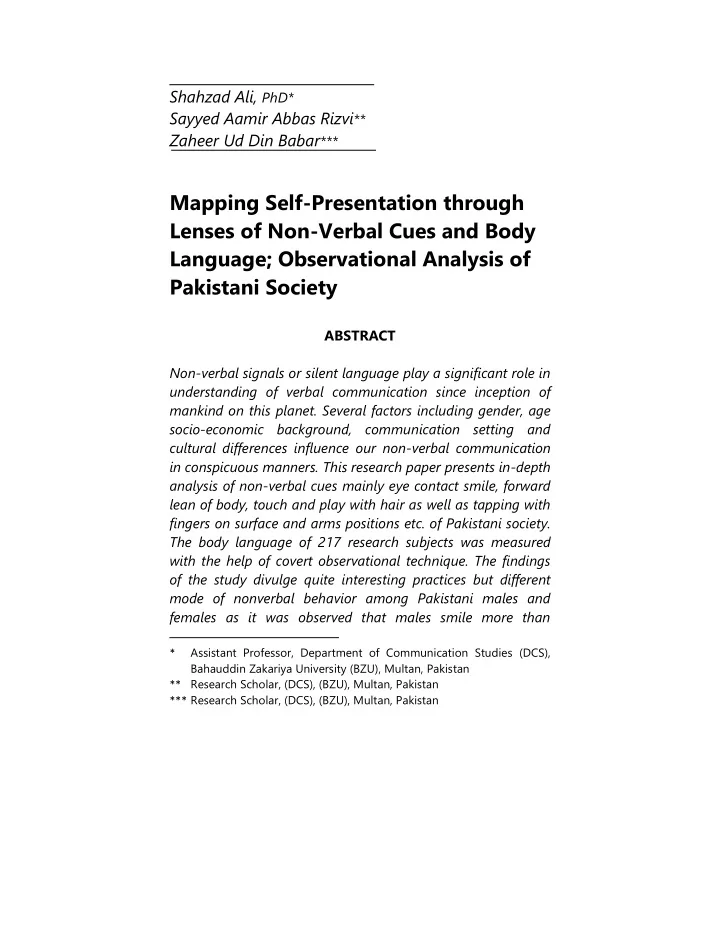
SLIDE 1 Shahzad Ali, PhD* Sayyed Aamir Abbas Rizvi** Zaheer Ud Din Babar***
Mapping Self-Presentation through Lenses of Non-Verbal Cues and Body Language; Observational Analysis of Pakistani Society
ABSTRACT Non-verbal signals or silent language play a significant role in understanding of verbal communication since inception of mankind on this planet. Several factors including gender, age socio-economic background, communication setting and cultural differences influence our non-verbal communication in conspicuous manners. This research paper presents in-depth analysis of non-verbal cues mainly eye contact smile, forward lean of body, touch and play with hair as well as tapping with fingers on surface and arms positions etc. of Pakistani society. The body language of 217 research subjects was measured with the help of covert observational technique. The findings
- f the study divulge quite interesting practices but different
mode of nonverbal behavior among Pakistani males and females as it was observed that males smile more than
* Assistant Professor, Department of Communication Studies (DCS), Bahauddin Zakariya University (BZU), Multan, Pakistan ** Research Scholar, (DCS), (BZU), Multan, Pakistan *** Research Scholar, (DCS), (BZU), Multan, Pakistan
SLIDE 2 Journal of Social Sciences and Humanities: Volume 23, Number 1, Spring 2015
102
females irrespective of their age group at public places. Similarly Pakistani women of rural background seemed to be less confident, assertive and dominating with blend of shyness in term of body language as compared to urbanized women. On the other side men were found more open, commanding and confident than both type of women. It was also revealed that the ratio of open arm position among males was found greater as compared to females. Due to the social and Islamic cultural constraints, Pakistani women feel comfortable using free arm positions as well as of their bodies movement at in- house premises rather than open or public places. More and above the impact of customs and tradition was clearly seen in the context of posture, eye contacts, arm positions to the body, tapping fingers on the surface. Finally it is sum up conveniently that the gender difference, nature of relationship and location were the strong variables which created conspicuous influences on nonverbal mode of behavior of Pakistanis. Keywords: Self presentations, body language, eye contact, nonverbal behavior, gender differences, arm positions, smiling, covert observation, Pakistani society, gestures and facial expression.
Introduction
- mmunication is an integral part of our lives. We
communicate in different ways to express our thoughts, feelings, knowledge, skills, and ideas. It is normally assumed that communication is identified with speech and sounds but communication is, in fact, the combination of verbal and non-verbal transmission of
C
SLIDE 3 Shahzad Ali, Sayyed Aamir Abbas Rizvi and Zaheer Ud Din Babar
103
- knowledge. During everyday communication, especially face-
to-face interaction, vocal and visible behaviors are typically coordinated in ways that provide for their mutual
- performance. When people talk, they also locate their bodies,
assume various postures, direct their eyes, and perhaps move their hands, altogether behaving in ways that constitute an interactive event. Historically, however, verbal and nonverbal messages have been studied separately, as though they were independent rather than co-occurring and interrelated phenomena. Non-verbal communication includes sounds, gestures, body movements, eye contacts, facial expressions, pitch or tone of a voice, spatial distance, apparent behavior, postures, and dress of an individual. According to DIleo (1977) “Language comprises all forms of communication: crying, facial expression, gestures, touching, yelling, and also speech and writing.”Givens (2002) stated, “A body movements, postures, or material artifacts which encodes or influences a concept, motivation, or mood (thus, a gestures is neither matter nor energy, but information). In its most generic sense is a sign, signal, or cue used to communicate in tandem with, or part from words. Gestures include facial expressions, clothing cues, and body movements. In comparison to men, women in general differ in their communication style: they self-disclosemore (Eagly & Johnson,1990)) and use a greater relationship-oriented style, with more smiling, more gazing at the other, less physical distance, and increased emotional expressiveness. Women also tend to adjust their status to equal their partner’s, whereas men underscore status differences (Dindia & Allen, 1992). Within society, women behave less dominantly and are less likely to embrace hierarchies, be competitive, take on leadership positions, or emerge as group leaders than men
SLIDE 4
Journal of Social Sciences and Humanities: Volume 23, Number 1, Spring 2015
104
(Eagly et al, 1995). Research by Mehrabian (1971) in USA suggests that, as far as feelings and attitudes are concerned, the total impact of a message/communication is transmitted as follows: Head Movements to show receipt of a message; to indicate agreement or disagreement; to indicate uncertainty; to give somebody else space Facial Expressions to show a variety of moods including agreement; disagreement; sympathy; hostility; amusement; concern etc. Eye Contact to establish rapport; to watch for reactions in the other party Gestures to reinforce/add emphasis to the verbal message; to help somebody else into the conversation Posture to reinforce/add emphasis to the verbal message; to help establish rapport; to show interest and commitment; to help self-confidence; to indicate formality or informality Body Movements to reinforce/add emphasis to the verbal message; to help terminate a conversation Proximity to establish rapport; to allow space for the other parties; to indicate degree of formality or informality; to help engage or disengage Appearances indicate formality or informality; to help rapport.
Literature Review
Thill and Bovee (1999) stated, “The most basic form of communication is non-verbal communication: all the cues, gestures, vocal qualities, spatial relationships, and attitudes toward time that allow us to communicate without words.
SLIDE 5 Shahzad Ali, Sayyed Aamir Abbas Rizvi and Zaheer Ud Din Babar
105
Anthropologists theorize that long before human beings used words to talk things over, our ancestors communicated with one another by using their bodies. They gritted their teeth to show anger; they smiled and touched one another to indicate affection (p.21). Miller (1988) stated, “The most important and reliable features of the face, the eyes provide a constant channel of
- communication. They can be shifty and evasive; convey hate,
fear, and guilt; or express confidence, love, and support. He further stated, “Teachers can have individual contacts with every student in the classroom through eye contact. Attitudes of intimacy, aloofness, concern or indifference can be inferred by the way a teacher looks or avoids looking at a student. Witt and Wheeless (1999) conducted a research study on, “Nonverbal communication expectancies about teachers and enrolment behavior in distance learning.” This study was focused at exploring the relationship
nonverbal communication expectations between students and the
- teachers. The findings of the study showed that the students
- f distance learning had less expectation for teachers’ non-
verbal communication as compared to on-site classroom students they had fewer enrolments in the courses than on- site students. Darrow and Johnson (2009) conducted a study on “Pre- service music teachers' and therapists' nonverbal behaviors and their relationship to perceived rapport” in this article two studies were reported and the main purpose of the study was to analyzed whether or not a relationship exists between pr-eservice music therapists' and teachers' nonverbal behaviors and their perceived rapport. The results and findings of both studies show that nonverbal behaviors are
SLIDE 6 Journal of Social Sciences and Humanities: Volume 23, Number 1, Spring 2015
106
important to verbal and musical behaviors in determining therapists' and teachers' rapport. Wills and Briggs conducted a study entitled,” Relationship and touch in public settings” the main objective of this study was to analyzed gender differences among the US couples. They argued that men and women interpret touch
- differently. In this study the researchers analyzed touch
initiation among the couples and observed them in a variety
- f public places. The findings revealed that men were more
tend to touch than women during courtship and women were more likely to initiate touch after their marriage. Houser and Frymier (2009) analyzed the role of non-verbal behavior in the development of student’s confidence and their
- achievements. They argued that the way of communication
among educators and the students during their interaction can be reflected through both verbal and non-verbal communication. They further explained that the communication patterns of the educators are congruent and reinforcing that enable the students and provide them the clear sense of confidence in their everyday actions. However, when there is a lack of congruity in their verbal and nonverbal cues it can produces or create high degree of uncertainty for the students. Sime (2006) in the research entitled,” What do learners make of teacher’s gestures in the language classroom? “Explains the three areas for classroom development in which teachers nonverbal communication plays an effective role and have a deeper impact on student learning process. After analyzing the data concerning the teacher nonverbal cues and behavior researcher argued that teacher’s non- verbal responses strengthen the classroom processes in three particular areas.
SLIDE 7 Shahzad Ali, Sayyed Aamir Abbas Rizvi and Zaheer Ud Din Babar
107
According to Helmer and Eddy (2003) non-verbal communication among diverse cultural background can be a major and important issue. Therefore, the students from different cultures may misunderstand or misinterpret the nonverbal behavior and it can be a strong barrier in effective
- communication. They argued that it leads to conflict and also
disturbs the learning and stated that often non-verbal communication is culturally incline and unconscious. It can be possible that teachers may unintentionally employ non- verbal communication which can create conflict among culturally diverse students. According to Remland (1981) in the marketing research nonverbal behavior is mostly common. He further explains that the attitude of the consumers can be easily determined by the nonverbal communication because they pay more attentions to the nonverbal cues and they are able to identify more closely the true feelings by observing their body language, facial expressions and eye contact. Gottman and Porterfield (1981) hypothesized that marital satisfaction is related to the ability of married couples’ understanding towards nonverbal messages communicated by their wives. Twenty one married couples and additionally twenty one husbands and wives were selected to investigate and rate their marital satisfaction and understanding nonverbal cues and signs during their relationship. The results of the study indicated that there was a positive relationship between marital satisfaction and nonverbal competence but that was only for husbands who were able to read their wives nonverbal signs or cues. The study conducted by Damnet & Borland (2007) investigated five nonverbal cues which were different between Thai and native English norms including facial expressions, touching, vocalic communication, eye contact and bodily communication. The findings of the study
SLIDE 8 Journal of Social Sciences and Humanities: Volume 23, Number 1, Spring 2015
108
revealed that the experimental group students had more positive feelings towards the nonverbal communication of English native speakers and they also have the higher ability than the control group to understand and interpret the nonverbal cues of English native speakers.
Hypotheses
H1: The proportion of high eye contact frequency would likely to be observed greater among boys as compared to girls. H2: The ratio of smile of males would likely to be observed lower than females. H3: The ratio of open arm position would likely to be
- bserved greater among males as compared to
females. H4: Girls would tend to be observed with more open arm position within in-house premises as compared to public place. H5: The ratio of tapping hand or finger on surface would likely to be observed lower among males in comparison
H6: The ratio of touching or playing with hair would likely to be observed lower among males as compared to females. H7: The ratio of forward lean of the body of females would likely to be observed lower in public places as compared to in-house premises. H8: The ratio of touching or playing with clothes would likely to be observed higher among females as compared to males.
Methodology
SLIDE 9 Shahzad Ali, Sayyed Aamir Abbas Rizvi and Zaheer Ud Din Babar
109
In order to accurately measure non-verbal behavior of research subjects, the technique of covert observation was
- applied. Initially, a team of research suppliers was
systematically trained about how to measure and count the body language of the selected subjects. Subsequently, the proper instructions were given to the research team with regard to operational definitions of different variables i.e. low medium and high in the context of eye contact, smile, forward lean of the body, touch and play with hair, tapping hand or finger on the surface etc. For the purpose of cross examination and to establish internal validity, the assessment
- f research team regarding their observation of single
subject was evaluated. Deliberate and unintentional flaws, errors were rectified, so that the rest of the sample would be measured precisely and accurately.
Findings
Table-1: Respondents’ Demographics
Personal Characteristics Frequency Percentage Gender
142 65.5 % Female 75 34.6 % Age
182 83.9 % Old 35 16.1 % Nature of Subjects
178 82 % Employer/Businessmen 9 4.1 % Clients/Employees 9 4.1 % Family members 21 9.7 % Location
- Public place(canteen, garden. library
etc. 139 64.1 % Private place(In-house ,hostel room) 78 35.9 % Nature of conversation
24 11.1 %
SLIDE 10 Journal of Social Sciences and Humanities: Volume 23, Number 1, Spring 2015
110 Informal 193 88.9 %
N=217
The data of table No.1 presents a comprehensive picture about demographic profile of 217 respondents. Most of the research subjects were males (65%) because in a country like Pakistan where phenomena of religious extremism as well as social taboos were the hindrances in the way of observing female subjects. Additionally, the ratio of young research subjects was greater (approximately 84%) than older ones. It was relatively convenient task for the research team to measure the non-verbal behavior of familiar faces at public
- places. It is significant to identify here that non-verbal
behavior of overwhelming research subjects (approximately 89%) were calculated in informal setting.
Table-2: Frequency levels of Eye Contact Personal Characteristics Low Medium High Total Gender
22 (15.4) 62 (43.6) 58 (40.8) 142 Female 24 (32) 30 (40) 21 (28) 75 Age
44 (24.1) 72 (39.5) 66(36.2) 182 Old 2 (5.7) 20 (57.1) 13 (37.1) 35 Nature of Subjects
41 (23.1) 77 (43.2) 60 (33.7) 178 Employer/Businessmen 0 (0) 5 (55.5) 4 (44.4) 9 Clients/Employees 1 (11.1) 1 (11.1) 7(77.7) 9 Family members 4 (19.1) 9 (42.8) 8 (38.1) 21 Location
- Public place(canteen,
- garden. library etc.
28 (20.1) 56 (40.2) 55 (39.5) 139 Private place(In-house, hostel room) 18 (23.1) 36 (46.1) 24 (30.7) 78
SLIDE 11 Shahzad Ali, Sayyed Aamir Abbas Rizvi and Zaheer Ud Din Babar
111 Nature of conversation
4 (16.6) 5 (20.8) 15 (62.5) 24 Informal 42 (21.7) 87 (45.1) 64 (33.1) 193
N=217
SLIDE 12 Journal of Social Sciences and Humanities: Volume 23, Number 1, Spring 2015
112 Table-3: Eye Contact on Gender and Age basis Age Group Eye contact Total Low Medium High Young Gender Male 20 51 51 122 Female 24 21 15 60 Total 44 72 66 182 Old Gender Male 2 11 7 20 Female 9 6 15 Total 2 20 13 35
P-Value = 0.447 P-value<0.05
Above tables shows the Respondents' observed frequencies
- f eye contact. The researchers constructed two gender
based categories of respondents (young and old with respect to their age groups) and explained them along with their designed ranking (low, medium and high) respectively. Category containing young audience is consisted of 182 respondents including 122 males and 60 females. Using frequency and percentage, the results show that out of 122 young male respondents, 51 had higher eye contact, 51 put in medium category while 20 were at the lower level of eye
- contact. Same category also depicts the results of young
female respondents. Out of 60 female respondents, 15 captured the higher positions, 21 were placed in medium category while remaining 24 got to be at low level of eye
- contact. Males are much ahead here in their eye contacts in
comparison with females. Another category containing old audience has also been given place in this table which is consisted of 35 respondents including 20 males and 15
- females. Again same methods of frequency and percentage
were employed. The results show that out of 20 old male respondents, 7 respondents had higher eye contact, 11 were kept in medium category while rest of the 2 were found to
SLIDE 13 Shahzad Ali, Sayyed Aamir Abbas Rizvi and Zaheer Ud Din Babar
113
have lower level eye contact. It is observed that there were total 15 old female respondents amongst whom 6 and 9 had higher and medium level of eye contact respectively while no female respondent could get access even to the lower level
- f eye contact. Here, female respondents again showed less
eye contact in comparison with male respondents. So, these findings indicate that 58 males (51 young and 7 old) secured higher level of eye contact in comparison with female respondents who were just 21 in numbers (15 young and 6
- ld). Moreover, it is also learned that informal conversations
among friends at public place covered more space in comparison with formal conversations held elsewhere among different groups of people (employer, clients etc.) Since the results support the hypothesis. So H1 stands accepted and concluded on the basis of findings and results that proportion of high contact frequency is greater among boys (including both categories of young and old) as compared to girls.
Table-4: Frequency of Smile on the basis of Demographics Personal Characteristics Low Medium High Tota l Gender
80 (56.8) 50 (35.2) 12 (8.5 ) 142 Female 41 (54.6) 29 (38.6) 5 (6.6 ) 75 Age
98 (53.8) 68 (37.3) 15 (8.2) 182 Old 22 (62.8) 11 (31.4) 2 (5.7) 35 Nature of Subjects
102 (57.3) 61 (34.2) 15 (8.4) 178 Employer/Businessmen 5(55.5) 3 (33.3) 1 (11.1) 9 Clients/Employees 4 (44.4) 5(55.5) 0 (0) 9 Family members 10 (47.6) 10 (47.6) 1 (4.7) 21 Location
SLIDE 14 Journal of Social Sciences and Humanities: Volume 23, Number 1, Spring 2015
114 Public place(canteen,
75 (53.9) 50 (35.9) 14 (10) 139 Private place(In-house, hostel room) 46 (58.9) 29 (37.1) 3 (3.8) 78 Nature of conversation
15 (62.5) 7 (29.1) 2 (8.3) 24 Informal 106 (54.9) 72 (37.3) 15 (7.7) 193
N=217
Table-5: Levels of Smile on Gender basis Gender Smile Total Low Medium High Male 80 50 12 142 Female 41 29 5 75 Total 121 79 17 217
P-Value = 0.407P-value<0.05
The researchers created two gender based categories of respondents (male and female) and explained them along with their proposed ranking (low, medium and high)
- respectively. Category containing male audience is consisted
- f 142 respondents. Using frequency and percentage, the
results show that out of 142 male respondents, 12 had higher smile practices, 50 put in medium category while 80 were at the lower level of smile ratio. Another category containing female audience has also been specified in this table which is comprised of 75 respondents. Again same methods of frequency and percentage are employed. The findings reveal that 5 seized the higher positions, 29 were placed in medium category while remaining 41 caught to be at low level of smile rate. Likewise, it is also found that informal conversation among friends at private place protected more attention in comparison with formal
SLIDE 15 Shahzad Ali, Sayyed Aamir Abbas Rizvi and Zaheer Ud Din Babar
115
conversations held elsewhere among different groups of people (employer, clients etc.) Since the results don’t support the hypothesis. So H2 stands rejected.
Table-6: Frequency of Forward lean of Body within Demographic Context Personal Characteristics Low Medium High Total Gender
119 (83.8) 20 (14.1) 3 (2.1) 142 Female 71 (94.6) 3 (4) 1 (1.3) 75 Age
158 (86.8) 21 (11.5) 3 (1.6) 182 Old 32 (91.4) 2 (5.7) 1 (2.8) 35 Nature of Subjects
155 (87.1) 20 (11.2) 3 (1.6) 178 Employer/Businessmen 6 (66.6) 2 (22.2) 1 (11.1) 9 Clients/Employees 9 (100) 0 (0) 0 (0) 9 Family members 20 (95.2) 1 (4.8) 0 (0) 21 Location
- Public place(canteen,
- garden. library etc.
118 (84.8) 17 (12.2) 4 (2.8) 139 Private place(In-house, hostel room) 72 (92.3) 6 (7.7) 0 (0) 78 Nature of conversation
17 (70.8) 7 (29.2) 0 (0) 24 Informal 173 (89.6) 16 (8.2) 4 (2.1) 193
N=217
Table-7: Gender distribution of Forward lean of the Body Location Forward lean of the body Total
SLIDE 16 Journal of Social Sciences and Humanities: Volume 23, Number 1, Spring 2015
116 Low Medium High Public Place Gender Male 96 15 3 114 Female 22 2 1 25 Total 118 17 4 139 Private Place Gender Male 23 5 28 Female 49 1 50 Total 72 6 78
P-Value = 0.965 P-value>0.05
Above table shows the Respondents' observed ratio of forward lean of the body. This frequency is supposed to be
- bserved both at public place as well as private (in-house
premises). It primarily intends to discover that to what extent location does matter in determining the levels of this practice of forward lean. The researcher made two gender based categories of respondents (male and female) and explained them along with their designed ranking (low, medium and high) respectively. Category containing results
- f public places is consisted of 139 respondents including
114 males and 25 females. Using frequency and percentage, the results show that out of 114 male respondents, 3 had higher levels of forward lean, 15 positioned in medium category while 96 were at the lower level of this exercise of forward lean. Same category also illustrates the outcomes of female respondents. Out of 25 female respondents, merely 1 captured the higher positions, 2 were sited in medium category while remaining 22 got to be at low level of forward lean of the body. Another category encompassing results of private places has also been given place in this table which is consisted of 78 respondents including 28 males and 50 females. Again same procedures
frequency and percentage were employed. The results demonstrate that out
- f 28 male respondents, not even a single respondent took
SLIDE 17 Shahzad Ali, Sayyed Aamir Abbas Rizvi and Zaheer Ud Din Babar
117
higher position, 5 had access to medium category while rest
- f the 23 were found to have lower level of forward lean. It is
- bserved that there were total 50 female respondents
amongst whom no one could get access to higher spot while 1 and 49 had medium and lower level of forward lean practice respectively. So, these findings clearly suggest that females possessed lower level of forward lean of the body at public place in comparison with when they were at private
- sites. Additionally, it is also found that informal conversation
among friends at private place covered more space in comparison with formal conversations held elsewhere among different groups of people (employer, clients etc.).Since the results support the hypothesis. So H7 stands accepted and concluded on the basis of findings and results that the ratio of forward lean of the body is lower in public places as compared to in-house premises.
SLIDE 18 Journal of Social Sciences and Humanities: Volume 23, Number 1, Spring 2015
118 Table-8: Demographic distribution of frequencies of Touch and Playing with Hairs Personal Characteristics Low Medium High Total Gender
125 (88) 16 (11.2) 1 (.8) 142 Female 61 (81.3) 7 (9.3) 7 (9.3) 75 Age
152(83.5) 22 (12.3) 8 (4.4) 182 Old 34 (97.1) 1 (2.9) 0 (0) 35 Nature of Subjects
150 (84.3) 21 (11.8) 7 (3.9) 178 Employer/Businessmen 8 (89) 1 (11) 0 (0) 9 Clients/Employees 9 (100) 0 (0) 0 (0) 9 Family members 19 (90.5) 1 (4.8) 1 (4.8) 21 Location
- Public place(canteen,
- garden. library etc.
120 (86.3) 15 (10.8) 4 (2.9) 139 Private place(In-house ,hostel room) 66 (84.6) 8 (10.3) 4 (5.1) 78 Nature of conversation
21 (87.5) 2 (8.3) 1 (4.2) 24 Informal 165 (85.5) 21 (10.6) 7 (3.7) 193 N=217 Table-9: Distribution of Touch and Play with hair on Gender basis Gender Touches and play with hair Total Low Medium High Male 125 16 1 142 Female 61 7 7 75 Total 186 23 8 217
P-Value = 0.090 P-value>0.05
In the above table the researchers assembled two gender
SLIDE 19 Shahzad Ali, Sayyed Aamir Abbas Rizvi and Zaheer Ud Din Babar
119
based categories of respondents (male and female) and explained them along with their proposed ranking (low, medium and high) respectively. Category containing male audience is consisted of 142 respondents. Using frequency and percentage, the results show that out of 142 male respondents, only 1 had higher level of touches and play with hair, 16 placed in medium category while 125 were at the lower level of occurrence. Another category comprising female audience has also been quantified in this table which is comprised of 75 respondents. Again same methods of frequency and percentage are hired. The findings reveal that 7 grabbed the higher positions, 7 were engaged in medium category while remaining 61 grew to be at low level of touches and play with hair rehearsal. Furthermore, it is also learned that formal conversation among friends at private place covered more space in comparison with informal conversations held elsewhere among different groups of people (employer, clients etc.) Since the results support the
- hypothesis. So H6 stands accepted and concluded on the
basis of findings and results that the ratio of touching or playing with hair is lower among males as compared to females.
Table-10: Demographic distribution of Frequencies of touch and Play with clothes Personal Characteristics Low Medium High Total Gender
129 (90.8) 12 (8.5) 1 (.7) 142 Female 59 (78.7) 16 (21.3) 0 (0) 75 Age
158 (86.8) 23 (12.6) 1 (.5) 182 Old 30 (85.7) 5 (14.3) 0 (0) 35 Nature of Subjects
153 (86) 24 (13.5) 1 (.6) 178 Employer/Businessmen 8 (88.9) 1 (11.1) 0 (0) 9 Clients/Employees 9 (100) 0 (0) 0 (0) 9
SLIDE 20 Journal of Social Sciences and Humanities: Volume 23, Number 1, Spring 2015
120 Family members 18 (85.7) 3 (14.3) 0 (0) 21 Location
- Public place(canteen,
- garden. library etc.
123 (88.5) 15 (10.8) 1 (.7) 139 Private place(In-house, hostel room) 65 (83.3) 13 (16.7) 0 (0) 78 Nature of conversation
22 (91.7) 2 (8.3) 0 (0) 24 Informal 166 (86) 26 (13.5) 1 (.5) 193
N=217
Table-11: Gender distribution of Touch or Play with clothes Gender Touch or play with clothes Total Low Medium High Male 129 12 1 142 Female 59 16 75 Total 188 28 1 217
- P. Value: 0.233 P-value>0.05
Above table shows the Respondents' observed frequencies
- f touches and play with clothes. The researchers
constructed two gender based categories of respondents (male and female) and explained them along with their designed ranking (low, medium and high) respectively. Category containing male audience is consisted of 142
- respondents. Using frequency and percentage, the results
show that out of 142 young male respondents, only 1 respondent had higher level of touches and play with clothes, 12 placed in medium category whereas 129 were at the lower level of occurrence. Another category comprising female audience has also been computed in this table which is comprised of 75 respondents. Again same methods of
SLIDE 21
Shahzad Ali, Sayyed Aamir Abbas Rizvi and Zaheer Ud Din Babar
121
frequency and percentage are hired. The findings reveal that no single respondent clutched the higher positions, 16 were engaged in medium category while remaining 59 produced to be at low level of touches and play with clothes rehearsal. Moreover, it is also learned that informal conversation among friends at public place gained more attention in comparison with formal conversations held elsewhere among different groups of people (employer, clients etc.) Since the results support the hypothesis. So H6 stands accepted and concluded on the basis of findings and results that the ratio of touching or playing with clothes is lower among males as compared to females.
SLIDE 22 Journal of Social Sciences and Humanities: Volume 23, Number 1, Spring 2015
122 Table-12: Demographic distribution of Tapping hand or Finger Personal Characteristics Low Medium High Total Gender
112 (78.9) 26 (18.3) 4 (2.8) 142 Female 64 (85.3) 9 (12) 2 (2.7) 75 Age
152(83.5) 25 (13.7) 5 (2.7) 182 Old 24 (68.6) 10 (28.6) 1 (2.9) 35 Nature of Subjects
144 (80.9) 28 (15.7) 6 (3.4) 178 Employer/Businessmen 8 (88.9) 1 (11.1) 0 (0) 9 Clients/Employees 4 (44.4) 5 (55.6) 0 (0) 9 Family members 20 (95.2) 1 (4.8) 0 (0) 21 Location
- Public place(canteen,
- garden. library etc.
112 (80.6) 22 (15.8) 5 (3.6) 139 Private place(In-house ,hostel room) 64 (82.1) 13 (16.7) 1 (1.3) 78 Nature of conversation
17 (70.8) 1 (29.2) 0 (0) 24 Informal 159 (82.4) 28 (14.5) 6 (3.1) 193
N=217
Table-13: Gender distribution of Tapping hand or Finger Gender Tapping hand or finger Total Low Medium High Male 112 26 4 142 Female 64 9 2 75 Total 176 35 6 217
- P. Value: 0.876 P-value>0.05
The table data shows the respondents ‘observed frequencies
- f tapping hand or finger on surface. The researchers built
SLIDE 23 Shahzad Ali, Sayyed Aamir Abbas Rizvi and Zaheer Ud Din Babar
123
two gender based categories of respondents (male and female) and explained them along with their considered ranking (low, medium and high) respectively. Category containing male audience is comprised of 142 respondents. Using frequency and percentage, the results show that out of 142 male respondents, only 4 had higher level of this practice of tapping hand or finger, 26 placed in medium category whereas 112 were at the lower level of occurrence. Another category comprising female audience has also been totaled in this table which is comprised of 75 respondents. Again same methods of frequency and percentage are hired. The findings reveal that 2 seized the higher positions, 9 were engaged in medium category while remaining 64 rose to be at low level of tapping hand or finger rehearsal. Furthermore, it is also observed that informal conversation among friends at private place fascinated more responsiveness in comparison with formal conversations held elsewhere among different groups of people (employer, clients etc.).Since the results don’t support the hypothesis. So H6 stands rejected and concluded on the basis of findings and results that the ratio of tapping hand or finger on surface is not lower among males in comparison of females.
Table-14: Frequency distribution of Arm position with Demography Personal Characteristics Normal Open/Stretch Total Gender
12 (8.5) 130 (91.5) 142 Female 40 (53.3) 35 (46.7) 75 Age
45 (24.7) 137 (75.3) 182 Old 7 (20) 28 (80) 35 Nature of Subjects
45 (25.3) 133 (74.7) 178 Employer/Businessmen 0 (0) 9 (100) 9 Clients/Employees 1 (11.1) 8 (88.9) 9 Family members 6 (28.6) 15 (71.4) 21 Location
34 (24.5) 105 (75.5) 139
SLIDE 24 Journal of Social Sciences and Humanities: Volume 23, Number 1, Spring 2015
124
Private place(In-house, hostel room) 18 (23.1) 60 (76.9) 78 Nature of conversation
5 (20.8) 19 (79.2) 24 Informal 47 (24.4) 146 (75.6) 193
N=217
Table-15: Frequency distribution of distance of Arm with Gender Gender Arm position relative to body Total Normal (Close to the body) Stretch/Open Gender arms Male 12 130 142 Female 40 35 75 Total 52 165 217
P-value<0.05
Table 15 shows the respondents ‘observed frequencies of arm position of the body. The researchers constructed two categories of respondents (male and female) and explained them according to their arm positions (normal and stretch) relative to body. Category containing male audience is comprised of 142 respondents. Using frequency and percentage, the results show that out of 142 male respondents, 130 showed stretch/open gender arms whereas rest of the 12 male respondents performed normal arm position (close to the body). Another category comprising female audience has also been given place in this table which is comprised of 75 respondents. Again same methods
- f frequency and percentage are hired. The results show that
- ut of 75 female respondents, 35 were placed in
stretch/open gender arms category whereas the remaining 40 female respondents got to be located in normal (close to
SLIDE 25 Shahzad Ali, Sayyed Aamir Abbas Rizvi and Zaheer Ud Din Babar
125
the body) arm position category. So, these findings clearly suggest that male respondents (130 out of 142) stayed much ahead in showing open arm positions in comparison with females who were just 35 in numbers out of 75. Since the results support the hypothesis. So H3 stands accepted and concluded on the basis of findings and results that the ratio
- f open arm position is found greater among males as
compared to females.
Table-16: Distribution of frequencies of Arm position with Gender Location Arm position relative to body Total Normal (Close to the body) Stretch/Open arms Public Place (Canteen, garden, library etc.) Gender Male 11 103 114 Female 23 2 25 Total 34 105 139 Private Place (In House/Hostel room) Gender Male 1 27 28 Female 17 33 50 Total 18 60 78
P-Value = 1.000 P-value>0.05
Table shows the respondents ‘observed frequencies of arm position of the body. This frequency is supposed to be
- bserved both at public place (canteen, garden etc.) as well
as private (in-house) premises. It primarily emphasis to discover that to what extent location does matter in determining the levels of performing arm positions. The researcher constructed two categories of premises (public
SLIDE 26 Journal of Social Sciences and Humanities: Volume 23, Number 1, Spring 2015
126
place and private place) which individually explain the different responses of males and females. These findings then get further classified into two categories according to the arm positions (normal and stretch) relative to body. Category containing the results of public place is comprised
- f 139 respondents including 114 male and 25 female
- respondents. Using frequency and percentage, the results
show that out of 114 male respondents, 103 showed stretch/open arm positions whereas rest of the 11 male respondents performed normal arm position. This category also depicts the results of female respondents. It is observed that out of 25 females, only 2 showed stretch/open gender arm position while rest of the 23 female respondents performed normal arm position (close to the body). Another category comprising the results of private places has also been given place in this table which is comprised of 78 respondents including 28 male and 50 female respondents. Again same methods of frequency and percentage are hired. The results show that out of 28 male respondents, 27 were sited in stretch/open gender arms category whereas the remaining single male respondent got to be located in normal (close to the body) arm position category. It is
- bserved that out of 50 female respondents, 33 showed
stretch/open arm position while the lasting 17 respondents performed normal arm position (close to the body). So, these findings clearly suggest that female respondents showed more open arm positions at private places in comparison with when they were at public places. Since the results support the hypothesis. So H4 stands accepted and concluded on the basis of findings and results that the ratio
- f open arm position is found greater among girls within in-
house premises as compared to public places.
SLIDE 27 Shahzad Ali, Sayyed Aamir Abbas Rizvi and Zaheer Ud Din Babar
127
Discussion
The purpose of this study was to explore that how people including males and females used non-verbal signs in their everyday life to convey their messages more effectively. Non-verbal communication includes sounds, gestures, body movements, eye contacts, facial expressions, pitch or tone of a voice, spatial distance, apparent behavior, postures, and dress of an individual which aim to explore different meanings in different cultures. The sample comprised of 217 including 142 males and 75 females were taken to measure the non-verbal communication practices in Pakistani society. The presentstudy primarilyfocused on to see that those actions which come naturally without our consent differs to what extent between males and females in Pakistan. Eye contact deals with a great importance in evaluating
- nes non-verbal signs of communication. It was observed
that the ratio of eye contacting in Pakistan was found greater among males (including young and old) as compared to
- females. In Pakistani society, women are considered as shy,
reluctant and less dominant so they hesitate to look into
- thers’ eyes while communicating but men are more leading,
confident and dare to have considerable eye contact which shows its degree of social acceptance. In most cultures like Pakistan superiors are freer to look at sub-ordinate traditionally, men can look more at women than women at
- men. In western cultures, eyes are considered to show the
central point of a person’s focus. So, if somebody, doesn’t give any eye contact during a conversation, it may be considered insulting and show a sign of distraction. In North American and Northern European cultures, eye-contact
SLIDE 28 Journal of Social Sciences and Humanities: Volume 23, Number 1, Spring 2015
128
shows openness, trust worthiness and integrity one doesn’t has anything to hide. If a woman from the United States looks directly at someone, she allows that person to see her eyes and decide whether she is trustworthy. Someone who does not make eye contact is considered shifty (flirty) and makes the listener suspicious. But the Japanese feel uncomfortable with direct eye contact and they want to avoid it. So this form of non-verbal communication varies from culture to culture. People in all cultures smile which unfold different meanings set according to different societal and cultural
- patterns. It is observed that men in Pakistani society are
more ahead in passing smiles as compared to women. Perhaps it is because smiling women are less appreciated in Pakistani society. Here, people assume that the more a woman is smiling, the more she is confident. And bold kind
- f women is always less encouraged here due to male
dominant society. The meaning of a smile may vary. For some culture, it indicates joy and amusement, but for other culture it can also indicate embarrassment. People in the United States smile a lot. Everyone smiles at everyone. But situation differs in Japan where people don’t smile often and women in Japan are not supposed to show their teeth while
- smiling. The practice of forward lean of the body in different
places was also watched. People in Pakistan were got more comfortable while showing forward lean of the body at in- house premises as compared to public places. The cover observation also unearthed this mode of nonverbal behavior that female especially young girls were found more customary of touching or playing with their hair as compared to males. It seems an obvious thing as women have got good aesthetic senses so they love to be looked
SLIDE 29 Shahzad Ali, Sayyed Aamir Abbas Rizvi and Zaheer Ud Din Babar
129
more beautiful and attractive than men so they do this practice all the time consciously or unconsciously. Most non-verbal communications do have such complex properties and, indeed, there is often ambiguity about how non-verbal cues should be interpreted. Tapping hand or finger on surface is taken as one of these activities which don’t have clear-cut meanings. Whether it shows someone’s restlessness or feelings of joy heavily depend upon one’s mental state doing it. Observed frequencies of tapping hands or fingers on surface explored that males were
- bserved more habitual of doing it than women in Pakistan.
The existing study reveals that ratio of open arm position among males is greater as compared to females. Girls are comparatively shy of and reluctant due to the social and cultural constraints so they feel comfortable using arm positions of their bodies at in-house premises rather than
In the nut shell, it can be concluded that non-verbal communication has become an integral part of our routine
- conversation. During everyday communication, especially
face-to-face interaction, vocal and visible behaviors are typically coordinated in ways that provide for their mutual
- performance. When people talk, they also locate their bodies,
assume various postures, direct their eyes and perhaps move their hands altogether behaving in ways that constitute an interactive event. It is important to consider any list of non- verbal signals within the cultural context in which they are being used because many of these signals will have different meanings within different cultures. Pakistan is an Islamic country where people belong to different regional cultures. These regional cultures determine the practices of these local people especially in the context of women. The women who were highly religious minded, come up with less openness. In
SLIDE 30 Journal of Social Sciences and Humanities: Volume 23, Number 1, Spring 2015
130
the same way, women who belonged to backward areas were restricted to remain hesitant and reluctant. They were not allowed to look into their men’s eyes while
- communicating. They were not often allowed to shake hands
with men or to use body movements. On the other hand in urban areas where people were more educated and civilized used all forms of non-verbal communication to convey their messages more effectively. So, it can be said that these practices of non-verbal communication make a lot of differences in leaving impact of a particular message but meanwhile the meanings of these non-verbal signs highly depend on cultural boundaries and are taken differently according to different cultural setup.
References
Caris-Verhallen, W.M.C.M., Kerkstra, A. &Bensing, J.M (1999). Non- verbal behavior in nurse-elderly patient communication. Journal of Advanced Nursing 29(4), 808-818 Damnet, A. & Borland, H. (2007). Acquiring nonverbal competence in English language contexts: the case of Thai learners of English viewing American and Australian films. Journal of Asian Pacific Communication, 17 (1), 127-148. Darrow, A. Johnson. C. (2009). Pre-service music teachers' and therapists' nonverbal behaviors and their relationship to perceived rapport. International Journal of Music Education vol. 27 no. 3 269-280: doi: 10.1177/0255761409337276. DIleo, J. H. (1977). Child Development: Analysis and synthesis. New York:Brunner/Mazel. (p. 40).
SLIDE 31 Shahzad Ali, Sayyed Aamir Abbas Rizvi and Zaheer Ud Din Babar
131 Dindia, K.&Allen. M. (1992). Sex differences in self-disclosure: a meta-analysis. Psychological Bulletin; 112: 106–124. Eagly, A.H.& Johnson,B.T. (1990). Gender and leadership style: a meta-analysis. Psychological Bulletin; 108: 233–256. Eagly, A.H., Karau, S.J. & Makhijani, M.G. (1995). Gender and the effectiveness of leaders: a meta-analysis. Psychological Bulletin; 117: 125–145. Ekman, P. (1976). Movements with precise meanings. Journal of Communication, 26(3),14–26. Fatt, J. P. (1998). Nonverbal communication and business success. Management Research News, 21(4/5), 1-8. Friesen, W. V., Ekman, P., & Wallbott, H. (1979). Measuring hand
- movements. JournalofNonverbal Behavior, 4, 97–112.
Given, D. B. (2002). The nonverbal dictionary of gestures, signs & body language cues. Washington: Centre for nonverbal studies press. Retrieved from http:/www.4shared.com/network/ searches (pp. 7, 10, 38). Gottman, J., Markman H., & Notarius C. (1977). The topography of marital conflict: A sequential analysis of verbal and nonverbal
- behavior. Journal of Marriage and Family, Vol. 39, No. 3 (Aug.,
1977), 461-477. Gottman, J.M and Porterfield A.L. (1981). Communicative competence in the nonverbal behavior of married couples. Journal of Marriage and Family, Vol. 43, No. 4, 817-824. Griffith, C .H, Wilson JF, Langer S, et al. (2003). House staff non- verbal communication skills and standardized patient
- satisfaction. Journal of General Internal Medicine; 18: 170–174.
SLIDE 32 Journal of Social Sciences and Humanities: Volume 23, Number 1, Spring 2015
132 Hall, J.A. (1984). Non-verbal sex differences: Communication accuracy and expressive style. Baltimore, MD: Johns Hopkins University Press. Hall, J.A., Coats, E.J. & Smith, L.L. (2005). Non-verbal behavior and the vertical dimension of social relations: a meta-analysis. Psychological Bulletin; 131: 898–924. Helmer, S. & Eddy, C. (2003). Look at me when I talk to you: ESL learners in non-ESL classrooms. Tonawanda, NY: Pippin. Houser, M.L., & Frymier, A.B. (2009). The role of student characteristics and teachers behaviors in students’ learner
- empowerment. Communication in Education, 58(1), 35-53.
Jones, E.S. & LeBaron, C.D. (2002). Research on the Relationship Between Verbal and Nonverbal Communication: Emerging
- Integrations. Journal of Communication, 499-521.
Knapp, M.L. & Hall, J.A. (2002). Non-verbal communication in human interaction, 5thedition. Fort Worth: Thomson Learning. Kroehnert, G. (2006). Basic training for trainers (3rd ed.). New Delhi, India: McGraw-Hill. 151-153. LaFrance, M., Hecht, M.A. & Paluck, E.L. (2003). The Contingent Smile: A Meta-Analysis of Sex Differences in Smiling. Psychological Bulletin, Vol. 129, No. 2, 305–334. DOI: 10.1037/0033-2909.129.2.305. Mast, M.S. & Hall, J.A. (2004). Who is the boss and who is not? Accuracy of judging status. Journal of Nonverbal Behavior, 28(3), 145-165. McCroskey, J. C., Fayer, J. M., Richmond, V. P., Sallinen, A., & Barraclough, R. A. (1996). A multi-cultural examination of
SLIDE 33 Shahzad Ali, Sayyed Aamir Abbas Rizvi and Zaheer Ud Din Babar
133 relationship between nonverbal immediacy and affective
- learning. Communication quarterly, 44 (3), 297-307.
Mehrabian, A. (1971). Silent Messages. Wadsworth, Belmont:
Miller, P. W. (1998). Nonverbal communication: what a researcher says to the teachers (3rded.). USA: Nea. 6-7, 11-14, 18, 22. Morand, D.A. (2001). The emotional intelligence of managers: Assessing the construct validity of a nonverbal measure of “people skills”. Journal of Business and Psychology, 16(1), 21-33. Remland, M. (1981). Developing leadership skills in nonverbal communication: Asituational perspective. Journal of Business Communication, 18(3), 18-29. Scherer, K. R. (2003). Vocal communication of emotion: A review of research paradigms. Speech Communication 40,227–256. Available at www.elsevier.com/locate/specom. Sime, D. (2006). What do learners make of teacher’s gestures in the language classroom? International Review of Applied Linguistics in Language, 44(2), 211-230. Thill, V. J. and Bovee, L. C. (1999). Excellence in business communication (4th ed.). New Jersey: Prentice Hall. p. 21. Watson, O. M. (1970). Proxemic behavior: A cross-cultural study. The Hague, The Netherlands: Mouton. Willis, F.N., Briggs. L.F. (1992). Relationship and touch in public
- settings. Journal of Nonverbal Behavior Volume 16, Number 1,
55-63, DOI:10.1007/BF00986879.
SLIDE 34
Journal of Social Sciences and Humanities: Volume 23, Number 1, Spring 2015
134 Witt, P. L., Wheeless, L. R. (1999). Nonverbal communication expectancies about teachers and enrollment behavior in distance learning. Communication education, 48 (2)149-154.