Erbil, Iraq 31/10/2019 Emergency Livelihoods National Cluster - - PDF document

erbil iraq 31 10 2019 emergency livelihoods national
SMART_READER_LITE
LIVE PREVIEW

Erbil, Iraq 31/10/2019 Emergency Livelihoods National Cluster - - PDF document

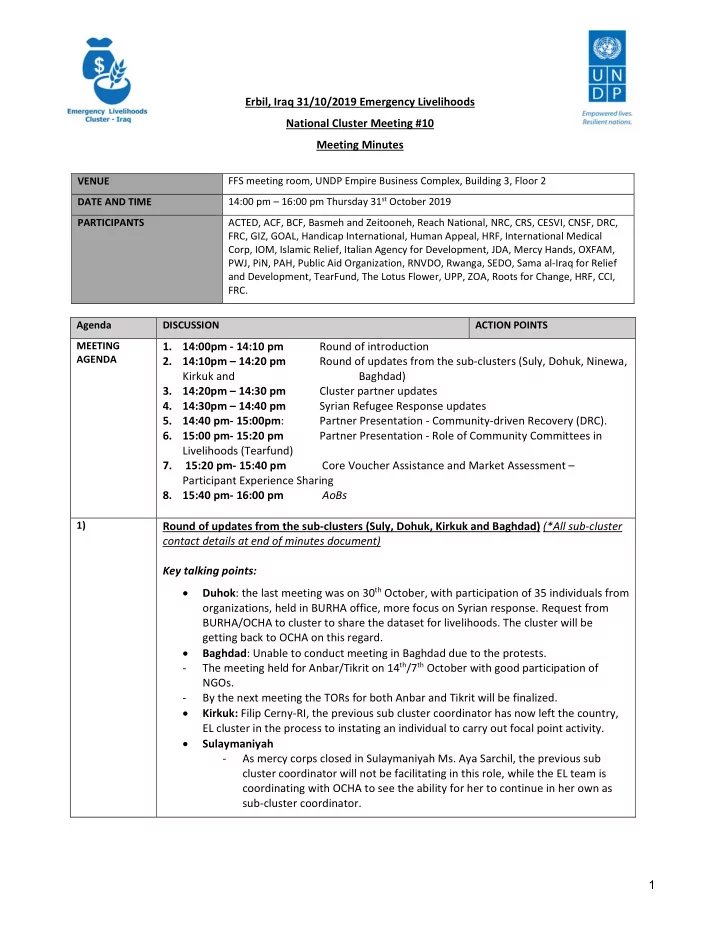
Erbil, Iraq 31/10/2019 Emergency Livelihoods National Cluster Meeting #10 Meeting Minutes VENUE FFS meeting room, UNDP Empire Business Complex, Building 3, Floor 2 14:00 pm 16:00 pm Thursday 31 st October 2019 DATE AND TIME ACTED, ACF,


slide-1
SLIDE 1

Erbil, Iraq 31/10/2019 Emergency Livelihoods National Cluster Meeting #10 Meeting Minutes 1

VENUE FFS meeting room, UNDP Empire Business Complex, Building 3, Floor 2 DATE AND TIME 14:00 pm – 16:00 pm Thursday 31st October 2019 PARTICIPANTS ACTED, ACF, BCF, Basmeh and Zeitooneh, Reach National, NRC, CRS, CESVI, CNSF, DRC, FRC, GIZ, GOAL, Handicap International, Human Appeal, HRF, International Medical Corp, IOM, Islamic Relief, Italian Agency for Development, JDA, Mercy Hands, OXFAM, PWJ, PiN, PAH, Public Aid Organization, RNVDO, Rwanga, SEDO, Sama al‐Iraq for Relief and Development, TearFund, The Lotus Flower, UPP, ZOA, Roots for Change, HRF, CCI, FRC. Agenda DISCUSSION ACTION POINTS MEETING AGENDA

  • 1. 14:00pm ‐ 14:10 pm

Round of introduction

  • 2. 14:10pm – 14:20 pm

Round of updates from the sub‐clusters (Suly, Dohuk, Ninewa, Kirkuk and Baghdad)

  • 3. 14:20pm – 14:30 pm

Cluster partner updates

  • 4. 14:30pm – 14:40 pm

Syrian Refugee Response updates

  • 5. 14:40 pm‐ 15:00pm:

Partner Presentation ‐ Community‐driven Recovery (DRC).

  • 6. 15:00 pm‐ 15:20 pm

Partner Presentation ‐ Role of Community Committees in Livelihoods (Tearfund)

  • 7. 15:20 pm‐ 15:40 pm Core Voucher Assistance and Market Assessment –

Participant Experience Sharing

  • 8. 15:40 pm‐ 16:00 pm

AoBs

1)

Round of updates from the sub‐clusters (Suly, Dohuk, Kirkuk and Baghdad) (*All sub‐cluster contact details at end of minutes document) Key talking points:  Duhok: the last meeting was on 30th October, with participation of 35 individuals from

  • rganizations, held in BURHA office, more focus on Syrian response. Request from

BURHA/OCHA to cluster to share the dataset for livelihoods. The cluster will be getting back to OCHA on this regard.  Baghdad: Unable to conduct meeting in Baghdad due to the protests. ‐ The meeting held for Anbar/Tikrit on 14th/7th October with good participation of NGOs. ‐ By the next meeting the TORs for both Anbar and Tikrit will be finalized.  Kirkuk: Filip Cerny‐RI, the previous sub cluster coordinator has now left the country, EL cluster in the process to instating an individual to carry out focal point activity.  Sulaymaniyah ‐ As mercy corps closed in Sulaymaniyah Ms. Aya Sarchil, the previous sub cluster coordinator will not be facilitating in this role, while the EL team is coordinating with OCHA to see the ability for her to continue in her own as sub‐cluster coordinator.

slide-2
SLIDE 2

Erbil, Iraq 31/10/2019 Emergency Livelihoods National Cluster Meeting #10 Meeting Minutes 2

2)

Partner updates and presentations: Human Appeal: in partnership with local partner DSPO has started the activities under UNDP‐ CfW project in Duhok district’s of Zakho, Akre, Sumel. The project will focus on activities for solid waste management, debris removal, light rehabilitation of schools/shelters, and public parks/community centres. Total 585 will be engaged from IDP, Refugees and HCs through CFW modality, and each participant entitled to $20 (unskilled) & $25 (semi‐skilled) per/day. HA in partnership with WFP has completed the project of 89 greenhouses in Namroud, Ninewa while handing over will be done by end of November to project beneficiaries and Director of Agriculture. Another greenhouse project with university of Mosul is in progress. In this project agriculture university graduates will be selected to handover 40 greenhouses, as Letter of commitment has been signed with University of Mosul to donate the land for this activity. 100 farmers will be given olive trees with other agriculture inputs in Hamdanyiah (bazani) and Basheeqa area. Assessment of the beneficiaries has completed, and work will be started from the first week of November. In Rabi’a Al‐Jazira canal area 82 KM of canal area has been cleaned on Phase‐I &II through the engagement 400 CfW participants through 40 days of work. IRW: Implementing 2 projects with UNDP until end of March 2020. For IDPs and returnees,

  • HC. Targeting 200 people
  • 1. Ninawa (Hamdaniyah and Sinjar) SMEs business grants, more related to agriculture

side

  • 2. KRI (Erbil) Vocational training to support SMEs.

REACH: Livelihood projects in KRI governorates as well as Khanaqin district in Diyala and Ninewa plains. 3 years project focusing on Asset replacement, agriculture activities, VT, SMEs. The project started in DEC 2018 to NOV 2021 covering IDPs, Refugees returnees, remainees as well as vulnerable HCs. The target beneficiaries for VT is 250 with 51% female targeted. SEDO: working in Salah Al‐Din (Tooz) as IOM partner targeting 270 beneficiaries (80% returnee 20% IDP) finishing in November with the modality of asset replacement. Tearfund: working in Mosul (urban areas and Wana) covering about 200 business recovery grants and 80 beneficiaries identified in Wana for similar support. From mid‐November TF will start assessments for west Mosul for another 100 and Kirkuk(Hawija) covering 100 business recovery grants as well as conducting business/finance literacy training and market

  • assessments. Started with IHf 190 beneficiaries outside the camps, working with Women

Economic Organization (WEO) to empower the women in the business sector. CNSF: starting VT projects in partnership with Malteser int. supporting 240 beneficiaries in Wana providing computer training 300 students in Mosul University with partnership of mission east. Also implementing training in Kakai villages in Hamdanyiah for greenhouse agriculture supporting 100 beneficiaries starting in November‐February, by providing 30 greenhouses and agriculture kits.

slide-3
SLIDE 3

Erbil, Iraq 31/10/2019 Emergency Livelihoods National Cluster Meeting #10 Meeting Minutes 3 BCF: Distribution to the new arrivals of Syrian refugees using CFW for 30 beneficiaries. * BCF needs to comply with ELC CFW SOPs when using CFW modality. ( 40 days and 20$ for unskilled or $25 for semi‐skilled and 40$ for skilled) CRS: Ninewa (Bashiqa, Bartellah, Hamdaniyah, Tilkaif and Tilsqoof) supporting 150 beneficiaries VT, entrepreneurship, grants. Another project starting November 2019 focusing

  • n 850 beneficiaries across Mosul District, Talafar, Hawija and Faluja for asset replacement.

PWI: working in refugee camps, providing CFW for shelter. IOM: SME support across Iraq, next year to support agro‐businesses and looking at value chain expertise to come on board. Partners encouraged to share contacts. CESVI: started 12 months in Erbil (Qushtapa, Shawesh and Bahrka) for 150 women from HC, IDPs and Refugees, providing CFW and agriculture kits for kitchen gardens. Mercy hands: starting CFW activity for 250 beneficiaries in Hamdaniyah on irrigation channels providing a variety of trainings, in partnership with WHH started horticulture and nutrition training for 350 HHs in Bartellah and Qaraqoush until end of December 2019. Benf will also receive the home garden kits. ACTED: OFDA starting Sept 2019 to Nov2020 for 125 CFW in Ninawa governorate, productive input support to 150 beneficiaries and rehabilitating 30 shops in Talafar. Syrian Response: As of 30th October, 12,748 individuals arrived at KRI, based in Bardarash and Gawilan Camp. Source: IOM Coming through Sahela and fishkhabour borders. 42% male and 58% female As of the REACH KIIs to beneficiaries, the families spent 2300 dollar per group to enter KRI. NRC: planning to do CFW in Bardarash camp, also livelihoods in Gawilan camp and looking to involve new arrivals to current activities. *For more information refer to presentation slides Partner’s presentations: 1‐ Community‐driven Recovery presented by Giulia from DRC. giulia.canali@drc.ngo 2‐ Role of Community Committees in Livelihoods presented by Hilary Motsiri from (Tearfund) hilary.motsiri@tearfund.org 3‐ Core Voucher Assistance and Market Assessment – Participant Experience Sharing by Lea Richard (PIN) and Elsa (PAO) *For more information refer to presentation slides 3) Actions and AoBs ‐ The next meeting to be held on the 28th November, will be conducted at (Expertise France)

  • ffice which is in Bakhtiari (UB Plaza building). The confirmation and the meeting location will

be shared. ‐ emergency livelihood cluster has identified the UNDP gender focal point Marley Tinnock, (marley.tinnock@undp.org) and the local NGO gender focal Elsa Dahan (reportingpao@gmail.com).

slide-4
SLIDE 4

Erbil, Iraq 31/10/2019 Emergency Livelihoods National Cluster Meeting #10 Meeting Minutes 4 Cluster Contact Info: EL Cluster Coordinator: Mitchell McTough (mitchell.mctough@undp.org) T: +964 (0) 7507389942, Skype: mitchell.mctough EL Co‐cluster Coordinator Ayman Ramsis (a.ramsis@zoa.ngo) T: +964 (0)751 053 9220, Skype: aymanramsis Information Management Officer (IMO): Sameer Qader Email: elc.imo@undp.org Skype: samirizzat Cell: (964) 0750 475 05 67 General Cluster Email: Emergency Livelihoods: el.sc@undp.org Sub Cluster contact info:1  Dahuk/ Ninewa Sub‐Cluster Coordinator: Ashis KUNDU– GOAL akundu@iq.goal.ie Ninewa Emergency Livelihoods Working Group Co‐Coordinator: Ibrahim Alothman ialothman@iq.goal.ie  Mosul Sub‐Cluster Coordinator: Mohammad Aslam Khatti– NRC aslam.khatti@nrc.no  Sulaymaniah Sub‐Cluster Coordinator: Kamil Shihab– REACH kamils@reach‐iraq.org Sulaymaniah Sub‐Cluster Co‐Coordinator: Pending  Kirkuk Sub‐Cluster Coordinator: Pending  Baghdad Sub‐Cluster Coordinator: Tauqeer Ahmad– OXFAM tahmad@oxfam.org.uk

1 Respectively, please keep coordination teams in Cc for any questions related to national coordination activities.

slide-5
SLIDE 5

MEETING #10 – 31 OCT 2019

slide-6
SLIDE 6

INTRODUCTION Emergency Livelihoods Cluster Team

Cluster Coordinator a.i: Mitchell McTough – UNDP mitchell.mctough@undp.org Co-Cluster Coordinator: Ayman Ramsis – ZOA a.ramsis@zoa.ngo General Cluster Email: Emergency Livelihoods: el.sc@undp.org Cluster Information Management Officer: Sameer Ezzat - UNDP elc.imo@undp.org

slide-7
SLIDE 7

Emergency Livelihoods Sub-Cluster Coordinators Team

Dahuk/ Ninewa Sub-Cluster Coordinator : Ashis KUNDU– GOAL akundu@iq.goal.ie Mosul Sub-Cluster Coordinator: Rizwan Qazi – DRC rizwan.qazi@drciraq.dk Sulaymaniah Sub-Cluster Coordinator: Kamil Shihab– REACH kamils@reach-iraq.org Baghad Sub-Cluster Coordinator: Tauqeer Ahmad– OXFAM tahmad@oxfam.org.uk Anbar Sub-Cluster Coordinator: Gull Sadia Altaf– OXFAM galtaf@oxfam.org.uk Salahaddin Sub-Cluster Coordinator: Amman Ali - OXFAM aali5@oxfam.org.uk Diala Sub-Cluster Coordinator: Abbas Al Soudany– Wand Alkhair wandalkhir.org@gmail.com

slide-8
SLIDE 8

AGENDA

14:00pm - 14:10 pm Agenda and Round of introduction 14:10pm – 14:20 pm Round of updates from the sub-clusters (Suly, Dohuk, Ninewa, Kirkuk, Baghdad, Tikrit and Anbar) 14:20 pm – 14:30 pm Cluster partner updates 14:30 pm – 14:40 pm Updates – Syrian Refugee Response 14:40 pm – 15:00 pm Partner Presentation - Community-driven Recovery (DRC) 15:00 pm- 15:20pm Partner Presentation - Role of Community Committees in Livelihoods (Tearfund) 15:20 pm- 15:40 pm Core Voucher Assistance and Market Assessment – Participant Experience Sharing 15:40 pm- 16:00 pm AoBs

slide-9
SLIDE 9

Agenda and Round of introduction

slide-10
SLIDE 10

Round of updates from the sub-clusters (Suly, Dohuk, Ninewa, Kirkuk, Baghdad, Tikrit and Anbar, Dyiala)

slide-11
SLIDE 11

Cluster partner updates

slide-12
SLIDE 12

Updates – Syrian Refugee Response

slide-13
SLIDE 13

Syrian Refugees new influx

Consequences of Attacks on North East Syria: The numbers and pace

slide-14
SLIDE 14

New Refugees Pathways

  • Potential population flow coming

through pre selected border points Fishkhabour and Ibrahim Al Khalil in Dahuk, Al Fao and Rabi’a in Ninewa and nearby Sahela and Alwaleed villages in Ninewa. Identified Camps:

  • Domiz Camp 1 (182)
  • Bardarash Camp (11,622)
  • Gawilan Camp (Most recent) (944)
  • Arrivals reached 12,748 individuals

since 14 October.

  • The majority of recently arrived

individuals came from Ras al Ain and Qamishli sub districts in Al Hasaka and Kobane in Aleppo.

  • Of today’s arrivals, 42% are male & 58 %

are female, and about 43% are 18 years

  • f age or below.

IOM, DTM 28 OCT

slide-15
SLIDE 15

Bardarash Camp:

Re‐opened ‐ 15 October 2019

Source: UNHCR & BRHA

Bardarash camp was constructed by Ministry of Displacement and Migration (MODM) Iraq in 2015.

Yellow areas denoting camp sectors in use for new arrivals.

11622 individuals hosted in Bardarash camp as of 30 October 2019, Bardarash Camp has reached its capacity. The camp was decommissioned in December 2017 after the return of Iraqi IDPs and reopened to receive Syrians refugees from north‐east Syria since 15 October 2019. It is currently managed by BRHA.

slide-16
SLIDE 16

Gawilan Camp:

Opened – 28 August 2013 New tents have been pitched and the new sector in Gawilan can accommodate up to 1,588 families. The camp currently accommodates 8,115 Syrian refugees. Latest figures of arrivals as of 30 October are 944 individuals.

slide-17
SLIDE 17

Pace of Arrivals over 17 days

slide-18
SLIDE 18

Who’s responding?

  • Who among partners are responding? With which inerventions?
  • Livelihoods needs:
  • Nearest market in Bardarash town is very limited, the market is not vivid.
  • Job opportunities/cash for work for skilled and unskilled labor that have

arrived into the camp.

  • Work opportunities in communication with camp management at Gawilan

camp; section for new arrivals, to work on preparations of camp, installation

  • f WASH facilities.. Etc.
slide-19
SLIDE 19

Partner Presentation - Community-driven Recovery (DRC)

slide-20
SLIDE 20

COMMUNITY-DRIVEN RECOVERY

PROGRAMMING

NATIONAL EMERGENCY LIVELIHOODS CLUSTER MEETING October 2019

Presented by – Giulia Canali

slide-21
SLIDE 21

Pilot Overview

Donor DFID Conflict, Stability and Security Fund (CSSF) Description Community Reintegration and Safety in Areas of IDP Return in Iraq Locations Ninewa: Zummar sub‐district Salah al‐Din: Tikrit, Al Alam and Bajii district centre sub‐ districts Duration June 2016 to March 2019 Methodology Community‐driven recovery and safety (CDRS)

Slide 1 of 18

slide-22
SLIDE 22

Slide 2 of 18

Al Alam

slide-23
SLIDE 23

Context – Ninewa Governorate

Changes in control Retaken from Islamic State: October 2014 Change in authority from Kurdish Government Security Forces to Iraq Security Forces: October 2017 Social demographics 55% Kurdish, 42% Arab, 3% mixed 80% returnees, 13% Internally Displaced People, 7% not displaced Recovery needs Asset recovery and employment opportunities, especially for the youth; infrastructure rehabilitation and service provision in newly inhabited villages of the sub‐district. Stabilisation and security challenges Hotspot for social cohesion and safety severity, mainly due to ethno‐religious and tribal tensions. Safety concerns are mostly centered on IS‐ related attacks and ethno‐religious violence

Slide 3 of 18

Zummar subdistrict

slide-24
SLIDE 24

Context ‐ Salah Al Din

Changes in control Retaken from the Islamic State: end of 2015 Social demographics Majority Sunni (multiple tribes), IDPs from surrounding rural areas (Tikrit & Al Alam) Recovery needs Infrastructure rehabilitation and reconstruction (large‐scale damage to property / socio‐economic assets), market recovery Stabilisation and security challenges Ongoing extremist threat, inter‐communal perceptions regarding service delivery, poor IDP‐host relations (Al Alam), ongoing presence of popular Mobilisation Forces (PMF)

Al Alam

Slide 4 of 18

slide-25
SLIDE 25

Objectives

Governance and service delivery 02 Communities exhibit greater ability to advocate for improved services and hold local government to account. Economic recovery and livelihoods 01 Increased access to appropriate livelihoods support and opportunities for households in target area Social cohesion 03 Increased communication, cooperation and trust within and between communities

  • f different backgrounds

Slide 5 of 18

slide-26
SLIDE 26

Methodology

Establish CDCs Build capacity

  • f CDCs

Engage local government Draft LRDPs Identify CAPs Implement projects

Slide 6 of 18

CDC meeting in Tikrit, November 2017

slide-27
SLIDE 27

Project Impact Evaluation: Methodology

Ninewa Governorate Salah al Din Governorate

Number of individuals surveyed, by location

Slide 7 of 18

slide-28
SLIDE 28

Project Impact Evaluation: Findings

Economic recovery and livelihoods

  • Households within the area of intervention are

12% more likely to report improved economic prospects

  • Namely, 53% of the respondents from locations

in the treatment group reported improved economic prospects compared to 41% of those from the control group

  • The study also found a small but positive

difference in the proportion of households reporting an increase in income and reduction in debt load as a result of the intervention

  • The intervention shows a strong positive effect
  • n economic prospects at the community‐level

showing the potential of a community‐driven recovery and safety (CDRS) approach to improve perceptions on the current and future socio‐economic situation.

Slide 8 of 18

slide-29
SLIDE 29

Project Impact Evaluation: Findings

Governance

  • 10% overall increase in perceptions of local government inclusiveness and responsiveness ‐ likely a result of long‐term

municipality engagement and visibility of community development committees (CDCs) establishment (eg. elections)

  • Possibly as a result of better perceptions of inclusiveness and responsiveness of local government ‐ 4% overall increase in trust in

local government

Slide 9 of 18

slide-30
SLIDE 30

Project Impact Evaluation: Findings

Governance

  • Higher impact on trust in the Salah al Din (7% difference); likely due to pre‐crisis services (also possibly skewed by Baiji)
  • Negligible impact on local government trust within the 18‐29 age bracket; supports notion that younger groups feel more

excluded from service delivery (as observed through social cohesion activities)

  • Similar impact on local government among women (4%) and men (3%)

Slide 10 of 18

slide-31
SLIDE 31

Project Impact Evaluation: Findings

Service delivery

  • Household in a treated community are 13% more likely to report an improvement in access to public services across different

areas of Iraq. However, the difference between treatment and control group is almost 25% amongst villages in Ninewa and not significant in Salah al‐Din, suggesting a stronger effect of the program in Zummar than in Tikrit, Al Alam and Bajii sub‐districts

  • Overall female respondents are more likely to report improvements in access to public services. However, the effect of the

intervention is much stronger on men, who are 17% more likely to report improved access to public services

Slide 11 of 18

slide-32
SLIDE 32

Project Impact Evaluation: Findings Social cohesion

  • Relationship between community development committees’ (CDCs) presence and levels of trust is mixed at best and the
  • verall results display a negative correlation (5% lower in project locations)
  • In Salah al Din, improvements in trust levels were 13% higher in locations without a CDC highlighting the prevalence of

social tensions in areas selected for CDC interventions

Slide 12 of 18

slide-33
SLIDE 33

Project Impact Evaluation: Findings Social cohesion

  • Low but positive effect of CDCs on younger age brackets (7% improvement) and on individuals who returned in 2019 (2%

improvement)

  • Sept 2016 ‐ June 2018: social cohesion interventions restricted to training beneficiaries and CDCs members. Remaining project

period ‐ activities focused heavily on mapping

Slide 13 of 18

slide-34
SLIDE 34

Overview of achievements

While the study found improved economic prospects at the community level, this did not reflect in reported positive change in income and the debt load at the household‐level. More qualitative information would help to qualify these findings, but likely related proportions of population served in each area, Far higher proportions were supported in Ninewa. Highly context

  • dependent. Target

locations in rural Ninewa have been historically underserved, leading to a widespread feeling of disenfranchisement from the state.

Economic prospects and service delivery Households living in areas where DRC implemented community‐driven recovery and safety (CDRS) program are substantially more likely to report improved economic prospects. When communities in Nineveh with and without a community‐development committee (CDC) are compared, a substantially higher proportion (+25%) of the communities with a CDC report improvements in access to basic services. There is a negligible difference between ‘treatment’ and ‘control’ sites when it comes to perceptions of access to services in Salah‐al‐Din. As this finding does not correlate with an increased trust in local government in project locations in Ninewa, we can assume that the improvement in basic services is strongly linked to the intervention itself, rather than government‐led service delivery.

Slide 14 of 18

Higher likelihood

  • f Households

reporting improved economic prospects

12%

Higher likelihood

  • f Households

reporting improved access to services

13%

slide-35
SLIDE 35

Overview of achievements

Slide 15 of 18

Trust in local government and inclusiveness and responsiveness There is a small (4%) but statistically significant improvement in ‘trust in local government’ in intervention sites as compared to control sites. The difference is accounted for entirely by Salah al Din, implying that community development committees did not significantly help boost trust in government in Ninewa. In locations where a CDC was introduced, 10% more households reported that local government was more inclusive and responsive. The positive effect of a community‐driven recovery and development program is only observable among

  • lder demographics (40 yeas old and above), suggesting that more targeted

programming should be implemented to reach the youth.

Higher likelihood

  • f Households

reporting increased trust in local government

4%

Higher likelihood

  • f Households

reporting increased inclusiveness and responsiveness of local government

10%

slide-36
SLIDE 36

Overview of achievements

Slide 16 of 18

Inter‐ and intra‐community trust (i.e. social cohesion): Overall, substantial improvements in levels of trust in intervention and control sites, ie. situation appears to have been improving across the board, regardless of CDC support. Higher levels in control locations in Salah al Din – possibly explained by DRC’s target selection process in the first instance. Other contextual factors are likely far more influential than community development committee (CDCS) presence.

But overall, higher likelihood

  • f households

reporting improved trust within/between diverse communities

Mixed

slide-37
SLIDE 37

Way forward for DRC Recovery Program

1.

Mainstreaming community‐driven methodology across all programs and field locations

2.

Integrating conflict‐sensitive recommendations to improve programming and impact on community dynamics

3.

Continue implementing through an area‐based approach, including multi‐sectorial programming

4.

Tightening the link between CDCs and other civil society actors

5.

Strengthening the role of CDCs vis‐à‐vis government structures

Slide 17 of 18

slide-38
SLIDE 38

Questions?

Slide 18 of 18

slide-39
SLIDE 39

Partner Presentation - Role of Community Committees in Livelihoods (Tearfund)

slide-40
SLIDE 40

Working with Community Committees

slide-41
SLIDE 41

The purpose of establishing and working with Community Committees

The Purpose of Community Committees :

  • Establishing Trust
  • Establishing Representation of community members on Committees
  • Enhanced participation and ownership of projects by community members
  • Ensuring that committees and the community understand Tearfund’s work
  • Ensuring that the community understands Tearfund’s implementation priorities
  • Facilitation of communication ‐ to communities, beneficiaries and Tearfund
slide-42
SLIDE 42

Factors to take into consideration when establishing Community Committees

Tearfund takes the following into consideration :

  • What is the purpose of the committee?
  • What are the terms of reference for working together?
  • What is Tearfund seeking from the Committee and what is the Committee seeking from TF
  • Is there an existing committee or similar structure that can fulfill Tearfund’s requirements?
  • Are there any government rules in the area regarding establishment Community Committees?
  • What is the appropriate level of representation across genders, ethnicities, religions, ages, and

tribal affiliation ‐ consider the makeup of the community as well as cultural restrictions.

  • Tearfund seeks to ensure that Community Committees are representative of the diversity

within the community it represents, to the extent that it is feasible.

slide-43
SLIDE 43

Guide on setting up/establishing Community Committees

  • Invite community members to a meeting and introduce your programme

(Contacts can be identified through needs assessments)

  • Hold consultative meetings to describe the purpose of Community Committees
  • Give community members the opportunity to nominate individuals
  • Keep local leadership/authorities updated and involved where its necessary
  • If necessary organize separate male and female meetings.
  • Tearfund programmes engage with the community as one entity, with all

relevant sectors plus MEAL staff.

  • Allow time for feedback on selection of representatives:
  • After getting permission, post shortlist / final list with the hotline number.
  • Plan for at least 1 week for this process to take place.
slide-44
SLIDE 44

Detailed explanation

  • f how Tearfund works
  • How Tearfund works and is going to work within the project
  • Expectations
  • Safeguarding messages
  • Accountability to the community
  • How support services support the programme eg how Finance, MEAL team works
  • Feedback mechanisms
  • Community Agreement etc
slide-45
SLIDE 45

Any Questions ?????

slide-46
SLIDE 46

Core Voucher Assistance and Market Assessment – Participant Experience Sharing

slide-47
SLIDE 47

CASH AND VOUCHER ASSISTANCE

Source: nrc.no Formerly called CTP or Cash Transfer Programming

slide-48
SLIDE 48

Training When? 13th – 17th October Where? Ankawa Royal Hotel Who? Tony Dines & Ayman Ramsis

slide-49
SLIDE 49

True or False?

Fa lse . CVA is a to o l / mo dality and no t a

pro g ramme itse lf. I t is o ne way - amo ng many o the rs - to de live r assistanc e .

  • 1. Cash/ Vo uc he r Assistanc e is a se c to r in

itse lf.

slide-50
SLIDE 50

True or False?

Fa lse . CVA is a to o l that c an be use d

ac ro ss multiple se c to rs.

  • 2. Cash/ Vo uc he r Assistanc e is a to o l that

is o nly use d within the L ive liho o d se c to r

slide-51
SLIDE 51

True or False?

Fa lse . CVA is a to o l that c an be use d

alo ne o r c o mbine d with o the r mo dalitie s.

  • 3. Cash/ Vo uc he r Assistanc e is a to o l that

c an o nly be use d o n its o wn.

slide-52
SLIDE 52

True or False?

T rue . CVA ne e ds to fulfill c e rtain c rite ria

in o rde r to be favo re d (in c o mpariso n to the use o f o the r to o ls)

  • 4. Cash/ Vo uc he r Assistanc e c anno t be

imple me nte d witho ut fulfilling c e rtain e sse ntial pre -c o nditio ns.

slide-53
SLIDE 53

True or False?

Fa lse . CVA has to be inte g rate d into the

e ntire c yc le

  • 5. Cash/ Vo uc he r Assistanc e o nly
  • c c upie s o ne part o f the pro je c t c yc le .
slide-54
SLIDE 54

Training Agenda

  • 1. PREPAREDNESS

Baseline assessments, contingency planning, ready-to go solutions

  • 3. DESIGN AND

IMPLEMENTATION SET UP

Action Plan, Contract with Partners & Suppliers, Program Level SOPs, Implementation Set Up

  • 5. EXIT AND

FEEDBACK

Reporting & Documentation, Lessons Learned

  • 2. ASSESSMENTS

AND ANALYSIS

Feasibility check, Assessments, Analysis

  • 4. DISTRIBUTION CYCLE

AND MONITORING

Distribute, Reconcile, Monitor, Make Adjustments

Following the CVA Project Cycle

Is there a need? Modality Decision Ready to Distribute? More Distributions ?

slide-55
SLIDE 55

Important Information

K e y te rmino lo g y Pre -c o nditio ns CVA Pro je c t Cyc le - ste ps CVA & Co re Humanitarian Standards (CHS) I mpo rtanc e o f the Marke t (Syste m, Asse ssme nt, Mapping ) & its c o nstant e vo lutio n (M. Mo nito ring ) Risk Manag e me nt & Mitig atio n linke d to the nature o f CVA Co ntrac t Supplie rs vs. Co o pe rating Partne rs Data Pro te c tio n & Manag e me nt Supply c hain in CVA Pro g ramming Cash de live ry pro c e ss & se g re g atio n o f dutie s CVA & e xte rnal c o o rdinatio n (c luste rs, e tc .)

slide-56
SLIDE 56

 CaLP website: http://www.cashlearning.org/resources/libr ary  Programme Quality Toolbox: http://pqtoolbox.cashlearning.org/  E-learning: https://kayaconnect.org/index.php  Market Assessment Tools: MSMA, MIRA, RMA, EMMA, LAMA, etc.

Key Resources & Tools

slide-57
SLIDE 57

Key Resources & Tools (2)

slide-58
SLIDE 58

CALP MARKET TOOLS ASSESSMENT TRAINING IN ERBIL : AN OVERVIEW

31st October 2019 Lea Richard, PIN

slide-59
SLIDE 59

CALP TRAINING SESSIONS

 The Cash Learning Partnership (CaLP) : a global partnership with over 80

members  CaLP is based on learning, knowledge sharing, networking, policy and coordination around the appropriate and timely use of Cash and Voucher Assistance (CVA) in humanitarian response  CaLP offered 2 trainings in Erbil:

  • 1. Core CVA
  • 2. Market Assessment Tools
slide-60
SLIDE 60

WHAT DID WE DO?

Focus: market assessments in emergency situations / post- crisis. Goals of the training:  Deeper understanding of why market assessments are important in emergency situations  Understand how to conduct a market assessment in pre-emergency / amergency / post- emergency context  Introduction to the different market assessment tools and how / when to use them  Conduct our own market assessments

slide-61
SLIDE 61

THE 6 (ITERATIVE) STEPS TO CONDUCTING A MARKET ASSESSMENT

slide-62
SLIDE 62

STEP 1. IDENTIFY NEEDS AND GAPS

Gaps = Needs – What people already have – what others are already providing

STEP 2. MARKET ASSESSMENT OBJECTIVE

What are we trying to achieve through this assessment? E.g – what is the most appropriate response? Can we support the local market?

STEP 3. CRITICAL MARKET SELECTION

Select markets that are critical to the target group, affected (or will be affected) by the crisis, and aligned with your organization’s objectives.

slide-63
SLIDE 63

STEP 4. SCOPE AND DEPTH OF ASSESSMENT

Marketplace or market system analysis? What do we need to know? Where do we stop?

STEP 5. KEY ANALYTICAL QUESTIONS

KAQS represent the fundamental issues that need to be addressed before taking a programme decision. E.g: is there enough supply of drinking water in case there is a rise in demand due to a crisis?

slide-64
SLIDE 64

STEP 6. ASSESSMENT TOOL SELECTION

 PCMA: Pre crisis market analysis  RAM: Rapid Assessment of Crisis (48h after crisis)  OXFAM 40h tool  EMMA: Emergency Mapping and Market Analysis (emergency -> recovery)  MISMA: Multi Sector Market Assessment  MAG: Market Analysis Guidance

slide-65
SLIDE 65

MARKET MAPPING

3 components:  Market Chain  Infrastructure and Services  Environment (rules) 2 maps:  Baseline Map (pre-crisis)  Post-crisis Map : how has the crisis affected the market?

  • What has been disrupted: supply, demand, both? Market integration? Competition and power?
  • What are opportunities for markets to contribute to humanitarian response?
  • What do we want to focus on? Supply and demand system, or income market system?
slide-66
SLIDE 66
slide-67
SLIDE 67

DATA COLLECTION AND ANALYSIS

 Prepare data collection : teams, logistics, questionnaires  What do we measure? market system context, number of actors, supply and demand, market integration, market power, prices, volumes, seasonality  Data collection methods: qualitative, quantitative, KIIs, FGDs, etc.  Analysis : Triangulate! Triangulate! Triangulate!  Use data to decide what programmatic actions you recommend

slide-68
SLIDE 68

FIELD SCHOOL

We were divided into four groups to analyze 4 critical markets:  Housing and rental  Basic Foods Items  Drinking water  Unskilled and skilled labour

slide-69
SLIDE 69

Data collection: drinking water supply in Ainkawa

slide-70
SLIDE 70
slide-71
SLIDE 71

MARKET MONITORING

 What to monitor: Actors, prices, seasonality, availability of commodities, volume, income, sources

  • f income, purchasing power

 Adjust intervention according to monitoring and continue monitoring  Monitoring tools: MARKit: Market Price Monitoring WFP- VAM: Food Security Analysis

slide-72
SLIDE 72
slide-73
SLIDE 73

AOB?

Thank you