Mangrove Restoration Efforts in Sri Lanka Thalatha S. Ranasinghe - - PowerPoint PPT Presentation

mangrove restoration efforts in sri lanka
SMART_READER_LITE
LIVE PREVIEW

Mangrove Restoration Efforts in Sri Lanka Thalatha S. Ranasinghe - - PowerPoint PPT Presentation

Mangrove Restoration Efforts in Sri Lanka Thalatha S. Ranasinghe Marine Environment Protection Authority, No: 758, Baseline Road, Colombo 09, Sri Lanka Location Map of Sri Lanka Including Introduction Materials and methods

slide-1
SLIDE 1

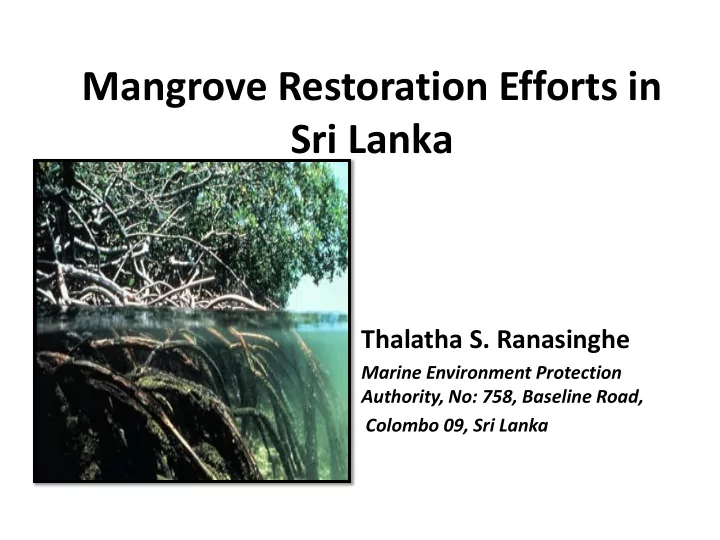
Mangrove Restoration Efforts in Sri Lanka

Thalatha S. Ranasinghe

Marine Environment Protection Authority, No: 758, Baseline Road, Colombo 09, Sri Lanka

slide-2
SLIDE 2

Location Map of Sri Lanka

slide-3
SLIDE 3

Including………

  • Introduction
  • Current status of mangroves

in Sri Lanka

  • Study sites
  • Rekawa Lagoon
  • Negombo Lagoon
  • Puttalam Lagoon
  • Madu Ganga
  • Objectives
  • Materials and methods
  • Evaluation of Results
  • Discussion
  • Conclusion
slide-4
SLIDE 4

CURRENT STATUS OF MANGROVES IN SRI LANKA

  • Associated in 22 brackish water bodies
  • Vegetation is estimated ~ 12,000 ha.
  • Many benefits - economic goods and ecological services.
  • Habitat degraded due to human activities.
  • increase of population density
  • Attempts taken to restore mangrove
slide-5
SLIDE 5

Six Study Sites

Rekawa lagoon

  • ne site

Puttlam lagoon two sites Negombo lagoon two sites Madu Ganga

  • ne site
slide-6
SLIDE 6

Rekawa lagoon

  • Located about 200 km south of

Colombo in Hambantota District.

  • Extent of the lagoon is about

250ha

  • Mangrove and scrub forest (about

200 ha.) surround the lagoon

slide-7
SLIDE 7
  • Rekawa lagoon is shallow with the water depth averaging 1.4

meters.

  • ~5,400 people living
  • About half of the population is engaged in sea and lagoon

fishing.

slide-8
SLIDE 8

Negombo Lagoon

  • Large

estuarine lagoon in Gampaha District, south-west

  • f Sri Lanka.
  • Located about 35 km away

from Colombo.

  • Fed by number of small rivers

and a canal.

slide-9
SLIDE 9
  • Surrounded by a densely populated region. The land is used for

fishing and agriculture.

  • People in the area are engaged on lagoon fishing and shrimp

industry.

  • Mangrove cover is depleting rapidly due to land clearing for large-

scale shrimp aquaculture.

Negombo Lagoon

slide-10
SLIDE 10

Puttalam Lagoon

  • Largest

mangrove patch in Sri Lanka.

  • Coastal communities depend on

lagoon fishery and mangrove forests for their survival.

  • Heavy

exploitation by coastal community .

  • large-scale

shrimp farming and agriculture.

slide-11
SLIDE 11

Puttlam Lagoon

More than 3000 ha of mangroves lands were converted to shrimp farms.

slide-12
SLIDE 12

Madu ganga

  • The

lakes Madu Ganga is located on the south-western coast of Sri Lanka.

  • Madu Ganga has one of the

most unique biodiversity.

  • These

vegetation types comprise a total of 303 species

  • f plants.
slide-13
SLIDE 13

Pic of madu ganga Madu Ganga

slide-14
SLIDE 14

Objectives of the Study

  • To compare sustainability of six planting sites
  • Study environmental suitability for the

mangrove planting

  • To compare increase of ecological &

economical values of study sites

  • To study reasons for failures
slide-15
SLIDE 15

Materials used:

  • Reports on Mangrove restoration projects
  • Research papers and presentations done by

researchers in Sri Lanka.

  • Questionnaires – 20 individuals per site
  • Test kits -chemical/physical parameters in lagoon

water.

slide-16
SLIDE 16

Methods applied for the study:

  • Discussions with project leaders and participants.
  • compare number of plants succeeded
  • find out reasons for the failures
  • On-site observations and photographs.
slide-17
SLIDE 17
  • Questionnaires and interviews with community /20

individuals in each site – Increase of ecological & economical values

  • Water Quality analysis
  • Study environmental suitability for the mangrove

planting

  • Water Quality parameters measured;

pH, salinity, Temp, Conductivity, DO

slide-18
SLIDE 18

10 20 30 40 50 60 70 80 90 100

% of survival of plants

% of survival of plants

Study sites

slide-19
SLIDE 19

5 10 15 20 25 30 35

Temperature (0C) DO(mg/l) Conductivity (ms/cm) pH Salinity (ppm)

Study sites Variation of Water Quality Parameters at Six Sites

slide-20
SLIDE 20

2 4 6 8 10 12 14 16 18

Increase of Ecological values Increase of Economical values

  • No. of people with the positive answers

Study sites

Increase of ecological and economical values after re-plantation

slide-21
SLIDE 21

Discussion

  • Among 6 mangrove re-planting sites, identified

successful and unsuccessful results. In Rekawa Lagoon and Madu Ganga sites,

  • Low salinity conditions.
  • Lack of monitoring after planting.
  • The poor species selection without adequate

site assessment

  • Poor coordination among institutions and the

community

slide-22
SLIDE 22

Sites at Negombo and puttlam Lagoons where success;

  • Suitable environmental conditions
  • Monitoring after planting
  • Correct species selection
slide-23
SLIDE 23

Mangrove plantation at Kalpitiya

slide-24
SLIDE 24

Mangrove plantation at Anawasala

slide-25
SLIDE 25

Conclusion

  • Increase of ecological/economical values in 4

success sites.

  • Water quality impact on the growth of mangrove

plants Recommendations:

  • Building awareness among villagers, school

children, government/NGO officials.

  • Carryout

more researches

  • n

mangrove habitats.

  • Introduce appropriate technology and suitable

legislations.

slide-26
SLIDE 26