
SLIDE 1
Managing continuity and preparedness of school feeding programmes under COVID-19 and the South-South Cooperation role
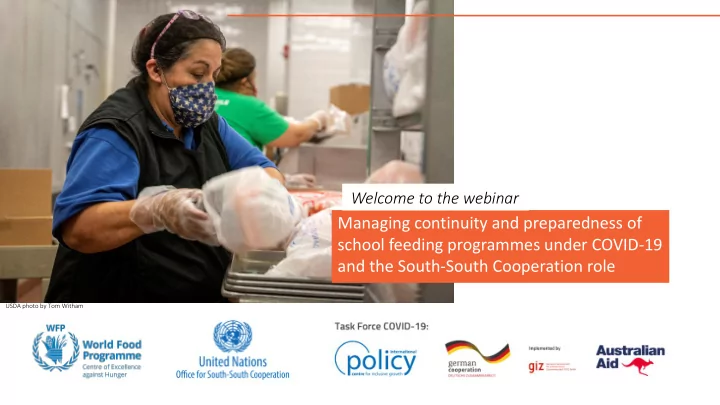
Welcome to the webinar
USDA photo by Tom Witham
Managing continuity and preparedness of school feeding programmes - - PowerPoint PPT Presentation
Welcome to the webinar Managing continuity and preparedness of school feeding programmes under COVID-19 and the South-South Cooperation role USDA photo by Tom Witham simultaneous interpretation Ho How to o acce ccess fr from th the e
Managing continuity and preparedness of school feeding programmes under COVID-19 and the South-South Cooperation role
Welcome to the webinar
USDA photo by Tom Witham
Ho How to
ccess fr from you
eb browser Ho How to
ccess fr from th the e smartphone app
ld
sporgwebinar
English option
CONNECT again.
sporgwebinar and select Eng English:
Có Cómo acce cceder des esde su su naveg egador web eb Có Cómo acce cceder desde la la aplic licación del l smartphone
sporgwebinar
Español
nuevamente.
sporgwebin inar y seleccione Esp Español del menú de selección.
This joint effort is inspired by colleagues and
issemin inate and dis iscu cuss th the e mos
ecent con
esponses es to
19. The initiative has three major components:
1. A weekly special edition of a dedicated ne newsle letter, featuring a compilation of relevant information from all over the world on social protection initiatives dealing with COVID-19; 2. Weekly web ebin inars to foster discussions and exchanges; 3. An on
ine com
ity to systematise the information gathered
Photo by Gelani Banks on Unsplash
#SPcovid19 #COVID19 #SPresponses
So Socia ial exp xpenditure, leg legisla lativ ive fr frameworks an and fin findings
impact evalu luations of
socia ial l protectio ion in in So South Asi Asia
Thursday, 23 July – 9 AM (EDT/GMT-4)
Reachin ing ru rural l ar areas s in in th the so social l protection resp sponse to
ies an and ch chal alle lenges
Tuesday, 28 July – 10 AM (CEST/GMT+2)
So Social l Protection an and Child ild Mar arria iage: Evid idence, Practic ice an and Opportunitie ies
Thursday, 30 July – 9 AM (EDT/GMT-4)
Next webinars at socialprotection.org:
socialprotection.org presents:
Speakers
Discussants
South-South Cooperation (New York) Moderator
Managing continuity and preparedness of school feeding programmes under COVID-19 and the South-South Cooperation role
type them in the chat bar Also, interact with us on Twitter (@SP_Gateway):
#SPorgWebinar #SPcovid19 #COVID19 #SPresponses
Managing continuity and preparedness of school feeding programmes under COVID-19 and the South-South Cooperation role
Managing continuity and preparedness of school feeding programmes under COVID-19 and the South-South Cooperation role
Moderator
Mr Daniel Balaban WFP Centre of Excellence in Brazil
Economist, MBA in Finance, Specialist in Public Budget and Master in International Relations, since August 2011 Daniel Balaban is the Director and Representative of the World Food Program Centre of Excellence against Hunger in Brazil. He is a Board Member of the Global Child Nutrition Foundation (GCNF) and member of the World Economic Forum’s Global Agenda Councils. Balaban served as Special Adviser to the Secretary of the Economic and Social Development of the Presidency of the Republic of Brazil and as President of the Brazilian National Education Development Fund (FNDE), where he became one of the main actors responsible for the Brazilian School Feeding Law approval.
Managing continuity and preparedness of school feeding programmes under COVID-19 and the South-South Cooperation role
Discussant
Mr Jorge Chediek United Nations Office for South-South Cooperation and Envoy of the Secretary-General
leading United Nations system-wide promotion and coordination of South-South cooperation for development. In March 2016, Mr. Chediek was appointed by the UN Secretary-General as his Envoy on South-South Cooperation. Prior to this, Mr. Chediek served as the UN Resident Coordinator/United Nations Development Programme (UNDP) Resident Representative in Brazil (2010-2015). In that capacity, he was also the Director of the International Policy Centre for Inclusive Growth, UNDP’s global forum for policy dialogue and South-South learning on social development innovations. Mr. Chediek holds a Master of Science in Foreign Service (honors) from Georgetown University in Washington, D.C., and a Bachelor of Science in Political Science from Catholic University in Buenos Aires, Argentina.
Managing continuity and preparedness of school feeding programmes under COVID-19 and the South-South Cooperation role
Discussant
Ms Carmen Burbano WFP School-Based Services
During her 16 years of experience with WFP, Carmen Burbano de Lara has specialized in supporting governments to strengthen their national social protection and safety net policies and programmes and to tackle malnutrition and food insecurity. Ms. Burbano de Lara is WFP’s world expert in school feeding and a member of the Technical Committee for School Feeding of the Partnership for Child Development at the Imperial College in London. She is the co-author of the most influential publications on school feeding over the last ten years including “Re-imagining school feeding: a human capital investment in health, education, social protection and agriculture” (2018); “The School Feeding Sourcebook” (2016); and “Rethinking School Feeding” (2009), published by the World Bank. Carmen is Ecuadorian and holds a Master’s Degree in Public Administration from Harvard University and Bachelor in Latin-American Studies and Comparative Literature from New York University.
AN UPDATE ON SCHOOL HEALTH AND NUTRITION DURING COVID 19 Ensuring children don’t miss out on School Health and Nutrition
EDUCATION
Learning & Enrolment, Girls Education
SOCIAL PROTECTION
Income Transfers, Household Food Security
AGRICULTURE
Rural Economy, Food Systems
HEALTH AND NUTRITION
Dietary Diversity, Growth and Development
transferred through meals
by 9.2 million schoolchildren in Nigeria every week
reduced health care
Africa and Middle East
Asia and Latin America
Europe and North America
HIC/UMIC: Put in place alternatives such as food stamp assistance to households with children, delivery of food parcels, supermarket vouchers, cash transfers. MIC/LIC: Countries looked for options to ensure continuation of school meals particularly in LAC (cash transfers, food distribution at drop off points and THR). UN agencies: Starting March a consistent and consolidated approach is established with joint guidelines, introduction of Global Education Coalition for COVID-19 Response.
return, particularly girls.
Operations
countries - Global Map
Activating partnerships
Financing
feeding during COVID-19
Honduras: Packages of food are home delivered with support of teachers and local school feeding focal points.
students covering 3 months.
grants
targeting 400,000 children with a SHN package and COVID19 messaging in schools.
the Multi-Partner Trust Fund to support the Ministry of Education's strategy for distance learning.
Congo: Father and son with their take-home ration outside the school.
than 200,000 schoolchildren in 800 schools in 11 districts.
a total of 943mt of grains, oil, and fish are distributed
energy biscuits, mineral and vitamin fortified date bars or other healthy snacks.
44,000 children.
Teachers in Honduras get on their bikes to help deliver school meals. Nutritious meals reach children despite coronavirus lockdown through collaboration between WFP, UNICEF and government How school feeding persists in spite of Cameroon’s coronavirus
provide vulnerable pupils with critical take-home food rations School feeding at home. Stories from Colombia, Congo, Cambodia and Libya on how nutritious school meals make the way into children’s homes. Coronavirus: WFP take-home packs are a lifeline for schoolchildren in Laos. Malawi: ‘My biggest fear is coronavirus will keep the school closed’. Take-home rations supply children with critical nutrition as they wait to return to classrooms
Laos: Boungpheng Jinya is a sugarcane farmer from Lang Pha village picking up THR from the school
Health (WASH) Investing in the future
children Nutrition School feeding
10 million children
Coalition of partners led by UNICEF and WFP Integrated package (SHN)
30 low-income countries
Fragile Countries
Managing continuity and preparedness of school feeding programmes under COVID-19 and the South-South Cooperation role
Speaker
Mr Pedro Mortara WFP Mozambique Country Office
Pedro Mortara is a Programme Policy Officer at the WFP Mozambique Country Office, where he leads WFP school feeding implementation and capacity strengthening activities. Before this, he managed an urban social protection programme in WFP Zimbabwe and served as Field Response Coordinator for the Cyclone Idai response. Pedro has worked with WFP also in South Sudan, Ethiopia and Rome holding various programme positions. Prior to WFP, he worked in the Brazilian private sector with the management consulting company BCG. Pedro has a master's degree in International Political Economy from the University of Warwick in the UK.
22
July 2020
23
COVID19 arrived at a time of recovery:
In March/2020 the Government of Mozambique closed all schools and plans to reopen have been delayed
halted
24
THR to assist close to 90,000 children in 81 affected schools, leading to a 25% increase in enrolment
partnership with local authorities, started a THR support to the families of 41,000 children in 104 schools in Tete Province
17
25
Pre-distribution
retailers
On distribution day
prevention
children, specially girls
26
Short term:
benefits to specific contexts should be expanded
beneficiaries Way forward:
preparedness and response
27
The creation of PRONAE was a landmark for Mozambique’s SF and it is the result of SSTC Recent emergencies and COVID-19 evidenced the need for exchanges in new topics:
response
systems
19
Managing continuity and preparedness of school feeding programmes under COVID-19 and the South-South Cooperation role
Speaker
Mr Juan Carlos Martínez Ministry of Education, Government of Colombia
Engineer from the Universidad Pedagógica y Tecnológica de Colombia (UPTC) with a specialization in Development Projects from the Escuela Superior de Administración Pública (ESAP). Extensive work experience in the areas of planning and territorial development and more than 20 years contributing to the education sector both in the Ministry of Education, leading the areas of Coverage, Planning and rural education, as well as in Boyaca and Tunja in the role of Secretary of Education and Planning, also has been an adviser at the Colombian Institute for the Evaluation of Education ICFES, adviser at the University Jorge Tadeo Lozano, and undergraduate and graduate professor.
AL ALIMENT IMENTACIÓN ÓN ES ESCOL COLAR AR PARA ARA APR APRENDI ENDIZAJ ZAJE E EN EN CAS CASA 21 21 de de Juli lio 2020 2020
ACCESO Y PERMANENCIA
BIENESTAR PARA EL APRENDIZAJE ALIMENTACIÓN SALUDABLE
ACTIVAR ECONOMÍAS LOCALES
Garantiza acceso y permanencia especialmente a la población rural y vulnerable. Mejora condiciones de bienestar de los estudiantes con el consecuente efecto en su disposición para el aprendizaje Oportunidad para crear cultura social alimentaria con hábitos de vida saludable. Fortalecer las economías territoriales por los mayores consumos locales
✓ El propósito del sistema educativo es lograr que los niños alcances sus trayectorias completas, con resultados de calidad y en ambientes apropiados para su desarrollo integral. ✓ En consecuencia el país pierde cuando un estudiante tiene bajo logro educativo, se rezaga o deserta del
PROPÓSITOS DE LA ALIMENTACIÓN ESCOLAR EN COLOMBIA
El Programa de Alimentación Escolar opera descentralizado a través de 96 Entidades Territoriales Certificadas en Educación (ETC)
ADAPTACIÓN NORMATIVA
El Gobierno Nacional y el Ministerio de Educación Nacional
de 2020
2020
Unidad Administrativa Especial de Alimentación Escolar
marzo de 2020
abril de 2020 Medidas extraordinarias para la prestación del servicio educativo y el PAE durante la emergencia en el entendido de la importancia de la seguridad alimentaria a población vulnerable para posibilitar el aislamiento social. Modificación transitoria de los lineamientos técnicos - administrativos, los estándares y las condiciones mínimas del Programa de Alimentación Escolar – PAE Alimentación Escolar para aprendizaje en casa
15 DE MARZO DECRETO DE AISLAMIENTO SOCIAL POR EMERGENCIA SANITARIA Y CONSECUENTE CIERRE DE TODOS LOS ESTABLECIMIENTOS EDUCATIVOS 16 DE MARZO LINEAMIENTOS PARA EVITAR DESPERDICIO Y APROVECHAMIENTO DE ALIMENTOS EN ESTABLECIMIENTOS EDUCATIVOS
alimentario listo para consumo, se entrega en forma individual y en el empaque primario. Ración Industrializada
equivalente a un tiempo de comida al día por un mes para la preparación y consumo en el hogar. Ración Para Preparar en Casa
un valor de $50.000 por mes para el canje por alimentos. Bono Canjeable
MECANISMOS DE AFRONTAMIENTO MODALIDADES PAE EN CASA
Modalidades de Entrega
21%
RACION INDUSTRIALIZ ADA
88%
RACION PARA PREPARAR EN CASA
5%
BONO PARA ALIMENTOS
15.999.733
Raciones Entregadas
ETC = Entidad Territorial Certificada en Educación (actualmente 96) Fuente: Reporte PAE para Aprender. Corte 16 de Julio de 2020
35 ETC
Marzo
79 ETC
Abril
95 ETC
Mayo
38 ETC
Atención P. Indígena
95 ETC
Junio
Dos 1.491.034 Tres 1.472.380 Cuatro 2.134.695 Cinco 33.879 Total Estudiantes 5.131.988 Estudiantes beneficiados y número de canastas- ración/mes recibidas
5’600.000 estudiantes venían siendo atendidos en condiciones regulares
La inversión por ración entregada es de UD$0,63 dólares día o UD$ 12.6 dólares por 20 días promedio Cada Entidad Territorial diseñó su ruta de entrega, distribución y los protocolos que favorecieran el distanciamiento social, así como la participación de docentes y rectores. Minutas con autonomía territorial, de acuerdo con la disponibilidad y hábitos de consumo de la población Para la atención a población indígena se adelantó la concertación con las comunidades. Ante el desabastecimiento de algunos productos en los territorios, en conjunto con Ministerio de Agricultura se levantaron directorios de productores para compartirlos con los operadores de PAE y conectar oferta y demanda, para evitar especulación de precios y sobreprecio en algunos productos. Con cada ración se entregaron recomendaciones de alimentación saludable, propuestas de menús y las indicaciones para la correcta higiene y preparación de alimentos dentro del hogar
LECCIONES APRENDIDAS PARA FUTURAS SITUACIONES DE EMERGENCIA
Fortalecimiento de los procesos de asistencia técnica para acompañar los equipos territoriales y fortalecimiento de sistemas de información. Aprovechamiento de la experiencia territorial e internacional. Autonomía de las Entidades Territoriales para realizar los ajustes de las minutas, que cumplieran con el aporte nutricional mínimo Arreglo normativo para flexibilizar los lineamientos y las condiciones de
contratación de operadores Coordinación intersectores para medidas integrales de condiciones de disponibilidad y acceso a alimentos, para reducir el impacto de la crisis. Refocalización y microfocalización para garantizar la atención con equidad a la población con mayor vulnerabilidad. Diseño de rutas de entrega, distribución y protocolos que favorecieran el distanciamiento social y participación de docentes y rectores
Mineducacion @Mineducacion @Mineducacion
Managing continuity and preparedness of school feeding programmes under COVID-19 and the South-South Cooperation role
Speaker
Mr Chhun Ramy Ministry of Education Youth and Sport of Cambodia
Ministry of Education Youth and Sport where he previously worked as a planning official since
sub-sector. He obtained his Bachelor's degree in Accounting in 2002 at National University of Management and Master degree in Finance in 2005 from the same University. He has also taught Accounting and Finance at some universities as a part time work. His interest is to work with the School Support Committees of all primary schools to improve the community involvement at school level. Ramy is currently working on the program 'Primary School Feeding' and 'Early Grade Learning'.
type them in the chat bar Also, interact with us on Twitter (@SP_Gateway):
#SPorgWebinar #SPcovid19 #COVID19 #SPresponses
Managing continuity and preparedness of school feeding programmes under COVID-19 and the South-South Cooperation role
Managing continuity and preparedness of school feeding programmes under COVID-19 and the South-South Cooperation role responses to COVID-19?
So Socia ial exp xpenditure, leg legisla lativ ive fr frameworks an and fin findings
impact evalu luations of
socia ial l protectio ion in in So South Asi Asia
Thursday, 23 July – 9 AM (EDT/GMT-4)
Reachin ing ru rural l ar areas s in in th the so social l protection resp sponse to
ies an and ch chal alle lenges
Tuesday, 28 July – 10 AM (CEST/GMT+2)
So Social l Protection an and Child ild Mar arria iage: Evid idence, Practic ice an and Opportunitie ies
Thursday, 30 July – 9 AM (EDT/GMT-4)
Next webinars at socialprotection.org:
Make sure to answer our webinar survey, available after the session!